Students in Ridgefield, Greenwich, Rocky Hill and West Haven Win Top Honors in First Amendment Essay Contest
/Nora Kallusky, a senior at Ridgefield High School, has won the first prize of $1,000 in the 2026 Connecticut Foundation for Open Government’s Forrest Palmer High School Essay Contest.
Her essay addressed the debate over hate speech and the First Amendment after the death of conservative activist Charlie Kirk. Nora’s essay was selected from among 70 entries from students attending high schools across the state.
“What stood out to me was not just what people said, but how quickly reactions shifted depending on who was speaking,” she wrote. “People who often criticized cancel culture suddenly supported consequences for speech they found offensive. It made me question whether free speech is truly a principle we believe in, or something we defend only when it is convenient.”
Nora noted that her grandparents lived in Argentina during the oppressive military dictatorship in the 1970s, a connection that made free-speech rights personal to her rather than abstract.
“If we only defend free speech when we agree with it, then it is no longer something we can all rely on. It becomes something we apply selectively, depending on who is speaking,” she wrote. “My family’s history makes that danger feel real.”
Students were asked to write essays addressing one of three timely First Amendment issues: Hate speech, the free-speech rights of non-citizens on college campuses, and access by journalists to the White House and Air Force One.
Two students shared second-place honors, each with a $500 prize: Mayumi Iwai of Greenwich High School and Prithika Venugopal of Rocky Hill High School.
Mayumi wrote about the arrest of a Tufts University Ph.D. student whose visa was revoked after she wrote an opinion piece in the school newspaper critical of the university’s reaction to the war in Gaza.
Challenging the argument that visas can be revoked for expressing opinions deemed in conflict with American interests, Mayumi wrote: “If ‘American interests’ become the standard for permissible speech, then free expression is no longer a right—it becomes a conditional privilege dependent on political alignment. This undermines the very purpose of the First Amendment, which exists precisely to protect unpopular or dissenting views from government suppression.”
Prithika also wrote about the Tufts case, pointing out that courts have consistently ruled that all people in the United States – not just citizens – enjoy Constitutional rights, and that the government cannot target particular political viewpoints. “If the government only revokes visas from students who speak out on one side of the Gaza conflict, while leaving students with opposing views untouched, that is in no way neutral enforcement,” she wrote.
Third-place honors and a $300 check went to Caitlin Pinedo of West Haven High School, who also selected the Tufts University topic. “The strength of the American legal system is shown by how it treats its most vulnerable guests, not just the powerful citizens,” she wrote. “Deporting a student for her words is an admission that her ideas are seen as a threat. However, the First Amendment was created specifically to protect speech that the government might find threatening or disagreeable.”
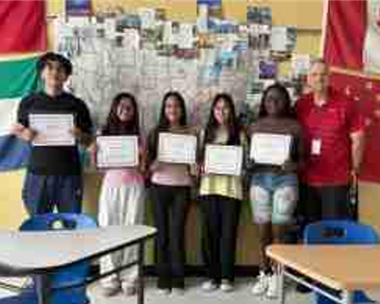
Honorable mention prizes of $50 were awarded to four other West Haven High School students: Juan Florez Sanchez, Quindaya Mouzon, Martha Agustin and Jessica Ngo. Their essays, and Caitlin’s, were written as part of an assignment in Social Studies Department Chair Mark Consorte’s AP U.S. Government & Politics classes.
The essay contest is named in honor of the late Forrest Palmer, a former editor and publisher of the News-Times in Danbury, who began the contest in 2000 when he was president of CFOG’s board of directors.
The Connecticut Foundation for Open Government is a nonprofit educational organization founded in 1991 on the principle that open, transparent government is in the public interest. CFOG sponsors the essay contest to encourage thought and debate among students on free-speech and other First Amendment issues.