The Analog Shift – Unmistakable and Endlessly Encouraging
/by Rachel Shuler
Something unexpected happened at a recent show. I’m almost 50, which means everyone under 35 looks young to me. So when a group of people in their mid/late-twenties wandered into my booth at a recent show, I smiled, braced for “ooh, that’s cool” — and fully expected them to walk straight back out.
They didn’t.
They lingered. They wandered out and came back. They brought their partners. They stood in front of paintings for longer than I expected, asked real questions, and ultimately bought. Two sets of couples who were friends, arriving separately and leaving as collectors.
Then a couple — maybe mid-thirties — stopped in front of the largest piece I’ve made in my Fractured Light series. We talked a little. They said they might be back, which, if you’ve ever done an art fair, you know is the polite way of saying goodbye forever. I smiled and let them go.
Barely an hour later they walked back in and bought it. $750, without much deliberation.
I’ll be honest — I didn’t have that kind of money at their age. I’m not sure I had that kind of confidence either.
Later, a young couple — early thirties, just moving in together — found my very latest piece. The varnish was barely dry, which I mentioned somewhat nervously. They stood in front of it for fifteen minutes. I asked a few gentle questions — what caught their eye, whether they had a space for it — and then mostly left them alone. They bought it. Their first home, their first piece of art for it.
By the end of the day I kept asking myself the same question: what is going on?
So I went looking for answers. And what I found was genuinely fascinating.
The Analog Shift
It turns out what I witnessed at my booth wasn’t a fluke. It’s a documented, measurable cultural shift — and it has a name.

Researchers and market analysts are calling it the “analog turn.” Having grown up entirely online, a significant portion of Gen Z and younger millennials are experiencing what’s being described as digital fatigue — a genuine exhaustion with screens, algorithms, and the relentless optimization of everything. Nearly half of American teenagers now say social media’s effects are mostly negative. People in their twenties and thirties are voluntarily buying “dumb phones” and setting app time limits, not because someone told them to, but because so little of their digital life feels real anymore.
And in response, they’re turning toward things that are irrefutably, undeniably physical.
Vinyl record sales have increased by nearly 300% over the past eight years. Independent bookshops are thriving, driven largely by younger readers who prefer the weight of a printed book to a screen. The art and craft materials industry is now worth over $23 billion, and nearly three-quarters of American adults participated in a crafting project last year — up significantly from just a few years prior.
One retail analyst put it simply: “If we are going more and more digital and using more AI, the counter-trend is going to be very tactile. Nostalgia is the single biggest trend out there right now.”
They’re Not Just Browsing
Here’s where it gets really interesting for those of us who make and sell physical work.
This generation isn’t just buying candles and vinyl records. They’re buying art — seriously, and at significant price points — in ways that are reshaping the entire market.
According to recent Art Basel and UBS Global Collecting research, millennials and Gen Z now make up nearly three quarters of active art collectors globally. Gen Z alone allocates an average of 26% of their total wealth to art and collectibles — more than any other generation. They’re not dabbling. They’re collecting with real intention.
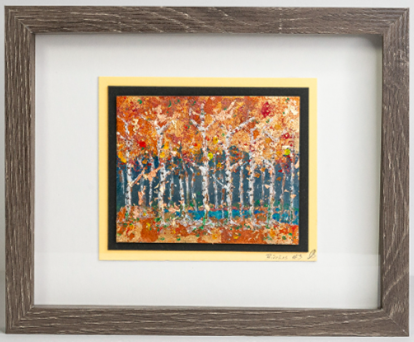
And the $400–800 price point — the range at which several pieces sold at my show — sits squarely in the sweet spot where this demographic makes decisions quickly and confidently. Research shows 40% of younger collectors regularly spend between $100 and $1,000 per piece. They know what they like, and when they find it, they don’t need to sleep on it.
What they’re not doing is buying for status or investment. The motivations here are different from previous generations of collectors. They’re buying for meaning, for identity, for the story a piece carries. One gallery director described her younger collectors as wanting to feel genuinely connected to an artist’s practice — not just own a decorative object.
Which explains a lot about those fifteen minutes in front of a painting with barely-dry varnish.
Why Physical Art Specifically
There’s something else worth saying here, and it connects directly to the kind of work I make.
“The motivations here are different from previous generations of collectors. They’re buying for meaning, for identity, for the story a piece carries.”
The gold leaf and metallic grounds I use in both my Fractured Light and What Lies Beneath series do something in physical light that simply cannot be reproduced on a screen. The luminosity shifts as you move. The surface catches and releases light differently depending on where you’re standing. You cannot photograph it fully. You cannot experience it on a phone.
In a world where most art is consumed as an image on Instagram — flattened, filtered, scrolled past in under a second — a painting that demands your physical presence is doing something genuinely countercultural. It requires you to be there. It rewards you for staying.
I think that’s part of what those young couples were responding to. Not just the image, but the experience of being in front of something that could only be fully known in person. Something made by hand, with material that has weight and history and a surface that changes with the light.
In a world drowning in digital content, that’s not a small thing. That’s increasingly rare.
What It Means for Me as a Working Artist
I’ve been making art for a long time. I know my longtime collectors — the ones who think carefully, come back twice, and have been following my work for years. I love them and I’m grateful for every one of them.
But something shifted at that show, and I don’t think it’s going away.
A new generation of collectors is entering the market — not tentatively, but with real confidence and real resources. They’re looking for work that means something, made by someone they can know and follow and feel connected to. They want the story behind the piece as much as the piece itself. They want to feel like early participants in something, not late arrivals to an established name.
That’s partly why I started writing here. Not to sell, but to share — the process, the thinking, the meaning behind the work. What I didn’t fully anticipate was that writing about why I make things would become part of what connects someone to a painting before they’ve even seen it in person.
Physical work, it turns out, doesn’t need to compete with the digital world. It just needs to be unapologetically, entirely itself — made by hand, experienced in person, impossible to fully render on a screen.
In a world that is becoming more virtual by the day, that might be the most radical thing an artist can offer.
________________________________________
Artist Rachel Shuler works from Mountain Tree Studio in West Hartford, and can be seen, surrounded by her distinctive art, showcasing her latest work and engaging with individuals of all ages at local community fairs and events throughout New England. This perspective first appeared on Substack in July 2026.