MetroHartford, Connecticut Have Strong Linguistic Diversity; Plus for Global Marketplace

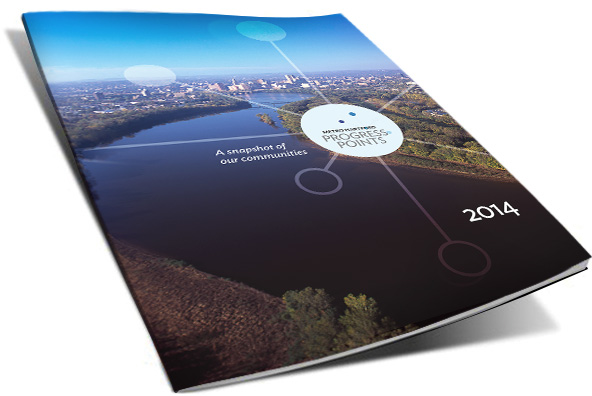
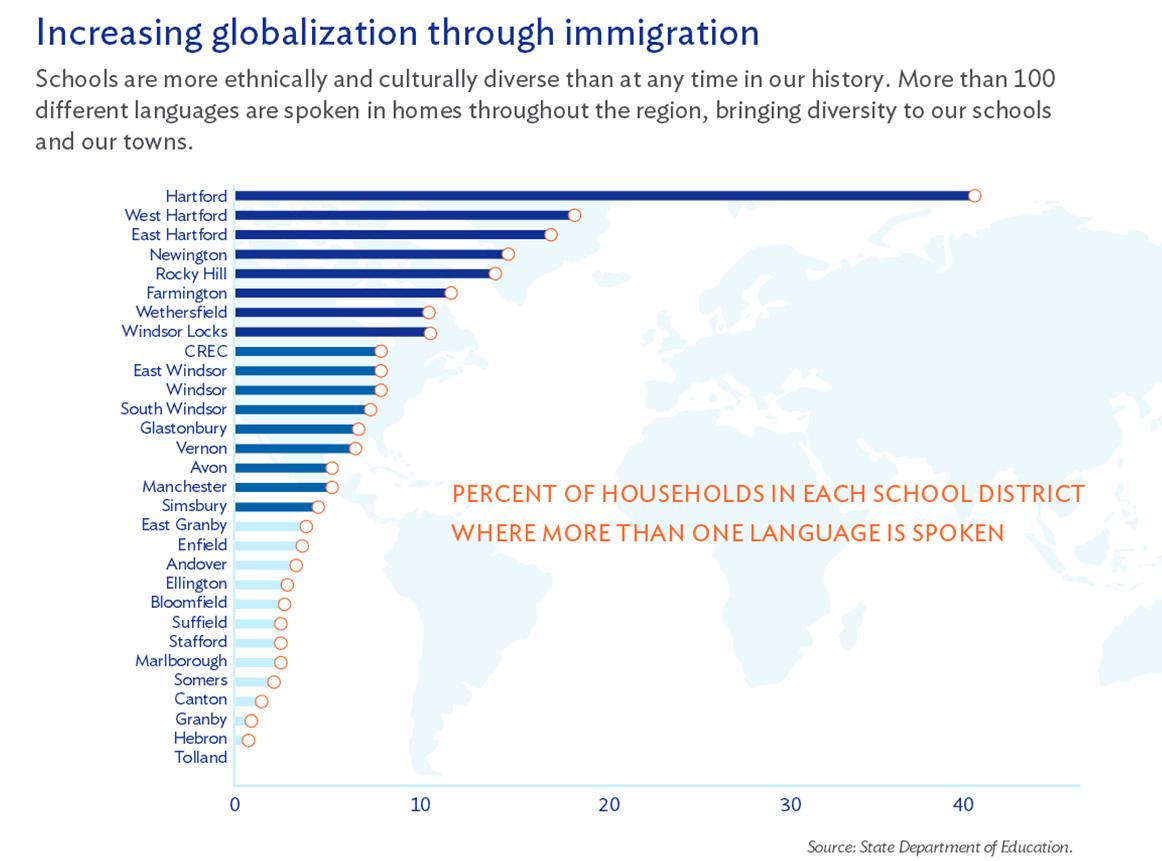
The number of languages spoken in Connecticut is considerably larger than most people expect.  That fact was highlighted in the recent MetroHartford Progress Points Report, prepared for the MetroHartford Alliance.  The linguistic diversity and global connections of the region are reflected in schools and employers, with more than 100 different languages spoken in homes of students attending schools throughout the region, according to the report.progress points report The “number of students with non-English home language” according to data on the website of the State Department of Education include Avon, 185; Bloomfield, 59; East Hartford, 1,124; Farmington, 474; Hartford, 8,371; Manchester, 335; Newington, 653; Simsbury, 228; South Windsor, 328; Tolland, 14; West Hartford, 1,876; and Windsor, 280.  The report indicated that 75 percent of English language learner (ELL) students are Spanish-speaking, 25 percent speak other languages at home.
Some of the languages spoken in the homes of students attending schools in the region may be unexpected.  In Manchester, for example, the lead languages are Spanish, Bengali, and Urdu, and the list also includes Twi/Fante, Telugu, and Gujarati.

The Hartford region consists of 750,000 people living in the city of Hartford, its surrounding inner-ring suburbs, and outer-ring and rural towns that have historical, economic or social ties with the city.

In 2013, the Hartford Foundation for Public Giving gathered a group of regional stakeholders to develop a unique community partnership that came together to collect, analyze and disseminate a broad range of data, to place a spotlight on some of the central challenges and opportunities for the region. The goal was to share critical information “with residents and policymakers that will result in meaningful dialogue and propel action in our communities.”  Among the report’s areas of research is “increasing globalization through immigration,” using data from the state Department of Education (SDE).progresspointslogo
Sponsoring organizations of Metro Hartford Progress Points include Capital Workforce Partners, Trinity College’s Center for Urban and Cultural Studies, the Capitol Region Council of Governments, the Hartford Foundation for Public Giving, Hispanic Health Council, MetroHartford Alliance, United Way of Central and Northeastern Connecticut, Urban League of Greater Hartford and the City of Hartford.

Data on English-language learners and languages spoken in schools is based on reports retrieved from the SDE CEDAR Data Tables on English Language Learners, for both Number of English Language Learners (ELL) and Languages Spoken by Connecticut Students for the 2010-11 school year, the most recent data available.

Statewide, the variety of languages spoken by Connecticut students is considerable.  Nearly 73,000 students live in homes with a “non-English home language,” according to the State Department of Education. The leaders include:

  • Spanish                        47,190
  • Portuguese                  2,846
  • Polish                          2,279
  • Albanian                      1,263
  • Chinese                       2,215
  • Creole-Haitian             1,714
  • Arabic                         1,159
  • Vietnamese                 1,157
  • Urdu                            1,131
  • Russian                        811
  • French                         762
  • Gujarati                       738
  • Serbo-Croatian            705

For the uninitiated, Gujarātī is an Indo-Aryan language spoken by about 46 million people in the Indian states of Gujarat, Maharashtra, Rajasthan, Karnataka and Madhya Pradesh, and also in Bangladesh, Fiji, Kenya, Malawi, Mauritius, Oman, Pakistan, Réunion, Singapore, South Africa, Tanzania, Uganda, United Kingdom, USA, Zambia and Zimbabwe.  And, apparently, Connecticut - in the homes of 738 slanguages spokentudents.
Close to 100 million people around the world speak Urdu. It is the official language of Pakistan, a status and is also spoken and understood in parts of India, Bangladesh, Nepal, the Middle East.

The Progress Points partners include: Capital Workforce Partners, Capitol Region Council of Governments, City of Hartford, Hartford Foundation for Public Giving, Hispanic Health Council, MetroHartford Alliance, Trinity College Center for Urban and Global Studies, United Way of Central and Northeastern Connecticut , and the Urban League of Greater Hartford.

https://www.youtube.com/watch?feature=player_embedded&v=0zTQjsbNlw0

Immigration Reform: Economic Impact in Connecticut

As the fate of immigration reform remains unresolved in Congress, plays out on the nation’s borders, and is debated  in states around the country - including Connecticut -  the potential economic benefits remain an element in the debate.  Connecticut-centric data seeks to provide local context as a new national immigration policy is considered and stalled and considered again in Washington, D.C. Some highlights, as released by the White House, point out that immigration reform will “strengthen Connecticut’s economy and creates jobs.”  Some of the data points that have been part of the past year's debate:

• Immigrants alreaImmigration-reformdy make important contributions to Connecticut’s economy. For example, Connecticut’s labor force is 16.7% foreign-born.


• 18.5% of Connecticut business owners are immigrants. These businessmen and women generate $2.05 billion in income for Connecticut each year.

• In Connecticut, 38.2% of science, technology, engineering, and math (STEM) graduates at the state’s most research-intensive schools are foreign-born. Also, 68.2% of the state’s engineering PhDs are foreign-born.

• According to Regional Economic Models, Inc., a set of reforms that provides a pathway to earned citizenship and expands a high-skilled and other temporary worker programs would together boost Connecticut’s economic output by $568 million and create approximately 6,904 new jobs in 2014.  By 2045, the boost to Connecticut’s economic output would be around $3 billion, in 2012 dollars.

The White House has also indicated that “common sense immigration reform increases workers’ income, resulting in new state and local tax revenue, contribute to the recovery of Connecticut’s housing market and strengthen Connecticut’s technology, agriculture, and tourism industries:

• Providing a pathway to earned citizenship and expanding high- and low-skilled visa programs will increase total personal income for Connecticut families by $1.6 billion in 2020, according to Regional Economic Models, Inc.

•  Immigration reform would have increased the state and local taxes paid by immigrants in Connecticut by approximately $29 million in 2010, according to one study.

• Immigrants significantly increased home values in Connecticut between 2000 and 2010 - in New Haven County, the increase was $2,680 for the median home.

• There are 4,916 farms in Connecticut that sell approximately $552 million in agricultural products. Noncitizen farm workers accounted for 24% of all farm workers in Connecticut between 2007 and 2011. According to one study, in 2020 an expanded temporary worker program would mean 264 new jobs for U.S. citizens and immigrants (including jobs not only in agriculture, but also retail trade, construction, and other sectors) in Connecticut, and increase Connecticut’s real personal income by $15 million in 2012 dollars.

• These provisions will increase tourism to the U.S., including to Connecticut - which saw approximately 307,000 overseas visitors in 2011.

An August 2014 poll by FOX News found that by a more than three-to-one margin, voters nationwide would pick immigration reform that only includes a pathway to citizenship over no Congressional action at all.  The  poll finds 65 percent of voters prefer legislation that only focuses on creating a pathway for certain illegal immigrants if that’s the only action Congress takes on immigration this year.   The survey also found substantial bipartisan agreement on the issue: 76 percent of Democrats and 56 percent of Republicans say something is better than nothing on immigration reform, and 60 percent of independents agree, FOX News reported.

Fraud Watch Aims to Limit Costly Scams Targeting Elderly

Connecticut state agencies are collaborating, in concert with private sector organizations, to protect senior citizens from elder abuse.  In issuing an Executive Order, Governor Malloy directed agencies to identify ways to increase public awareness, reporting and social network support of elder abuse victims, consider ways to improve programs for elder abuse victims, and identify best practices in elder abuse prevention, detection and intervention. Recent surveys by AARP underscore the susceptibility of seniors to identity theft and fraud, reporting that seniors were likely to have engaged in behaviors including:fraud

  • Clicked on pop-up ads – 26 percent of victims and 10 percent of non-victims said they had done so in the previous seven days;
  • Opened an email from an unknown person – 27 percent of victims and 17 percent of non-victims said they had done so in the past seven days;
  • Signed up for free trial offers – 18 percent of victims and 8 percent of non-victims had done so in the previous week.

Fraud victims were also found to have experienced the following life experiences, which may have impacted the susceptibility statistics cited:

  • Sixty-six percent of victims and 42 percent of non-victims said they “often or sometimes feel isolated.”
  • Twenty-three percent of victims and 10 percent of non-victims said they had experienced loss of a job.
  • Forty-four percent of victims and 23 percent of non-victims said they had suffered a “negative change in financial status” in the past two years. fraud watch

Connecticut AARP is a member of the state’s Elder Justice Coalition Coordinating Council, which convened this summer, and one of the 16 agencies appointed by the Commissioner of the State Department on Aging to work on elder justice issues.  AARP is leading the Consumer Fraud Education workgroup which has hit the ground running with the recent launch of the AARP Fraud Watch Network – a national campaign that connects people to experts, law enforcement and people like them who can help them spot and avoid scams.

As part of the CT Elder Justice Coalition, AARP Connecticut is working with state, federal and community organizations across the state utilizing Fraud Watch Network resources to educate older adults and their families about scams and provide tools and information to prevent identity theft and fraud.

Fairfield Chief of Police, Gary MacNamara, representing the CT Police Chiefs Association and a member of the CT Elder Justice Coalition, stated, “Police officers understand efforts to prevent our community members from being victims is really important.  The first step in prevention is awareness.  The AARP Fraud Watch Network provides a great place for older adults and families to get accurate information and become aware of the threat.”seniorlady-570x230

Last fall, a survey of nearly 2,400 U.S. adults age 40 and older conducted by the FINRA Foundation revealed that financial fraud solicitations are commonplace.  Many Americans are unable to spot fraudulent sales pitches, and older Americans (age 65 and older) are particularly vulnerable.

Specific findings include:

  • Over 80 percent of respondents have been solicited to participate in potentially fraudulent schemes, and over 40 percent of those surveyed cannot identify some classic red flags of fraud.
  • More than 8 in 10 respondents were solicited to participate in a potentially fraudulent offer. And 11 percent of all respondents lost a significant amount of money after engaging with an offer.
  • More than 4 in 10 respondents found an annual return of 110 percent for an investment appealing, and 43 percent found "fully guaranteed" investments to be appealing.
  • Americans age 65 and older are more likely to be targeted by fraudsters and more likely to lose money once targeted.

According to AARP volunteer and Executive Council member, Byron Peterson, “Identity theft, investment fraud and scams rob hard-working Americans of billions of dollars each year – with older adults often the biggest targets.  Through the AARP Fraud Watch Network, we’re arming people with information about what makes them vulnerable and giving them access to the tools they need to outsmart con artists before they strike.”AARP

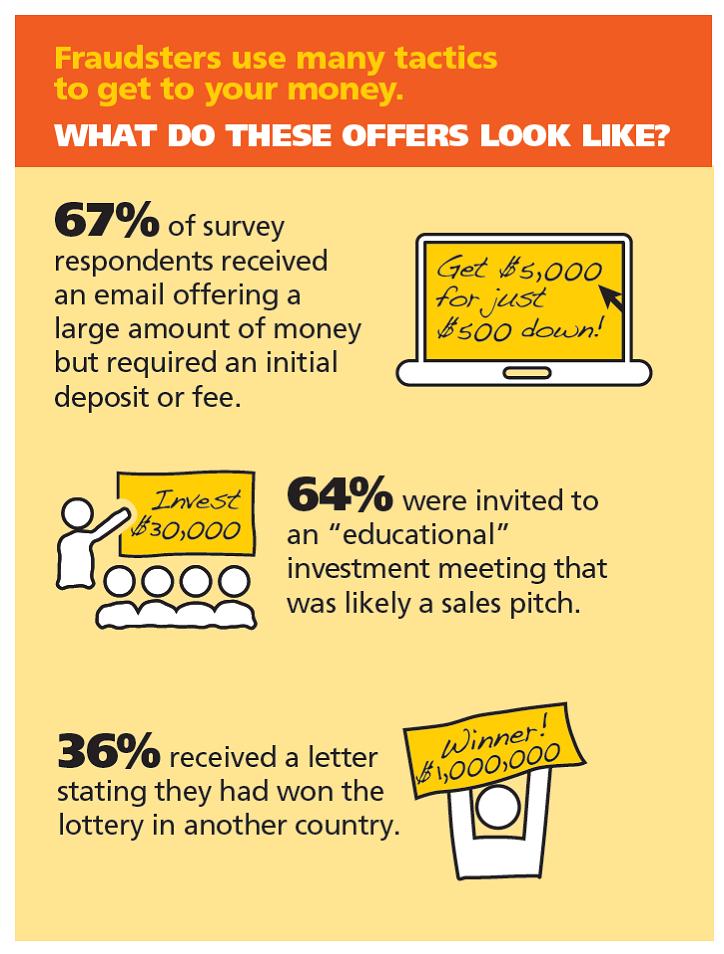
The FINRA Foundation's survey found that 64 percent of those surveyed had been invited to an "educational" investment meeting that was likely a sales pitch. Additionally, 67 percent of respondents said they had received an email from another country offering a large amount of money in exchange for an initial deposit or fee. Upon being solicited for fraud, older respondents were 34% more likely to lose money than respondents in their forties.

In collaboration with partner agencies and organizations, AARP staff and volunteers are making fraud prevention presentations to community groups and encouraging all residents to sign up for watchdog alerts and stay abreast of current scams through the AARP Fraud Watch Network.  Available free of charge to AARP members and non-members alike, and people of any age, the Fraud Watch Network provides an array of educational information and access to individuals who share experiences and provide expertise.

Yale Grad One of 12 to Win Emmy, Grammy, Oscar and Tony; Frozen’s “Let It Go” Was Family Affair

As the Frozen juggernaut continues with no signs of slowing whatsoever, the ubiquitous anthem “Let It Go” rings in the ears of children and parents worldwide.  What many may have missed in the phenomenon is the Connecticut connection. The anthem “Let It Go,” sung in the movie by both Idina Menzel and Demi Lovato (over the closing credits), was penned by Yale graduate Robert Lopez,  whose notoriety and track-record is virtually without recent parallel.  The song was co-written with his wife, Kristen Anderson-Lopez.  Together, they also wrote the songs for the 2011 Disney animated musical Winnie the Pooh.family frozen

Prior to Frozen, Lopez was best known for co-creating The Book of Mormon and Avenue Q, two of Broadway’s stand-out box office smashes of the past decade. He is one of only 12 people who have won an Emmy, Grammy, Oscar, and Tony Award, and the only person to win all four within a decade.

Lopez was born in Manhattan, developed an interest in music from an early age, and wrote his first song at age seven. He received a B.A. in English from Yale University (Class of ’97), where he was a member of the Yale Spizzwinks and wrote comedic songs for various student-run theater groups, according to the Avenue Q website.

Earlier this year, when Lopez took home an Academy Award for Best Original Song for co-writing "Let It Go" he became the youngest person, at age 39, to "EGOT", (win an Emmy, Grammy, Oscar, and Tony Award).  Lopez previously won the Grammy and Tony for The Book of Mormon, and received Daytime Emmy Awards for music direction and composition for the kids TV series The Wonder Pets.

IMDb and Variety reported that "EGOT" members include Whoopi Goldberg, Audrey Hepburn, Mel Brooks, Mike Nichols, and Scott Rudin, among the 12 members of the exclusive club.

In 2011, he told the Yale Daily News “the Spizzwinks are still my best friends, longest-lasting friends from college. I first got my inkling in college that I might not want to just write serious stuff. That music could be funny. That was something I enjoyed doing. The Spizzwinks were really the first place where I started dabbling with that.”  Success, however, did not come overnight.  “Right out of college I lived with my mom and dad. I lived with them for four years after college. They were extremely supportive of me. Without that, I don’t know where I’d be,” he told the newspaper.

In an interview this year with People magazine, Anderson-Lopez said "Frozen has been a team, family effort," says Anderson-Lopez. "Every song we wrote, our [daughters Annie, 4, and Katie, 9,] were the first audience for it and if they didn't want to hear it again, we went back to the drawing board."  The couple wrote eight songs for Frozen.  

Lopez told NPR’s Terry Gross that “When this song came to us, we were on a little stroll through Prospect Park in Brooklyn near our house, and we both started to improv what Elsa might be feeling. So we stood up on picnic tables.”  He added, “Once we had the idea for the song, it came quite quickly. It took about, you know, a day and a half.”let it go

In April, Frozen became the highest-grossing animated film in box office history, just days after the film was released on DVD and Blu-ray.  The Frozen soundtrack is also the best-selling digital soundtrack album in history and the top-selling album of 2014, having spent 31 consecutive weeks in the top 5 on the Billboard 200 chart, including 13 nonconsecutive weeks at No. 1. The "Let It Go" film clip from Frozen has been viewed nearly 300 million times on YouTube.

Disney had the song recorded in 25 different languages for international versions of the film:  French, German, Dutch, Mandarin, Swedish, Japanese, Latin American Spanish, Polish, Hungarian, Castilian Spanish, Catalan, Italian, Korean, Serbian, Cantonese, Portuguese, Bahasa Malaysian, Russian, Danish, Bulgarian, Norwegian, Thai, Canadian French, and Flemish.

"The Story of Frozen: Making a Disney Animated Classic" will be broadcast by Disney-owned ABC television on Tuesday, Sept. 2 at 8 p.m. 

Pay Equity Gap Between Men and Women Begins As Children, Studies Show

The stubborn pay equity gap between men and women – larger in Connecticut than some neighboring states – apparently has its roots in childhood. National surveys indicate that parents are more likely to give their sons an allowance than their daughters. Among all young people surveyed, 67 percent of boys compared with 59 percent of girls say they get an allowance from their parents, according to Junior Achievement USA® (JA) and The Allstate Foundation’s 2014 Teens & Personal Finance Survey.allowance hand

A study by the University of Michigan Institute for Social Research found that girls do two more hours of housework a week than boys, while boys spend twice as much time playing. The same study confirmed that boys are still more likely to get paid for what they do: they are 15 percent more likely to get an allowance for doing chores than girls.  Study Director Frank Stafford indicated that the trend continues into adulthood. allowance graphic

Writing this month in the National Journal, Connecticut Congresswoman Rosa DeLauro pointed out that “right now, women make less than men in nearly every occupation for which wage data are tracked. One year out of college, women are paid 18 percent less than their male counterparts. Ten years out of college, the wage gap leaves women earning 31 percent less.  Over a 35-year career, these earnings discrepancies swell to exceedingly large sums. Across the entire workforce, the average career-long pay gap is $434,000. For college-educated women, the pay deficit averages $654,000.”

Earlier this year, CT Mirror reported that “women in Connecticut earn about 78 percent of what men make.  Numbers from the 2012 Census show that Connecticut's gender wage gap is wider than in many other states in the Northeast; and that, within the state, the gender difference varies as well. The most pronounced gap…is in Fairfield County.”

In a November 2013 report, the Governor’s Gender Wage Gap Task Force indicated that “Connecticut still has a long way to go before the gender wage gap is eliminated.”  The 14-member task force found that that “more mothers than ever before are the sole or primary breadwinners of their families. Yet, women in Connecticut are more likely than men to live in poverty and below the self-sufficiency standard. 24% of households in Connecticut headed by women with children fall below the federal poverty level. Eliminating the wage gap would provide critical income to these families.”

The report also indicated that “among all full-time, year-round workers, Connecticut women earn, on average, 22%-24.2%less than men. This gap is even more pronounced among minority women. Understanding this inequity is not a simple matter. Many factors contribute to the overall wage gap including education and skills, experience, union membership, training, performance, hours worked and the careers women and men choose. However, even after these factors are controlled for, an estimated wage gap of 5-10% remains.”

In 2012, the National Partnership for Women and Families reported that “If the wage gap were eliminated, a working woman in Connecticut would have enough money for approximately:

  • 109 more weeks of food
  • 7 more months of mortgage and utilities payments
  • 14 more months of rent
  • 44 more months of family health insurance premiums
  • 3,410 additional gallons of gas

The Connecticut Task Force issued a series of recommendations to address the pay equity gap, focused on current workplaces, businesses, training and education.  Apparently, efforts need to begin sooner, when youngsters begin household chores and ask for an allowance.

gender gap map

Fairfield County May Hold Key to Trans-Atlantic Flights at Bradley; Passenger Numbers Increasing

Bradley International Airport has seen passenger traffic increase for two consecutive months, and is stepping up efforts to re-establish service to trans-Atlantic destinations. The Connecticut Airport Authority (CAA) is working with the state’s business community and potential airline carriers to demonstrate the need for the overseas service. In May, passenger traffic at Bradley increased 9 percent, compared with a 7.8 percent decrease at T.F. Green Airport in Providence and a 9.5 percent decrease at Manchester Regional Airport in New Hampshire. Logan International Airport in Boston increased 7.5 percent that month.

During June, Bradley saw a 9.3 percent increase in passengers, while Providence saw a 7.3 percent decrease and Manchester saw passenger numbers drop by 14.6 percent. Logan experienced a 4.1 percent increase in June.  July data was not yet available.

Kevin A. Dillon, ExecuBradley_INTL_Logo.svgtive Director of the Connecticut Airport Authority, told members of the CAA at their August meeting that the state’s improved economy and ongoing efforts to add capacity at the airport are lead factors in the upbeat numbers. United Airlines recently announced plans to begin service to Houston in October. In June, JetBlue initiated service from Bradley to Reagan National Airport in Washington, D.C.

Year to date, Dillon reported, passenger numbers at Bradley are up 10.6 percent, while Providence is down 6.8 percent, Manchester is down 13.0 percent, and Logan is up slightly, 4.4 percent.

The return of trans-Atlantic service to Bradley is one of the CAA’s top priorities, Dillon said. Much of the business case for trans-Atlantic routes depends on corporate clients outside the immediate Hartford-Springfield market, Dillon explained. He indicated that the CAA would be “orienting our advertising program for the next year” toward Fairfield County and Southeastern Connecticut, to include targeted outreach urging potential business customers to “give Bradley a try,” underscoring that “Bradley is a great option” compared with the New York airports.

The CAA is also poised to move forward with the demolition of the old Terminal B at Bradley, with the contract awarded to S&R Corporation of Lowell MA, with a price tag of $12, 572,622.75. The CAA anticipates that the demolition will begin before the end of this month, consistent with the airport’s strategic plan. The goal of the CAA is to make Connecticut’s airports more attractive to new airlines, bring in new routes, and support Connecticut’s overall economic development and growth strategy.CAA logo

Members of the CAA also discussed a potential new retail business for the airport – Dairy Queen – and approved plans for a 20-year agreement with WFSB-TV for the lease of land at Bradley for a Doppler radar installation at Bradley, which would be relocated from Terminal B where it has been since 1999.

Bradley will also be enhancing band-with capacity of wi-fi at the airport, which has seen increased usage as passenger levels have increased.

Bradley International Airport is the second largest airport in New England. According to the most recent economic impact analysis, Bradley contributes $4 billion in economic activity to the state of Connecticut and the surrounding region, representing $1.2 billion in wages and 18,000 full-time jobs. The CAA was established in 2011 to develop, improve, and operate Bradley International Airport and the state’s five general aviation airports.

CT Women Underrepresented Among Top Earners; 4th Widest Gap in US

In only three states in the nation are women more underrepresented among the top 1 percent of wage owners, when compared with the state’s overall female population. Connecticut ranks 4th – after South Dakota, New Hampshire and Wyoming – in underrepresentation of women among the top earners in the state. Connecticut has a ratio of 6 men for every woman in the state’s top 1 percent of wage earners. South Dakota has the widest gap and largest ratio, at 8.2.

In Connecticut, 51.3 percent of the state’s population is female, yet only 14.4 percent of the top 1 percent of wage earners in the state are women. That is a gap of 36.9 percent, ranking the state fouTheOnePercentrth.  In Wyoming the gap is 37.1 percent, in New Hampshire 38.6 percent, and in South Dakota, 39 percent. In South Dakota, with the widest gap, only 10.9 percent of the wage earners in the top one percent are women.

On the other end of the spectrum, the gap in Delaware is 10.6 percent, in Hawaii 16.8 percent, Rhode Island 17.8 percent and Vermont 21.7 percent. The ratio of males to females among the top one percent earners is 1.4 in Delaware, 2.0 in Hawaii, 1.9 in Rhode Island and 2.5 in Vermont, compared with Connecticut’s 6.0.

Bloomberg ranked the U.S. states and the District of Columbia on the extent to which females are underrepresented in the 1% income bracket, utilizing U.S. Census data.

Connecticut also had the nation’s second highest threshold income to gain entry into the one percent club, at $429,793. Only Alaska, at $500,052 was higher. Just slightly lower than Connecticut was the District of Columbia, New York, New Jersey, North Dakota and Minnesota ($387, 414). At the opposite end of the states tally was Wyoming, with an income of $244,207 placing individuals in the state’s top one percent of earners.

In the percentage of women in the overall population, Connecticut ranked 10th, at 51.3 percent. Only 10 states have more men than women in their population. Alaska has the highest percentage of men, at 52.1, and the District of Columbia the highest percentage of women, at 52.7. Following closely behind are Rhode Island and Mississippi, both with 51.7 percent of their population being female.

Using data from the U.S. Census, Bloomberg calculated the approximate 99th percentile, or top 1%, of inflation-adjusted wage or salary income figures for those ages 16 and older and employed. Gender information was extracted and the gap between the percentage of females in the 1% bracket and the percentage of females in the state's population was calculated.

Teen Journalists Bring Attention to Issues of Cyber-Bulling, Underage Drinking, Social Media Stress

Connecticut teen girls drink at a higher rate than the national average, Connecticut’s teen drinking rate is higher than ever, cyber-bullying rates among girls in the state have increased, and moderate to high stress levels among a majority of teens nationwide – and how they respond to stress – are raising new concerns. Those are just some of the statistics highlighted this month by student journalists at the Connecticut Health Investigative Team (C-HIT), an investigative news website populated by veteran journalists focusing on health issues facing the state. In recent days, the higPicture1h school students - participants in week-long journalism workshops at UConn, Quinnipiac and Yale universities led by C-HIT - have been producing news stories that target issues facing a demographic they are not only familiar with, but, in most cases, part of. The students are learning research methods intrinsic to journalism and the results of their work have been eye-opening. Some of the highlights:

With access to social media reaching an all-time high, cyber-bullying rates have gone up among girls in Connecticut, according to the latest Connecticut High School Youth Risk Behavior Survey. In Connecticut in 2013, cyber-bullying rates among girls were at 22.8 percent - more than 1 in 5 girls reported being cyber bullied. That was an increase of 2.7 percent from 2011. Unlike among females, cyber bullying among males dropped by .2 percent, to 12.3 percent in 2013.

According to statistics from the Bureau of Justice, 37 percent of teenagers reported being bullied at school and 52 percent said they were victims of cyber bulling. Cyber bullying is tormenting, humiliating, or harassing another individual using the Internet, cell phones, or other types of social media.

journalismOf the young people who reported cyber bullying incidents against them, one in three reported that they experienced threats online. Well over half of young people do not tell their parents when cyber-bullying occurs, the website says. Surveys show that girls are twice as likely as boys to be both victims and perpetrators of cyber bullying.

The Youth Risk Behavior Survey of 2013 reported that Connecticut girls are more likely to drink than their peers nationally. In Connecticut, 8.5 percent of high school girls have driven drunk – which is higher than the national average of 7.8 percent. In Connecticut, 37 percent of high school girls surveyed said they had at least one alcoholic drink, at least one day before the survey, compared to 35.5 percent nationally.

Teen drinking is a problem nationwide, but it is more apparent among teenage girls. Roughly 90 percent of adults who have substance abuse problems now began as adolescents, according to Dr. J Craig Allen, the chief medical officer of Rushford Center, a Connecticut substance abuse and mental health treatment center. Overall, Connecticut’s teen drinking rate is higher than ever, with students experimenting with alcohol as early as 11 years of age -- nearly two years younger than the national average, according to the Rushford Center. Teens in Connecticut are consuming 26-28 percent more alcohol than their peers around the country, according to data from the Office of Juvenile Justice and Delinquency Prevention.

The availability of alcohol plays a factor in teen drinking. Other contributing factors in suburban areas include stress, with many teens placed under academic and other pressures on a day-to-day basis, experts suggest. A 2012 study by the Columbia University Teachers College found evidence that “affluenza,” described as a “metaphorical illness connoting hyper-investment in material wealth among upper-middle class families,” was a factor in negative behaviors including drug and alcohol use.

Nationally, teens are feeling stressed in and out of school, according to a survey done for the American Psychological Association. The survey showed that during the 2012-13 school year 55 percent of the 1,000 teens questioned said that they felt moderate stress during the school year, and 27 percent said that they felt “extreme stress.” Forty percent of teens said that stress is making them irritable or angry, and 36 percent said that stress made them nervous, angry or fatigued, according to the survey.

The survey also found that social media plays a role in teen stress. Thirty-nine percent of girls and 29 percent of boys questioned said that they do care how others perceive them on social media --- and that they need to keep up a persona on social media websites.

Of most concern to doctors in the survey findings was how teens dealt with stress. Forty-six percent of teens responded that playing video games was their way to manage stress, 43 percent said they surf the internet and only 37 percent said that they would exercise or walk.

This summer, C-HIT worked with 75 students in a 'newsroom' setting, with each student researching, reporting and writing his or her own story,  working with complex databases and conducting interviews.  The 2014 workshops were supported by organizations and individual donors including the Dow Jones News Fund, William Graustein, the Fisher Foundation, People’s Bank, the Knox Foundation, Quinnipiac University, and the Community Foundation for Greater New Haven. The journalism workshops will be offered again next summer.

Photo:  Among the C-HIT students are (left to rigCHIT internsht) Mackenzie Brayman, a student at North Stonington High School; Julyanna Schreider and Shamoya Hanson, students at the Journalism & Media Academy, Hartford; Talon Cooper, a student at Hillhouse High School, New Haven; and Conner Fritchley, a student at Wilton High School. Information included in this article was researched and developed by the students for their news stories.

Additional investigative news stories by the students participating in the C-HIT summer journalism program can be seen at http://c-hit.org/

Summer Sandwiches: Lobster Roll is Connecticut Standout, Zagat Says

When Zagat’s decided to take a bite into the uniqueness of sandwiches during August (It is national sandwich month! Who knew?) – highlighting particularly noteworthy culinary endeavors in every state in the nation – the focus in Connecticut landed squarely on the lobster roll. Their review of “delicious regional sandwiches” found in each state had some overlap (Maine was also noted for its Lobster Roll, for example) and some regional favorites with a national following. And some surprises (see bison, reindeer, and marshmallow, below). zagat_logo

“While many consider the cold, mayonnaise-driven Maine lobster roll to be the quintessential version of the sandwich, the first lobster roll was actually a hot, buttered one served at a restaurant called Perry’s in Milford, Connecticut, in the 1920s,” Zagat’s explained. “This version is usually simpler, featuring just lobster meat, butter, and maybe some black pepper or lemon juice on a grilled, split-top hot dog bun, and served with potato chips or French fries. “

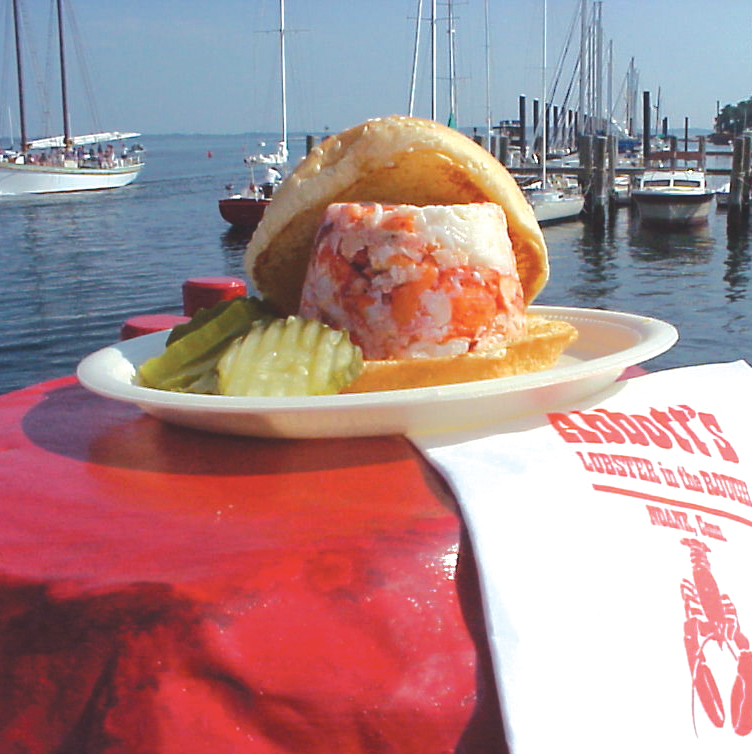
Cited by the Zagat surveyhotlob600 was Abbott’s Lobster in the Rough in Noank, founded in 1947. “They take the simplicity of the Connecticut-style hot lobster roll and turn it into an art form. Their award-winning sandwich is made with a full quarter-pound of lobster meat (more than is found in the average small lobster) drenched in melted creamery butter and heaped onto a bun. It’s a sandwich so opulent, it’s well worth the trip to this far-off-the-beaten-path lobster pound to get one (not to mention the crowds you have to battle to order).”

Noteworthy in the region were the Italian Sub in New Jersey and the Italian Grinder in Rhode Island. (A distinction without a difference?) In Massachusetts, the Zagat selection was the Fluffernutter: “The delectable marshmallow fluff was in fact invented in Somerville, Massachusetts, in 1917. A man named Archibald Query sold it door-to-door before he sold the recipe, though who it is that thought to pair it with peanut butter on white bread is not as clear. Nevertheless, the fluff is celebrated to this day with a Fluff Festival in Somerville” in September.

New Hampshire was noted for its “Beer-Battered Fish Sandwich” and Vermont for the aptly-named Vermonter, a “ sweet-and-savory sandwich that typically includes either turkey or ham (sometimes both), sharp Vermont cheddar cheese, thinly-sliced green apples and honey mustard, although there are many different variations (including a decent number that come with cranberry mayonnaise instead of honey mustard).”

In case you were wondering, in Alaska it is the Reindeer Sausage Sandwich, in Wyoming the Bison Reuben, in Alabama the Chicken Sandwich with White Sauce, and in Arkansas the Fried Bologna Sandwich, and Mississippi the Elvis sandwich (peanut butter, fried banana and bacon). The Zagat’s  reporting (and tasting) was conducted for the August 2013 observance of National Sandwich Month, with a tip of the plate to the notable Earl of Sandwich.

Hartford Region Improves Among Nation's Best Performing Cities in 2013

The Hartford region was the state’s only metropolitan area to improve its ranking relative to other metropolitan areas around the country in an analysis of job growth and regional economic factors in 2013 that ranked the nation’s top 200 Best Performing Cities. The top ranked Connecticut metropolitan area was Hartford-West Hartford-East Hartford, which ranked #85 among the nation’s top 200, an improvement in ranking from #93 the previous year.state map

Connecticut’s other major metro areas dropped in the rankings: Bridgeport-Stamford-Norwalk dropped to #106 from #94 in 2012, New Haven-Milford fell to #142 from #109 , and Norwich-New London ranked #187, falling from #152 the previous year.

Best Performing Cities Index Report (PDF)The 2013 Milken Institute Best-Performing Cities Index ranks U.S. metropolitan areas by how well they are creating and sustaining jobs and economic growth. The components include job, wage and salary, and technology growth.

Topping the list of Large Cities were Austin-Round Rock–San Marcos, Texas and Provo-Orem, Utah followed by San Francisco-San Mateo-Redwood City, CA, San Jose-Sunnyvale-Santa Clara, CA and Salt Lake City, UT. Rounding out the top 10 were the metropolitan areas of Seattle, Dallas, Houston, Boulder, and Greeley, CO.

Biggest gainers on the list include Hagerstown-Martinsburg, Md.-W.V. (70th, up 100 slots); Tulsa, Okla., (42nd, up from 118th), and Phoenix, (66th, up from 122nd). Within the top 25 metro areas, Texas claimed seven spots; Colorado and California each had four.

The website interactive features offer a means of comparing cities in the various economic factors.  In most years, according to the study authors, the factors evaluated in the index give a good indication of the underlying structural performance of regional economics.

A nonprofit, nonpartisan economic think tank, the Milken Institute works to improve lives around the world by advancing innovative economic and policy solutions that create jobs, widen access to capital, and enhance health.