Home Grown Start-Up Business Aims to Help CT Grow
/“Simply redeveloping economic development.” That’s how the leadership of Help Grow CT, a fledgling business dedicated to helping other start-up entrepreneurial enterprises, describe their endeavor. As a playful video summarizes the serious intent driving the effort, “Several years ago, a group of entrepreneurs utterly frustrated with the bad press their beloved state was receiving, just couldn’t accept Connecticut as being one of the worst places to do business in the country.”
Christopher Sacchinelli and a handful of colleagues quietly began the venture a few years ago, having spent some time at a Norwalk accelerator program and with a track-record in business start-ups. They tweaked and revised their business model and platforms, traveling and researching economic development strategies that have been successful elsewhere, and why. About 50 businesses signed on, and helped refine the effort. 
Six months ago they began a public push to grow the business and this month a new member platform is being launched. The immediate goal is 3,000 small business owners, about one percent of businesses in Connecticut. The company is about one-third of the way there.
“We knew that there had to be a way we could catalyze change via our own actions,” Sacchinelli said, recalling the drive to start Help Grow CT. “The goal is to help and empower Connecticut businesses. To make it cheaper and easier to grow a business.”
In surveying the new business landscape, it became clear to Sacchinelli that “the problem that most small business owners were experiencing was high costs, not enough time and low profits.” What they did as a result was develop a business that provides opportunities for new businesses to band together to succeed as individual enterprises, and by doing so, “help grow CT.” It is an endeavor that aims to bring other businesses together as a group to drive economies of scale, reduce costs, increase efficiencies and grow profits. And in doing so, boost Connecticut’s economy and turn around the state’s less-than-stellar reputation.
“The number one business killer is lack of action. We focus on solutions,” said Sacchinelli, a Trumbull resident and lifelong entrepreneur born and raised in Norwalk who turned 27 this month. “Connecticut is my community. I’m vested in Connecticut.” A previous venture landed him on the cover of the Fairfield County Business Journal in 2013, soon after graduating college. He has authored a book to encourage young entrepreneurs like himself, and has endeavored to use his expertise to encourage and guide businesses and potential business owners in his home state.
Through Help Grow CT, member companies are able to save up to 30 percent on dozens of exclusives partners, apps and platforms, and participating businesses are said to achieve, on average, 9 percent annual growth. Individuals, called Growth Analysts, work with businesses to navigate through their specific business needs.
By offering savings on back room operations, such as bookkeeping, Help Grow CT not only allows business start-ups to focus more on their business product or service and less on the paperwork, without sacrificing the important detail that can lead a new enterprise to sink or swim. They point out that businesses with healthy ledgers are 76 percent more likely to succeed over a 5 year period.
“HelpGrowCT has helped small business owners identify areas in their business where they can cut costs, invest in inefficiencies and grow their profitability,” the company’s website points out, offering support in branding, social marketing, and growth strategy development, responding to what is often new business owners “feeling overwhelmed” as they navigate all that is necessary to propel a new endeavor forward. “We work with the nitty gritty that can hold a business back,” adds Sacchinelli.
Thus far, the initiative has been self-funded. As members, who will pay monthly fees for the service, are added, Sacchinelli hopes the venture will be self-sustaining, and ultimately, profitable. The number of members will largely determine that. He is also cognizant of the potential social impact of the venture, and aims for it to be a “sustainable, evergreen accelerator program,” that will also deliver value to existing businesses.
In addition to the resources provided directly by Help CT Grow to member businesses, “we can listen to problems and crowd source solutions,” Sacchinelli explains, bringing the power of the network of members to bear on individual business challenges. “The vast majority of small businesses have some of the same problems. Together, we can guide a business toward the solution.” He was encouraged recently by the positive feedback (and new members) from among attendees at the Connecticut Business Expo in Hartford, where he raised the profile of HelpGrowCT with the first visible foray into central Connecticut.
HelpGrowCT is also interested in the opinions of Connecticut's business community as their own business evolves. A companion website, www.helpgrowct.org, includes a brief online survey for start-ups, business owners, investors, residents and students, aimed at propelling the venture and giving voice to the state's growing entrepreneurial community. And HelpGrowCT continues to seek talent as it grows, actively seeking "energetic, self-driven community leaders who share our passion" and can apply their skills in journalism, event planning, advisory services, or community advocacy," according to the website.
Never too far from the surface is the drive to turn around Connecticut’s reputation as inhospitable to new businesses. Says Sacchinelli, “After reading article after article about how Connecticut is a poor place to do business, we’re trying to build something that matters.”
https://youtu.be/tPIrcx3oEz8
https://youtu.be/xnac_ll-5I4
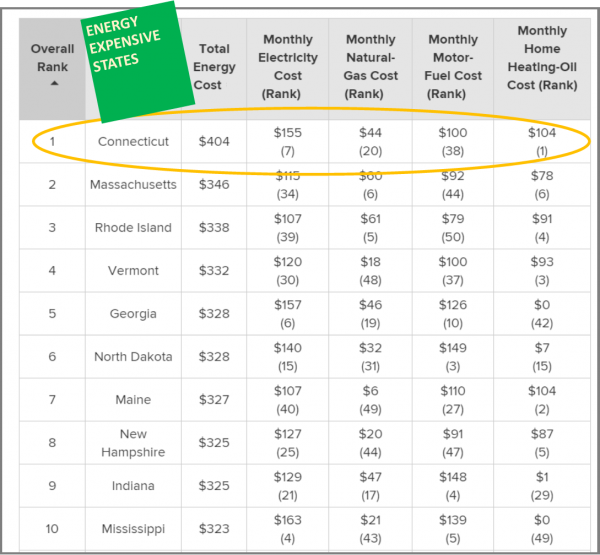
 necticut ranked as the most energy expensive state mainly due to its high retail prices for energy,” analyst Jill Gonzalez told CT by the Numbers. “The state has the third highest retail price for electricity and heating oil at $0.20 per kWh and almost $4 per gallon, respectively. Natural gas isn't cheap either, ranking 14th highest, at $14 per thousand cubic feet. These prices paired with high heating consumption in the winter months put Connecticut on top of these rankings."
 Describing Hartford’s prominent manufacturing history, Hinz said “Hartford, CT, is a classic story in the history of American technology. If you have ever wondered why people refer to “Yankee ingenuity,” this is what they are talking about.” He adds, “In the mid and late 1800s, the United States overtakes Great Britain as the world’s foremost economic superpower, largely on the strength of its prowess in inventing and manufacturing new technologies. Hartford is at the center of that revolution.”
 The exhibit notes that by the 1850’s “Hartford became the center of production for a wide array of products—including firearms by Colt, Richard Gatling and John Browning; Weed sewing machines; Royal and Underwood typewriters; Columbia bicycles; and even Pope automobiles.”
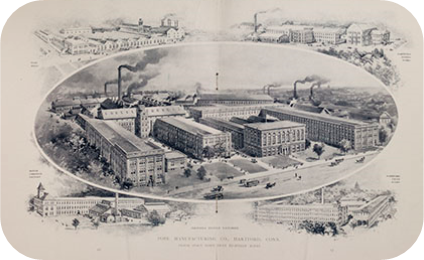 rode his high-wheeler from the station down Capitol Avenue to the Weed Sewing Machine Company.’”
 Jeanne Manzelli, a resident of Windsor, has a
  BFA in Sculpture from the Massachusetts College of Art and her MED in Art Education from the University of Massachusetts, Amherst. Her experience includes a 20 year career in design, manufacture, appraisal and sale of jewelry, two decades as mural artist working closely with interior designers as an industry professional, and 14 years teaching basic and advanced drawing, sculpture and 3D design as well as color theory at Tunxis Community College.
 The site said of
  s, including:


 The analysis points out that the type of land in a given area has a significant impact on its worth. Agricultural and other largely undeveloped areas are generally worth significantly less than cities and suburbs land. Developed land, or land where housing, roads, and other structures are located, is valued at an estimated $106,000 per acre, while undeveloped land was estimated at $6,500 per acre, and farmland at only $2,000 per acre, according to the analysis.

 In addition to its impact on drivers, the AMA notes that blue-rich LED streetlights operate at a wavelength that most adversely suppresses melatonin during night. It is estimated that white LED lamps have five times greater impact on circadian sleep rhythms than conventional street lamps, the AMA indicated. Recent large surveys, according to the AMA, found that brighter residential nighttime lighting is associated with reduced sleep times, dissatisfaction with sleep quality, excessive sleepiness, impaired daytime functioning and obesity.
 The Conversation website is a collaboration between editors and academics to provide "informed news analysis and commentary that’s free to read and republish." It
  PHOTO: Traditional street lighting (left) vs. LED lighting (right).


 “Wholesome Wave is thrilled by the innovations that USDA is supporting through the new FINI grants, which are taking the work of increasing affordable access to healthy food to even greater levels of impact,” said Michel Nischan, CEO & Founder of Wholesome Wave. “So many SNAP shoppers are working parents with limited time to source healthier food choices. Through the new Farm-to-Grocery model, our partners in Connecticut and Vermont will be able to expand affordable access to SNAP consumers in a way that allows them to find and purchase more healthy food from a variety of retailers.”