Project Undertakes Mapping CT With Precision From the Air

Unbeknownst to most of us, there is a world of difference between an aerial photograph and an orthophotography.  In fact, enough of a difference for the State of Connecticut to get behind an initiative to photograph the entire state. The results are to be made publicly available through the state’s Open Data Initiative.  The orthoimaging of Connecticut, now complete, was undertaken by the Sanborn Map Company, under a contract with the Capitol Region Council of Governments made possible by a grant from the state's Office of Policy and Management. It will provide Connecticut with its first statewide acquisition of datasets at this high level of accuracy, according to those involved with the project.PR_Mystic_Seaport_Connecticut_06142016

The Sanborn flight team overcame challenging spring weather conditions to successfully collect high-resolution imagery of the entire state of Connecticut and its coastline in just five weeks, according to the company.  Altogether, the firm collected more than 42,500 4-band, 3-inch resolution images during March and April, including more than 6,000 coastline images during low-tide conditions.

The Sanborn team, which included subcontractors, also collected more than 5,200 square miles of high-density light detection and ranging (LiDAR) data covering the entire state during the same time period. All of the data were collected during snow-free, cloud-free and leaf-off conditions, which makes them ideal for a host of products and applications.

A conventional perspective aerial photograph contains image displacements caused by the tilting of the camera and terrain relief, or topography. It does not have a uniform scale and one cannot measure distances on an aerial photograph as if it were a map.orthophotography

In orthophotography, the effects of tilt and relief are removed from the aerial photograph by a computer rectification process to create an orthophoto, which then becomes a uniform-scale photograph. Since an orthophoto has a uniform scale, it is possible to measure directly on it, as with traditional maps.

The product combines the image characteristics of a photograph with the geometric qualities of a map; thus, it is possible to get direct measurements of distances, areas, angles, and positions.

That distinction can make a big difference for governments and businesses seeking such images. Brad Arshat, Sanborn director of strategic accounts in the Northeastern United States, estimates that statewide collaboration on the project will result in several million dollars in tax dollar savings, as opposed to each of the state's 169 municipalities acquiring its own data.

Sanborn is now creating mapping products from the data, which will be delivered later this year. These include 3-inch ground sample distance (GSD) orthoimagery; U.S. Geological Survey (USGS) QL2 LiDAR data; bare Earth digital elevation models (DEMs); and 1-foot contour maps.

223284LOGOIndividual municipalities and state agencies also have options to purchase additional products as needed, such as 3-D building footprints, planimetrics, landcover maps, impervious surface maps and more, according to company officials.

"We need to support our communities by giving them the tools to do their jobs in a modern, efficient and effective way," Gov. Dannel Malloy pointed out in a Sanborn news release. "As a former mayor, I know how valuable this information is to municipalities. In addition, this information is critical to our state agencies."crcog-logo

Sanborn is a preeminent innovator in the geospatial industry, the company website indicates, delivering state-of-the-art mapping, visualization, Web GIS™ and 3-D solutions to customers worldwide. The firm, which marked its 150th anniversary in 2016, operates a fleet of 14 aircraft located strategically across the United States.

connecticut"Our flight team did an exceptional job of outmaneuvering the unusual weather present during the collection period (in Connecticut)," says Shawn Benham, Sanborn project manager. "The savings truly are astronomical when you merge many smaller project areas into a single large project because of the fixed costs associated with each mobilization," added Arshat in statement released by the company.

Home Grown Start-Up Business Aims to Help CT Grow

“Simply redeveloping economic development.”  That’s how the leadership of Help Grow CT, a fledgling business dedicated to helping other start-up entrepreneurial enterprises, describe their endeavor.  As a playful video summarizes the serious intent driving the effort, “Several years ago, a group of entrepreneurs utterly frustrated with the bad press their beloved state was receiving, just couldn’t accept Connecticut as being one of the worst places to do business in the country.” Christopher Sacchinelli and a handful of colleagues quietly began the venture a few years ago, having spent some time at a Norwalk accelerator program and with a track-record in business start-ups.  They tweaked and revised their business model and platforms, traveling and researching economic development strategies that have been successful elsewhere, and why. About 50 businesses signed on, and helped refine the effort. circular_HGCT

Six months ago they began a public push to grow the business and this month a new member platform is being launched. The immediate goal is 3,000 small business owners, about one percent of businesses in Connecticut.  The company is about one-third of the way there.

“We knew that there had to be a way we could catalyze change via our own actions,” Sacchinelli said, recalling the drive to start Help Grow CT. “The goal is to help and empower Connecticut businesses.  To make it cheaper and easier to grow a business.”

In surveying the new business landscape, it became clear to Sacchinelli that “the problem that most small business owners were experiencing was high costs, not enough time and low profits.”   What they did as a result was develop a business that provides opportunities for new businesses to band together to succeed as individual enterprises, and by doing so, “help grow CT.”  It is an endeavor that aims to bring other businesses together as a group to drive economies of scale, reduce costs, increase efficiencies and grow profits.  And in doing so, boost Connecticut’s economy and turn around the state’s less-than-stellar reputation.

“The number one business killer is lack of action.  We focus on solutions,” said Sacchinelli, a Trumbull resident and lifelong entrepreneur born and raised in Norwalk who turned 27 this month.  “Connecticut is my community.  I’m vested in Connecticut.”  A previous venture landed him on the cover of the Fairfield County Business Journal in 2013, soon after graduating college. He has authored a book to encourage young entrepreneurs like himself, and has endeavored to use his expertise to encourage and guide businesses and potential business owners in his home state.graphic

Through Help Grow CT, member companies are able to save up to 30 percent on dozens of exclusives partners, apps and platforms, and participating businesses are said to achieve, on average, 9 percent annual growth.  Individuals, called Growth Analysts, work with businesses to navigate through their specific business needs.

By offering savings on back room operations, such as bookkeeping, Help Grow CT not only allows business start-ups to focus more on their business product or service and less on the paperwork, without sacrificing the important detail that can lead a new enterprise to sink or swim.  They point out that businesses with healthy ledgers are 76 percent more likely to succeed over a 5 year period.

“HelpGrowCT has helped small business owners identify areas in their business where they can cut costs, invest in inefficiencies and grow their profitability,” the company’s website points out, offering support in branding, social marketing, and growth strategy development, responding to what is often new business owners “feeling overwhelmed” as they navigate all that is necessary to propel a new endeavor forward.  “We work with the nitty gritty that can hold a business back,” adds Sacchinelli.

Thus far, the initiative has been self-funded.  As members, who will pay monthly fees for the service, are added, Sacchinelli hopes the venture will be self-sustaining, and ultimately, profitable.  The number of members will largely determine that.  He is also cognizant of the potential social impact of the venture, and aims for it to be a “sustainable, evergreen accelerator program,” that will also deliver value to existing businesses.

In addition to the resources provided directly by Help CT Grow to member businesses, “we can listen to problems and crowd source solutions,” Sacchinelli explains, bringing the power of the network of members to bear on individual business challenges.  “The vast majority of small businesses have some of the same problems.  Together, we can guide a business toward the solution.”  He was encouraged recently by the positive feedback (and new members) from among attendees at the Connecticut Business Expo in Hartford, where he raised the profile of HelpGrowCT with the first visible foray into central Connecticut.

HelpGrowCT is also interested in the opinions of Connecticut's business community as their own business evolves.  A companion website, www.helpgrowct.org, includes a brief online survey for start-ups, business owners, investors, residents and students, aimed at propelling the venture and giving voice to the state's growing entrepreneurial community.   And HelpGrowCT continues to seek talent as it grows, actively seeking "energetic, self-driven community leaders who share our passion" and can apply their skills in journalism, event planning, advisory services, or community advocacy," according to the website.

Never too far from the surface is the drive to turn around Connecticut’s reputation as inhospitable to new businesses.  Says Sacchinelli, “After reading article after article about how Connecticut is a poor place to do business, we’re trying to build something that matters.”


https://youtu.be/tPIrcx3oEz8

https://youtu.be/xnac_ll-5I4

CT is Most Expensive Energy State in the Nation, Analysis Says

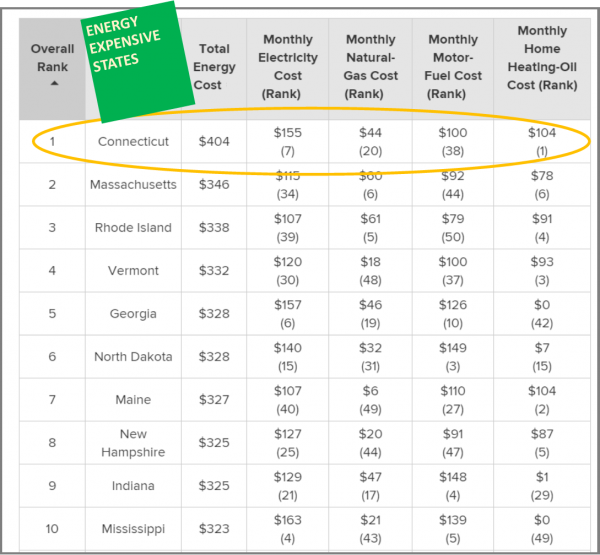
With an average monthly energy bill of $404 per consumer, Connecticut is the most energy expensive state in the nation, according to a new analysis. Using a formula that accounts for residential energy sources including electricity, natural gas, motor fuel and home heating oil, analysts at WalletHub compared the average monthly energy bills in each of the 50 states and the District of Columbia.  Connecticut ranked at the top of the list, with other New England states close behind.  The 10 most expensive states in the analysis, after Connecticut, were Massachusetts, Rhode Island, Vermont, Georgia, North Dakota, Maine, New Hampshire, Indiana and Mississippi.  Among the least expensive energy states for consumers were Oregon, Colorado and Washington, where the average monthly energy bill was $218.

top tenThe monthly consumer costs in Connecticut average $155 for electricity, $104 for home heating oil, $100 for motor fuel and $44 for natural gas.

Connecticut ranked third in the price of home heating oil and second highest in the nation for home heating oil consumption per consumer, for an overall ranking as highest in the nation for home heating oil costs.

Regarding electricity consumption, as a relatively small state, Connecticut ranked 37th.  However, for the price of electricity it ranked third, for an overall ranking of seventh when the two stats were combined for the overall Monthly Electricity Cost category.

"Constacknecticut ranked as the most energy expensive state mainly due to its high retail prices for energy,” analyst Jill Gonzalez told CT by the Numbers.  “The state has the third highest retail price for electricity and heating oil at $0.20 per kWh and almost $4 per gallon, respectively. Natural gas isn't cheap either, ranking 14th highest, at $14 per thousand cubic feet. These prices paired with high heating consumption in the winter months put Connecticut on top of these rankings."

The website notes that energy costs account for between 5 and 22 percent of families’ total after-tax income, with the poorest Americans, or 25 million households, paying the highest of that range.

Sources used to create the rankings, according to WalletHub, were collected from the U.S. Energy Information Administration, Federal Highway Administration, Environmental Protection Agency (EPA) and AAA’s Daily Fuel Gauge Report.

The report was issued this month, as July typically produces the highest energy bills for consumers.


Hartford’s Innovation, Manufacturing History Highlighted in Exhibits at Smithsonian and State Capitol

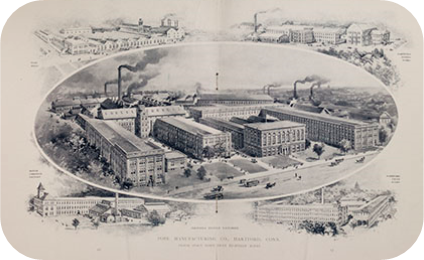
On Wednesday, July 13, the Smithsonian Institution’s National Museum of American History will make public a special portion of their collection with “Objects Out of Storage: Hartford, CT.”  The special exhibit, led by curator Susan Tolbert and historian Eric Hinz, will take place at noontime in the Lemelson Center for the Study of Invention and Innovation in the nation’s Capitol.banner-POI-sign-ET2015-4379_1 Describing Hartford’s prominent manufacturing history, Hinz said “Hartford, CT, is a classic story in the history of American technology. If you have ever wondered why people refer to “Yankee ingenuity,” this is what they are talking about.”  He adds, “In the mid and late 1800s, the United States overtakes Great Britain as the world’s foremost economic superpower, largely on the strength of its prowess in inventing and manufacturing new technologies. Hartford is at the center of that revolution.”
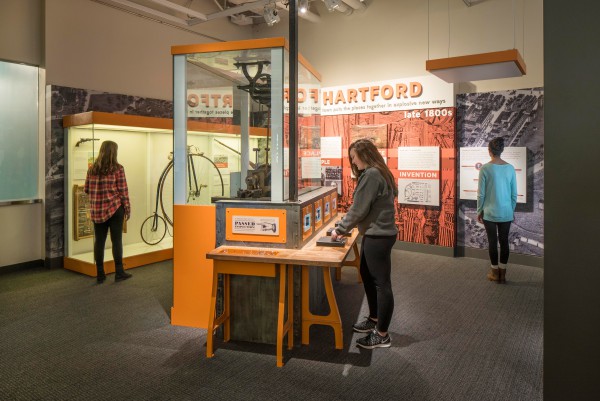
Hartford, described as “one of the birthplaces of American mass production,” is well represented in the ongoing exhibit, Places of Invention, which “takes visitors on a journey through time and place to meet people who lived, worked, played, collaborated, adapted, took risks, solved problems, and sometimes failed—all in the pursuit of something new.”

HartfordThe exhibit notes that by the 1850’s “Hartford became the center of production for a wide array of products—including firearms by Colt, Richard Gatling and John Browning; Weed sewing machines; Royal and Underwood typewriters; Columbia bicycles; and even Pope automobiles.”lemelson

The Lemelson Center is located at the Smithsonian's National Museum of American History, Constitution Avenue between 12th and 14th Street NW, in Washington, DC. The Lemelson Hall of Invention and Innovation is located on the Museum's first floor in its Innovation Wing. In the exhibit, which debuted  last summer, Hartford is featured with Silicon Valley and just four other locations: Hollywood, home of Technicolor; the Medical Alley of Minnesota, where cardiac innovations of the 1950s flourished; the Bronx, N.Y., birthplace of hip-hop in the 1970s; and the current, clean-energy innovations of Ft. Collins, Colo.

Among the featured innovations on display is the bicycle, manufactured for the first time in the United States in Hartford.  As the Smithsonian historian explains, “sensing a commercial opportunity, Albert Pope began importing bicycles from England and hatched a plan to produce them domestically in 1877. Within a year, Pope rode the train from Boston to Hartford, then, ‘to the amazement of the city’s onlookers, plantrode his high-wheeler from the station down Capitol Avenue to the Weed Sewing Machine Company.’”

The history continues: “Pope approached factory superintendent George Fairfield with a proposal: would Weed agree to build a test run of 50 bicycles under contract? When Fairfield agreed, Pope (via the Weed Sewing Machine Company) became the first domestic manufacturer of bicycles in the United States. By 1895, Pope’s expanded Hartford operations included five factories set on 17 acres, employing 4,000 workers, making him Hartford’s largest employer.” Pope manufactured bicycles, motorcycles, and automobiles.

That chapter in Hartford history has recently captured the imagination of a well-known Hartford artist, whose cut-paper recreations of that chapter of the city’s transportation and recreation breakthrough is now available for display, having just completed an exhibition at the Connecticut State Capitol.

IMG_0185Jeanne Manzelli, a resident of Windsor, has a IMG_0176BFA in Sculpture from the Massachusetts College of Art and her MED in Art Education from the University of Massachusetts, Amherst. Her experience includes a 20 year career in design, manufacture, appraisal and sale of jewelry, two decades as mural artist working closely with interior designers as an industry professional, and 14 years teaching basic and advanced drawing, sculpture and 3D design as well as color theory at Tunxis Community College.

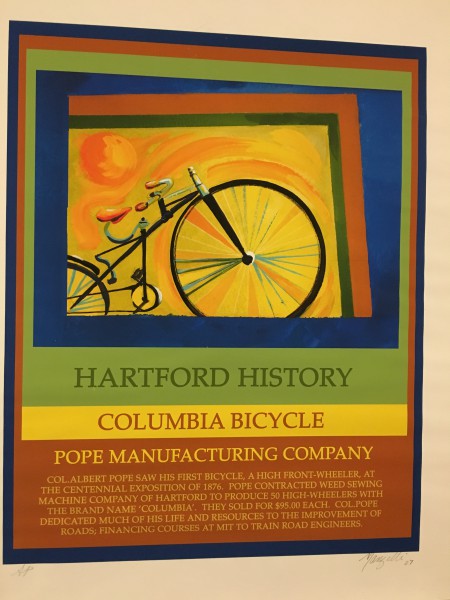
Her latest endeavor is a departure, and a salute to an innovation from a century and a half ago. The intricate designs, accompanied by information panels highlighting the history, are now available to be displayed at public facilities, such as schools, libraries, and community centers.  Manzelli looks forward to sharing her work (and is seeking a sponsor to underwrite the exhibit), as well as stimulating a conversation about innovation in Hartford, then and now.

IMG_0196

Best Bargain for Retirees? Waterbury Ranks 10th in the USA

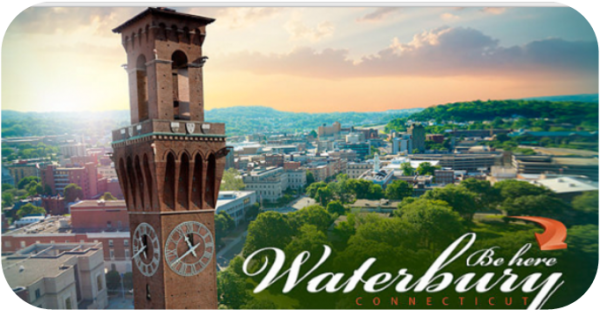
Headed towards retirement?  Keep Waterbury in mind.  A new ranking of the best bargains for retirees has the Brass City holding down the final slot on the top ten list.  The list, developed by the website GO Banking Rates and running on the CBS Moneywatch website, ranks Waterbury as the 10th best town in the country for retirees. waterbury imageThe site said of Waterbury: “Waterbury is in New Haven County on the Naugatuck River, close to Hartford and New York City. Waterbury has a colonial history with historic houses, and the downtown is clean and has many trees. You will find art and cultural events, and great health care facilities.”

A 2015 report by the Government Accountability Office found that about half of households led by people ages 55 and older have no retirement savings at all. Among households with retirement savings, the median amount of those savings is just $104,000 for households ages 55-64, and $148,000 for households ages 65-74. Such modest savings make it difficult to keep up with expenses during retirement. Americans 65 years of age or older average nearly $44,686 in annual expenses, according to the Bureau of Labor Statistics.

And Waterbury, apparently, can make those dollars go further.  The GOBankingRates website ranking considered several local factorretireess, including:

  • Housing — rental prices for a one-bedroom apartment, rounded to nearest dollar.
  • Percentage of retirees — in the local population as of April 1, 2010.
  • Walkability — scores ranging from 25 for Montgomery, Ala., to 65 for Allentown, Pa.
  • Safety factors — scores ranging from 6 for Rochester, N.Y., and Louisville, Ky., to 30 for Boise, Idaho.

Each city was given a weighting for each of the criterion and was ranked based on the overall score.  The top 20:

  1. Boise, Idaho
  2. El Paso, Texas
  3. Allentown, PA
  4. Grand Rapids, MI
  5. Champaign, IL
  6. Charlottesville, VA
  7. Lincoln, NE
  8. Bloomington, IN
  9. Cedar Rapids, IA
  10. Waterbury, CT
  11. Colorado Springs, CO
  12. Missoula, MT
  13. Rochester, NY
  14. Greensboro, NC
  15. Fort Worth, TX
  16. Billings, MT
  17. Phoenix, AZ
  18. Lexington, KY
  19. Omaha, NB
  20. Columbus, OH

The City of Waterbury’s website highlights “the sense of neighborhood identity and pride is so important that Waterbury has some of the most active neighborhood associations in the state.”  The site explains that “their efforts focus on protecting the small-town character and livability of their communities as they plan neighborhood block parties, concerts and beautification projects.  And with over twenty distinct and diverse neighborhoods-- many with their own commercial center, park, school, and sports associations-- there is truly a place for everyone in Waterbury.  These well-preserved and diverse neighborhoods are often recognized as one of the city's greatest assets.”

The original settlement of Waterbury – the 9th largest city in New England - dates back to 1674 and the city's name is reference to its proximity to the Naugatuck River and its many tributaries which flow through the heart of the city.


https://youtu.be/4MZDO2vFPjA

New Haven to Host Regional Economic Development Conference for Northeast

Each year, the Northeastern Economic Developers Association convenes a conference of practitioners and thinkers from throughout the region who learn and do business together. For the organization’s 60th annual conference this fall, the selected theme of “Transportation at the Crossroads” is designed “to help us bring a big idea to life - increasing economic self-sufficiency and vibrancy for citizens, businesses and communities.” The city selected to host the landmark event is New Haven. “We are broadly defining transportation to include moving people, cargo and data,” explain conference organizers of the event, expected to bring more than 250 professionals in a range of economic development areas to the September 11-13 conference.   new haven conf

NEDA will offer sessions in New Haven in the priority topic areas related to the transportation theme - a broad array of program topics, professional tools and networking opportunities that will provide high value to conference attendees.

Who is expected to attend?  Organizers anticipate community planners; representatives of banks, specialty lenders and investors; Chambers of Commerce leaders; developers; economic development organizations and consultants; engineering service firms; entrepreneurs; municipal planners, place-makers; policy makers; transportation planners and implementers; and federal, state, regional and local government representatives.

Keynote speakers include state and federal officials, including Governor Malloy; state Economic and Community Development Commissioner Catherine Smith; Transportation Commissioner James Redeker; Alissa DeJonge, Vice President of Research for the Connecticut Economic Resource Center; and New Haven Mayor Toni Harp.   In addition, former Gov. Parris N. Glendening of Maryland, President of Smart Growth America’s Leadership Institute and the Governors’ Institute on Community Design, a technical assistance program run in partnership with the EPA-DOT Partnership for Sustainable Communities and Smart Growth America, will address the conference, as will Congressman Bill Shuster, Chairman of the U.S. House Transportation and Infrastructure Committee.map

The conference will also recognize outstanding initiatives throughout the region, including the Project of the Year, Program of the Year, Educator of the Year, Member of the Year, and a series of marketing awards in categories including branding, marketing and promotion, and economic development content.  Nominations must be submitted (by NEDA members) by June 24.

Through NEDA membership, economic development practitioners, officials, and volunteer leaders develop and perfect their development tools, network with others in the field, and partner regionally to do the work of economic development, according to organization officials.

The NEDA “core philosophy” will be reflected in the conference sessions.  It reads “We believe economic development is inseparably intertwined with both community development and the leveraging of community assets to drive change. By forming collaborative partnerships with organizations pursuing goals similar to ours, local resources are maximized and the foundation for community sustainability is established from local stakeholders and small businesses committed to their common future.”

NEDA members “build stronger economies throughout the Northeastern United States,” including Connecticut, Delaware, Maine, Massachusetts, Maryland, New Hampshire, New Jersey, New York, Pennsylvania, Rhode Island, and Vermont, as well as the District of Columbia.

https://youtu.be/iphybn4GS8U

Most Valuable States in America: Connecticut Ranks #3

A recent study estimates that the combined value of all land in the contiguous United States is worth nearly $23 trillion. The most valuable state, according to the survey, is California, which accounted for 17 percent of the total value of the 48 bordering states. New Jersey, however, had the most valuable real estate relative to its size, estimated at $196,400 per acre, or 16 times the average value per acre across the contiguous U.S. Connecticut ranked third overall.  Although the third smallest state in the country, containing just over 3 million acres, Connecticut is also one of just four states where land is valued at over $100,000 per acre on average. By contrast, the estimated value of an average acre across the country is just over $12,000.

The study, authored by William Larson, senior economist at the Federal Housing Finance Agency and previously at the Bureau of Economic Analysis, estimated the value of different property types, including agricultural areas, federal land, and developed suburban and urban areas.  The study is featured on the website 24/7 Wall St.

States with generally larger rural areas tended to have a lower value relative to their size, while more densely populated states that contain large urban centers had the highest estimated worth per acre. The value of Connecticut’s land is reflected in the higher cost of a house in the state. The typical house is worth $267,200, compared to a national median home value of $181,200, according to the analysis.connecticut-state-map

Key data for Connecticut includes:

  • Value of land per acre: $128,824
  • Total value: $400 billion (18th highest)
  • Total acres: 3.1 million (3rd lowest)
  • Percent land mass rural: 62.3% (4th lowest)

The top 10 “most valuable” states:  New Jersey, Rhode Island, Connecticut, Massachusetts, Maryland, Delaware, New York, California, Ohio, and Pennsylvania.  Next are Florida, Michigan, Illinois, Virginia, New Hampshire, South Carolina, Indiana, Washington, North Carolina and Tennessee.

valuableThe analysis points out that the type of land in a given area has a significant impact on its worth. Agricultural and other largely undeveloped areas are generally worth significantly less than cities and suburbs land.  Developed land, or land where housing, roads, and other structures are located, is valued at an estimated $106,000 per acre, while undeveloped land was estimated at $6,500 per acre, and farmland at only $2,000 per acre, according to the analysis.


That said, the analysis notes that it is not surprising that most of the states with the highest per acre land values are predominantly urban, such as New Jersey, Rhode Island, Connecticut, and Massachusetts. These Northeastern states are smaller and have less rural acreage “to bring the average value down.”  The data reflects that the six most valuable states were also among the 10 smallest states by landmass. In New Jersey, for example, 39.7 percent of the area is considered urban, compared to a national urban share of just 3 percent.

The entirety of Delaware is worth just $72 billion, the second smallest total value compared to the other states in the lower 48, the analysis notes. On a per acre basis, however, the state is valued at $57,692 on average, the sixth highest in the country. Just behind Delaware is New York, with more than 30 million acres worth $41,314 each, on average. In total, the Empire State’s acreage is worth $1.25 trillion, based on the analysis. Because of the large rural areas in the state, the analysis explains, less than 10 percent of New York’s total area is considered developed. However, that developed property is so valuable it accounts for roughly two-thirds of the state’s total value.247logo_clear

All 10 of the states with the largest proportions of federally-owned land are west of Kansas, reflecting the way in large swaths of that land entered the United States at various junctures in U.S. history.   The Louisiana Purchase and the conclusion of the Mexican-American War left considerable areas across the western United States in the hands of the federal government.

While less than 25 percent of all land in the lower 48 states is owned by the federal government, in Nevada, as one prime example, the third least valuable state by acre, 86.8 percent is federal, the highest share in the country.  As a result, western states with a lot of federal land tend to have lower average values per acre. More than 30 percent of land in nine of the 15 “least valuable” states was federally-owned as of 2009.

AMA Policy, UConn Professor Raise Concerns About Municipal Conversions to LED Lighting

An article authored by UConn professor of Community Medicine and Health Care Richard G. Stevens, which highlights red flags being raised by the American Medical Association regarding the safety of LED lighting being installed in cities around the country, is gaining notice.  The article first appeared on an international website, theconversation.com, which features articles researched and written by college faculty from the U.S. and around the world.  The site’s tagline, “Academic rigor, journalistic flair,” reflects its approach.  The article has since been re-published on the CNN website, and it gaining traction on dozens of other internet sites. The article revolves around a policy statement issued by the AMA this month that suggests “conversions to improper LED technology can have adverse consequences.” Stevens, who has written about the health risks of electric lighting for more than two decades,  indicates that the policy statement comes "in response to the rise of new LED street lighting sweeping the country.” ama-logo

The new "white" LED street lighting which is rapidly being retrofitted in cities throughout the country has two problems, according to the AMA, Stevens highlights. “The first is discomfort and glare. Because LED light is so concentrated and has high blue content, it can cause severe glare, resulting in pupillary constriction in the eyes. Blue light scatters more in the human eye than the longer wavelengths of yellow and red, and sufficient levels can damage the retina. This can cause problems seeing clearly for safe driving or walking at night.” The AMA goes on to point out that blue-rich LED lighting can decrease visual acuity and safety, resulting in concerns and creating a road hazard.

tresser__elm_led_st_lts1In addition to its impact on drivers, the AMA notes that blue-rich LED streetlights operate at a wavelength that most adversely suppresses melatonin during night. It is estimated that white LED lamps have five times greater impact on circadian sleep rhythms than conventional street lamps, the AMA indicated. Recent large surveys, according to the AMA, found that brighter residential nighttime lighting is associated with reduced sleep times, dissatisfaction with sleep quality, excessive sleepiness, impaired daytime functioning and obesity.


The AMA points out that “converting conventional street light to energy efficient LED lighting leads to cost and energy savings, and a lower reliance on fossil-based fuels. Approximately 10 percent of existing U.S. street lighting has been converted to solid state LED technology, with efforts underway to accelerate this conversion.”

Although no comprehensive list is available, among the communities in Connecticut making the switch to LED lighting are Stamford, Plainville, East Hartford, Southington, and Berlin, according to published reports. Cheshire launched a streetlight replacement program earlier this year, indicating that “the new LED fixtures will provide the appropriate amount of lighting for locations across the town and will focus light directly downward on the sidewalks and roadway.  The fixtures have a ten-year product warranty, but are anticipated to have a much longer life. The project is expected to be completed in July 2016.”

"Despite the energy efficiency benefits, some LED lights are harmful when used as street lighting," AMA Board Member Maya A. Babu, M.D., M.B.A. "The new AMA guidance encourages proper attention to optimal design and engineering features when converting to LED lighting that minimize detrimental health and environmental effects."

The AMA encourages communities to minimize and control blue-rich environmental lighting by using the lowest emission of blue light possible to reduce glare. Stevens, however, says that “the AMA's recommendation for CCT below 3000K is not quite enough to be sure that blue light is minimized. The actual spectral irradiance of the LED -- the relative amounts of each of the colors produced -- should be considered, as well.”

Stevens concludes that “there is almost never a completely satisfactory solution to a complex problem. We must have lighting at night, not only in our homes and businesses, but also outdoors on our streets. The need for energy efficiency is serious, but so too is minimizing human risk from bad lighting, both due to glare and to circadian disruption. LED technology can optimize both when properly designed.”replacement

The Hartford Courant reported last year that ESCO Energy Services is working with the Connecticut Conference of Municipalities to implement its municipal Street Light LED Conversion Program to buy the current streetlights from utilities and replace them with more efficient LED fixtures.

Stevens proposed in 1987 what was then seen as a radical new theory that use of electric lighting, resulting in lighted nights, might produce "circadian disruption" causing changes in the hormones relevant to breast cancer risk, according to the UConn Health website. Accumulating evidence has generally supported the idea, the site indicates, and it has received wide scientific and public attention. For example, his work has been featured on the covers of the popular weekly Science News (October 17, 1998) and the scientific journal Cancer Research (July 15, 1996). His most recent paper, “Shift work as a harbinger of the toll taken by electric lighting,” was published in Chronobiology International, The Journal of Biological and Medical Rhythm Research, in January 2016.

TheConversationLogo_smallerThe Conversation website is a collaboration between editors and academics to provide "informed news analysis and commentary that’s free to read and republish." It launched as a pilot project in the U.S. in October 2014 after starting in Australia in March 2011 and​ the UK in May 2013. Boston University’s College of Communication is are hosting the operation in the U.S.

140206225605-01-los-angeles-led-horizontal-large-galleryPHOTO:  Traditional street lighting (left) vs. LED lighting (right).


Enforcement Hold Lifted, FCC Will Now Consider License Renewal Application of WTIC-AM, Pending for Two Years

Just days after a federal appeals court upheld former Gov. John G. Rowland’s conviction for violating federal campaign laws, the Federal Communications Commission lifted an enforcement hold on WTIC-AM's license renewal. At the time that Rowland was accused of secretly accepting pay as a political consultant, he was also an afternoon radio host on WTIC-AM. His use of the airwaves in order to favor the candidate, Lisa Wilson-Foley, whose spouse was paying Rowland at the time, was raised during his trial.

The FCC is now “in a position to consider the objections that have been filed regarding the renewal application,”  an agency official told CT by the Numbers.  There is no timetable for that review, which is just beginning now that the agency’s enforcement hold has been “lifted,” or for a final decision on the station’s license renewal application.fcc-logo

The station’s broadcast license expired almost 27 months ago, on April 1, 2014.  In accordance with FCC procedures, the station filed a license renewal application on November 27, 2013.  By September 2014, the FCC’s enforcement division placed the renewal application on “enforcement hold,” which precluded any action by the agency on the renewal.

The station, owned by CBS Radio, could continue broadcasting while the FCC held the renewal application. Stations in such a status routinely continue to operate without any interruption until a decision on license renewal is made.

Even as the station remained on the air, the license renewal has been in limbo. As the agency’s Enforcement Bureau considered “an alleged violation of FCC rules,” the agency’s Media Bureau could not proceed with a decision on whether or not to renew the station’s broadcast license, typically an 8-year renewal.WTIC-AM-2

The FCC has not provided the reason that the license application was put on hold.  FCC officials have indicated that most often enforcement holds are instituted due to a complaint being filed that requires investigation, but they would not confirm whether that was true in this instance.  That information is only made available to the licensee or their attorney, according to an FCC official.

Now that the license renewal application has reached the agency’s Media Bureau, they will consider “how the allegation of violation was resolved,” as well as a range of other factors in deciding whether or not to renew the station’s license.  The other, more routine, factors include whether any other objections have been raised about the station, whether the station has been adequately serving the public in their area of license, their history of compliance with FCC regulations, and their overall performance.

Hartford Attorney Ken Krayeske filed an informal objection on October 1, 2014 to WTIC’s broadcast license renewal, alleging that the station “demonstrated serious malfeasance” and “helped conceal violations of federal law.”  The FCC has confirmed the receipt of that objection.

Rowland resigned from his drive-time talk show on WTIC-AM in April 2014.  The station currently airs a locally-originated sports talk program in that time slot. The FCC had no comment on whether the now more than two-year delay in making a determination on the license renewal is among the longest in FCC history.

Bridgeport-Based Wholesome Wave Receives $500,000 USDA Grant to Increase Food Access in Hartford and Vermont

The announcement of the second round of funding for the U.S. Department of Agriculture’s Food Insecurity Nutrition Incentive (FINI) Program, included the selection of national nonprofit Wholesome Wave to receive nearly $500,000 designated to increase affordable access to healthy food in Hartford, Connecticut, and the Northeast Kingdom of Vermont (the northeast corner of the state, comprising Essex, Orleans and Caledonia counties). The funds will flow through an innovative Farm-to-Grocery Nutrition Incentive model, which funds coupons for fresh fruits and vegetables that match the value of SNAP spent at participating grocery stores and increases locally-grown food those stores procure from nearby farmers.farmer

Combined with an additional $500,000 from other funding sources, this project will amount to a $1 million investment in Connecticut and Vermont’s local food economies, according to Wholesome Wave.

Wholesome Wave plans to work with two community nonprofits, Hartford Food System and Green Mountain Farm to School, and eight local grocery stores, to help an estimated 5,000 people purchase more fresh produce. Participating stores will purchase approximately $122,000 worth of regional produce from nearby farmers in Connecticut and Vermont.

The USDA award to Wholesome Wave was one of only 15 community-based initiatives across the country to be selected to receive multi-year grants.  The project is expected to trigger $920,000 in SNAP and incentive purchases in its first three years, officials project.  Overall, the initiative is aimed at  increasing food access for low-income residents, supporting grocery stores as healthy food providers, strengthening local economies, and driving revenue to nearby farms.

WWLogoFinal_gacrop_fullgreen_nat-01“Wholesome Wave is thrilled by the innovations that USDA is supporting through the new FINI grants, which are taking the work of increasing affordable access to healthy food to even greater levels of impact,” said Michel Nischan, CEO & Founder of Wholesome Wave. “So many SNAP shoppers are working parents with limited time to source healthier food choices. Through the new Farm-to-Grocery model, our partners in Connecticut and Vermont will be able to expand affordable access to SNAP consumers in a way that allows them to find and purchase more healthy food from a variety of retailers.”

The areas selected both face high levels of poverty and are home to farmers seeking new markets for their healthful crops, according to Wholesome Wave.  They point out that 40 percent of Hartford’s children live in poverty and 42 percent of the city’s residents use SNAP, formerly known as food stamps.

In the first iterations of healthy food incentives – which also match the value of SNAP spent – Wholesome Wave worked with local partners to offer them at farmers markets. By expanding healthy food incentives to grocery stores where many families already shop, this project is designed to offer a promising solution to each community’s food access challenges.

Wholesome Wave’s expertise in facilitating and scaling successful food access projects, combined with the local nonprofits’ experience within the communities, represents an ideal partnership to move this work forward, according to the organization.

This project builds on Wholesome Wave’s existing work across 40 states, including expansion through the large-scale FINI grant received last year, a $3.77 million grant from the USDA through the new Food Insecurity Nutrition Incentive (FINI) grant program.   Wholesome Wave began in Bridgeport in 2008; a 501(c)(3) nonprofit that strives to create a vibrant, just and sustainable food system. By making fresh, locally grown fruits and vegetables affordable and available, it enables underserved consumers to make healthier food choices.

In particular, this year’s FINI grant expands on the successes of Wholesome Wave’s and partners’ efforts to pilot nutrition incentives in grocery stores in Connecticut and Vermont.

In the first few months of 2016, Wholesome Wave invested in the Hartford food system by providing SNAP consumers with $23,000 in nutrition incentives to spend on fresh fruits and vegetables at two locally-owned grocery stores. During the program period, attributable at least in part to this project, SNAP sales at the local C-Town supermarket increased 7 percent and produce sales increased by 19 percent over the same period in 2015. USDA+Logo_wides

Executive Director of Hartford Food System, Martha Page, said: “As demonstrated in the pilot program, the SNAP Up! nutrition incentives are an excellent way to get more fresh fruits and vegetables on Hartford dinner tables. The enthusiastic response to the incentives by Hartford SNAP participants clearly shows that there is a demand for affordable, high quality produce.  For our local farmers, this will represent a new customer base that they have not been able to easily access. We are so excited at the opportunity to bring Hartford area farmers and Hartford consumers together; we believe that we will prove that good food is good business!”

National leaders emphasize how this new model will benefit their state’s economies, while increasing access to produce for low-income residents and improving the bottom line for regional farmers.

“Increasing access to fresh, healthy food for the low-income residents of food deserts will help move our communities one step closer to ending food insecurity. The federal funding awarded to Bridgeport’s Wholesome Wave to help provide fresh produce to Hartford’s local grocers is an investment in an incredible partnership that will help ensure the well-being and health of Hartford’s residents,” said U.S. Sen. Richard Blumenthal.WW-300x274

“Just a few days ago, I was at Hartford Regional Market talking to local farmers and Hartford community leaders about better connecting local food to city grocery stores,” recalled U.S. Sen. Chris Murphy. “This grant for Wholesome Wave is a great opportunity to make that happen. It just makes sense—we should help families afford locally-grown, fresh food at the grocery stores they already shop at. We worked so hard to get North Hartford its Promise Zone designation so that the city can hop to the front of the line when it comes to getting federal grants. This shows why that’s so important.”

“Food deserts correlate very highly with areas of poverty across our country, and a lack of healthy and affordable food options can have a very detrimental effect, especially on children,” said U.S. Rep. Jim Himes, who represents the Congressional District that includes Bridgeport. “With this grant, we will be able to help more families eat nutritiously in Hartford and also support the excellent work that Wholesome Wave is doing right here in Bridgeport, creating innovative ways to bring healthy, local produce into more stores and kitchens.”

In the initiative, neighborhood grocery stores will become access points for fresh local produce, and experience increased revenues. Beyond direct impact to the community, Wholesome Wave expects to use this project in the two states to develop a replicable Farm-to-Grocery Nutrition Incentive model that the organization hopes can spread nationally through their national network of over 110 organizations in 40 states – including 12 in Connecticut - with the promise of impact on a national scale.

The second-round USDA funding award to Wholesome Wave, announced this month, is for $499,720.  The programs in Hartford and Vermont’s Northeast Kingdom are expected to launch in August.


https://youtu.be/BU0sOg9GhWA