

Report Outlines Responses to Opioid Emergency as Numbers Climb
/It’s official. The opioid crisis has grown from a national crisis to a national emergency. That fact is plainly evident than in Connecticut. The national Centers for Disease Control and Prevention (CDC) estimates there are enough opioid prescriptions for every American adult to have their own bottle. Connecticut saw 729 deaths from drug overdoses two years ago, and 917 last year. Published reports suggest that the number is trending towards a thousand deaths in the state this year.
In 2012, Connecticut was ranked 50th in the nation in opioid deaths, with just 2 per 100,000 people. By 2015, that number spiked 5-and-a-half times, and Connecticut's ranking climbed to 12th.The latest numbers from the Office of the Chief State's Medical Examiner show the trend continued in 2016, with a 21 percent increase in deaths involving opioids in a year.
According to the National Center for Health Statistics, the first three quarters of 2016 brought an average overdose death rate of 19.3 per 100,000 population — a rate that’s 17 percent higher than during the same period in 2015. If 2016’s rate holds steady through the final quarter — data for it isn’t yet available — it is anticipated that more than 62,300 people will have died of overdoses in the United States in 2016. For Connecticut, however, last year’s numbers were more than 25 deaths per 100,000 - significantly higher than the national average.
A 28-page policy report produced this year by the Governing Institute found that Baltimore, Washington, Ohio, Massachusetts and Pennsylvania “serve as models for other states to jump start their efforts,” to respond to the opioid crises.
The addictive nature of opioids and overprescribing are fueling the epidemic, the Governing report explains, pointing out that “in the last 15 years, the number of opioids prescribed and sold in the U.S. has quadrupled, even though the amount of pain Americans report is the same.”
“The most important thing for policymakers to remember is this epidemic is a multi-faceted that requires multifaceted policy solutions,” the report, “A Crisis: A Practical Guide for Policymakers to Mitigate the Opioid Epidemic,” concluded.
A report released last week from a national commission led by New Jersey Gov. Chris Christie noted that number of deaths is approaching 142 each day from drug overdoses across the country – a death toll that is "equal to September 11th every three weeks," AP reported.
State medical examiner James Gill said in May that his office sees at least two or three overdose deaths a day, and as many as five or six. The state budget crisis has kept the state’s Chief Medical Examiner’s Office from releasing quarterly data for this year, WTNH reported this month.
“There is no single spot on the continuum of interventions that is the magic bullet,” explained Ohio’s director of the Department of Mental Health and Addiction Services in the Governing Institute report. “Really you just have to take it piece by piece.”
 The report noted that “Medicaid beneficiaries are prescribed opioids at twice the rate of the rest of the population, and research indicates they are at 3 to 6 times greater risk of a fatal overdose.” The report also observed the impact of the epidemic on the nation’s prison population: Eighty percent of prisoners have a history of drug abuse; 50 percent are addicted to drugs; 60 to 80 percent of prisoners abusing drugs commit a new crime after release; and approximately 95 percent of addicted prisoners relapse when they’re released, according to National Association of Drug Court Professionals (NADCP) data.
In 2016, the Connecticut General Assembly passed a law that prohibits a prescribing practitioner authorized to prescribe an opioid drug from issuing a prescription for more than a seven-day supply to (1) a minor or (2) an adult for first-time outpatient use (PA 16-43). That timeframe was tightened further under legislation signed into law last month. The 2016 law included an exception if the prescriber, in his or her professional judgment, determines a longer prescription is necessary, OLR noted.
In June, Gov. Malloy signed a bill that has as a key component reducing the maximum opioid drug prescription for minors from seven to five days. It was introduced by Malloy at the beginning of session and passed unanimously through the Senate and House. The bill also increases security on controlled substance prescriptions by requiring scheduled drugs to be prescribed only electronically, which officials believe will cut back on the potential for prescription forgeries. And it requires increased data-sharing between state agencies regarding opioid abuse and overdose deaths.
Attorney General George Jepsen’s office recently announced it would be joining a multistate probe into the marketing practices of opioid drugmakers. Jepsen did not specify any companies by name, citing “the ongoing and sensitive nature of the investigation.”
Connecticut law allows various health care providers to prescribe opioids and opioid antagonists within their professional scope of practice, including physicians, APRNs, dentists, nurse-midwives, optometrists, PAs, podiatrists, and veterinarians, according to the Office of Legislative Research. Pharmacists can prescribe opioid antagonists if they receive a special certification and training to do so.

 For example, almost a quarter (23%) of Connecticut workers in science, technology, engineering, and math fields such as healthcare and bioscience were immigrants. Over 36,000 foreign-born Connecticut residents are self-employed, with immigrant-owned businesses generating $1.1 billion income in 2014 while employing 73,047 people. “Immigrants are already playing a huge part ensuring that Connecticut remains a leading innovator in industries like healthcare and bioscience,” according to the analysis.


 In May, Jepsen announced that Connecticut joined with 46 other states and the District of Columbia in an $18.5 million settlement with the Target Corporation to resolve the states' investigation into the retail company's 2013 data breach. The settlement represented the largest multistate data breach settlement achieved to date. That breach affected more than 41 million customer payment card accounts and contact information for more than 60 million customers. Connecticut will receive $1,012,936 from the settlement, which will be deposited in the state's General Fund.


 Tesla is prohibited from selling directly in Connecticut, Michigan, Texas, and West Virginia, according to the company. There are about 1,300 Teslas registered in Connecticut, nearly two-thirds of the electric vehicles in the state, according to the state Department of Motor Vehicles.
 For the uninitiated, an

 Put most succinctly, the website headlines, “Everyone should have access to science.” Towards that end, they’re in the midst of enlisting “a group of scientists dedicated to making science accessible to everyone,” by forming the “Massive Science Consortium.”


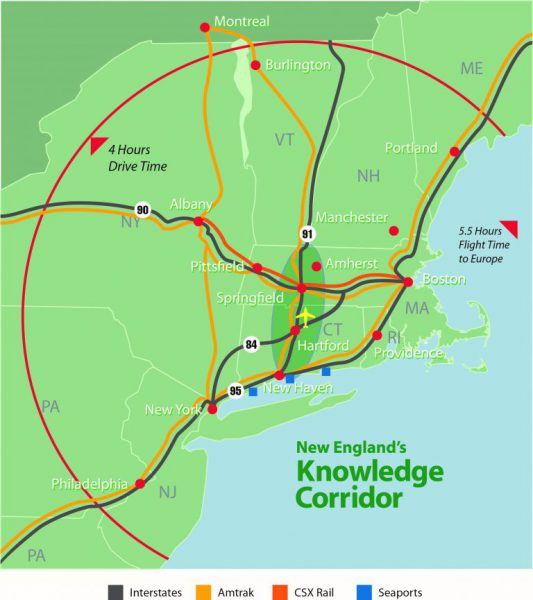
 The Hartford Line will act as a regional link with connections to existing rail services, including Metro-North, Shoreline East, and Amtrak Acela high-speed rail services on both the New Haven Line to New York and on the Northeast Corridor to New London and Boston. There will also be direct bus connections to the Bradley Airport Flyer and to CTfastrak. With a heightened level of direct and connecting service linking the region, the hope is that towns along the future Hartford Line will become magnets for growth – ideal places to live and to relocate businesses that depend on regional markets and travel.
 Also, very much a part of the strengthening transportation options with the potential to spur economic development is
 Webster earned the highest score of any Northeast-based banks and ranked seventh overall in the United States. People’s United ranked at number 11. The annual survey measures U.S consumers' perceptions of major bank brands.


 y. Perhaps more tellingly, over 30% received "strong" ratings from non-customers, versus zero in last year's survey.


 A sweeping mandate for these manufacturers to cover all labor and replacement costs associated with warranty claims would have led to higher prices, they explain, along with weakened consumer protections, and fewer products available to consumers. The legislation would have also required manufacturers to address warranty claims within 30 days’ receipt of a claim – which industry officials say would have been “an unreasonable timeframe” to comply with.





















