New Haven Chamber Recognizes Business Success Stories, Starting with "Juice"

The annual Greater New Haven Chamber of Commerce awards luncheon on Thursday, September 28  will celebrate the diverse accomplishments of members of the region’s business community – including an entrepreneurial business with the “juice” to grow from a home-based start-up in Wallingford to employ more than 120 people in New Haven in less than a decade. The company - FreshBev LLC - produces two primary lines of beverages - RIPE Craft Juice and RIPE Craft Bar Juices, bringing real fresh juice to the market, and connecting local farmers to consumers by using only ingredients that could be traced back to the grower and region.

“We don’t heat our juice, we don’t pasteurize it. It’s cold-pressed,” founder Michel Boissy told NewsChannel 8 earlier this year. “We use an amazing new technology called high-pressure processing, which does everything that pasteurization does minus the heat. So we’re not heating the juice, we’re not killing the color, flavor, aroma, nutritional profile and all of what fresh juice is.”

The company’s website explains that “In the fall of 2008, tired of being subjected to the big ol’ bottle of day glow “margarita” mix, childhood friends and founders Michel Boissy and Ryan Guimond came to the conclusion that they had no choice but to create the first line of legit, handcrafted bar juices. With Mike's experience in high end kitchens and behind the bar, coupled with Ryan’s picky palate and a shared love of a good cocktail, these drink mix mercenaries set forth to create the nation's first pure squeezed, cold pressed, Bar Juice™.
The results are making local history, and spreading.  RIPE Craft Juices are available nationally through Whole Foods and select regional grocery chains.

The Chamber’s business leadership event is highlighted by the presentation of the Community Leadership Award to an individual who has made an outstanding contribution to the Greater New Haven Community.   That award will go to longtime Quinnipiac University President John Lahey, who has announced his retirement.  The other awards to be presented by the Greater New Haven Chamber of Commerce include:

Small Business Achievement Award  Four Flours Baking Company

Legislative Leadership Award   First Selectman Mike Freda, Town of North Haven

Achievement in Manufacturing Award  Cowles & Company

Leadership in Healthcare Award  Cornell Scott-Hill Center

Community Partnership Award  Easter Seals Goodwill Industries

Developer Investment Award  Randy Salvatore, RMS Companies

Alumnus of the Leadership Center Award  Paul Bartosic, Harvard Pilgrim Health Care

Volunteer of the Year Award  Mary Grande, New Reach

The awards will be presented on September 28 at the Omni Hotel in New Haven.


https://youtu.be/X56KIS8TEd0

Personal Finance, Economic Education Curriculum Not Required in State's Schools

Connecticut has a curriculum for financial literacy for schools in the state.  But they’re not required to use it.  That’s true for economic education and personal finance education.  Despite having a 9-page state approved set of curriculum guidelines and expectations for student learning detailed on the website of the State Department of Education, there appears to be no indication as to where or whether courses are actually offered, taken and taught. Economic Education is included in the state’s K-12 standards in Connecticut, as it is in every state in the nation.  But Connecticut is one of only six states where the standards are not required to be implemented by districts, one of 27 states where a high school course is not required to be offered, one of 30 states where a high school course is not required to be taken, and one of 34 where standardized testing in the subject is not provided.

The numbers are similar for personal finance education.  Connecticut is one of 13 states that does not require standards to be implemented by local school districts, one of 28 states that does not require a high school course to be offered, and one of 28 that do not require a high school course in personal finance education to be taken. Connecticut, like most states (43) does not have standardized testing in personal finance.

That’s according to the Council for Economic Education’s “Survey of the States 2016,” a report on “Economic and Personal Finance Education in Our Nation’s Schools.”  Among the national findings:

  • While more states are implementing standards in personal finance, the number of states that require high school students to take a course in personal finance remains unchanged since 2014 – just 17 states.
  • Only 20 states require high school students to take a course in economics – that’s less than half the country and two fewer states than in 2014.
  • There has been no change in the number of states that require standardized testing of economic concepts – the number remains at 16.

Connecticut’s seven “content standards” in personal finance focus on personal decision making, earning and reporting income, managing finances and budgeting, savings and investing, buying goods and services, banking and financial institutions, and maintaining credit worthiness, borrowing at favorable terms and managing debt.  The “frameworks” outline skills that students are expected to master, and “learner expectations” at various levels, from beginning to advanced.

“Some states offer little guidance to school districts related to what personal finance content to offer in schools at each grade level; others have pushed ahead, requiring courses from elementary to high school aged students, supporting and training teachers, and in some cases even testing students on learning outcomes,” said J. Michael Collins, of the Center for Financial Security at the University of Wisconsin-Madison in the report.

“Rigorous state standards can facilitate local schools to implement well-designed programs, which in turn expose students to concepts they otherwise would not learn. Communities may also benefit from having more financially competent households; perhaps stronger economics and personal finance standards could even be viewed ultimately as an economic development strategy, equipping young people with an increased ability to manage credit and invest in their future,” Collins added.

Statistics were not available in Connecticut on the number of school districts requiring financial literacy coursework, or the number of students who take such classes.

"States that combine personal finance and economics, support teachers, and hold students accountable for learning objectives have the best chance of promoting the development of young people who are better financial managers and stewards of their credit—behaviors with which many, if not most, young people tend to struggle," Collins pointed out.

The Council for Economic Education (CEE) is a leading nonprofit organization in the United States that focuses on the economic and education of students from kindergarten through high school.  The 65 year-old organization is based in New York City.


CT Ranked 36th in Construction Jobs Added During Past Year

Connecticut ranked 36th in the nation in the number of construction jobs added between July 2016 and July 2017, one of 36 states (and the District of Columbia) that added construction jobs during the 12-month period. The analysis by the Associated General Contractors of America of Labor Department data found that firms in parts of the country that build infrastructure projects are seeing less demand for their services amid overall declines in public-sector spending. Only 100 construction jobs were added in Connecticut during the past year, moving the states employment level in construction industries from 58,800 to 58,900, reflecting growth of two-tenths of one percent.

“Despite growing private-sector demand, it appears that construction employment in some parts of the country is being brought down by declining public-sector investments,” said Ken Simonson, chief economist for the association.  “Some of these declines will be offset thanks to recently enacted state infrastructure funding increases, but stagnant federal investments are not helping.”

Among the New England states, Rhode Island ranked third in the nation, with a 12-month gain of 12.7 percent, New Hampshire ranked fourth with 11.8 percent growth in construction jobs, and Maine ranked sixth, with a 9.3 percent increase.

California added the most construction jobs (51,000 jobs, 6.6 percent) during the past year. Other states adding a high number of new construction jobs for the past 12 months include Florida (35,800 jobs, 7.5 percent); Louisiana (13,900 jobs, 9.8 percent); Oregon (11,900 jobs, 13.2 percent) and Texas (10,400 jobs, 1.5 percent). Oregon added the highest percentage of new construction jobs during the past year, followed by Nevada (12.8 percent, 9,700 jobs).

Thirteen states and the District of Columbia shed construction jobs between July 2016 and July 2017 while construction employment was unchanged in North Dakota. Iowa lost the highest number of construction jobs  (-4,400 jobs, -5.4 percent), followed by Illinois (-4,300 jobs, -2.0 percent) and North Carolina (-2,500 jobs, -1.2 percent).  South Dakota lost the highest percentage for the year (-5.6 percent, -1,400 jobs) followed by Iowa and Mississippi (-3.9 percent, -1,700 jobs).

Association officials have continued to urge Congress and the administration to make needed new investments in the country’s aging infrastructure to offset declining public-sector investments in construction. In particular, they urged officials to consider including new infrastructure investments as part of a tax reform measures expected this fall, the association indicated in a news release.

PEZ Dispenser and Whiffle Ball Named Finalists for National Toy Hall of Fame

Two Connecticut natives are being considered for induction into the National Toy Hall of Fame.  The Strong National Museum of Play in Rochester, N.Y. has announced its twelve finalists for this year’s induction into the National Toy Hall of Fame, and the Wiffle Ball – invented and still manufactured in Shelton –  and the PEZ Candy Dispenser  - still the pride of Orange - are among them. The Strong’s National Toy Hall of Fame in Rochester, New York, announced the 12 finalists for induction into the hall: Clue, Magic 8 Ball, Matchbox Cars, My Little Pony, paper airplane, PEZ Candy Dispenser, play food, Risk, sand, Transformers, Uno, and Wiffle Ball.

EZ emerged first as a breath mint in 1927, but in 1948, the creators turned it into a candy and added a small, mechanical box to dispense the PEZ bricks. The dispensers featured pop-culture characters, making them both a plaything and collectible. PEZ sells three billion individuals candies each year and keeps about 60 or 70 dispensers in production—such as Batman, Mickey Mouse, and Wonder Woman.

PEZ Candy is manufactured in Orange, Connecticut by PEZ CANDY, INC. and marketed through supermarkets, mass merchandisers, variety stores, drug stores, convenience stores, toy chains and gift stores throughout the U.S. and Canada; available around the world in more than 80 countries.

Whiffle ball? It all began in the summer of 1953, when David N. Mullany, grandfather of the current company owners (brothers David and Stephen) was watching his 12 year old son and a friend play a game in their backyard in Fairfield, using a perforated plastic golf ball and a broomstick handle. They had given up on baseball and softball – not enough players for two teams, not enough space for a field, and too many broken windows.

After some trial and error, Wiffle Ball’s inventors determined that a ball with eight oblong slots cut into one hemisphere worked best at grabbing the air and diverting the trajectory. Pitchers then could easily throw curves, sliders, or even difficult knuckle balls, and the rest is history – perhaps Hall of Fame worthy history. Even with the abundance of toys and rapidly expanding new technology available to today’s youth, the Wiffle Ball business remains strong, with millions manufactured in Shelton and distributed world-wide every year.

The National Toy Hall of Fame receives thousands of nominations annually. Whiffle Ball was nominated, but not selected, in 2015.  The final 2017 toy inductees, chosen on the advice of a national selection advisory committee, will be announced at The Strong museum on Thursday, November 9.  Only two or three of these finalists will join other iconic toys in the hall and sit alongside past inductees such as Barbie, LEGO, Monopoly, Rubik’s Cube, and Star Wars action figures.

The Strong’s National Toy Hall of Fame recognizes toys that have engaged and delighted multiple generations, inspiring them to learn, create, and discover through play. Criteria for induction include: Icon-status (the toy is widely recognized, respected, and remembered); Longevity (the toy is more than a passing fad and has enjoyed popularity over multiple generations); Discovery (the toy fosters learning, creativity, or discovery through play); and Innovation (the toy profoundly changed play or toy design).

To date, the following 63 toys have been inducted into the National Toy Hall of Fame: alphabet blocks, Atari 2600 Game System, baby doll, ball, Barbie, bicycle, Big Wheel, blanket, bubbles, Candy Land, cardboard box, checkers, chess, Crayola Crayons, dollhouse, dominoes, Duncan Yo-Yo, Dungeons & Dragons, Easy-Bake Oven, Erector Set, Etch A Sketch, Fisher-Price Little People, Frisbee, G.I. Joe, The Game of Life, Hot Wheels, hula hoop, jack-in-the-box, jacks, jigsaw puzzle, jump rope, kite, LEGO, Lincoln Logs, Lionel Trains, little green army men, marbles, Monopoly, Mr. Potato Head, Nintendo Game Boy, Play-Doh, playing cards, puppet, Radio Flyer Wagon, Raggedy Ann and Andy, rocking horse, roller skates, rubber duck, Rubik’s Cube, Scrabble, Silly Putty, skateboard, Slinky, Star Wars action figures, stick, Super Soaker, swing, teddy bear, Tinkertoy, Tonka Trucks, Twister, and View-Master.

New Haven's “SeeClickFix” Selected by National Mag, Set to Host User Summit as Hurricane Residents Use Service

When Fast Company magazine developed a feature article entitled “United States of Innovation” for its most recent issue, they selected one business in each state to highlight.  Connecticut’s representative was SeeClickFix, a New Haven-based business that began a decade ago with a basic premise and has expanded steadily since. As Fast Company described it:  “A Help Desk for Citizens – New Haven resident Ben Berkowitz created the SeeClickFix app to allow locals to quickly report non-emergency issues (broken meters and streetlights, potholes, and even excessive noise from ice-cream trucks).  Officials can track, manage and reply within the app.  It has since expanded to some 300 municipalities across the country.”

There have been a total of more than 3 million “issues fixed” according to the SeeClickFix website, in communities including Chicago, Minneapolis, St. Petersburg, Detroit, Oakland, Albany, Albuquerque, Washington, D.C. Of particular interest this during the past two weeks - SeeClickFix in numerous Florida communities, and in Houston.

In the aftermath of Hurricane Harvey, the efforts with Houston instantly intensified.  Berkowitz said SeeClickFix has worked with the city of Houston and several of its neighboring suburbs since 2009, handling an estimated 30,000 residents.  Those numbers will likely jump when the totals for 2017 are tallied.  Berkowitz told CTNewsJunkie that will be especially true in the coming weeks as operations shift from emergency calls handled by police and other emergency personnel to calls that are SeeClickFix specialties, such as power outages, downed trees and other types of “more routine” assistance.
In Florida, St. Petersburg is among the 10 communities with SeeClickFix in operation, and the site is filled with reports of downed trees, storm debris, broken water mains, non-working street lights, and other hazards, with many accompanied by photos illustrating the danger or dilemma.  Other communities include Pinellas County (which includes Clearwater), Seminole, Gainsville, and Venice, which signed on a year ago.

The company’s website continues to proudly boast “Made in New Haven” and Berkowitz’ company profile explains “The inspiration for SeeClickFix came from a desire to improve his own community with his neighbors and his government.”

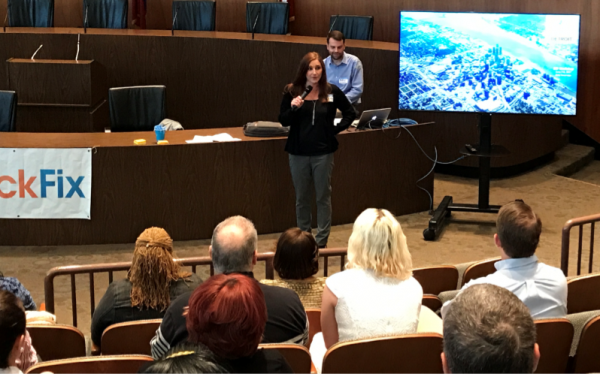
Even before the hurricane in Houston this year, the company's growth has continued, with the first city in Kentucky signing on recently, and communities in Georgia and Michigan also added.  A workshop, with municipal attendees from more than 80 communities, was held in Detroit.  Next, a SeeClickFix User Summit is scheduled for September 13 & 14 in New Haven.

Fast Company summed up “50 projects that are really making America great again” noting that “Change doesn’t have to happen from the top down” as the publication highlights “some of the most promising projects, initiatives, and companies that are springing up in every state of the union. Together, they present a portrait of the country today—its concerns and responses, and its enduring capacity for progress.”



State’s Money Woes Earn National Spotlight

The cover of the national magazine depicts a waterfront home in Mystic Seaport, under the headline that reads “The fiscal mess in America’s richest state.”  Connecticut, without an approved state budget for all of July and August and nearly half of September, is earning some notice.  And it is not particularly friendly. The article, in the September issue of Governing, begins with the question, “How could the nation’s wealthiest state become a fiscal basket case?”  The answer is complex, and the magazine devotes a full six pages to walking through how the state got into this mess, and how it might navigate its way out.

Along the way, the magazine suggest that the state “may be too rich for its own good,” pointing out that “long blessed with a disproportionate number of high-income residents, the state has entertained lavish spending habits for decades.” It also cites statistics that underscore the problems and challenges:

  • Over the past 20 years, job creation numbers have ranked in the bottom five among the 50 states
  • Connecticut has the nation’s second-highest rate of income inequality, after New York
  • The state has lost population for three years running
  • Last year, Greater Hartford ranked fourth and New Haven fifth in population loss among the nation’s 100 largest metro areas

The ineffective state spending cap, approved by voters more than 20 years ago but routinely circumvented since, is cited as a contributor to the fiscal cliff the state sits on, along with an overreliance on the income tax, political infighting, increased taxes, the lack of regionalism and a host of other decisions made by Governors and legislatures for decades.

One glaring example cited:  “Connecticut, which is home to 3.6 million people, has 111 police dispatch centers.  By comparison, Houston, which as 2.3 million residents, has just one emergency dispatch center, which handles fire as well as police.”

With a circulation of 85,000 in print and a widely viewed website, Governing is described as "the nation's leading media platform covering politics, policy and management for state and local government leaders." It is among the most widely read and most influential among government leaders - with an audience that also includes "journalists, academics, advocates and activists."

The article did point to some silver linings, past and present.  “Connecticut clearly has the means to change course. Not only is its median income still high, but the state boasts assets such as proximity to Boston and New York, amiable coastlines and river valleys, and notable institutions of higher education.  In addition to the continuing presence of a thriving financial sector, Connecticut is home to aerospace and defense contractors and other advanced manufacturers who can’t hire help fast enough, as well as a growing medical and life sciences sector.”

On the other hand, the publication points out, “Connecticut is 80 percent white, but its population of white children under the age of 10 is falling faster than in any other state.  Racial and ethnic minorities already make up more than 50 percent of infants and toddlers and are about to become a majority of 3- and 4-year olds.”  There is, the publication adds, “a pronounced achievement gap among racial groups and by geography.”

The conclusion reached by the Governing article?  “Connecticut is not in a death spiral but it has failed to position itself to react to changing demographics and location preferences… it’s clear that what’s worked so well for Connecticut in the past isn’t working now.”

Summed up House Speaker Joe Aresimowicz, one of many political leaders, including the Governor and legislators from both political parties, as well as city officials and economic analysts, who were interviewed for the article: “We are the land of steady habits and the world has changed around us.”

NY Settlement with Outlet Mall Owner Eliminates Non-Compete Extending into Southwestern Connecticut

Most Connecticut residents are likely unfamiliar with Woodbury Common, an outlet mall in the town of Central Valley in Orange County, New York brimming with 240-plus retailers.  Due to a contract provision with those retailers that prevented them from opening another location within a 60 mile radius of Woodbury Common, however, the impact of that mall may have been felt throughout southwestern Connecticut for decades. A settlement in pending litigation reached between the New York Attorney General’s Office and Simon Property Group (SPG), owner of Woodbury Common, and announced late last month, could open the door to new retail outlet opportunities in Southern and Western Connecticut – regions that had long been under the restrictions.

"No business should be allowed to stifle an entire industry at the expense of consumers—but for years, that's exactly what Simon Property Group did to New Yorkers," said New York Attorney General Schneiderman. "Simon's anticompetitive conduct blocked competition and drove up prices for New York consumers. That ends today. I am pleased this agreement will allow for new shopping outlets to finally open within New York City, and make affordable shopping more accessible for residents across the region."

While Schneiderman focused on New York, the possible consumer benefits from the agreement extend further.  The region under the now-eliminated restrictions extends beyond New York into Connecticut, including much of Fairfield County – including Norwalk, Stamford, Danbury and Bridgeport - and extending nearly into New Haven.  (The straight line distance from Central Valley, NY to New Haven is 62 miles; to Milford is 55 miles.)

In a press release, Simon said Woodbury Common's 60 mile radius provision has been used since 1985, well before SPG acquired Woodbury Common as part of its 2004 acquisition of Chelsea Property Group. The statement pointed out that Woodbury's radius provisions have been upheld as lawful, reasonable and consistent with industry practice in the courts, as recent as 2010.

“While we have agreed to reduce the reach of the radius provisions in Woodbury Common leases, these provisions will continue to cover Woodbury Common's essential trade area, extending to all of Manhattan,” the company noted.

Simon Property Group described Woodbury Common as “an economic engine for Orange County, the lower Hudson Valley, and New York State,” indicating that “it regularly granted exceptions to radius provisions and understands the importance of competition and consumer choice in the market.”  In Connecticut, SPG operates two properties in southeastern Connecticut - Clinton Crossing Premium Outlet in Clinton and Crystal Mall in Waterford.

Reached via the New York State Thruway at exit 16 in Harriman, Woodbury Common Premium Outlets features “the most sought after, high-end fashion and designer retail brands in the world,” SPG said in its news release, highlighting stores including Tory Burch, Nike, Celine, Bottega Veneta, Polo Ralph Lauren, Michael Kors, Burberry, Coach, and The North Face.

As part of the settlement, Simon Property agreed to revise their existing leases with Woodbury Common retailers to remove the radius restrictions; not to engage in exclusionary tactics, including radius restrictions, for the next 10 years; and pay a $945,000 fine to New York State.

Even as negotiations proceeded on the settlement, Woodbury Common announced last month that 10 new retailers would be opening at the premium outlet mall, including Zadig & Voltaire, a high-end French ready-to-wear brand, and Sayki, a Turkish menswear designer.  The outlet mall also recently completed extensive multi-million dollar renovations. Simon Property Group, based in Indianapolis, owns nearly 100 outlet malls around the world and is an S&P 100 company.

Women in Manufacturing Bring Summit to Hartford Next Week

The 800-member Women in Manufacturing (WiM) professional organization will hold their annual Summit at the Connecticut Convention Center in Hartford, September 13 - 15, 2017. This annual Summit is geared toward women who have chosen careers in manufacturing and want to share perspectives and network with others in the industry. It is expected to attract more than 300 professional women in manufacturing, with titles ranging from production to CEO. Attracting hundreds of women in manufacturing from across the country, WiM's annual Summit is the only national conference of its kind. This networking and educational event features manufacturing plant tours, professional development tracks, industry roundtables, keynote presentations and social events to expand participants' networks.

Plant tours that have been organized as part of the conference agenda include visits to Kaman Corporation, CNC Software, Hartford Flavor Company, TRUMPF Inc., and Pratt & Whitney, all on the opening day of the conference on September 13.

Break-out sessions will focus on Technology, Leadership & Professional Development, Operational Excellence, and Diversity & Inclusion.  Speakers at conference-wide sessions will discuss topics including “Engineering Young Women,” “Developing Your Personal Brand,” “Recruiting A Pipeline for Skilled Labor Positions,” “Empowering Women Through Sales,” and “The growing Digital Intensity of Manufacturing.”

Speakers will include Jonna Gerken, Manager, PCME Group, Pratt & Whitney and the president of the Society of Women Engineers, and George Saiz, President & CEO of The Association for Manufacturing Excellence.

The Board Chair of Women in Manufacturing is Sheila LaMothe, Vice President of Strategic Initiatives for Goyer Management International, a Florida-based company.  Previously, she spent 15 years responsible for the marketing and public relations activities for TRUMPF Inc. in Farmington, CT, initially serving as Marketing Manager before becoming Associate Director of Marketing & Public Relations. She founded the WiM Connecticut Chapter and served as chapter chair until her relocation to Florida.

Among the host committee members is the Connecticut Business and Industry Association.  The New Haven Manufacturers Association and the Waterbury Regional Chamber’s Manufacturer’s Council are among the Supporting Partners for the Summit.
This is the organization’s first summit to be held in the Northeast.  The Summit location moves around the country giving attendees the opportunity to experience manufacturing and develop their networks throughout the United States.  The  6th annual summit was held last year in Nashville, TN.  Previous events were held in Minneapolis, MN; Schaumburg, IL; Dearborn, MI; Milwaukee, WI; and Cleveland, OH.

How Connected is Connecticut? State Ranks 6th in the USA

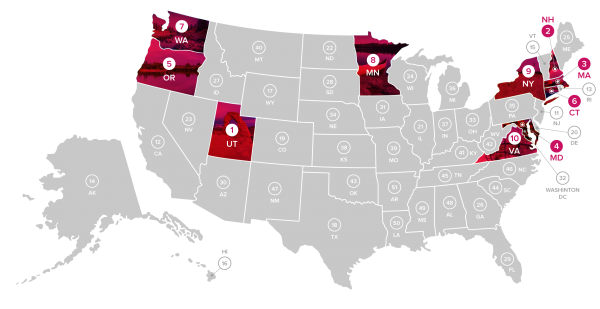
Internet access is as good in Connecticut as just about anywhere else in the country.  A new report on the Top Connected States in America ranks Connecticut as the 6th most connected state in the nation. The analysis, by USDish.com, found that the top 10 states showing excellent connectivity to broadband all value connecting rural citizens to the resources they need to succeed economically, both in school and at work. “Overall we found that the most important factor in these states’ ability to connect rural citizens to the internet were the use of government funded broadband task forces, infrastructure maintenance, and local support. The states that listened to the community were more likely to connect them to proper resources and economic growth flourished.”

While Connecticut ranked 6th overall, the state’s ranking varied in each of the categories of the analysis:  Connecticut ranked 10th in Access, 1st in Rural Access, 12th in Speed, and 21st in Support (by government).

Analysts compiled and ranked the report using data from the American Community Survey, conducted by the U.S. Census Bureau, the EducationSuperHighway non-profit, Fastmetrics, the National Conference of State Legislatures (NCSL) and the Institute for Local Self-Reliance.

Connecticut ranked 10th in Access, 1st in Rural Access, 12th in Speed, and 21st in Support.  The top five states for Rural Access were all in the Northeast – Connecticut, Massachusetts, New Hampshire, New Jersey, and Rhode Island. “Perhaps the emphasis on education and communication makes it easier to access the internet as a student, even in a rural area like Connecticut,” the analysis stated.

The analysis points out that a main reason why people don’t have access to broadband internet is due to a lack of income. Cited is a Pew Research poll that found 23 percent of people making under $30,000 per year don’t use the internet, possibly because of the high price for something they don’t consider a basic need. Most rural schools across the country still lack access to fiber and pay more than twice as much for bandwidth.

In contrast, Minnesota, New Hampshire, Oregon, and Maryland all have state government broadband task forces which promote the expansion of internet access throughout their rural areas, the analysis points out.

For internet access per state, the USDish team analyzed the percentage of school districts meeting a minimum of 100 Kbps per student.  They also examined the percentage of those with an internet subscription, and the total percentage of users with any access to the internet at all, be it in the form of a community library, town hall, or school.

Speed was analyzed by the average Mbps per state, and they evaluated states on whether they had a stimulus project, broadband task force, or whether the state had barriers preventing them from expanding the connectivity of those living in the area (i.e. laws, infrastructure support, prohibitions, etc.). As for rural area access, data on the number of households that had broadband internet in both urban and rural areas was used.  USDish.com is an authorized retailer of DISH Network.

Former CT Sportscaster Handling Weather Reporting Duties During Hurricane in Houston

Khambrel Marshall, who once delivered the evening sports news on Hartford’s Channel 3, has accomplished the rare broadcast trifecta – he has been a sports anchor, news anchor, and weather reporter during his career – all in some of the nation’s largest media markets.  It is a career with heightened visibility in recent days, as a Hurricane Harvey barrelled in on Houston, where Marshall is an on-air member of the NBC affiliate’s “Severe Weather” team, as well as the host of a weekly public affairs program on KPRC-TV. Joining the WFSB sports team in 1980 at age 27, Marshall spend five years at channel 3, moving from the nation’s number 23 TV market to number 13 when he relocated to Miami in 1985.  At the time, he became the first black sports anchor in South Florida, according to published reports.  He had received his broadcasting degree from Arizona State University while working in his first job in television as weekend sports anchor in Phoenix, prior to arriving in Hartford. He remained in sports until news captured his attention while he was sports director in Miami and was called upon to anchor during Hurricane Andrew.

In a 1980 interview published in Hartford Sports Extra, Marshall said “I’m an honest person.  And I have a great rapport with people.”  That has been evident at each stop in his career, because, Marshall explained three decades ago, “I like to rub elbows. I really like to meet the folks.”  He was one of 12 recipients to receive the National Community Service Award from the Westinghouse Corporation and was named "Outstanding Young Floridian" by the Fort Lauderdale Jaycees for his humanitarian efforts in the wake of Hurricane Andrew.

Marshall later joined KPRC in Houston in 1999 as a news anchor after 13 years in Miami.  He left the air in 2006 to accept a producer's position.  He then returned as a member of the station’s "Severe Weather Team."  He also airs a weekly public affairs program, Houston Newsmakers, that airs on Sunday mornings, just after Meet the Press.   He is approaching his 2oth anniversary at the Texas station, just a couple of years away.

A self-proclaimed "weather geek" since high school, he earned his Broadcast Meteorology Certification from Mississippi State University – after his broadcasting career was already underway.  Living through and reporting on Hurricane Andrew solidified his thirst for meteorological knowledge, specifically tropical weather phenomena.   It is an interest, and experience, that has been on display over the weekend in Houston.

Among his numerous honors is one of broadcasting's top awards, the Emmy, for a feature series titled "Guardians at Sea," chronicling the efforts of the U.S. Coast Guard to rescue Cuban and Haitian refugees crossing the Florida Straits.

He almost came to Hartford two years earlier, after the president of Post Newsweek, then the owner of WFSB, saw him on the air in Phoenix.  The station’s news director got in touch.

“He said the president of Post Newsweek stations saw in Phoenix for a convention or something, saw me on the air, and would like me for the Hartford station.”  Marshall recalled that although he liked Hartford, he decided to stay in Phoenix.  Two years later, after a brief stint in Detroit, Marshall and Hartford connected as he became the sportscaster on the 11 PM newscast, joining a team led by veteran sportscaster Dave Smith.

Marshall has made his mark supporting local nonprofit organizations in addition to his on-air work.  He supports Big Brothers Big Sisters, and was March of Dimes Texas Communications volunteer of the year twice.  He is a past Chairman of the Executive Committee of Big Brothers Big Sisters of Southeast Texas, and recent board member of Collaborative for Children.  In addition, he is a Senior Fellow in the "American Leadership Forum: Houston/Gulf Coast Chapter." The intense ALF one-year program is designed to join and strengthen diverse leaders in the community to better serve the public good.  Marshall was married in 1979 – just months before landing at WFSB in Hartford - to his wife Debbie, and they have two daughters.