Occupational Illnesses Remain High in Connecticut, Report Finds

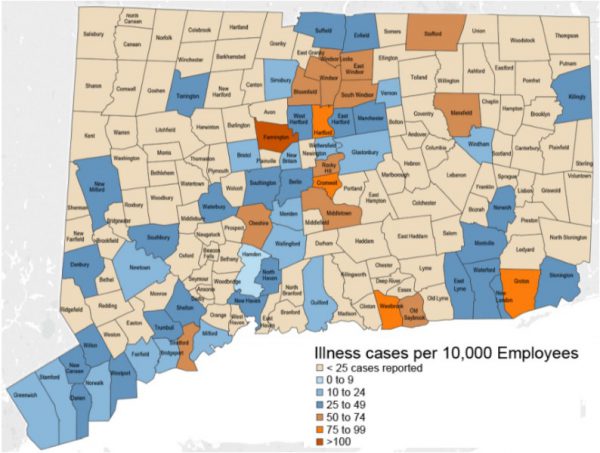
Occupational illnesses remain a serious and under-reported issue in Connecticut, with a rate 6 percent higher than the national average, according to a new report issued by UConn Health.  The latest data shows a reporting of over 7,500 occupational illnesses, with up to an estimated 25,000 cases going unreported. The highest number of cases reported were in Farmington, Hartford and Cromwell. The newly published Occupational Disease in Connecticut, 2018 report examined the latest 1997-2016 data, based on reports of individuals filing for workers’ compensation, physician reports to the Occupational Injury and Illness Surveillance System, and the ConnOSHA/BLS survey of employers.

Connecticut’s illness rate ranked 15th highest out of 41 states with publishable data (fourteen states had higher rates and 26 had lower rates). Maine had the highest rate of 38.8 and Texas had the lowest at 9.8. Private sector rates for occupational illness were 15.0 in Connecticut and 14.1 nationally. Connecticut’s public sector rate was 35.7; the U.S. public sector rate was 31.6, according to the report.
The Connecticut data revealed reports of 7,675 unique occupational illnesses.  Most frequent were 3,430 musculoskeletal cases (such as sprains, Carpal Tunnel Syndrome, and tendonitis), and 2,408 infectious diseases (such as bloodborne diseases and exposures, meningitis, and Lyme Disease).  In addition, the data indicated there were 431 respiratory illnesses (such as chemical exposures, asthma, and poisonings), 313 skin disorders (such as poison ivy and chemical dermatitis), 115 cases of hearing loss, and 978 “other illnesses” (such as heart conditions, stress, and dizziness).

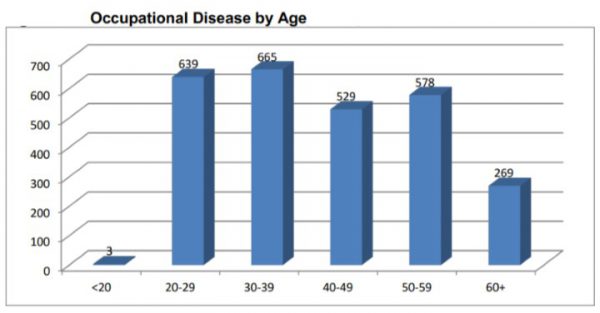
The OSHA/BLS survey shows a rate of 17.4 cases per 10,000 workers in Connecticut, 6 percent higher than the national rate of 16.4. The report focuses on chronic job-related illnesses, and does not include acute traumatic injuries. Overall, approximately 49% were for women, but this varied by type of case, with women accounting for 66% of infectious cases. Based on workers’ compensation reports of occupational illnesses, there were similar proportions (between 20%-25%) for workers in their 20’s, 30’s, 40’s and 50’s.

Rates of occupational illnesses varied widely across Connecticut towns and cities. Based on workers’ compensation reports from towns with at least 25 cases, the 10 highest rates were found in Farmington (126 cases per 10,000 workers - almost 4 times the rate as the state average), Hartford (89), Cromwell (89), Groton (85), Westbrook (84), Windsor Locks (73), East Windsor (63), Cheshire (61), Stratford (60), and Middletown (58). The town average across the state was 33 cases per 10,000 workers.
These higher town rates often reflect the locations of large employers in higher hazard industries, and may also reflect better reporting of cases, since cases of occupational illness are often not reported, the study points out.

Based on workers’ compensation reports, the highest rates of occupational illnesses were found in the industries of beverage and tobacco product manufacturing (170 cases per 10,000 workers), computer and electronic product manufacturing (131), primary metal manufacturing (112), state government (103), local government (81), transportation equipment manufacturing (59), electrical equipment manufacturing (57), miscellaneous retail stores (51), fabricated metal product manufacturing (49), and hospitals (46).

The highest specific sector rate, according to the report, was State Government with 41.8, with the highest rates for skin conditions (17.7) and lung conditions (7.9).  Local Government was second with 32.1, and Utilities third highest rate with 31.8.

Each year the report is prepared for the Connecticut Workers’ Compensation Commission by occupational and environmental health expert Tim Morse, professor emeritus at UConn Health. The 53-page report is part of the Occupational Injury and Illness Surveillance System, a cooperative effort of the Connecticut Workers’ Compensation Commission, the Connecticut Department of Public Health, and the Connecticut Labor Department.
The system is designed to track occurrences of work-related disease, with an eye to understanding patterns and developing approaches to prevent occupational illness.

“We must take stronger actions to improve the employee work safety experience and environment, with improvements in ergonomics, safe needle devices in health care, reducing mold and increasing fresh air flow in indoor environments, providing education on toxic chemicals, and increasing the recognition of such hazards as poison ivy,” Morse told UConn Today.

Morse and UConn Health researchers analyze survey responses and occupational illness reports from the State Labor Department/Bureau of Labor Statistics (BLS) survey; the first reports of injury to the Connecticut Workers Compensation Commission; and health provider reports to the Connecticut Departments of Labor and Public Health under the Occupational Illnesses and Injury Surveillance System.

Want to Live at the Mall? It Could Happen – in Trumbull

The Westfield Trumbull mall’s unusual request for a zoning change that would allow it to build 290 apartments on its 76-acre site may be the harbinger of things to come for suburban malls.  The plan was the subject last month of a Trumbull Planning & Zoning Commission hearing; a final decision is pending. The 290 units are planned to be one or two-bedroom apartments, with the opportunity to rent a garage and/or a storage space. The buildings will be on slabs, four stories high, with elevator access. Developers are hoping for a clubhouse, with a gym and common meeting room, and a pool.

The units would be marketed to professionals, young couples and older couples looking to stay in Trumbull, but not in a single-family home.  The plan is a trimmed down version of a proposal floated in the spring that would have developed 580 units.

Mall housing?  Nina Fuhrman, head of retail strategy at global design company IDEO, noted that “As we see the lines blurring between where you work and where you play and where you live, we’re going to see more residences and office spaces attached to malls.”

Trumbull may provide a glimpse into a trend gaining traction.  In a feature article last May in Business of Fashion, Westfield’s development of mall-adjacent residential properties was described as “a no-brainer because doing so will not only create a revenue stream from rent, but will also increase foot traffic to stores.” Already, Chief Operating Officer Bill Hecht told the publication, “the residential buildings in close proximity to our malls can charge slightly above market rent, because they have access to all our amenities close by.”

Trumbull First Selectman Vicki Tesoro has expressed reservations, encouraged public comment, and kept an open mind. In a public statement, she “expressed an understanding that malls throughout the country are reinventing themselves out of necessity. We, as a town, should work with them to the extent possible in that process. The mall is our largest taxpayer, and its success is a shared goal.”

In Bethesda, Maryland, Westfield plans to close a Sears store at the Westfield Montgomery Mall within the next year and is looking to launch a major mixed-use development on its piece of the property. The first phase, according to a report published by Bisnow, is expected to be completed by 2022, and would create 170K SF of new retail space with 350 to 360 apartments above, plus a health club. After that, Westfield would build an additional 300 units and 130K SF of retail and hotel space.

Jim Agliata, Westfield’s vice president of development, told Bethesda magazine earlier this year that the project represents the next phase of Westfield Montgomery’s emergence as a “lifestyle destination.”

Business Association Launches Campaign Urging Candidates to "Fix Connecticut"

Connecticut’s largest business association is launching a statewide advertising blitz to exert its voice in the political debate in the aftermath of the state’s primaries as the focus turns to the November elections.  CBIA will on focus on raising public awareness of what it describes as the critical issues and challenges impacting the state's economic future and job growth. The campaign, called “Fix Connecticut” will include digital, broadcast, and print advertising and will run into the 2019 General Assembly session and beyond, officials said.  It includes a website, fixconnecticut.com, and a video that acknowledges some progress made since the 2016 election, noting that "our state's economy is better than it was," but stresses that "we have a long way to go."

“High taxes, job growth, and a sluggish economy are the top concerns for Connecticut residents and must be priorities for lawmakers and candidates for elected office," CBIA president and CEO Joe Brennan said, echoing the video's urging "we need lawmakers that have a plan" to make the state more affordable, cut state spending and "help us compete with other states in the region."

The advertising campaign may also serve as a precursor to anticipated endorsements of candidates by CBIA in statewide and local legislative races.  In 2016, CBIA endorsed candidates in 22 of 36 State Senate races, urging the election of 4 Democrats and 18 Republicans.  There were also endorsements made in 85 of 151 House districts, including 23 Democrat and 62 Republican candidates.  Those endorsements came in mid-September two years ago.

“Lawmakers and candidates must understand what really matters to Connecticut and we want residents to understand how critical these issues are to the state's economic future,” Brennan added.  “We want to make sure those issues are front and center during what we believe is a make-or-break time for Connecticut.

The Fix Connecticut campaign centers on a five-point plan that outlines key policy steps designed to remove barriers to economic growth and leverage the state's many strengths, according to CBIA:

  • Prioritize Economic and Job Growth. Help businesses compete for talent, expand private-public workforce development initiatives, and continue strengthening high school and college programs to meet the needs of our 21st century economy. The best way to solve the state's fiscal problems is to grow the economy.
  • Cut State Spending. Reduce the size and cost of government, privatize appropriate state services, expand the use of non-profit agencies, and put the brakes on spiraling overtime costs.
  • Make Connecticut More Affordable. That starts with lowering taxes. Connecticut's personal income, business, and property tax burden is one of the highest in the country—a key factor behind the state's population decline, including the loss of billions of dollars in income.
  • Reform the State Employment Retirement System. Align state employee compensation and benefits with Northeast states' public sectors and the private sector and end the use of overtime in calculating pensions.
  • Improve Connecticut's Business Climate. Reject costly, burdensome workplace mandates, cut unnecessary red tape, block new taxes and fees that drive up healthcare costs, reform the state's unemployment compensation system, and overhaul transportation infrastructure.

"State lawmakers' actions have a far greater impact on our daily lives, our workplaces, and our economy than decisions that are made at the federal level.  With so much attention on national politics, we cannot lose sight of the critical issues impacting Connecticut,” Brennan pointed out, noting that the campaign will complement CBIA's advocacy efforts during the next legislative session, which begins in January.

https://youtu.be/1UTTqLaVpUI

4 Renowned CT Manufacturers to be Inducted into Hall of Fame; Timex, Cheney Brothers, Farrel, Handy & Harman to be Honored

Timex Group USA (Middlebury), Cheney Brothers (Manchester), Farrel Corporation (Ansonia), and Handy & Harman (Fairfield) will be inducted into the American Manufacturing Hall of Fame in Connecticut this fall, in the fifth annual ceremony. The American Manufacturing Hall of Fame (AMHoF) celebrates the innovative history of American manufacturing, raises funds for educational programs and promotes awareness of advanced manufacturing, which is critical to the economy.

The Hall of Fame is affiliated with the Housatonic Community College (HCC) Foundation in Bridgeport, which also serves as fiduciary.  BlumShapiro will serve as the Founding Platinum Sponsor of the ceremony for the fifth consecutive year. The 2018 AMHoF Induction Ceremony will take place on October 9 at the Trumbull Marriott.

The AMHoF has also announced that Robert Klancko is the recipient of its 2018 Leadership Award. Klancko has been a manufacturing leader in Connecticut’s manufacturing community for several decades. He has been a partner in his consulting firm of Klancko & Klancko LLC, and held key managerial positions for 20 years in the brass industry and another 15 years in the utility industry.

Timex began as the Waterbury Clock Company in 1854, and initially gained success with its dollar pocket watches. Renamed Timex in 1941, the renowned world-wide brand has its headquarters in Middlebury.  Cheney Brothers was a center of the silk industry in the late 19th and early 20th century in Manchester.  The 175-acre historic district in Manchester, includes over 275 mill buildings, workers houses, churches, schools and Cheney family mansions.

Founded in 1848, Farrel Corporation is based in Ansonia. During the American Civil War, they produced bayonets and cannon barrel.  Today, they manufacture process equipment for the plastics industry, and employ roughly 100 people.  Handy & Harman leveraged an early market advantage in silver bullion through acquisitions to provide not only bullion but alloys and prefabricated silver bands, wires, and moldings, as well as reclamation services to leading jewelers.

Klancko has contributed tirelessly to the field of technical education since 1972. He served as an educator at both the former Hartford Graduate Center and Waterbury State Technical College, and more recently at Mattatuck Community College. More recently, Klancko worked to educate educators in the Materials Manufacturing Summer Teachers' Institute at Southern Connecticut State University. He has also chaired and co-founded Environmental Studies and Materials Technology Advisory Committees at a number of state public and private colleges.

2017 inductees into the American Manufacturing Hall of Fame were Better Packages, MacDermid Performance Solutions, R.C Bigelow, Stanley Black & Decker and Ulbrich Stainless Steels & Specialty Metals. In 2016, the inductees were Bead Industries, The Benedict & Burnham Mfg. Co.; C. Cowles & Co., Chance Vought & Platt Brothers & Co.

The manufacturing firms added to the Hall in 2015 were Bridgeport Brass, Moore Tool, Inc. and Wheeler & Wilson/Singer, from Bridgeport, and A.C. Gilbert, Brewster Carriage and Auto and Sargent Co., from New Haven.  In the inaugural year of the Hall of Fame, the inductees were Bridgeport Machines, Bullard Machine Tool, Hubbell, Inc., Sikorsky Aircraft Corporation and Warner’s.

The American Manufacturing Hall of Fame is comprised of “a group of passionate citizens and manufacturers who believe it is important to appreciate and understand the proud history of American Manufacturing as a catalyst to take advantage of the distinct opportunities that advanced manufacturing can bring to American lives today and in the future.”  It was launched in Bridgeport at HCC, because the city was a “hub of manufacturing leadership and innovation in America for over a century, the organization’s website points out.

The site highlights that the first practical submarine, the first practical carbon electric light bulb filament, the modern automobile assembly line and the first robot all have their roots in, or were invented, in Bridgeport.

Any company engaged in manufacturing for at least ten years can be considered for induction. Companies considered have made “significant contributions to the field of manufacturing either by innovation, the improvement of a manufacturing process or by creating a product that has advanced humankind.”

Founding sponsor BlumShapiro is the largest regional accounting, tax and business advisory firm based in New England. The HCC Foundation was founded in 1990 to provide financial assistance to the College and its students beyond the fundamentals provided by the State of Connecticut.  Tickets to the induction ceremony event are now available.

2017 Was A No-Growth Year for CT Hotel Industry; 2018 Brings Lower Rates

The Connecticut Lodging Association reports that the state’s hotel and lodging occupancy numbers were flat in 2017, with “little to no growth.”  The state’s occupancy numbers have “considerable room to grow” this year, in comparison to the New England Market.  The membership association also notes that one of the traditionally strongest regions of the state, the Stamford market, declined in 2017, while the neighboring New York market remained stable. “The Stamford market historically has the highest occupancy numbers in Connecticut,” officials point out, noting that “with business travel, leisure and New York City overflow, this market is generally stable and measure equal occupancy to New England’s numbers.  That wasn’t true in 2017, and they warn that “Stamford’s declining trend may be a forecast for other Connecticut markets.”

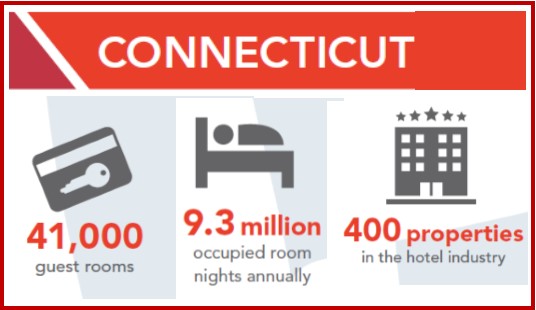
Overall, data for Connecticut compiled by the American Hotel & Lodging Association indicate that the state’s 400 properties in the hotel industry generate 55,000 hospitality jobs and 27,00 hotel hobs, which result in $4.4 billion guest spending at hotels, local businesses and on transportation.  The industry contributes $5.1 billion to GDP.

Connecticut has the highest combined lodging and sales tax in the nation at 15 percent, according to HVS Convention, Sports & Entertainment’s most recent state-by-state study in 2017, one of just five states in double digits along with Maine, Hawaii, Rhode Island and New Jersey.

Adding in local lodgings taxes in many cities nationally — Connecticut law does not allow it — 34 cities have higher combined rates than in Connecticut, HVS determined, none in the Northeast. St. Louis led the nation in 2017 at nearly 18 percent, with New York City highest in the Northeast with a 14.75 percent rate that is only a fraction below that of Connecticut, Hearst newspapers recently reported.

Earlier this month, a survey by BostonHotels.org found that Hartford and Stamford hotels offer the lowest rates for travelers in New England, with hotel stays averaging $107 per night in the Capitol City and $126 in Stamford. Among the other New England cities with low hotel rates are in North Conway, N.H. ($117), Groton ($119), and Lincoln, N.H. ($124).

The survey reviewed hotel rates at 30 popular destinations in New England during August. Hotels in New Haven ranked 19th (most expensive in Connecticut) with rooms averaging $174 a day and Mystic at 21st with rooms costing $168.

The most expensive in New England?  Martha's Vineyard, Mass. ($362), Kennebunkport, Maine ($347), Chatham, Mass. ($324), Portland, Maine ($294) and Provincetown, Mass. ($284). Boston ranked 9th, at $224.


39 CT Companies Among 5,000 Fastest Growing in U.S.: Inc.

A total of 39 Connecticut companies are among the 5,000 fastest-growing private companies in America, according to the 2018 ranking published by Inc. magazine. Leading the way are Southbury-based Current Staffing Solutions (#133), InGenius Prep (#657), a New Haven business, ONE SOURCE Companies of Wallingford (#824) and Votto Vines Importing (#911) headquartered in Hamden. Stamford Technology Solutions (#919) was the only other Connecticut-based company to earn a spot in the top 1000.

Collectively, the companies on this year’s list, according to Inc., amassed $206.2 billion in revenue in 2017, up 158 percent from $79.8 billion in 2014. Last year's list included 34 Connecticut companies.

No company on the 2018 Inc. 5000 list has grown by less than 50 percent over the past three years. To make the even more exclusive Inc. 500 list this year – as one Connecticut business did - a company had to grow by more than 1,000 percent.

Only about 12 percent of American companies achieve one-year revenue growth of 25 percent or more, according to Inc., yet those are the companies that are responsible for half of all jobs created.

Companies on the 2018 Inc. 500 were ranked according to percentage revenue growth from 2014 to 2017. To qualify, companies must have been founded and generating revenue by March 31, 2014. They must be U.S.-based, privately held, for-profit, and independent--not subsidiaries or divisions of other companies--as of December 31, 2017.

Bill Evans is President of Current Staffing Solutions, an industry leader offering a full variety of staffing options.  The company was founded in 2012.  The company website notes that “as a Disability Owned Business, you will find we are not your typical recruiting agency.” Evans was diagnosed with Early Onset Parkinson's Disease.  The company’s 3-year growth, according to Inc.: 2,987 percent.

The goal of InGenius Prep is to “get you in the school of your dreams, and we have a spotless track record.”  The company’s website indicates that the company is led by “Admissions Experts - Former Deans of Admissions and Grads of Top Universities - who will bring your dream schools into reach.”

Among the 39 Connecticut companies, the largest employee growth was at Inspira Marketing, a Norwalk-based “experiential marketing agency that specializes in forging connections between brands and consumers,” which added 631 jobs.  The top revenue generator among the companies based in the Nutmeg state was Carla’s Pasta, with $116.5 million in revenue in 2017.

A total of 24 Connecticut companies earned a slot in the first 3,000: Current Staffing Solutions (133), InGenius Prep (657), ONE SOURCE Companies (824), Votto Vines Importing (911), Stamford Technology Solutions (919), Julia Balfour (1129), Inspira Marketing (1180), MediaCrossing (1189), The Pi Group (1196), GEM Advertising (1258), Port One (1562), Port One (1562), Laurel Road (1801), Alliance All Trades (1919), The Lockwood Group (2042), Health Products For You (2043), Leap the Pond (2333), northeast Private Clint group (2598), The Junkluggers (2743), NEOS (2863), Buyers Edge (2841), Avanta Systems USA, (2897), Charles IT (2934) and i2e Consulting (2975).

The other companies from Connecticut among the top 5,000 are: IMPACT Branding & Design (3127), Metropolitan Interacrtive (3194), Framework Solutions (3216), heartsmart.com (3258), Choice Merchant Solutions (3343), Bizzmark (3693), CME Associates (3745), Kyber Security (3832), Torque Technologies (4451), Carla'sPasta (4567), Frsh Green Light (4596), FCP Euro (4750), Fosina Marketing Group (4840), SCIO Health Analytics (4908), Strategic Sales (4959), and Mediassociates (4979).


(Note:  a previous version of this story inadvertently indicated 59, rather than 39, Connecticut companies, although the list of companies correctly included 39.)


New $1 Coin Series to Be Produced by U.S. Mint; CT’s Himes, Murphy Advocated for Innovation – and CT Company

American innovation is about to be highlighted by the U.S. Mint, but don’t expect to see the results in your loose change. The American Innovation $1 Coin Act will launch the newest numismatic coin program of the United States Mint later this year. The Mint will soon produce and sell $1 collector coins in recognition of American innovation and significant innovation and pioneering efforts of individuals or groups from each of the 50 States, the District of Columbia, and the five U.S. territories.  The new program – passed by Congress and signed into law this year - calls for the minting and issuance of non-circulating American Innovation $1 coins.

The legislation was initially proposed by U.S. Rep. Jim Himes of Connecticut’s 4th District, and in the Senate by Connecticut U.S. Sen. Chris Murphy.

The program’s duration is a 14-year period that begins January 1, 2019.  The coins are to be issued in the order in which the state or territory ratified the Constitution or were admitted to the Union. The law also authorizes a 2018 introductory coin which will be minted and issued in the latter part of this calendar year.

When the bill passed the House, Himes said: “This bill will support jobs and the industry around collectible coins, including here in Connecticut, all without costing taxpayers at all.” Murphy added: “Our country was built on innovation and entrepreneurship, and what better way to celebrate it than through a program that creates jobs and reduces the national debt.”

He noted that the proposed coin series would also support local jobs at Norwalk-based MBI Inc., one of the leading commemorative coin companies in the country.

The introductory coin will bear an obverse common to all coins in the program. It will consist of a likeness of the Statue of Liberty, and the inscriptions of “$1” and “In God We Trust.” The reverse of the introductory coin will be inscribed with “United States of America” and “American Innovators,” and it will include a representation of President George Washington’s signature on the first U.S. patent. The inscription of the year of minting or issuance, mint mark, and “E Pluribus Unum” will be edge-incused into all coins.

American Innovation $1 coins, to be issued at a rate of four new coins per year, will bear a reverse image or images emblematic of a significant innovation, an innovator, or a group of innovators from each of the 50 states, the District of Columbia, and the territories of the United States.  Published reports indicate that the $1 coins would sell for more than face value — up to $1.32 — providing a healthy profit for the federal government since the coins cost less than 35 cents to make.

“Americans tinkering in the shed, programming in the garage, and growing big ideas from humble roots have always had great impact on our economy and future,” added Himes. “We can honor them, inspire a new generation of entrepreneurs and scientists, and help the economy with this coin series.”

MBI markets a wide range of historic coinage, like rare silver dollars and foreign coins from antiquity, according to the company website.  The company also capitalizes on the newly minted designs in circulation, and has already begun marketing the new state innovation dollar series to collectors.  The coins offered by the company, through PCS Coins, would be “protectively encased” in custom-designed “collector panels” prepared for placement in albums.  The coins will also be available from numerous other sources, but will not be issued by the U.S. Mint for general circulation.

The company’s publicity suggests that the Connecticut coin would include a back design honoring the state’s contribution to American Sign Language, but it is unclear if that decision has yet been made.  The company’s coin designs are shown on marketing materials “for illustrative purposes only.”

According to the legislation, the Secretary of the Treasury will select the designs after consultation with each Governor or other chief executive and the U.S. Commission of Fine Arts; and review by the Citizens Coinage Advisory Committee.

Congress created the United States Mint in 1792, and the Mint became part of the Department of the Treasury in 1873. As the Nation’s sole manufacturer of legal tender coinage, the Mint is responsible for producing circulating coinage for the Nation to conduct its trade and commerce. The Mint also produces numismatic products, including proof, uncirculated, and commemorative coins; Congressional Gold Medals; silver and bronze medals; and silver and gold bullion coins. Its numismatic programs are self-sustaining and operate at no cost to taxpayers, according to the Mint.

9 CT Communities Among Nation’s Best to Start Small Business

Nine Connecticut communities are among the best in the nation for starting a small business, according to student loan company LendEdu, which has produced a list of the 500 Best Cities to Start a Small Business in the U.S. Storrs/Mansfield topped the list in Connecticut at 89. Also making the list were Stamford (178), Farmington (214), Windsor (247), Hamden (285), Oxford (387), Westport (477), Cromwell (486) and New Fairfield (493).

Founded in 2014, LendEdu describes itself as a marketplace for private student loans, student loan refinancing, credit cards and personal loans.

The top 10 included three cities in North Dakota, four from Virginia, and cities in Maryland, Colorado and Alabama.  The highest ranked New England community – Canton, MA – was number 49. Storrs-Mansfield was the leading community in Connecticut.

On the population score rankings alone, New Fairfield had the eighth best score in the nation.  On the income score scale, Hamden ranked 29th, highest among the Connecticut communities.  On the Expense scale, Stamford, just outside the top 50, was tops in Connecticut.

Cities were ranked based on the following criteria:

  • Population Score (20 points maximum) – including the daytime population score - the difference in the normal population and the population that is present during standard working day hours – and the population growth score - forecasted population growth over the next five years.
  • ​Income Score (40 points maximum) – consisting of the average disposable income available to residents and forecasted income growth over the next five years.
  • Expense Score (40 points maximum) – which includes consideration of property tax rates, sales tax rates, average cost of utilities, rate of burglaries and property crimes compared to the national averages.

Education, Individual Impact Drive Mission of New Climate Change Center

Former Connecticut Commissioner of Environmental Protection and Administrator of the federal Environmental Protection Agency Gina McCarthy has made the shift from government to academia, with the launch of The Center for Climate, Health, and the Global Environment (C-CHANGE) at the Harvard T.H. Chan School of Public Health. C-CHANGE is a new collaboration between Harvard University and Google that will seek to reduce the use of harmful chemicals in building products and materials.  C-CHANGE is committed to transforming science into meaningful actions that will deliver a healthier, more just, and sustainable world, according to the university.

The Center aims to ensure that government officials, business leaders, and the public have access to the best science so they can understand the health and environmental challenges they face, why it matters to them, and how they can get engaged.

McCarthy headed the Connecticut DEP from 2004 to early 2009, and left to become head of EPA's air and radiation office before advancing to the nation’s top environmental protection job in 2013.

Appearing on Conversations on Health Care, a podcast produced by Middletown-based Community Health Center Inc., McCarthy discussed past, present and future.  On the program, hosted by President and Co-founder Mark Masselli and Senior Vice President and Clinical Director Margaret Flinter, McCarthy said C-CHANGE was working to make climate change “very personal, and actionable to individuals, and families and businesses.”  She added, “information is power… I want people to have that information.”

McCarthy said she understands the concerns of some in the environmental community regarding Trump Administration efforts to roll back many of the Obama-era policies, but she said it will be tougher to accomplish than most believe.

“What we did was follow the science, we followed the law, we did great public process around it and I think we did a really good job,” McCarthy said, noting that many of the rule-change proposals of the past year or so are not yet final, and may not become final. “They’re going to have a very hard time.”

Her work at C-CHANGE is designed to accelerate and strengthen public education on climate change and pollution issues, bringing the science down to the individual level, highlighting the impacts on people, rather than the planet.
Reflecting on her time leading EPA, McCarthy said “We showed you can make progress environmentally, to preserve and protect public health, and our natural resources, but you can also, at the same time, do them in very cost effective, reasonable ways that in fact enhanced our economy and jobs.”

Last spring, Gov. Malloy appointed McCarthy to serve as a member of the Board of Directors of the Connecticut Green Bank.

At the C-CHANGE kick-off this spring, Harvard Chan School Dean Michelle Williams said “The Center will pave the way for new research and student engagement on energy systems, food and nutrition, healthier buildings, and products to benefit our school, our country, and the world.”  McCarthy spoke about the importance of broadening support for environmental and climate action by calling attention to the impact of climate change on people’s health and the solutions to address it.

“Climate change isn’t about saving the planet and it’s not about politics, it’s about our kids and making sure they have the opportunity for a healthy, sustainable world,” said McCarthy. “C-CHANGE will ensure that cutting-edge science produced by Harvard Chan School is actionable—that the public understands it, and that it gets into the hands of decision-makers so that science drives decisions.”

C-CHANGE, the Harvard Office for Sustainability, and Google will work together to develop a set of public tools and resources that use the latest scientific research to inform decision-making by large institutions, purchasers, and manufacturers to help transform the marketplace to healthier alternatives. The collaboration,  to the university, aims to improve public health and the well-being of communities, reduce the use of harmful chemicals and leverage lessons learned to create a model that can be replicated by other organizations.

Moving forward, the two groups intend to continue partnering with Harvard’s schools to use the campus as a living lab to test new ideas and verify performance.


Nine CT Employers Among Nation's Best for Women, Analysis Shows

Nine Connecticut companies are among the 300 best employers in the country for women, according to a new analysis. Four of them - Booking Holdings in Norwalk (54), Pitney Bowes in Stamford (63), The Hartford in Hartford (88) and Farmington-based United Technologies (99) earned a spot in the top 100. The No. 1 company on Forbes' list was Iowa-based Principal Financial Group. According to Forbes, 59 percent of the company's employees are women and the company offers benefits like flexible work schedules and onsite child care. Philadelphia-based Penn Medicine was ranked second. According to Forbes, women comprise 77 percent of Penn Medicine's workforce and 55 percent of its executive positions. Five of Penn Medicine's seven CEO positions are held by women, the magazine noted. 
The survey is the first-ever ranking of America’s best employers for women produced for Forbes.  Rounding out the top five were Hallmark CardsBayCare and Oregon Health & Science University.  At Hallmark, 83 percent of employees, 40 percent of senior managers and 75 percent of board members are women.  Hallmark closed its longtime Enfield distribution center two years ago.

The five other Connecticut employers to merit mention in the inaugural top 300 list were: WR Berkley of Greenwich (171), Synchrony Financial of Stamford (194), Ethan Allen (197) and Praxair (220), both based in Danbury, and Hartford-based Aetna (287).

Forbes partnered with market research firm Statista to develop the list. Statista surveyed 40,000 Americans, including 25,000 women, working for businesses with at least 1,000 employees. The surveys were anonymous.

Respondents were first asked to rate their organizations on criteria such as working conditions, diversity and how likely they’d be to recommend their employer to others. These responses were reviewed for potential gender gaps. If women, for example, rated an organization poorly on diversity, but men rated it highly, Statista would take that into account and adjust the company’s score accordingly. Women were also asked to rate employers on factors like parental leave and pay equity, according to Forbes.

Earning a position in the top 10 were Keller Williams Realty (#6), Boston Children’s Hospital (#7), Providence Health & Services (#8), and Harvard University (#9).

Among the employers on the list with a presence in Connecticut are YMCA (#34), Lincoln Financial (#52), Ikea (#56), Five Guys (#65), Gap (#66), Hilton (#90) and Whole Foods (#93).