Combating Opioid Epidemic in Connecticut Schools - Officials Team Up for Educators Workshop

The Connecticut Association of Schools (CAS), in partnership with the U.S. Attorney's Office, the FBI, the Drug Enforcement Agency (DEA), and victims of drug abuse, will be offering a one-half day workshop for administrators, teachers, and counselors on the devastating opioid epidemic that is growing in severity in Connecticut an across the country. This video-based educational program is designed for high schools and geared specifically for teens and adolescents, officials explain, and will be accompanied by an educator’s discussion guide. The guides will be available for participants to immediately use in a variety of educational settings.

Projections for 2016 by the State Medical Examiner indicate that close to 900 people died of accidental drug overdoses in Connecticut. That is almost three times the number of people who died in car accidents last year, organizers point out. Even more devastating, they note, is the fact that a majority of these deaths are of young people ages 18 to 25, many of whom developed an addiction to opioids after misusing prescription pills while in their teens or early adolescence. Sports injuries, dental pain and other illnesses are common reasons for the original prescription.

According to the Centers for Disease Control and Prevention, opioids were involved in 33,091 deaths nationwide in 2015, and opioid overdoses have quadrupled since 1999.Significant increases in drug overdose death rates from 2014 to 2015 were primarily seen in the Northeast and South Census Regions. States with statistically significant increases in drug overdose death rates from 2014 to 2015 included Connecticut, Florida, Illinois, Kentucky, Louisiana, Maine, Maryland, Massachusetts, Michigan, New Hampshire, New Jersey, New York, North Carolina, Ohio, Pennsylvania, Rhode Island, Tennessee, Washington, and West Virginia.  In Connecticut, between 2014 and 2015 the rate increased by 25 percent.  

Recognizing that law enforcement is only one facet of the solution, the U.S. Attorney’s Office is fighting this epidemic on several fronts, including criminal prosecution and outreach to schools for prevention, officials said. The office has formed a Heroin Education Action Team (HEAT), which includes parents of local overdose victims, to further assist in this effort.

Opioid Epidemic in CT – Stemming the Tide” will take place on March 3, 2017, 8:30 to 11:00 a.m., at the CAS-CIAC Conference Center in Cheshire.  Registration deadline is February 24, 2017; the cost is $15.00

CAS officials are also calling for schools to show, “as soon as possible, and no later than the end of the school year,” videos about the crisis.

“Please ensure that every student in your high school sees at least one of the following two films,” the association urges:

  • 1) a 15-minute film called The Opioid Crisis Hits Home: Stories from Connecticut that can also be used to educate educators, parents and the general public about the opioid epidemic; and
  • 2) the FBI/DEA documentary film Chasing the Dragon: The Life of an Opiate Addict, which is 45-minutes long and accompanied by an educator’s discussion guide geared specifically to teens and adolescents.

Since last September, a number of Assistant U.S. Attorneys have partnered with parents of overdose victims, young recovering addicts, FBI, DEA, and local law enforcement to facilitate Chasing the Dragon presentations at high schools in Milford, New Haven, Danbury, Plymouth, Shelton, East Hartford and New Fairfield.

The films “are provided as a public service for the sole purpose of saving lives,” officials underscore. School officials can schedule an opioid awareness presentation by contacting  Assistant U.S. Attorneys Vanessa Avery or Robert Spector at 203-821-3700.

The Connecticut Association of Schools,  a non-profit, tax-exempt educational organization, has grown to represent well over 800 of Connecticut’s public and parochial schools.

First Television, Now Picture Books – Contributors to Less Healthy Eating Among Children

Concerns about the impact of television promoting products such as snack food and soda have been well documented for some time, but academic research is now suggesting another culprit for childhood obesity and a growing lack of healthy eating among youngsters. Children’s picture books – the books filled with brightly colored drawings and basic themes that are staples of bedtime stories, pre-school readings and local story hours.  How they depict food – and eating – has led a UConn researcher to raise red flags.

The study – conducted by Jane Goldman, professor emerita in UConn’s Department of Human Development and Family Studies, and Lara Descartes, a former assistant professor with the department and now a professor of Family Studies at Brescia University College in Canada – found that while the ratio of healthy to unhealthy foods depicted in books is higher than it is on television, books more often link positive events and concepts – such as love and nurturing – to treats, such as ice cream and baked goods, rather than fruits or vegetables.

The findings were first published a year ago in the journal Appetite and were the subject of presentations last fall by Goldman and Descartes at the University of California at Irvine and a global conference on food in the United Kingdom, and reported this month by UConn Today.

“It’s not that you shouldn’t have ice cream in books, but people should be aware of what the underlying message is,” Goldman said. “What are the messages children are getting about foods when a picture book is read to them, and are those messages related to the obesity epidemic among children?”

The researchers evaluated 100 picture book titles in Scholastic’s “Favorite Books for Preschoolers” collection – a mix of classics and newer titles, fiction and non-fiction. Sixty-nine of the 100 books in the collection included one or more food items in the text and/or illustrations. Although “the ratio of healthy foods to nutrient-poor foods was higher in the books,” according to the researchers, there was bad news as well as good in their findings.

Goldman and Descartes first identified books in which food is mentioned one or more times – 48 titles fit into that category – and others in which food is a theme or sub-theme, a group that included 21 titles. The pages on which food is mentioned were then coded based on the placement of the food, or centrality; the level of emotion expressed, or affect; and the number of times, or frequency, with which the food is mentioned. Using characters’ expressions as a guide, researchers assigned a rating of positive, negative, or neutral to each food reference.

The researchers found that vegetables are depicted in more than a third of the books and centrally portrayed in more than half, but only 18 percent of the depictions received a positive “affect” rating.  Conversely, sweetened baked goods are both centrally positioned, and have a positive “affect” about 80 percent of the time.  And ice cream, although not in many books, always was associated with positive outcomes - five of the seven times ice cream is mentioned, it’s offered as a treat, to make someone feel better, or as a happy ending.  Among the other findings:

  • Almost all 69 picture books in the sample depict one or more healthy foods.
  • Twenty-nine (42 percent) depict only healthy foods; and thirty-three (48 percent) depict both healthy and nutrient-poor food, but the majority of the depictions are healthy foods.
  • Fruits, while depicted in more than half the books, are most often in the background, and only one-third of fruit depictions received a positive “affect” rating.

The researchers say it’s important to look at the context in which foods are presented as well as the frequency, observing that the people they interviewed rarely noticed that food was mentioned in children’s books, nor what messages were being conveyed, UConn Today reported.

Goldman was not surprised, UConn Today reported, that many of the picture books surveyed in the study portrayed sweet and comparatively unhealthy foods as very desirable or that they were associated with positive outcomes.  When nutrient- poor foods are presented both frequently and positively, she indicated, it may well contribute to children’s view of them as more desirable.  This is especially likely given the fact that picture books are just one part of a child’s total media consumption and that television content is known to promote a positive association with nutrient-poor foods.

“What we hope the study  does is make people aware of how food is presented in picture books, in the same way they have become aware of how gender roles are presented in books,” Goldman says. “Books are a tool we use all the time, so how can we use books to promote healthy ideas about food. In early childhood there is an emphasis on helping children read and on healthy eating and lifestyle, so why not think about the messages in books that support or contradict that healthy lifestyle message.”

Economic Insecurity A Key Factor in School Shootings Nationwide, Academic Study Finds

There is a connection between economic insecurity and gun violence in the nation’s schools.  That is the conclusion reached in a “rigorous” Northwestern University study of a quarter-century of data which found that when it becomes more difficult for people coming out of school to find jobs, the rate of gun violence at schools increases. The study, “Economic Insecurity and the Rise in Gun Violence at US Schools,” was published this week in the journal Nature Human Behaviour.  It breaks new ground, researchers explain, replacing a “patchwork of contradictory claims” with a clear finding that “multiple indicators of economic distress significantly correlate with increases in the rate of gun violence” at both K-12 and post-secondary schools.

The interdisciplinary study by data scientists Adam R. Pah and Luís Amaral and sociologist John L. Hagan reveals a persistent connection over time between unemployment and the occurrence of school shootings in the country as a whole, across various regions of the country and within affected cities, including Chicago and New York City, the university reported.

“The link between education and work is central to our expectations about economic opportunity and upward mobility in America,” said Hagan, the John D. and Catherine T. MacArthur Professor of Sociology in the Weinberg College of Arts and Sciences. “Our study indicates that increases in gun violence in our schools can result from disappointment and despair during periods of increased unemployment, when getting an education does not necessarily lead to finding work.”

The December 2012 school shootings in Newtown, Connecticut is among those routinely cited among a number of mass shootings that have garnered public attention in recent years.  While a number of factors have been said to have contributed to the violence, clear answers have been elusive as to the cause or causes.

The Northwestern researchers used data from 1990 to 2013 on both gun violence in U.S. schools and economic metrics, including unemployment, in an effort to determine factors that may be relevant. They found the rate of gun violence at schools has changed over time. The most recent period studied (2007-2013) has a higher frequency of incidents than the preceding one (1994-2007), contradicting previous work in this area, according to the university.

The researchers focused on all gun violence at schools, not only mass shootings. They used the following criteria for an event to be included in the study: (1) the shooting must involve a firearm being discharged, even if by accident; (2) it must occur on a school campus; and (3) it must involve students or school employees, either as perpetrators, bystanders or victims.  They then evaluated the timing of these events against multiple indicators of economic distress, including unemployment, the foreclosure rate and consumer confidence.

The researchers found that “given the nature of the school-to-work transition, it is predictable that more violence would occur closer to the last link in the chain from education to employment. An implication of our findings is that as economic prospects improve, the frequency of shootings in K12 schools should remain relatively stable, with declines at post-secondary schools.”

The research indicated that gang-related violence and lone mass shooters comprise only small fractions of the gun violence that occurs at U.S. schools. Gang-related violence constitutes 6.6 percent of all incidents.  Among the key findings were that gun violence at schools has not become more deadly over time and that most shootings are targeted, with the shooter intending to harm a specific person.

The report also noted that while Chicago is singled out in the study as one of the six cities with the most incidents from 1990 to 2013, Chicago schools are not any more dangerous than schools in other large cities.

The results suggest that during periods of heightened unemployment, increased gun violence may be a growing risk in American college and university settings, finding that “a breakdown in the school-to-work transition contributes to an increase in gun violence at schools.”

“Once we consider how important schools are to American ideas about economic opportunity and upward mobility, we can better understand why school settings are revealed in our research as focal points of violent responses to increased unemployment,” said Hagan, who also is a research professor at the American Bar Foundation. “Prior research about gun violence in schools has not adequately analyzed these connections.”

The Northwestern study differs from earlier studies on gun violence in U.S. schools by considering accumulated knowledge about the school-to-work transition in American society. In the last 25 years, there have been two elevated periods of gun violence at U.S. schools, the researchers found; 2007-2013 was largely due to events at postsecondary schools while 1992-1994 more often involved events at K-12 schools.

“Our findings highlight the importance of economic opportunity for the next generation and suggest there are proactive actions we could take as a society to help decrease the frequency of gun violence,” concluded Pah, clinical assistant professor of management and organizations at the university's Kellogg School of Management.

Connecticut Book Awards Set to Make a Comeback in 2017

Connecticut Center for the Book at Connecticut Humanities is now accepting submissions for the Connecticut Book Awards, returning after a multi-year absence from the literary landscape in the state.  The awards were last presented in 2011.  They were presented annually beginning in 2002. These awards recognize the best books of 2016 by authors and illustrators who reside in Connecticut.   The 2017 Connecticut Book Awards will honor authors in Fiction, Nonfiction, and Poetry. There will also be awards open to authors and illustrators in the category of Books for Young Readers (Juvenile, Young Adult, and Teen).  Book award nominations may be made through April 21, with the formal announcement of recipients later this year.

"There is a void in the Connecticut literary landscape for this kind of recognition of home grown authors. Several other awards and prizes in the state exist, awards such as The Nutmeg Awards, New Voices in Children’s Literature: Tassy Walden Awards, The Windham Campbell Prize, and a small handful of others, but these awards have specific criteria and don’t necessarily focus on Connecticut-based authorship," the Center for the Book website points out. "Without the Connecticut Book Awards, there is no statewide recognition of Connecticut authors who craft words and convey ideas in a compelling way."

Entry fee starts at $40 for a 2,000 copy or less print run. Award winners will receive exposure in Connecticut media outlets and personal appearances in Connecticut locations. For guidelines and to submit, please visit http://bit.ly/CTBook2017

The Center for the Book at Connecticut Humanities promotes the written and spoken word throughout the state and is an affiliate of the Center for the Book in the Library of Congress.  "We’re bringing the Connecticut Book Awards back. Because they are important," the website notes emphatically.

Nominated authors must currently reside in Connecticut and must have lived in the state at least three successive years or have been born in the state, or the book must be substantially set in Connecticut. Panels of five judges will assess nominated books in each category.

Eligibility Requirements for Book Awards to be made in 2017:

  • Author must currently reside in Connecticut and must have lived in the state at least three successive years or have been born in the state. Alternatively, the work may be substantially set in Connecticut.
  • Titles must have been first published between January 1, 2016 and December 31, 2016.
  • All submitted books must have a valid ISBN.
  • Authors may enter more than one book per year.
  • Anthologies are acceptable. Author(s) must have resided in Connecticut for at least three years of have been born in the state. Alternatively, the works must be substantially set in Connecticut.
  • Books by deceased authors will be accepted only if the author was still living at the beginning of the eligibility year (January 1, 2016).

CT Council Urges Change in Focus to Combat Human Trafficking in State

Recognizing that the sex industry – especially when it involves underage children – is a form of human trafficking, the Connecticut Trafficking in Persons Council (TIP) is making several legislative recommendations aimed at shifting the onus for the crime of prostitution from the prostitute to “the demand side” – the buyers of sex. On National Human Trafficking Awareness Day, the TIP Council released its Annual Report and recommendations for the state legislature, and launched a new initiative and website, www.enddemandct.org.

“Conversations about sex trafficking almost exclusively disregard the role of the individual buying sex—the ‘john,’” says Jillian Gilchrest, chair of Connecticut’s Trafficking in Persons Council and Director of Health Professional Outreach at the Connecticut Coalition Against Domestic Violence. “The sex trafficking of Connecticut’s women, men, and children is driven by demand for the commercial sex acts they perform. Put simply, without ‘buyers’ to purchase sex there would be no sex-for-pay industry. So, we are embarking on an ‘End Demand’ campaign to bring much needed attention to those buying sex who create the demand that fuels sex trafficking.”

The TIP report questions why, since Connecticut enacted the felony crime of patronizing sex from a minor in 2013, there have been no arrests or convictions for the felony. Significantly, DCF has seen an increase in the trafficking of children; currently, there are 456 referrals for children at high risk of trafficking.

The report also calls on Connecticut lawmakers, state agencies, and advocates to work together to better understand the demand side of sex trafficking in order to effectively prevent this crime from happening. This begins, the report explains, with creating awareness, since more often than not, those buying sex are left out of conversations about human trafficking. With the use of social media, traditional media, and advertising, the TIP Council indicated it aims to raise public awareness about the individuals in our state who choose to pay to sexually abuse children and exploited individuals.

The report indicates that law enforcement and State’s prosecutors argue that those buying sex with children and exploited adults can be charged with other crimes, such as sexual assault in the second degree or risk of injury. The Council will be looking into this, the report notes, to better understand if buyers of sex are being arrested, and if not, why.

In addition, the report outlined that with over 100 members, the Department of Children and Families (DCF) Human Anti-trafficking Response Team (HART) comprises multi-department, multiagency partners, various levels of law enforcement, the provider community, faith-based network, among others. In 2015, DCF received 133 referrals of youth who were at risk or confirmed victims of human trafficking. As of September 2016, DCF has received 151 referrals of youth who were at risk or confirmed victims of human trafficking, the report indicated.

Tammy Sneed, Director of Gender Responsive Adolescent Services at Department of Children and Families and co-chair of DCF’s Human Anti-Trafficking Response Team, said: “Reports of children suspected to be victims of domestic minor sex trafficking are increasing every year -- and, in 2016, there were just under 200 such referrals. For every child victim, the number of buyers on a given day in Connecticut is unfathomable. Some children report 10 to 15 buyers per night, which leads us to estimate that a minimum of 2,000 buyers in Connecticut bought sex from children last year.”

In the report, the Council recommends:

  • the Connecticut Sentencing Commission, Special Committee on Sex Offender, Subcommittee on Sex Offender Sentencing consider whether to include 53a-192a. Trafficking in persons and 53a-83(c), Patronizing a prostitute when such other person is under the age of 18, to the Registration of Sex Offender statutes;
  • further discussion and inquiry on why there have not been any convictions under Sec. 53a-83(c), Patronizing a prostitute under the age of 18, effective 2013;
  • further discussion on increasing the penalty for Sec. 53a-83(c), patronizing a prostitute under the age of 18, to align with similar sexual crimes against children; and
  • further discussion on revising Sec. 53a-192a, Trafficking in persons, to include recruitment, harboring, transportation, provision, obtaining, patronizing, or soliciting of a person for the purpose of a commercial sex act and increasing penalties to recognize the severity of the crime.

The Trafficking in Persons (TIP) Council is convened by the Commission on Women, Children and Seniors and chaired by the Connecticut Coalition Against Domestic Violence (CCADV). The Council was formerly run by the Permanent Commission on the Status of Women. The council consists of members from a diversity of backgrounds, including representatives from state agencies, the judicial branch, law enforcement, motor transport and community based organizations that work with victims of sexual and domestic violence and immigrants and refugees, and address behavioral health needs and social justice and human rights.

“Demand keeps sexual exploitation and trafficking profitable,” says Beth Hamilton, associate director of the Alliance to End Sexual Violence (formerly CONNSACS). “We’ve started seeing the criminal justice system hold traffickers responsible, but we do not often see the people who purchase sex being held accountable for their role in keeping the industry thriving.  If we want to end commercial sexual exploitation, we need to focus on ending demand and creating survivor-centered services.”

In Connecticut, a person is guilty of trafficking in persons when such person compels or induces another person to engage in sexual contact or provide labor or services by means of force, threat of force, fraud or coercion. Anyone under the age of 18 engaged in commercial sexual exploitation is deemed a victim of domestic minor sex trafficking irrespective of the use of force, threat of force, fraud or coercion.

The report points out that “For many people, sex and labor trafficking bring visions of foreign places and people, but this idea is false. In reality, sex and labor trafficking are happening in the state, to Connecticut residents.”

Career Services Grows in Importance to College Students, Survey Finds

While 52 percent of U.S. college graduates report visiting the career services office at least once during their undergraduate experience, they are equally likely to say their experience was "not at all helpful" (16%) as they are to say it was "very helpful" (16%), according to a new national survey of college graduates.  Overall, just under eight in 10 graduates who visited a career services offices describe the experience as “very helpful,” "helpful" or "somewhat helpful." The findings are outlined in the Gallup-Purdue Index Report 2016, released last month, based on more than 11,000 interviews with U.S. adults aged 18 and older with at least a bachelor's degree, conducted Aug. 22-Oct. 11, 2016. The study was conducted as part of the third year of the Gallup-Purdue Index -- a nationally representative survey that has interviewed 70,000 different college graduates over three years.

The survey found that graduates who recall having a high-quality experience with their career services office are markedly more likely to rate their college experience positively. For example, graduates who rated their experiences with career services as very helpful are 5.8 times more likely to strongly agree that their university prepared them for post-collegiate life, nearly three times more likely to "strongly agree" that their education was worth, and 3.4 times more likely to recommend their alma mater.

The campus Career Services office has grown increasingly important to students.  The survey found that recent college graduates are more likely than those who graduated earlier to report visiting their school's career services office. Sixty-one percent of graduates who received their degree since 2009 say they visited the career services office at least once during their undergraduate experience, while 32 percent report they did not (7 percent were unsure).

The results could stem from substantial changes in college students' interactions with career services over time and the fact that colleges' career services' offerings have evolved dramatically in past decades. It is also possible that a larger percentage of earlier graduates may be unable to recall their experience with the career services office, Gallup points out.

Gallup notes that Americans with a bachelor's degree can expect to earn about $1 million more than those with a high school diploma over the course of their careers. However, the unemployment rate for college graduates in the U.S. aged 25 and older is now nearly double what it was in 2000, compared with an overall employment rate that is only one percentage point higher in 2016 than it was in 2000.

As a result, the Gallup organization observes, “schools must adopt new programs and policies to better prepare their graduates for a changing and competitive job market.”  Career services are apparently an increasingly important part of that changing landscape.

Career services offices often provide this support, which can include stimulating student interest in disciplines they had previously not considered, helping students select a major field of study, helping students secure employment while enrolled in college, and preparing students for finding a job upon graduation through mock interviews and resume workshops.

CT Playing Catch-up to Other States in Reducing Childhood Obesity

Although Connecticut has fared comparatively well to other states in adult obesity rates, the state does “not do as well for children, especially low-income children,” according to two new national reports, the Child Health and Development Institute (CHDI) of Connecticut indicates in the organization’s latest issue brief. “Preventing children from being overweight or obese requires action in the earliest years since experts agree that reversing these trends later in life can be very difficult,” CHDI points out. “It is currently estimated that one in four children are overweight or obese by the time they enter kindergarten.

The reports highlight how Connecticut is doing relative to other states on early childhood obesity prevention. Data for low-income children was drawn from families participating in the federal Special Supplemental Nutrition Program for Women, Infants, and Children (WIC).

The Trust for America’s Health and Robert Wood Johnson Foundation’s State of Obesity in America report shows that Connecticut ranks:

  • 12th out of 50 states for highest WIC obesity rates (low-income children ages 2-4 years old)
  • 27th out of 37 states for highest adolescent obesity rates (students grades 9-12) Mississippi high schoolers have the highest obesity rate in US: 18.9%. Montana the lowest: 10.3% Connecticut is 12.3%
  • 42nd out of 50 states for highest adult obesity rates (18 and older)

A new report from the Centers for Disease Control (CDC), Early Care and Education State Indicator Report, tracks state policies aimed at preventing obesity in child care settings and shows that Connecticut is missing opportunities to address healthy nutrition in early childhood and education settings (ECE).

The 2016 report examines 15 data indicators including, assessing each state’s licensing regulations for high impact obesity prevention standards. Connecticut only had 2 out of 47 obesity prevention standards in State licensing regulations for early care and education programs and lacked ECE professional development training on obesity prevention that 42 other states offer.

CHDI explains that since 2014, Connecticut state agencies have started to address early childhood nutrition through licensing and training. The State is currently in the process of reviewing Early Childhood Education (ECE) licensing regulations, and has developed general training for some early childhood providers on nutrition and fitness.

Additionally, the Department of Public Health offers training to ECE providers via funding through the Centers for Disease Control and is working with the Connecticut State Department of Education (SDE), Office of Early Childhood (OEC), and the UConn Rudd Center for Food Policy and Obesity to enhance professional development training focused on obesity prevention.

“Despite this progress,” the CHDI stresses, “more needs to be done to catch up with other states and reduce obesity rates among young children.” CHDI adds that “Connecticut must look at best practice standards related to early childhood obesity prevention and do better for our children to ensure that they grow at a healthy weight.”

Connecticut now has the 10th lowest adult obesity rate in the nation, according to The State of Obesity: Better Policies for a Healthier America released September 2016. Connecticut's adult obesity rate is currently 25.3 percent, up from 16.0 percent in 2000 and from 10.4 percent in 1990.

Sandy Hook Shooting Among Top 10 Impactful Historic Events for Millennials

Among American millennials, the 2012 shooting of students and teachers at Sandy Hook Elementary School in Newtown is one of the 10 events during their lifetime with the greatest impact on the country. That’s according to a new survey conducted by Pew Research Center in association with A+E Networks’ HISTORY. For Millennials, the 9/11 terror attacks and the Obama election leads the list – and by a greater margin than for other generations.

The top 10 list for these young Americans also varies from the rankings of other generations. For example, the Columbine school shooting makes the top 10 list of Millennials and Gen Xers but not Boomers or the Silent Generation.

Millennials also are unique in that five of their top 10 events – the Sandy Hook and Orlando/Pulse nightclub shootings, the death of Osama bin Laden, the Boston Marathon bombing and the Great Recession – appear in no other generation’s top 10 list.

The perceived historic importance of the attacks on New York and the Pentagon, span virtually every traditional demographic divide, the survey found.

The top 12 among millennials were: Sept.11; Obama election; Iraq/Afghanistan wars; Gay marriage; the tech revolution; Orlando shooting; Hurricane Katrina; Columbine shooting; Bin Laden; Sandy Hook; Boston Marathon bombing; Great Recession.

When participants of all ages were asked to identify a time or event during their lifetime when “you felt most disappointed in America,” among the events mentioned most often were the school shootings at Sandy Hook and Columbine.

To measure how Americans view the importance of recent historic events, Pew Research Center conducted a national, probability-based survey with a representative sample of adults who are members of the GfK KnowledgePanel, a national, probability-based online panel. Pew Research Center received supplemental funding from HISTORY to conduct this survey.

Survey participants were asked to list the 10 historic events that occurred during their lifetimes that they thought “have had the greatest impact on the country.” Respondents were further told that they could name a specific event, a series of related events or any other historic development that had a major influence on American life.

Leading the list among Generation X were Sept. 11; Obama election; Fall of Berlin Wall/End of Cold War; The tech revolution; Iraq/Afghanistan wars; Gulf War; Challenger disaster; Gay marriage; Hurricane Katrina; Columbine shooting; Orlando shooting; Oklahoma City bombing.

For baby boomers, the top historic events were Sept. 11; JFK assassination; Vietnam War; Obama election; Moon landing; the tech revolution; Civil rights movement; Fall of Berlin Wall/end of Cold War; MLK assassination; Iraq/Afghanistan wars.

Millennials are those young adults born between 1981 and 1998.  Generation X were born 1965 to 1980; the Baby Boom generation were born between 1946 and 1964.

CT’s Mortality Rate from Drug Poisoning is 11th Highest in US; Was 6th Lowest A Decade Ago

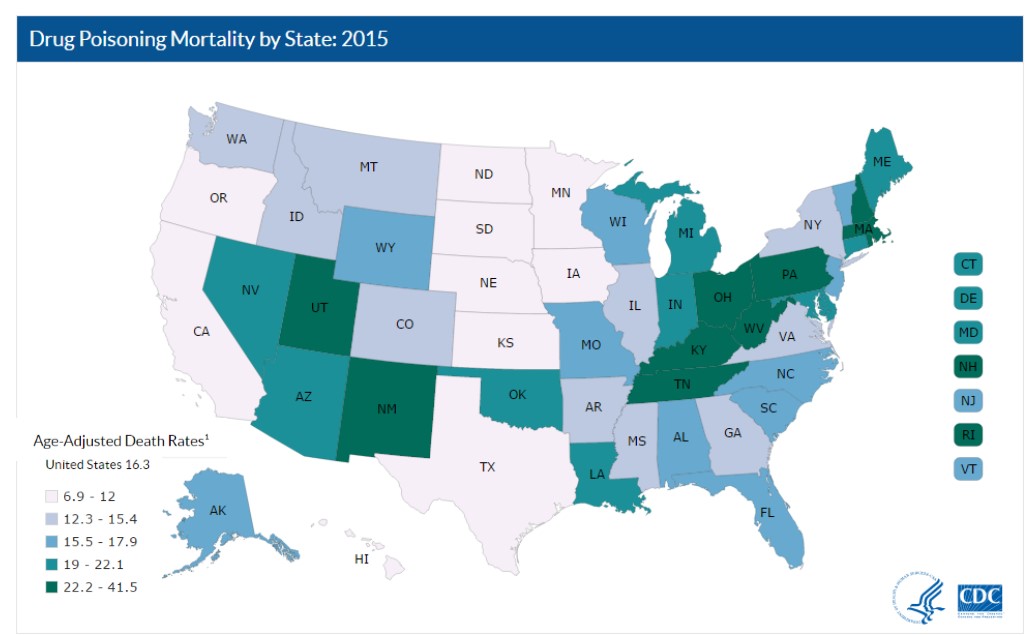
Connecticut’s mortality rate from firearms is less than half the national average, the state’s homicide rate is slightly above half the national average, but the rate of drug poisoning deaths exceeds the national average. Data from the Centers for Disease Control and Prevention (CDC) indicate that Connecticut’s mortality rate from drug poisoning was 17.6 per 100,000 population, with 623 deaths in the state in 2014, the 19th highest rate in the nation.  The U.S. rate that year was 14.7, with 47,055 fatalities.  Last year, Connecticut’s mortality rate from drug poisoning climbed to 22.1, which was the 11th highest rate in the nation, with 800 deaths. 

The states with the highest drug poisoning mortality rates in the nation in 2015 were West Virginia, New Hampshire, Kentucky, Ohio, Rhode Island, Pennsylvania, Massachusetts, New Mexico, Utah, Tennessee and Connecticut.  The lowest rates were in Nebraska, South Dakota, North Dakota, Texas and Iowa.

The CDC reported this month that opioids—prescription and illicit—are the main driver of drug overdose deaths. Opioids were involved in 33,091 deaths in 2015, and opioid overdoses have quadrupled since 1999.

In 2015, according to the CDC, significant increases in drug overdose death rates from 2014 to 2015 were primarily seen in the Northeast and South Census Regions. States with statistically significant increases in drug overdose death rates from 2014 to 2015 included Connecticut, Florida, Illinois, Kentucky, Louisiana, Maine, Maryland, Massachusetts, Michigan, New Hampshire, New Jersey, New York, North Carolina, Ohio, Pennsylvania, Rhode Island, Tennessee, Washington, and West Virginia.

The five states with the highest rates of death due to drug overdose were West Virginia (41.5 per 100,000), New Hampshire (34.3 per 100,000), Kentucky (29.9 per 100,000), Ohio (29.9 per 100,000), and Rhode Island (28.2 per 100,000).

The increase in drug overdose deaths in Connecticut from 2014 to 2015 was 25.2 percent, the fourth highest in the nation among states that had a statistically significant increase.  Only Massachusetts, New Hampshire and Maine had larger increases.

Among the 28 states meeting inclusion criteria for state-level analyses, 16 (57.1%) experienced increases in death rates involving synthetic opioids other than methadone, and 11 (39.3%) experienced increases in heroin death rates from 2014 to 2015, the CDC reported.

The largest absolute rate change in deaths from synthetic opioids other than methadone occurred in Massachusetts, New Hampshire, Ohio, Rhode Island and West Virginia. The largest percentage increases in rates occurred in New York (135.7%), Connecticut (125.9%) and Illinois (120%).

Connecticut, Massachusetts, Ohio, and West Virginia experienced the largest absolute rate changes in heroin deaths, while the largest percentage increases in rates occurred in South Carolina (57.1%), North Carolina (46.4%), and Tennessee (43.5).

Connecticut announced a detailed opiate response initiative this fall.  The Connecticut Opioid REsponse Initiative (CORE) is a strategic plan from Yale experts in response to the state’s opioid and overdose epidemics. It recommends: 1) expanding access to effective, medication-based treatment for substance use disorders; 2) improving transitions within the treatment domain; 3) increasing the availability of naloxone — the antidote to reverse an opioid overdose — and; 4) decreasing the over-prescribing of opioid at high doses or in combination with sedatives.

The CDC said “there is an urgent need for a multifaceted, collaborative public health and law enforcement approach to the opioid epidemic;” the Drug Enforcement Administration referred to prescription drugs, heroin, and fentanyl as the most significant drug-related threats to the United States, the CDC reported.


Connecticut Opioid REsponse Initiative (CORE) news conference, 10/6/16

https://youtu.be/fqw-AXvsL_8

Lead Poisoning Is A Problem for Connecticut Children, National Study Reveals

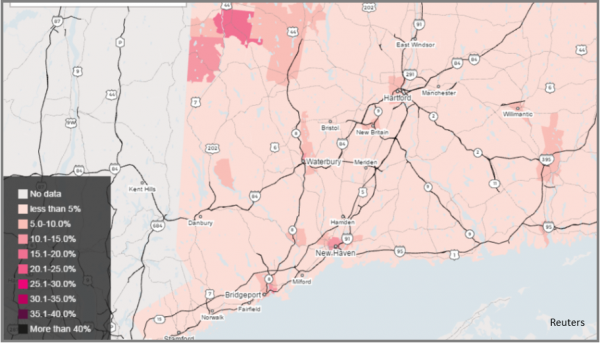
A Reuters news service examination of lead testing results across the country found almost 3,000 areas with poisoning rates far higher than in Flint, Michigan, which was the focus of national attention this year for its dangerously tainted water supply. reuters-investigates-logoThe review and analysis found at least seven areas in Connecticut, based on zip code geography, where the percentage of children found to have elevated lead levels exceeded – more than doubled – the percentage in Flint.
The Centers for Disease Control and Prevention (CDC) estimates that nationwide, around 2.5 percent of children ages 0-6 have an elevated lead level, defined as 5 micrograms/deciliter or higher. Among small children tested in Flint, Michigan during the peak of that city’s lead contamination crisis, 5 percent had elevated levels, or double the average.sign

In many neighborhoods – census tracts or zip code areas – across the country, a far higher rate of children have tested high in recent years.  The zip codes in Connecticut with elevated lead levels in more than 5 percent of children tested include more than a dozen neighborhoods and communities scattered across the state, with the highest levels  in the towns of Canaan and Sharon, and the cities of Bridgeport, New Haven, and Waterbury.

mapThe State Department of Public Health website indicates that “childhood lead poisoning is the most common pediatric public health problem, yet it is entirely preventable. Once a child has been poisoned, the impairment it may cause is irreversible. Lead harms children’s nervous systems and is associated with reduced IQ, behavioral problems, and learning disabilities.”

Since the 1970s, U.S. efforts to eradicate childhood lead poisoning have made what Reuters describes as “remarkable progress,” while pointing out that “the advances have been uneven.”  Legacy lead – in paint, plumbing, yards, well-water or even playgrounds – means that kids in many neighborhoods remain at a disproportionately high risk of poisoning, the news service report explained.

The news service conducted a nationwide analysis of childhood blood lead testing data at the neighborhood level. Census tract or zip code level data reflecting the local prevalence of elevated lead tests was obtained from 21 states, including Connecticut.  The highest prevalence was found in:

Zip Code                              Tested Children /Elevated Results

06031 Canaan                    107 / 15.89%

06608 Bridgeport            8,602 / 13.32%

06511 New Haven            15,731/12.88%

06519 New Haven            8,318 / 11.95%

06607 Bridgeport             4,079/10.9%

06710 Waterbury             6,133/ 10.48%

06069    Sharon                  137 /10.22%

Across the country, Reuters found nearly 3,000 areas with recently recorded lead poisoning rates at least double those in Flint during the peak of that city’s contamination crisis. And more than 1,100 of these communities had a rate of elevated blood tests at least four times higher.

Reuters reports that zip codes have average populations of 7,500. In each area, a relatively small number of children are screened for lead poisoninglead_free_kids_logo_web each year, the report indicated.
The poisoned places stretch from Warren, Pennsylvania, a town on the Allegheny River where 36 percent of children tested had high lead levels, to a zip code on Goat Island, Texas, where a quarter of tests showed poisoning, the Reuters analysis indicated. In some pockets of Baltimore, Cleveland and Philadelphia, where lead poisoning has spanned generations, the rate of elevated tests over the last decade was 40 to 50 percent.

“I hope this data spurs questions from the public to community leaders who can make changes,” said epidemiologist Robert Walker, co-chair of the CDC’s Lead Content Work Group, which analyzes lead poisoning nationwide. “I would think that it would turn some heads.”

The findings, Walker told Reuters, will help inform the public about risks in their own neighborhoods and allow health officials to seek lead abatement grants in the most dangerous spots.

Congress recently directed $170 million in aid to Flint - 10 times the CDC’s budget for assisting states with lead poisoning this year, Reuters reported.