Connecticut Adds High School Certificate of Global Engagement

Much has been said but less has been done to encourage Connecticut students to prepare for an ever more connected and interdependent world.  Until now.  The State Board of Education has voted to establish a Connecticut Certificate of Global Engagement, which high school students can earn by completing specific aspects of the curriculum, and aims to prepare “globally competent students who are college and career ready.”  The Certificate would be noted on high school transcripts. The Connecticut Certificate of Global Engagement was established, according to the curriculum overview, “to recognize public high school graduates who have successfully completed a global education curriculum and engaged in co-curricular activities and experiences that fostered the development of global competencies and global citizenship.”
“In today’s intricately interconnected world, informed citizens require an increasingly broader base of knowledge and perspective, because local communities, societies and economies are directly affected by events and trends that occur well beyond national borders,” the newly adopted curriculum guidelines point out.

The Certificate is based on the guidelines of the Connecticut Social Studies Frameworks and American Council on the Teaching of Foreign Languages (ACTFL) World Readiness Standards, and builds upon the recommendations of the Council of Chief State School Officers (CCSSO).  It supports student literacy as defined by the Common Core Standards and provides a pathway for 21st Century Skills.

Officials stress that the Certificate does not require additional resources in local school districts, “as all coursework would already be part of the curriculum. The Certificate, however, gives school districts an opportunity to evaluate the entire school curriculum through the lens of global knowledge.”

The mission of the Certificate program, officials explain, is to provide Connecticut students a “pathway to gain global knowledge and skills that will increase their competitiveness and ability to succeed in college and career and their participation as informed citizens.  In today’s global marketplace, it is in the long-term economic, social, and democratic interests of the United States, Connecticut, and local communities to encourage and facilitate international connections in the community, state and beyond.”

To be recognized for the Certificate, students will need to complete the following requirements:

  • coursework in world languages;
  • coursework with strong global implications and analysis;
  • extracurricular activities and experiences with global themes; and
  • a global service learning or action project.

The guidelines indicate that through coursework and co-curricular activities, globally competent students will demonstrate the following competencies:

  • investigate and express ideas about the world beyond their immediate environment;
  • recognize and articulate their own and others’ perspectives;
  • communicate ideas effectively with diverse audiences; and
  • translate ideas into appropriate actions to address a contemporary global issue.
Globally-Focused Coursework would require at least 7.0 credits or demonstration of mastery and Globally-focused Student Activities would require competency in global citizenship through active participation in “at least one or more co-curricular and other school-sponsored or endorsed activities over at least 3 years of their high school experience with suggested involvement of a total of at least 15 hours.”

The guidelines for the Certificate of Global engagement were approved at the Board’s May 2 meeting and is now available for high schools throughout the state to implement.  A copy of the guidelines appears on the State Department of Education website alongside the state’s Social Studies Frameworks and Resources.

The curriculum plan was developed by a 24-member committee including Stephen Armstrong, the state’s Social Studies Consultant in the Department’s Academic Office, David Bosso, President of the Connecticut Council for the Social Studies, Robert Rader, Executive Director of the Connecticut Association of Boards of Education, high school teachers, superintendents, language specialists, college professors and representatives of the World Affairs Council of Connecticut.

Quasi-Public Agencies Avoid Many Requirements, Controls

In addition to an array of nearly 100 state agencies of varying sizes and responsibilities, Connecticut has 15 quasi-public agencies, which operate under different rules of the road from run-of-the-mill state agencies. The main reason for establishing the “quasis,” as they’re often called, “was their organizational location outside the structure of state government,” according to a report this year from the Office of Legislative Research (OLR).  Thus, “they could avoid many of the requirements and controls imposed on governmental agencies.”

That status, according to OLR, meant “they could respond to problems and opportunities faster and more efficiently than a comparable state agency, while maintaining a degree of oversight and accountability.”

Some, such as the Connecticut Airport Authority, which runs Bradley International Airport and other airports in the state, the Connecticut Lottery Corporation, Access Health CT and the Connecticut Student Loan Foundation are relatively well known.  Others, such as the State Education Resource Center or the Materials Innovation and Recycling Authority, less so.

The full list of 15 quasi-public state agencies:

  1. Connecticut Innovations, Incorporated (CII);
  2. Connecticut Health and Educational Facilities Authority (CHEFA);
  3. Connecticut Higher Education Supplemental Loan Authority (CHESLA);
  4. Connecticut Student Loan Foundation (CSLF);
  5. Connecticut Housing Finance Authority (CHFA);
  6. State Housing Authority (SHA);
  7. Materials Innovation and Recycling Authority (MIRA);
  8. Capital Region Development Authority (CRDA);
  9. Connecticut Lottery Corporation (CLC);
  10. Connecticut Airport Authority (CAA);
  11. Connecticut Health Insurance Exchange (doing business as Access Health CT);
  12. Connecticut Green Bank (CGB);
  13. Connecticut Retirement Security Authority (CRSA);
  14. Connecticut Port Authority (CPA); and
  15. State Education Resource Center (SERC).

Each quasi-public organization has its own governing board, and funding sources for quasi operations varies, ranging from fees to ticket sales.

The law requires each quasi-public agency to submit an annual report to the governor and auditors of public accounts, OLR explains.  The report must, at a minimum, include:

  • a list of all bonds issued for the prior fiscal year, including their cumulative value, value of outstanding bonds, and the state's contingent liability;
  • a list of all projects, other than those pertaining to owner-occupied housing or student loans, receiving financial assistance during the preceding fiscal year, including each one's purpose, location, and funding amount;
  • a list of all outside individuals and firms receiving more than $5,000 in loans, grants, or payments for services;
  • a balance sheet showing all revenues and expenditures;
  • the affirmative action policy statement, a description of the agency's workforce composition, and a description of its affirmative action efforts; and
  • a description of planned activities for the current fiscal year

The law also prohibits quasi-public agencies from contracting with the same financial auditor or auditing firm for more than six consecutive fiscal years and each quasi-public agency must submit two quarterly reports to the Office of Fiscal Analysis (OFA).

All quasi-public agencies (except the Connecticut Lottery Corporation) must obtain the state treasurer's approval before borrowing any money or issuing any bonds or notes that are guaranteed by the state or for which there is a capital reserve fund that the state contributes to or guarantees.

The newest of the quasi-public agencies is the Connecticut Port Authority, established by the state legislature in 2015.

New Citizens Sworn In, Distinguished Immigrants Honored at State Capitol Ceremonies

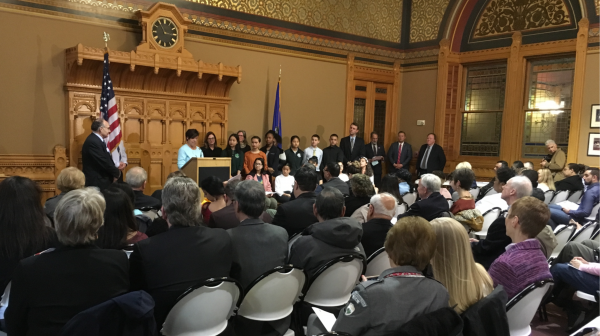
Fifteen recent immigrants living in Connecticut took the oath of allegiance as American citizens on Wednesday during a special court session to be held at the State Capitol.  Minutes after the new Americans were sworn in as citizens, the Connecticut Immigrant & Refugee Coalition (CIRC) honored eight longtime state residents who have made significant contributions to life in Connecticut. The individuals honored on the 21st Annual Connecticut Immigrant Day came to the United States from Belarus, Italy, Vietnam, Poland, Egypt, Pakistan, India and Taiwan.  The new Americans citizens came to the U.S. from Brazil, Canada, Ecuador, Guatemala, Iraq, Italy, Jamaica, Kenya, Mexico, Russia and Syria.

“Immigrants have always been – and continue to be – an abundant and enduring strength of our great nation,” said Robert Fishman, Executive Director of the Connecticut Immigrant & Refugee Coalition (CIRC), which sponsored the observance with the Office of Secretary of the State. “Connecticut is fortunate to have many remarkable individuals who have contributed tremendously to our state, and as we honor them we are also inspired by the newest group of proud and determined immigrants to take the oath of allegiance as Americans.”

The court session that administered the oath to 15 new Americans was presided over by The Honorable Donna F. Martinez, U.S. Magistrate Judge for the District of Connecticut.

Lieutenant Governor Nancy Wyman shared brief remarks at the ceremony, recalling her grandfather’s journey to America.  The CIRC award recipients at this year’s 21st annual ceremony included residents of Avon, Trumbull, Farmington, Norwich, Monroe and East Hartford, in addition to West Hartford.  The National Anthem was led by Chris Nelson, a native of Ghana and current Goodwin College student.  The Governor’s Foot Guard presented the colors at the start of the ceremony, which was led by Chris George of Integrated Refugee & Immigrant Services.

The mission of CIRC, a coalition of about a dozen organizations across Connecticut, is to promote the rights and opportunities of immigrants and refugees in Connecticut and to foster their civic participation.

The individuals honored are:

  • Bassam Gayed, born in Egypt, is Multicultural Services Coordinator at the Otis Library in Norwich.
  • Irena Rak Dzierzbinski, born in Belgium, teaches French and Spanish in middle school in Darien and is active in Girl Scouts. She hosts a Polish-English radio program at Fairfield University.
  • Naeem Khalid, born in Pakistan, started Sam’s Food stores and employs 1,000 in his businesses. He formed a charity, Sam’s Children, to assist needy children in Connecticut and is active with the Pakistan American Association of Connecticut.
  • Ruth Lazowski, born in Belarus, is a Holocaust survivor who speaks with school groups.
  • Cary Lakenbach, born in Italy, is the current Board Chair of the Jewish Federation of Greater Hartford and an actuary.
  • Bruce Tsan-Tang Liang, born in Taiwan, is the Dean of the University of Connecticut School of Medicine.
  • Vani Nidadavolu, born in India, operates an Indian Dance School and works part-time for Edward A. Jones. She holds an MA in Commerce and is a Philanthropist.
  • Trinh K. Duong, born in Vietnam, came to Connecticut as a refugee and now works with new refugees and immigrants, helping them to resettle. She received her degree in Accounting from UConn.

In addition, Alicia Kinsman, Director and Managing Attorney of Immigration Legal Services at the Connecticut Institute for Refugees and Immigrants received the Myra M. Oliver Memorial Award, and two student groups were presented with the Angela R. Andersen Memorial Award, created to honor students who demonstrate deep commitment to issues impacting refugees and immigrants.

Sixth-graders from the Interdistrict School for Arts and Communication in New London were recognized for their project, “Community Faces-Humanizing the Immigrant Label,” parts of which were on display at the Capitol.  The second group was Teens4Citizenship, a Hartford Public Library and Hartford Public Schools collaborative program. As "Citizenship Guides," these high school immigrant students support family and community members on the path to Citizenship and upon turning 18 pursue their own citizenship.

Member organizations in the Connecticut Immigrant & Refugee Coalition include: Milan Cultural India Association, Polish American Foundation of CT, The American Place at the Hartford Public Library, Catholic Charities Migration Services, Connecticut Coalition of Mutual Assistance, Connecticut Institute for Refugees and Immigrants, Integrated Refugee & Immigrant Services (IRIS), Jewish Family Services of Greater Hartford, Legal Assistance Resource Center, Center for Urban Research, Education and Training, Pakistani American Association of CT, Hellenic Society of Paideia and World Affairs Council of Connecticut.
 

Goodbye Columbus? Indigenous Peoples Day Gains Another CT School District

West Hartford’s Board of Education voted this month to mark Indigenous People’s Day, rather than Columbus Day, in the town’s schools beginning next year.  Bridgeport schools made the change in 2015, and the New London school district replaced Columbus Day with Indigenous Peoples Day in 2016. There are no Connecticut municipalities that have voted to change the name of Columbus Day. In 2017, Rep. Josh Elliott of Hamden introduced legislation at the state level to make the change, but the proposal died in a legislative committee and was not voted on by either the House or Senate.

Instead of honoring Christopher Columbus, the Indigenous Peoples’ Day recognizes Native Americans, who were the first inhabitants of the land that later became the United States of America. Advocates for the switch to Indigenous Peoples Day argue that Columbus did not “discover” America in 1492 but instead began the colonization of it.

The states of Minnesota, Alaska and South Dakota celebrate Indigenous People’s Day or Native Americans Day, instead of Columbus Day.

TIME magazine has reported that with the exception of Santa Cruz, Calif., and the state of South Dakota, which adopted the similar Native American Day in place of Columbus Day in 1990, the jurisdictions that have chosen to celebrate Indigenous Peoples Day have done so relatively recently, with cities like Minneapolis and Seattle voting to celebrate Indigenous Peoples Day instead in 2014, and Los Angeles doing so last year, with the observance to begin in 2019.  In 2016, the state of Vermont (by gubernatorial proclamation) and city of Phoenix, AZ celebrated Indigenous Peoples Day. When the city of Austin adopted Indigenous Peoples’ Day in October 2017, the resolution stated that the city wanted to encourage schools to teach this history.

For decades, Native American activists have advocated abolishing Columbus Day, which became a federal holiday in 1937.  On the 300th anniversary of Columbus’ landing, the Society of St. Tammany, or the Columbian Order, organized the first celebration of Columbus Day on Oct. 12, 1792, according to the Library of Congress. In 1934, President Franklin D. Roosevelt designated Oct. 12 as the national holiday called Columbus Day. It became a federal holiday honored annually on the second Monday in October in 1971.

Tracey Wilson, a former social studies teacher at Conard who is also town historian, told we-ha.com that it’s important to “help our students distinguish between nostalgia and history.” Today’s world is different than it was when Columbus Day was first celebrated in 1892 and when the day became a national holiday in 1934, she said.


Increase in College Student Voting Rates in CT Among Largest in US in 2016 Election, Study Finds

Across all regions of the U.S., students voted at higher rates in 2016 than 2012, with students enrolled in New England and the Mid-East having the highest increases (5.1% and 5.0%), according to a comprehensive new student on student turnout by the Institute for Democracy and Higher Education at Tufts University.  Connecticut saw the 7th highest increases in voting rates among the states. The National Study of Learning, Voting, and Engagement (NSLVE), which included college and university students attending 1,023 higher education institutions in the U.S. across all 50 states, found that Connecticut college students voted in higher numbers in 2016.  Nearly two dozen colleges in the state were included, and according to the data, all saw increases in student voting from 2012 to 2016.

Compared to the rest of the country, institutional voting rates in New York, Pennsylvania, and Massachusetts tended to increase the most, followed by California, Texas, Illinois, Connecticut, Indiana and Florida.  Institutions in Georgia, Wisconsin, and Mississippi had the largest decline.

The demographics of the nearly 10 million students in NSLVE resemble those of the approximately 20 million college students in the U.S, according to the study, which is described as “a significant step forward in measuring students' political interest and engagement.”

By combining student enrollment records with publicly available voting records, the Institute has “created a one-of-a-kind database that provides the higher education community with its only objective measure of student voting,” according to the study authors.  Overall, NSLVE students voted at a higher rate in 2016 than 2012 by about three percentage points, rising from 45.1% to 48.3%, according to the report. Relative to the turnout of the general U.S. population of 18 to 24-year-olds, NSLVE student turnout was somewhat higher in both election years and increased slightly more between elections.

Among undergraduates, turnout increased from 2012 to 2016 across all class years—first-years, sophomores, juniors, and seniors. In both elections, seniors voted at the highest rate (47.0% in 2012 and 51.8% in 2016) and first-years' turnout was lowest (39.5% in 2012 and 42.8% in 2016). Individual data for the participating colleges, or specific state-by-state data was not released in the national study.

Across the country, nine institutions saw turnout increases of at least 15 percentage points between 2012 and 2016. The study also found that 60.4% of students enrolled at women’s colleges voted in 2016, compared to 53.1% in 2012, an increase of over seven percentage points.  In addition, the study found that “unlike voting rates, registration rates did not increase appreciably.”

In addition, the largest increase in voting rate was among private four-year institutions, where turnout increased by 4.1 percentage points from 2012 to 2016, although four-year public institutions still have the highest turnout rate overall, the report indicated. Women voted at rates nearly seven percentage points higher than men in both elections.

The study also found that voting rates increased from 2012 to 2016 in all academic fields of study. In both election years, students majoring in the social sciences voted at the highest rate, followed by those studying health professions, the humanities, and business. Students majoring in STEM fields (science, technology, engineering, and math) voted at the lowest rate in both election years. These differences could be due to many potential factors, including civically engaged students self-selecting into more civically oriented majors, the study analysis theorized.

The objective measure of student civic engagement that the data provides can be particularly insightful to the extent that voting can be seen as a proxy for student interest in public affairs.  The Institute is in the Jonathan M. Tisch College of Civic Life at Tufts University.