West Hartford, Farmington, Cromwell Earn "Top Town" Titles

 West Hartford has been ranked as the Greater Hartford region's number one community in a new analysis published in the June issue of Hartford magazine.   Rounding out the top 10, in order, are South Windsor, Glastonbury, Manchester, Bristol, Farmington, Simsbury, Middletown, Avon and Enfield. The publication is produced by CT1Media, which also publishes The Hartford Courant.

The rankings are based on information highlighting more than three dozen factors, from school test scores to crime rate, property taxes to median home price, voter turnout to number of retail establishments. In 12 overall categories, the data was weighted to determine rankings broken down by small, medium and large towns, in addition to the overall results.

 top towns

  • The top-ranked large towns (over 30,000 population) are West Hartford, South Windsor, Glastonbury, Manchester and Bristol.  
  • The leading medium-sized towns (15,000-30,000 population) are Farmington, Simsbury, Avon, Berlin and Southington.
  • The top small towns (under 15,000 population) are Cromwell, Granby, Canton, Burlington, and East Granby.

Here’s the breakdown of the champions, by category (and size), according to Hartford magazine:

  • Best for Families/Schools: West Hartford (large), Simsbury (medium), and Granby (small).
  • Best for Seniors: West Hartford (large), Farmington (medium), and Cromwell (small).
  • Young and Hip: Hartford (large), Southington (medium), and Hebron (small).
  • City Living: Hartford (large), Southington (medium), and Cromwell (small).
  • Country Living: Glastonbury (Large), Simsbury (medium), and Granby (small).
  • Bang for the Buck: Bristol (large), Windsor (medium), and Windsor Locks (small).
  • Most Affluent:  West Hartford (large), Avon (medium), and Granby (small).
  • Most Educated:  West Hartford (large), Farmington (medium), and East Granby (small).
  • Lowest Crime:  Glastonbury (large), Simsbury (medium), and Hartland (small).
  • Leisure Life:  Hartford (large), Simsbury (medium), and Hebron (small).
  • Fastest Growing: Hartford (large), Southington (medium), and Cromwell (small).

West Hartford, en route to earning the top spot, finished first in five categories, second place in four, along with two fifth place finishes (Country Living and Lowest Crime) and one sixth place (Bang for the Buck).  Among the medium sized towns, Simsbury won four categories, and Southington and Farmington each  won three.   Among the small towns, Cromwell won four categories and Granby won three.

In addition to the rankings, the magazine outlines how they arrived at the rankings, explaining that data was gathered from a number of sources, “including the schools (we parsed 84 individual test score results for each town), town profiles compiled by Connecticut Economic Resource Center (www.cerc.com), Connecticut State Department of Education, Connecticut Secretary of the State and Nielson Pop-Facts 2013.”

Strategies to Advance Transit-Oriented Development Outlined by Coalition

Strategies including community engagement, placemaking, mixed-income housing, complete streets, parking configuration, green infrastructure and energy efficiency are outlined in a comprehensive 68-page “toolkit” focusing on opportunities to extend transit-oriented development in Connecticut, as the state moves forward with significant rail and bus initiatives.

 Working in partnership, Connecticut Fund for the Environment, Partnership for Strong Communities, Regional Plan Association and Tri-State Transportation Campaign have created a Transit-Oriented Development (TOD) Toolkit that highlights key strategies necessary for developing competitive and sustainable TOD in Connecticut.  The toolkit has been shared in recent weeks with interested officials  and organizations around the state, and discussed at two public forums in Bridgeport that brought together more than   80 municipal leaders from the region.TOD Toolkit

The document outlines the primary components of a TOD program that meets common community goals of strengthening town centers, supporting municipal budgets, expanding housing and commercial opportunities, and minimizing environmental impacts. Among the central components outlined:

  • The process and design for getting TOD built in a community, from developing a community vision and supportive zoning, to determining how accessible a station is for non-drivers.
  • The demographic trends that favor mixed-income, transit-accessible housing, the fiscal impacts of residential TOD, and mechanisms to include affordable housing within TOD development.
  • Complete Streets strategies that enhance streets and sidewalks to promote walking and biking to a station and to TOD built around it. Transit access, walking an bicycling, and the mix of uses in TOD mean that TOD districts require less parking than traditional development.
  • Best practices for managing parking, including parking maximums, shared parking, and transit incentives.  
  • Information and resources for incorporating green infrastructure and energy solutions in a community. Green infrastructure minimizes wastewater and pollutant impacts from development. Energy-efficiency, local energy generation and micro-grids help communities use less power and withstand disruptions to the regional energy supply. housing starts

Efforts are continuing by the organizations participating in the effort, and others pursuing a transit-oriented development agenda, to coordinate with key state agencies regarding strategies to move TOD forward in the state, especially along key transportation corridors.  Officials are working to secure funds for a new TOD position that would initially provide technical support to Meriden and other towns on the upcoming New Haven - Hartford - Springfield rail and CTfastrak bus lines and to develop a funding source to support financing and land acquisition for priority TOD sites.

 Transit-oriented development is described in the toolkit as “development that’s built to take advantage of the ability of people to access it with transit - a strategy for growth that produces less traffic and lessens impact on roads and highways.”  The overview also points out that “households located within walking distance of transit own fewer cars, drive less, and pay a smaller share of their income on transportation related expenses. Homes and businesses can be built with less parking, reducing the cost of development, making development more feasible in weak markets, and increasing local tax revenue.”


 

Northeast Homes are Older, Smaller than National Average

Applications for new home construction nationwide rose to a five-year high in April, offering evidence that the post-recession housing revival will be sustained, according to Associated Press reports on U.S. Commerce Department data.  Applications for building permits – considered an indicator of future demand - rose 14.3 percent to a rate of 1.02 million, the highest since June 2008.

The new construction data builds on a home ownership foundation that varies across regions.  There are 76 million owner-occupied homes in the United States, and three-quarters of them are in metropolitan areas.  The breakdown:  22 percent in central cities, 36 percent in urban suburbs, 17 percent in rural suburbs and only 25 percent outside of metropolitan areas.home size

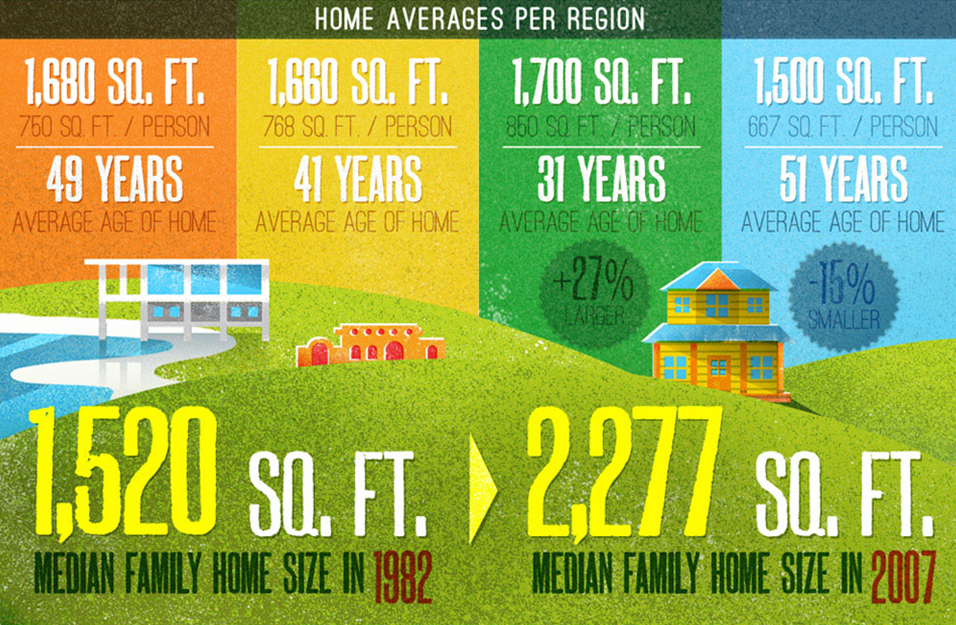
Not surprisingly, the oldest homes (51 years old on average) are found in the Northeast, where they are also 15 percent smaller than the national average; the newest homes are in the South – 27 percent larger than the national average and an average of 31 years old.  The average home in the west is 49 years old, in the Midwest 41 years old.

In Fairfield County, only 6.8 percent of homes were built after 2000, and in the entire state that figure is 7.1 percent, the Connecticut Post reported last month.

Nationwide, the median family home size has grown substantially in recent decades.  In 1982 it was 1,520 sq. ft.; by 2007, it was 2,227 sq. ft.

The data indicate an average of 2.6 people per household nationwide, with the percentage of households with children under age 18 greatest in the urban suburbs (37%), followed by rural suburbs (36%), central cities (33%) and those outside of metropolitan areas (30%).

The data, compiled by the websites of the National Association of Home Builders (nahb.org) and trulia.com, was featured in an infographic developed for Quicken Loans in partnership with Ghergich & Co.

The sites also compares Connecticut with national averages in key home-related categories:

  • Median Value of Owner-Occupied Housing Units: $166,900 [National Average $119,600]
  • Median Price Asked for Housing Units: $136,500 [National Average $89,600]
  • Median Household Income: $53,935  [National Average: $41,994]
  • Median Family Income $65,521 [National Average: $50,046]
  • Per-Capita Income: $28,766 [National Average: $21,587]

U.S. Census data featured by the state Department of Economic and Community Development indicates that Connecticut has 1,371,087 housing units occupied, led by the cities with the largest number of occupied housing units:  Bridgeport 51,255, New Haven, 48,877; Stamford, 47,357; Hartford, 45,124, and Waterbury, 42,761.

State, AARP Seek Volunteer Resident Advocates to Give Voice to Facility Residents

AARP Connecticut is working with the state Department on Aging Long Term Care Ombudsman Program  (LTCOP) to help recruit and train Volunteer Resident Advocates who help residents of skilled nursing facilities, residential care homes and assisted living facilities solve problems and voice their concerns.  Orientation sessions will be held in June in Manchester, Meriden and New Fairfield for individuals interested in learning more about the program.

 The Volunteer Resident Advocate, along with the Regional Ombudsman, helps voice residents’ concerns and empower residents speak up themselves, consistent with their individual rights. This is accomplished through individual consultation and complaint resolution as well as follow-through with state agencies and advocacy organizations.

In lending its support to help identify volunteers for the program, AARP Connecticut gets the word out to nearly 600,000 members age 50 and over throughout the state of Connecticut.

The LTCOP, mandated by the federal Older American’s Act and state law, works to improve the quality of life and quality of care of Connecticut citizens residing in nursing homes, residential care homes and assisted living communities.  All Ombudsman activity is performed on behalf ofltcop_v4_header_01, and at the direction of residents.  All communication with the residents, their family members or legal guardians, as applicable, is held in strict confidentiality.

 Volunteer Advocates may speak to the dietitian about a resident’s desire for a change in diet, let the nurse know a resident needs more timely assistance, or discuss with the administrator a resident’s idea for weekend activities.  Volunteer Advocates and Ombudsman support quality of life for residents by listening to and working for resident’s needs and interests and helping residents and families work with nursing home staff for changes to improvseniorlady-570x230e nursing home life. They help residents, their families and staffs communicate better with each other.

 Orientation sessions are being held in Connecticut this June at the following locations:

  • Wednesday, June 19, 2013, 9am – 12pm, Manchester Senior Center, 549 East Middle Turnpike
  • Monday, June 24, 2013, 9am – 12pm, New Fairfield Senior Center, 33 Connecticut Route 37
  • Tuesday, June 25, 2013, 9am – 12pm, Meriden Senior Center, 22 West Main St.

To learn more or to RSVP for one of the upcoming orientation sessions, call toll-free at 1-866-388-1888.

In addition to recruiting and training Volunteer Resident Advocates, the LTCOP responds to, and investigates complaints brought forward by residents, family members, and/or other individuals acting on their behalf.  Ombudsmen monitor state and federal laws and regulations, and make recommendations for improvement.  The State Ombudsman also works with policy makers, legislators and stakeholders to advance and improve systems and protections at the state level.

Got Cocaine? Yale Center for Clinical Investigation May Need You

If researchers at the Yale University School of Medicine discover a cure for cocaine addiction, it may be because of people being paid $800 to participate in a clinical research study, after responding to an advertisement in the local Advocate newspapers and a phone call to the “Cocaine Clinic Research Recruitment” line.

The ad asks “Are you currently using cocaine?  Are you NOT CURRENTLY on medication?”  It then goes on to offer payment for those deemed eligible to participate “in a paid cocaine use" study.

No mention of the fact that cocaine remains an illegal drug.  The Drug Policy Alliance indicates that according to government surveys, eight percent of high school seniors reported using cocaine at least once during their lifetime.  In 2010, 23 percent of eighth graders, 32 percent of tenth graders, and 45 percent of twelfth graders reported that crack was “fairly easy” or “very easy” to obtain.

The Yale Cocaine Research Clinic studies the “causes and consequences of cocaine addiction in order to develop improved treatments and, ultimately, to prevent addiction to the drug,” the clinic’s website explains.  Who is eligible?  “Individuals who are now using or have used cocaine.”

The nationally-recognized research includes active studies in  the genetics of addiction, brain imaging (PET, MRI), psychopharmacology, medications development,  and sleep and cognition. The clinic is located at 34 Park Street in New Haven.

Among four pages of studies highlighted on the website of the School of Psychiatry are a handful that relate to cocaine use or cocaine abstinence, and the impact of various medications on the addiction.

One study among the nearly 40 “active addictive behavior clinical trials,” sets out its impetus and objective:

“Opioid and cocaine dependence are major problems among veteran and non-veterans and no effective pharmacotherapy exists for cocaine dependence. Methadone has not shown robust effectiveness in reducing cocaine abuse. Thus, new treatments are needed for the individuals who have developed cocaine dependence. This study is designed to test a new pharmacotmza_6176734930892204893.170x170-75herapy for cocaine dependence and is a placebo-controlled trail.”

A separate study outlines detailed eligibility criteria which includes a requirement that individuals “are using cocaine more than once per week in the previous 30 days, provide a cocaine-positive urine specimen at screening, and fulfill criteria for current cocaine dependence.”  Another is an initial investigation for “A Drug Treatment for Cocaine Users Who Are Also on Methadone Maintenance Treatment.”  The “small clinical trial with cocaine users” would, if deemed sufficiently promising,  be followed by a more extensive double-blind, placebo-controlled study.

Yet another current clinical trial tests whether a “learning enhancing medication will help methadone maintained cocaine abusers with their learning and memory.”  Eligible participants – those with current cocaine abuse or dependence – must be willing to commit to 12 weeks of treatment, or a placebo.

Other ongoing clinical research studies within the School of Psychiatry related to addictive behavior include those related to alcohol addiction, smoking addiction, and post traumatic stress disorder.  In addition, there are approximately 30 mental health clinical trials underway, ranging from postpartum depression and domestic abuse to obsessive-compulsive disorder and binge eating.

Beyond those, there are numerous clinical trials for “healthy volunteers.” Chronic conditions like diabetes, cancer, cardiovascular disease, and pediatric and geriatric illnesses, are all being studied at Yale. The Yale Center for Clinical Investigation website stresses that “staff members, study doctors, nurses and coordinators are available to answer questions” of individuals considering participation in clinical studies, “so that you can make an informed decision.”  Trial categories include cancer, mental health, heart/cardiovascular, brain, spinal cord & nervous system, women's health and children's health. trial vial

At the beginning of 2013, Yale University launched a major effort to recruit thousands of volunteers to participate in clinical trials being conducted at Yale's Schools of Medicine, Nursing, and Public Health. Posters, brochures, newspaper ads, radio spots, transit ads, and community health fairs encourage members of the Greater New Haven community, including students, to enroll in the hundreds of trials that are initiated every year. The campaign is called "Help Us Discover" because without community involvement, lab research cannot be translated into treatments, the campaign kick-off announcement stated.

The Yale Center for Clinical Investigation (YCCI) was launched in January 2006, specifically to support and facilitate clinical and translational research and training. The School of Medicine was the only academic medical center in New England among the 12 institutions across the nation that received Clinical and Translational Science Award (CTSA) funding – a program that has expanded to about 60 academic medical institutions across the country.

With support from the CTSA, the School of Medicine, the University, and the Yale-New Haven Hospital, YCCI has developed into a home for clinical and translational research at Yale. By expanding existing programs, forging collaborations with other NIH-funded centers and establishing new initiatives. As a result of these efforts, almost $200 million per year of Yale’s National Institutes of Health (NIH) grant support is now directly connected to YCCI, the institution’s website explained.

New Haven's Prometheus Research Has Triple-Crown Worthy Win Streak

If innovation, recognition and funding are the triple crown of research technology, New Haven-headquartered Prometheus Research is in every sense a leader.

Autism Speaks and Prometheus Research have teamed up to develop a new, more user-friendly assessment portal through which parents can complete surveys for use in autism research.  The tool, called the Online Clinical System for Research (OSCR), allows parents to complete forms over the web and makes them accessible to Autism Speaks' Autism Genetic Resource Exchange (AGRE) scientists, among others.  Assessments collected via OSCR provide important clues for autism research, increase the power of statistical analyses, and are easily shared with scientists and clinicians via a secure browser.logo

Autism Speaks is now able to view OSCR data alongside information on patient visits, diagnosis, biospecimens, and medications, points out Prometheus CEO, Dr. Leon Rozenblit.  "Through its support for new study configuration and data re-purposing, the integrated data management platform will enable Autism Speaks to significantly grow their research capabilities."  Autism Speaks' VP of Clinical Programs, Dr. Clara Lajonchere , explained that “This web-based patient-facing data collection interface will allow families to work more closely with researchers and healthcare professionals in real time.  Questionnaires can be integrated with electronic medical records or made available to clinicians prior to a clinical visit allowing healthcare professionals to better understand patient needs."

Also within the past month, P to extend its Open Source Research Exchange Database (RexDB) for the management of autism spectrum disorders research. The project aims to empower autism investigators to make more effective use of their data and more efficiently exchange data across the scientific community.  AutismSpeaks

Collaborating with Prometheus on the grant are the Yale University Child Study Center, the Marcus Autism Center, Weill Cornell Medical College, the University of Missouri Thompson Center, and others. SBIR grants are judged for scientific and technical merit, including significance of the problem being addressed, the innovative nature of the proposed solution, the overall strategy for execution, and the quality of the research team.

And finally, completing a very good month, Prometheus Research was named as one of the top ten Best Places to Work in Connecticut by the Hartford Business Journal. Prometheus received the recognition for the second year in a row.  The survey and awards program was designed to identify, recognize, and honor the best employers in Connecticut, benefiting the state's economy, workforce, and businesses. Prometheus Research was selected in the small business category.

Autism Speaks is the world's leading autism science and advocacy organization. It is dedicated to funding research into the causes, prevention, treatments and a cure for autism; increasing awareness of autism spectrum disorders; and advocating for the needs of individuals with autism and their families. Autism Speaks was founded in February 2005 by Suzanne and Bob Wright, the grandparents of a child with autism.  Wright is the former vice chairman of Connecticut-based General Electric and chief executive officer of NBC and NBC Universal.

Prometheus Research's mission is to help research institutions and funding organizations get more utility from their data.  Prometheus offers integrated data management services, expert consulting, and software customization to deliver sensible solutions powered by their adaptable, open-source, web-based RexDB technology.  The company was founded a decade ago, and is an active community participant, most recently sponsoring an Arts for Autism contest at the Betsy Ross Arts Magnet School in New Haven.  Winning artwork was featured by the company on social media channels and provided inspiration for t-shirts to be worn by the Prometheus team during the Autism Speaks Walk.

Riding to Work, Protecting Vulnerable on the Way

 The goal is 2,500 people.  With the start of CTrides week set to begin on May 13, there are about 250 people registered on the organization’s website of free services and information, thus far.  Officials are hoping for a boost of support in the coming days, and remain optimistic, perhaps encouraged by the arrival (finally) of springtime weather and the increase in cyclists it inevitably brings.  And they acknowledge that many may choose to observe the spirit of the day, without formally registering their participation.

Commuters are asked to carpool, vanpool, take buses or trains, walk, bike or telecommute instead of driving alone to work.  CTrides is not alone in advocating alternate transportation – and the benefits of leaving the car in the driveway, or sharing the ride into work.

BikeWalk Connecticut is urging people to step outside their vehicles - May 8 is National Bike to School Bicycling_best-cardio-exercisesDay and May 17 is National Bike to Work Day.   There are community-based events taking place on May 17 in at least two dozen locations around the state, from Bloomfield and Bethel to Waterbury and West Hartford.  Most are open to the public, and some are held on-site for corporate employees, such as  CIGNA, GE, Aetna and United Technologies.

CTrides notes that Americans spend an average of 47 hours per year sitting in rush-hour traffic, and public transit is viewed as 170 times safer than automobile travel.  An averge family’s second largest expense, after housing, goes to buying, maintaining and operating a car.  For those acutely aware of environmental impacts, it has been estimated that a single person switching to public transportation reduces carbon emissions by 4,800 pounds per year.  On May 9, CTrides goes to college – Southern Connecticut State University in New Haven, specifically.  The midday Community Outreach event will focus on the benefits of sharing a ride. CT_rides2

Protecting Vulnerable Users

Beyond the personal riding advocacy, BikeWalk Connecticut also works for legal changes to make cycling safer.  This year, abike_walk_ct_logo_thumbmong their legislative priorities is the so-called “vulnerable user” bill (SB191).  It would establish a penalty for a motorist who, failing to exercise reasonable care on a public way, seriously injures or causes the death of a “vulnerable user,” provided the vulnerable user exercised reasonable care in using the public way. A driver who causes such injury or death would face a fine of up to $ 1,000. Reasonable care is the degree of care that a prudent and competent person engaged in the same endeavor would exercise under similar circumstances.

The bill applies to any public way, including a public highway, road, street, avenue, alley, driveway, parkway, or place, under the control of the state or any of its political subdivisions, dedicated, appropriated, or opened to public travel or other use.  Under the bill, vulnerable users include: 1. pedestrians; 2. highway workers; 3. bicyclists; 4. anyone riding or driving an animal (e. g. , driving a horse-drawn vehicle); 5. skaters, skateboarders, and roller bladers; 6. people driving or riding on a farm tractor; 7. people in wheelchairs or motorized chairs; and 8. blind people and their service animals.  The states of Washington, Delaware and Oregon have similar laws.  Efforts are underway to have Connecticut follow suit.

Achieving Efficiency in Human Services Delivery Proves Elusive for State

Perhaps this is why they call it bureaucracy.  Even when the goal is more family-friendly, responsive and efficient operations, it requires the following:  a presentation to the Governor’s Cabinet on Nonprofit Health and Human Services from the state legislature’s Bi-Partisan Municipal Opportunities & Regional Efficiencies (M.O.R.E.) Regional Entities Sub-Committee Human Services Working Group.  It occurred, without fanfare, at the State Capitol on May 6, 2013.

The subject:  a proposal now being considered by the state legislature to do what many in the room described as implementing a provision of law that generally dates back to the last century, circa 1992, that has been sitting on a shelf, as State Rep. Tim Bowles described it, waiting for just the right convergence of administration and legislature to take another crack at insisting on implementation.  Bowles viewed its original creation from the vantage point of the Office of Policy and Management, where he worked during the Weicker administration.

The plan, updated for 2013:  re-align the “service boundaries” of a series of state agencies in order to make them more easily navigable for families with troubled or challenged youth who can, at times, find themselves dealing with as many as 16 agencies and filesnonprofit organizations for necessary services, requiring a nightmare of navigation through agency after agency.

The state agencies involved: the Department of Social Services, Department of Developmental Services, Department of Children and Families, Department of Mental Health and Addition Services would adjust their geographic boundaries to create six service delivery areas that align with the six Regional Education Service Centers boundaries – thus bringing human services and education into geographic alignment, no easy task according to those gathered to discuss the proposal.

The initiative is embodied in House Bill 5267, approved by the Human Services Committee and now awaiting House action.  It’s stated goal:  “to establish an integrated human service delivery system to ease access for consumers and reduce inefficiencies.”

As was noted during the meeting, the bill omits the Department of Public Health from the list of participating agencies.  It also lays out a relatively aggressive time line for implementation – especially weighed against two decades of delay – including a plan to be submitted by 2014 that would include consolidation of office space, relocation of staff, implementation of one-stop services for referrals to services.  The one-stop centers would be required at half of agency office locations by December 2015, and the remainder by the following year.  All of which makes the stated expectation, in response to questioning by dubious Cabinet members,  that the plan implementation would move slowly – taking as long as a decade – even more curious, and seemingly inconsistent with the language of the bill.

The Office of Fiscal Analysis could not provide a fiscal impact for the planned service coordination, which also includes common information technology development.  The Office of Legislative Research report underscores the imperative for better coordination and collaboration by describing the status quo:  DCF has six regions covering the state.  DDA and DSS each have three regions covering the northern, southern and western parts of the state, but DSS maintains either a large regional office or a sub-office within the larger regions.  DMHAS has five service regions.

The Regional Educational Services Centersmap (RESC), whose boundaries would be mirrored by the other agencies, were created more than 30 years ago to “furnish programs and services” to Connecticut’s public school districts.  RESC works with DCF, DMHAS, DMR, DPH, DSS, the Department of Corrections, Department of Education and Board of Education & Services for the Blind on statewide issues.

The M.O.R.E. Human Services Working Group proposals also calls for “the establishment of pilot Regional Human Service Coordination Councils consisting of elected officials, representatives from DSS, DDS, DCF, DMHAS, DOC, ED, PH, Workforce Development Boards, Non-Profits, and Family Advocacy groups to coordinate regional efforts and continue studying and implementing more efficient service delivery.”

The Governor's Cabinet on Nonprofit Health and Human Services was established in September of 2011 to analyze existing public-private partnerships with respect to the state's health and human services delivery systems and to make recommendations to enhance the effectiveness of those systems in regard to client outcomes, cost-effectiveness, accountability and sustainability.   Members include:

  • Co-Chair Terry Edelstein, Nonprofit Liaison to the Governor
  • Co-Chair Peter S. DeBiasi - President/CEO, Access Community Action Agency
  •   Michelle Cook, State Representative
  •  Robert Dakers, Executive Finance Officer, Office of Policy and Management
  • Joette Katz, Commissioner, Department of Children and Families
  •  Terrence W. Macy Ph.D., Commissioner, Department of Developmental Services
  •  Patricia Rehmer, Commissioner, Department of Mental Health and Addiction Services
  • Dr. Jewel Mullen, Commissioner, Department of Public Health
  • Roderick L. Bremby, Commissioner, Department of Social Services
  •  Stefan Pryor, Commissioner, Department of Education
  • William Carbone, Executive Director, Judicial Branch
  • Yvette H. Bello, Executive Director, Latino Community Services
  •   Deborah Chernoff, Communications Director, SEIU 1199NE
  • Roberta Cook, President/CEO, BHcare, Inc.
  • Marcie Dimenstein, LCSW, Senior Director, Behavioral Health Connection, Inc.
  • Patrick J. Johnson, President, Oak Hill
  • Daniel J. O'Connell, Ed.D., President/CEO, Connecticut Council of Family Service Agencies
  • Maureen Price-Boreland, Executive Director, Community Partners in Action
  • Anne L. Ruwet, CEO, CCARC, Inc.
  • Amy L. Porter, Commissioner, Department of Rehabilitation Services


Volunteer Programs Celebrated in Ten Cities During Senior Corps Week

More than 4,900 seniors in Connecticut contribute their time and talents in one of three Senior Corps programs.

  • Foster Grandparents serve one-on-one as tutors and mentors to more than 1,000 young people who have special needs.
  • Senior Companions help more than 320 homebound seniors and other adults maintain independence in their own homes.
  • RSVP volunteers conduct safety patrols, renovate homes, protect the environment, tutor and mentor youth, respond to natural disasters, and provide other services through more than 830 groups across Connecticut.

The programs operate in ten Connecticut cities - Bridgeport, Bristol, Danbury, Hartford, New Britain, New Haven, New London, Norwalk, Norwich, and Waterbury.

Senior Corps Week 2013 is May 6-10 to align with Older Americans Month – a time to celebrate, recognize, and highlight the extraordinary contributions that Foster Grandparents, RSVP, and Senior Companion volunteers make through service in their communities each and every day.  [See video.]logo_sc_week_2010sc

The Corporation for National and Community Service is joining with organizations across the country to honor the powerful impact of Senior Corps volunteers and encourage more Americans 55+ to serve their communities through the fourth annual Senior Corps Week.

For more than four decades, Senior Corps volunteers have used their lifetime of skills and experience to meet community needs. Today more than 330,000 volunteers age 55+ are serving through Senior Corps' three programs.  The Corporation for National and Community Service is a federal agency that improves lives, strengthens communities, and fosters civic engagement through service and volunteering. CNCS annually engages more than five million Americans in service to meet local needs through Senior Corps, AmeriCorps, and national days of service; improves communities through the Social Innovation Fund, and leads President Obama's national call to service initiative, United We Serve.

To learn more visit NationalService.gov  or call 202-606-5000 or TTY 1-800-833-3722.

Thriving Initiatives on State Main Streets Gain Recognition

Communities and organizations actively championing the revitalization and economic development of downtowns across Connecticut - through initiatives ranging from rebuilding and redesigning downtown spaces to working with local partners to provide fresh food for downtown residents- are gaining recognition for their efforts.

Initiatives and organizations from Hartford, Waterbury, Willimantic and Storrs Center and among those selected for 2013 Awards of Excellence, to be presented by the Connecticut Main Street Center (CMSC) at their annual awards gala, being held in Hartford for the first time on June 10.  The projects and programs range from Fireball Run and iQuilt to vibrant partnerships bringing business, education, municipal and community organizations together to advance new initiatives.  The recipients are:

  • Main Street Partnership (sponsored by Webster Bank) - "Brass City Market on Field" Indoor Farm Market, to Brass City Harvest, Main Street Waterbury, Naugatuck Valley Community College, Waterbury Development Corporation and the City of Waterbury.
  •  Economic and Business Development - "Make New Friends, but Keep the Old": Retention and Relocation of Existing Businesses during Development of Storrs Center, to Mansfield Downtown Partnership, UConn, Town of Mansfield, LeylandAlliance, Milone & McBroom, Cipparone & Zaccaro, and the Business Owners of Mansfield & Storrs Center.
  •  Public Space Master Plan - The iQuilt Plan (Downtown Hartford), to iQuilt Partnership, City of Hartford, and Suisman Urban Design.
  • Historic Preservation - End of an Era": Past Identity/Future Vision and the Portrait Project (Downtown Willimantic), to Harrison Judd, Thread City Development, Inc., Eastern CT State University, Windham Textile & History Museum, Town of Windham, TBS Properties, Windham Region Chamber of Commerce, ArtSpace Windham Gallery.
  •  Downtown Event -  Fireball Run 2012 (Downtown Waterbury), to Waterbury Regional Chamber of Commerce, City of Waterbury, and Main Street Waterbury.
  • Business Owner of the Year (sponsored by Webster Bank) - Dr. Richard A. Fichman, Fichman Eye Center, in the Upper Albany Main Street District, Hartfordone-dog-lane

In addition, the 2013 Nationally Accredited Main Street Programs - Simsbury Main Street Partnership, Upper Albany Main Street (Hartford), and Main Street Waterbury will be recognized, and The Connecticut Light and Power Company Award for Outstanding Contributions to Main Street Revitalization will be presented to longtime activitst Toni A. Gold of Hartford.

"Connecticut's city centers are critical drivers of commerce and competitiveness," said Governor Dannel P. Malloy. "I applaud the 2013 award winners for their efforts to make Connecticut's downtowns thrive. The collaboration to create more livable communities is to the benefit of all Connecticut's residents."

Connecticut Main Street Center is a statewide nonprofit that inspires great Connecticut downtowns, Main Street by Main Street. Its mission is to be the champion and leading resource for vibrant and sustainable Main Streets as foundations for healthy communities.

The Connecticut Main Street Awards of Excellence, established a decade ago, recognize outstanding projects, individuals and partnerships in community efforts to bring traditional downtowns and neighborhood commercial districts back to life, socially and economically. Submissions were judged on criteria which included innovation, replication, representation, partnerships utilized, and outcomes.

Awards will be presented at the 2013 Connecticut Main Street Awards Gala on June 10th at the Wadsworth Atheneum Museum of Art in Downtown Hartford. Major Sponsors include Fuss & O'Neill, Webster Bank, Baywater Properties, Travelers, and Renaissance Downtowns.