National High School Mock Trial Championships to be in Hartford in 2017

The 2017 National High School Mock Trial Championship, promoting an understanding and appreciation of the American judicial system through academic competitions and related programs for high school students, will take place May 11-13, 2017 in Hartford. The national mock trial championship was initiated in 1984 in Des Moines, Iowa, with high school teams from Illinois, Iowa, Minnesota, Nebraska and Wisconsin participating. After the success of the inaugural tournament in Iowa, more states became interested in participating and the tournament became an "All-State" Tournament and now attracts competitors from across the country and internationally.

national_mock_trial_logo_0_1395406080The tournament is hosted annually by different states to ensure that the cost of running the tournament doesn't fall disproportionately on any particular state.

The Carolina Center for Civic Education is making final preparations for the 2015 National Championship, which will be held May 14-16 in Raleigh, North Carolina. Connecticut will be represented by the team from Weston High School, the 2015 High School Mock Trial State Champions.  The winning team was one of three from the school that participated in the statewide competition in March.  The finals were held in the State Supreme Court chamber in Hartford.  The students on the winning “Weston Red” team were Ursula Alwang, Cameron Edgar, Sam Glasberg, Zoe Howard, Alex Ishin, Scarlett Machson, Ben Muller, Jack Seigenthaler, Henry Tracey, and Micah Zirn, the Weston Forum reported.mocktrial-FI

The Idaho Law Foundation will host the 2016 National Championship in Boise, Idaho. Last year's competition in Madison, Wisconsin included a total of 46 teams, including Guam, South Korea, the Commonwealth of Northern Mariana Islands, and State Champion teams from across the country.

In Connecticut, the mock trial competition is sponsored by the nonprofit organization Civics First. Throughout its history, thousands of students and their teachers have participated in the program.  In recent years, the program has included over 700 students from more than 50 Connecticut high schools.

The high school mock trial competitions are held each year in the fall. Regional trials are held in early winter in superior courts throughout the state, followed by quarter-finals, and semi-final contests. The state final mock trial competition is held at the Connecticut Supreme Court in Hartford.

For the national competition, each state’s "official team" includes six to eight student team members; one primary teacher coach; one primary attorney coach, and the State Mock Trial Coordinator, for a maximum of 11 members of the "official" team.

In recent years, the competition has been held in Madison, Wisconsin (2014), Indianapolis, Indiana (2013), Albuquerque, New Mexico (2012), Phoenix, Arizona (2011), Philadelphia, Pennsylvania (2010), and Atlanta, Georgia (2009). The Executive Director of Civic First and state coordinator for the high school mock trials in Connecticut is Beth DeLuco.

CFCivics First is a private, non-profit association that promotes and conducts law-related education programs and projects in Connecticut's public and private schools, courtrooms and communities. Its goal is the incorporation of citizenship education into the curriculum of all schools, from kindergarten through high school.

Photo: The Weston High School Mock Trial Red Team won the Connecticut state championship . (This photo originally appeared in the Weston Forum.)


Connecticut Ranks #16, Above National Average in Online Job Ads for College Graduates

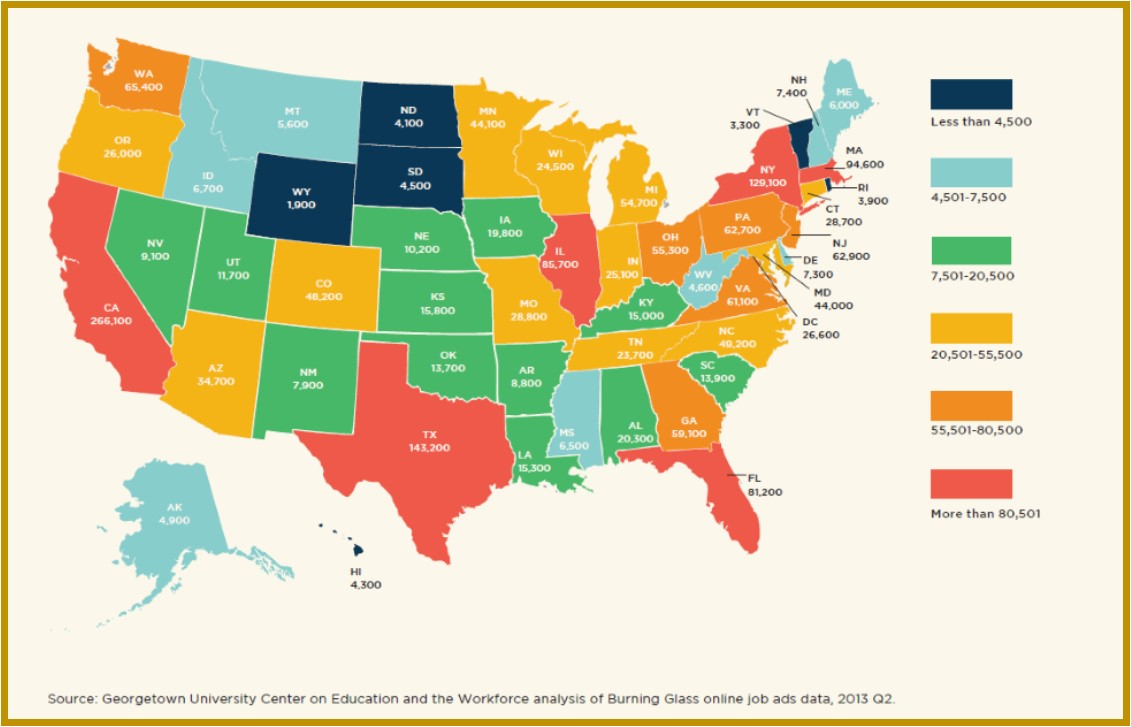
Connecticut ranks as the 16th best online college labor market in the U.S., according to data compiled by the Georgetown University Center on Education and the Workforce.  In Connecticut, 53 percent of online job ads seek college graduates.  That translates to 28,700 online job ads, and places Connecticut – just barely – in the top tier of the states. Massachusetts provides college graduates with the best odds of landing a job, according to the national survey. Using online job ads, the report provides information about where the jobs are for college graduates for each of the 50 states to help students, educators, and policymakers make better decisions.OCLM_Cover_326-234x300

The report ranks the states by how many job openings there are per college-educated worker overall and within industries and career fields. College graduates seeking work in science, technology, engineering, and mathematics (STEM) careers, for example, have the best odds in Delaware, Massachusetts, and New York.  Connecticut is in the middle of the pack.

Nationwide, between 60 and 70 percent of job openings are advertised online, and even though only 35 percent of workers have college degrees, nearly half of online job ads cater to college graduates.  The top five best online markets for college graduates are Massachusetts, Delaware, Washington, Colorado, and Alaska.

The survey found that in Connecticut:

  • 36% of online job adds for college graduates are for managerial and professional office occupations
  • 22% of online job ads are in the consulting and business services sector
  • The fastest growing occupational cluster for college graduates is in food and personal service, growing by 73 percent between the 1st quarter of 2010 and 2nd quarter of 2013
  • The fastest growing industry sector of college graduates is construction, with a 92 percent increase in employment between the 1st quarter of 2010 and 2nd quarter of 2013

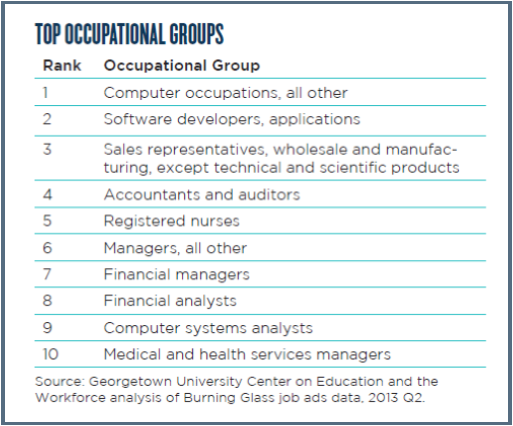
top occupationalThe top occupational groups reflected in the online job ads were 1) computer occupations, 2) software developers, 3) sales representatives,4) accountants and auditors, 5) registered nurses, 6) managers, 7) financial managers, 8) financial analysts, 9) computer system analysts and 10) medical and health services managers.

The distribution of online college job ads by occupational cluster shows that the largest percentage (24%) are in managerial and professional office occupations, followed by sales and office support (23%), STEM fields of science, technology, engineering and math (15%) and blue collar jobs (9%).

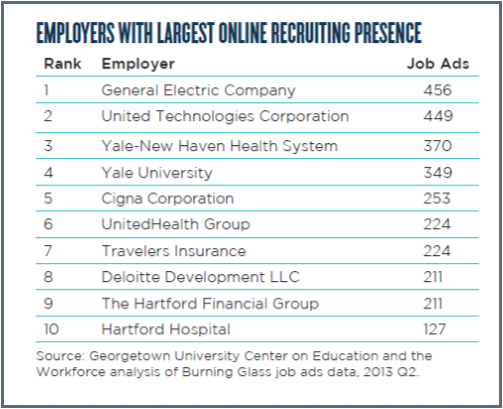
Connecticut employers with the largest online recruiting presence were General Electric Company, United Technologies Corporation, Yale-New Haven Health System, Yale University, Cigna Corporation, UnitedHealth Group, Travelers Insurance, Deloitte Development, The Hartford Financial Group, and Hartford Healthcare.

Across the country, college-educated workers will have the best odds of finding a job in STEM, managerial and professional office, and healthcare professional and technical occupations. The jobs of the new economy are prevalent for college graduates across the 50 states. Employers in information services, consulting and business services and financial services sectors post the most online job ads per college-educated worker.

largest employersThe Georgetown University Center on Education and the Workplace is affiliated with the McCourt School of Public Policy.  The study was done by Anthony Carnevale, Tamara Jayasundera, Dmitrirepnikov and Artem Gulish.

“The promise of this information is the ability to connect real people with real jobs in real time,” said Anthony P. Carnevale, the report’s lead author and director of the Center. “By combining information on online job ads with traditional employment data we are able to get a more complete picture of job opportunities available to college graduates in each state,” said Tamara Jayasundera, the report’s co-author.

In Massachusetts, 63 percent of job openings are for college graduates, while in West Virginia, only 36 percent of job openings are for college graduates.


college states

Weston High, Hotchkiss School Are Top High Schools in CT

Three Connecticut public high schools are ranked in the top 100 in the nation - Weston High School at #84 and New Canaan High School at #85, Staples High School in Westport at #94.  The rankings, compiled by the website Niche, focused on the overall student experience at the schools in developing the list.  Academics, health and safety, teachers, and student culture and diversity were aspects of the analysis.niche rankings banner 290px The top 15 public high schools in the state were Weston High School, New Canaan High School, Staples High School (Westport), Darien High School, Simsbury High School, Ridgefield High School, Wilton High School, Greenwich High School, Glastonbury High School, Amity Regional High School (Woodbridge), Conard High School (West Hartford), Farmington High School, Cheshire High School, Joel Barlow High School (Redding) and Daniel Hand High School (Madison).

Weston High School was named a National Blue Ribbon School for excellence in education by the U.S. Department of Education in 2013.  The school’s “greatest strength is the level of personalization that students receive during their four-year experience,” the Blue Ribbon citation indicated.

The Hotchkiss School in Lakeville is ranked as the top private school in Connecticut, and reached the top ten in the nation, at number seven.  It is the only Connecticut private school in the top 25.  The other Connecticut private schools in the top 50 nationally are Choate Rosemary Hall at #30 and Hopkins School in New Haven at #43. An independent boarding school founded in 1891, Hotchkiss School provides "an education of unsurpassed quality" to 600 students in grades 9 through 12, according  to the school website, which indicates that students come from across the United States and 34 foreign countries. best-overall_300x300 (1)

A high ranking in Overall Experience generally indicates that:

  • Students are very happy with their experiences in all aspects, including academics, teachers, health, safety, resources, facilities, extracurriculars, sports, and fitness;
  • The school is an exceptional academic institution in terms of teachers, students, resources for learning, and student outcomes;
  • The school is made up of a diverse population and fosters an accepting, positive school culture;
  • Students are actively involved in a variety of extracurriculars and sports the school offers.

The Best Public High Schools ranking provides what Niche describes as “a comprehensive assessment of the overall experience at public high schools in all 50 states, the District of Columbia, and Puerto Rico. It uses data sourced from various government and public data sets, Niche’s own proprietary data, and 4,625,227 opinion-based survey responses across a variety of topics from 287,560 current students, recent alumni, and parents.”

best-overall_300x300Factors considered in the analysis include:

  • Academics, which incorporates statistics and student, alumni, and parent surveys regarding academics at the school.
  • Health & Safety, which incorporates statistics and student, alumni, and parent surveys regarding health and safety at the school. R
  • Student Culture & Diversity, which incorporates statistics and student, alumni, and parent surveys regarding culture and diversity at the school.
  • Survey Responses, which consist of parent and student opinions about the overall experience at the high school they currently or recently attend(ed).
  • Teachers, which incorporates statistics and student, alumni, and parent surveys regarding teachers at the school.
  • Resources & Facilities, which incorporates statistics and student, alumni, and parent surveys regarding resources and facilities at the school.
  • Extracurriculars & Activities, which incorporates statistics and student, alumni, and parent surveys regarding clubs and activities at the school.
  • Sports & Fitness, which incorporates statistics and student, alumni, and parent surveys regarding athletics and general fitness at the school.

Niche-Rankings-CCA-GraphicAAmong private schools in Connecticut, according to the website analysis, the leaders are The Hotchkiss School in Lakeville, Choate Rosemary Hall in Wallingford, Hopkins School in New Haven, The Taft School in Watertown, Brunswick School in Greenwich, Greenwich Academy in Greenwich, Kent School in Kent, King Low Heywood Thomas School in Stamford, Greens Farms Academy in Westport and The Master’s School in West Simsbury.

According to the analysis, a high ranking indicates that “the school is an exceptional academic institution with a diverse set of high-achieving students who rate their experience very highly.”

The next ten private schools in the rankings are Westminster School in Simsbury, The Cheshire Academy, Miss Porter’s School in Farmington, Williams School in New London, The Loomis Chaffee School in Windsor, Canterbury School in New Milford, Marianapolis Preparatory School in Thompson, Kingswood-Oxford School in West Hartford, Avon Old Farms School  and Westover School in Middlebury.

Niche, based in Pittsburgh, was founded in 2002 by Carnegie Mellon University students as CollegeProwler.com, and has since “grown into one of the largest content startups in the country,” according to the company’s website.

Trees Sprouting Across Connecticut, 19 Municipalities Lead the Way

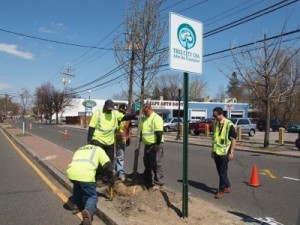
Tree City USA is an honor earned by cities and towns that meet four standards set by the Arbor Day Foundation and have their application approved the State Forester. Connecticut currently has 19 municipalities with the Tree City USA designation, which cover 31 percent of the state’s population. According to the Arbor Day Foundation, Connecticut’s longest running Tree City is Fairfield, which recently surpassed 26 years.  The largest community is Bridgeport, the smallest, by population, is Brookfieldthumb-grid-shaded-path

The four standards are having:

  • A tree board or department
  • A tree care ordinance
  • An urban forestry program with an annual budget of at least $2 per capita
  • An Arbor Day observance and proclamation

The other Tree City USA communities in Connecticut are Branford, Danbury, East Hartford, Groton, Hartford, Middletown, Monroe, New Canaan, New Haven, Norwalk, Ridgefield, Southbury, Stamford, West Haven, Wethersfield and Wilton.

Norwalk and Wethersfield, for demonstrating a higher level of tree care, have received Growth Awards from the organization.  Overall, there are 3,400 Tree City USA honorees across the country, with a combined population of more than 140 million.logo-tree-city-usa-color

Annual participation as a Tree City USA community provides the opportunity to educate people who care about their community about the value of tree resources, the importance of sustainable tree management and engage individuals and organizations in advancing tree planting and care across the urban forest.

The organization also offers on-line education courses for individuals interested in learning more about trees, or about serving in a citizen advisory role in their local community.

The Arbor Day Foundation indicates that an effective tree program can:

  • Reduce costs for energy, storm water management, and erosion control. Trees yield up to three times their cost in overall benefits to the city, averaging $273 per tree.
  • Cut energy consumption by up to 25%. Studies indicate that as few as three additional trees planted around each building in the United States could save our country $2 billion, annually, in energy costs.
  • Boost property values across your community. Properly placed trees can increase property values from 7-21% and buildings in woodedareas rent more quickly and tenants stay longer.

tree in BridgeportThe Arbor Day Foundation also has a campus program, designating colleges and universities as a Tree Campus USA.  The University of Connecticut is the only college in Connecticut to earn the designation.

The state Department of Energy and Environmental Protection's Urban Forestry Program is available to work with any community interested in exploring whether it qualifies as a Tree City USA and what is needed to earn that designation.

DEEP officials indicate that “many communities might be surprised at how close they are.”  Applications for next year's honor are due in December.  The program was initiated by the Arbor Day Foundation in 1976.

https://youtu.be/ol2_IcwaeDI


Bigelow Tea Takes On Flavor of Girl Scout Cookies

Fairfield-based Bigelow Tea, celebrating its 70th year of operation as a family-owned company, has teamed with the Girls Scouts of the USA in a licensing agreement that has put the popular Thin Mints and Caramel & Coconut cookie flavors in teas on shelves across the country. The teas are marketed as gluten free, sugar free and Kosher-certified and will be available for a limited time only, according to company officials. Bigelow produces 1.7 billion tea bags annually in 130 flavors, the company reported. Bigelow, which is privately held, employs 350 people in Fairfield; Boise, Idaho; and Louisville, Kentucky; as well as its Charleston Tea Plantation in South Carolina.

scoutsBigelow President and CEO Cindi Bigelow is a former Girl Scout. “Once a Girl Scout, always a Girl Scout,” she said in a statement. “As a proud Girl Scout alumna, our two new tea temptations reflect the Bigelow Tea blenders’ never-ending quest to delight consumers with up-to-the-minute flavor innovations in a way that’s very special to me.”

Only about 5 percent of companies nationwide have female CEOs, including Cindy Bigelow, who has been involved with the family business in one way or another since she was a teenager.  Bigelow, who represents the third generation in her family to run the business, said it's the personal touch that keeps the company successful.  The company was founded in 1945 by Cindi Bigelow's grandmother, Ruth Campbell Bigelow.

“These delicious teas are made possible by a licensing arrangement with Girl Scouts of the USA and combine the renowned flavor blending expertise of the Bigelow Tea Co. with the time-honored exciting Girl Scout Cookie flavors we all know and love,” the company said. The company-suggested price is $3.99 per 20-bag box.Cindi-Bigelow-head-shot

The Thin Mint tea “delivers the perfectly balanced mint and chocolate flavor of the Girl Scouts’ famous Thin Mints cookies” and the Caramel & Coconut tea is described as a “black tea blend offering a delectable taste combination of luscious caramel and coconut,” the company explained.

Tea has been increasing in popularity, and now ranks as the second most consumed beverage in the world, after water, according to the Tea Association of the U.S.A.  The wholesale value of tea sold in the U.S. grew from less than $2 billion in 1990 to more than $10 billion today.  Bigelow has about $150 million in annual sales, according to a company news release, but it claims 24 percent market share in the specialty teas category, making it the industry leader.

As CEO, Cindy Bigelow initiated the Annual Bigelow Tea Community Challenge that has donated over $1 million to local charities and participates in volunteer projects that include Habitat for Humanity’s Adopt-a-Home program. Under her leadership, the company was one of the first in Connecticut to install solar panels to offset energy usage, and she has implemented other innovations that have earned Bigelow Tea the distinction of being a Zero Waste to Landfill company.  Over the past several years, the company reports it has reduced our energy consumption by over 2.5 million kWh in the Fairfield plant through energy efficiency measures, resulting in a savings of over 2.7 million pounds of carbon, or the equivalent of planting 41 million trees.

As a family owned company for three generations, Bigelow Tea’s company culture includes a commitment to sustainability and fair business practices, "not only here at home but around the world.  That’s why we’re proud to be part of the Ethical Tea Partnership, an organization that works with tea growers to establish methods for responsible conservation of the world’s tea fields and improve the lives of the beautiful people who work the," the company website points out.


https://youtu.be/6xQVEtve_d4

Portions of this story originally appeared in the Fairfield County Business Journal

Support of American Heart Association Brings Benefits to Connecticut

The Greater Hartford Heart Walk, a noncompetitive 5K walk held annually each fall by the local affiliate of the American Heart Association, is one of many similar endeavors around the state by nonprofit organizations seeking to raise awareness and raise funds – and one of three organized annually by the American Heart Association in Connecticut. What is often overlooked, especially when the sponsoring organization bears a well-known national name, are the array of benefits that result close to home.   The American Heart Association is a case in point.

Cardiovascular diseases and stroke are the #1 cause of death in Connecticut. Last fall, just over 1,500 walkers at the Greater Hartford walk helped to raise nearly $190,000 to support research, advocacy and awareness of cardiovascular disease and stroke.  That money does not simply disappear into a giant national pool of funds – much of it finds its way back to Connecticut.americanheartphotos

The organization currently supports 43 research studies in Connecticut with awards totaling $9,300,533, officials report.  The grants and fellowships help to advance discovery, interpretation and delivery of new knowledge to spur improvements in cardiovascular health.  Among those supported by awards from the American Heart Association are researchers on the University of Connecticut campus in Storrs, the UConn Health Center in Farmington, Yale University and the Yale University School of Medicine.

The organization’s Greater New Haven Heart Walk will take place on Saturday, May 2 at Savin Rock. The event is hoping to raise over $340,000.  [Walk registration will begin at 9:00 a.m. and the walk will kick off at 10 a.m. with a walk along Savin Rock Beach.]  The Greater New Haven Heart Walk is part of the American Heart Association’s national healthy living initiative, My Heart. My Life. The program focuses on improving nutrition, physical activity and children’s health, helping individuals and families understand how to make incremental changes for a substantial long-term health impact.

The American Heart Association also urges employers to “create a culture of physical activity and wellness so that we may all live longer, heart healthy lives.”  The local chapter, based in Wallingford, works with Connecticut corporations to become a Fit Friendly Worksite.

Through the Fit-Friendly initiative, the American Heart Association provides free tools for worksites and employees including a Healthy Workplace Food and Beverage Toolkit, walking and physical activity programs, worksite wellness materials, and more.  Eligible worksites can then receive recognition by the American Heart Association at local events and in recognition program communication materials including an Annual Honor Roll published on the organizations website and other amenities.  In Connecticut, 40 companies have been designated as Fit Friendly Companies and in Massachusetts, 78 companies are committed to better employee health.

“More than two-thirds of American adults are overweight or obese putting them at risk for heart disease and stroke”, said American Heart Association Connecticut and Western Massachusetts Executive Director Dina Plapler. “Making healthy changes in the workplace, where many adults spend much of their day, is an important way to help people be healthier”.go-red-banner-icon

The annual Greater Hartford Go Red For Women Luncheon, another well-attended education and fundraising event, celebrated its 10th anniversary this year.  The March 18 event at the Connecticut Convention Center included survivor speaker, Leigh Pechillo.  A native of Connecticut, Leigh experienced sudden cardiac arrest on Mother’s Day, May 11, 2014.  She was fortunate that her husband knew CPR and helped to save her life.  Her husband, daughter and son were presented with a Heart Saver Award by American Heart Association President, Nancy Brown at the event.  The event raised over $400,000 to benefit women’s heart health.

The Go Red For Women initiative is dedicated to making an impact in the community through education and fundraising to fight the number one killer of women, heart disease. Heart disease and stroke account for 31.1 percent of all female deaths in Connecticut and on average, nearly 13 women die from heart disease and stroke in Connecticut every day.

For more information on the Greater New Haven Heart Walk go to www.newhavenheartwalk.org. Other Heart Walks taking place in Connecticut this year include the Rocky Neck Heart Walk on Sunday, September 27 at Rocky Neck State Park and the next Greater Hartford Heart Walk on Saturday, October 3.  For more information on these events and more, visit www.heart.org/connecticut.


Digital Citizenship Summit will Bring State, National Tech Experts to Connecticut

Connecticut will be the center of the digital universe this fall, when the University of Saint Joseph (USJ) in West Hartford hosts a Digital Citizenship Summit, bringing local and national experts together to explore the good, the bad and the ugly about the pervasive and ubiquitous use of technology in our personal and professional lives. The term “digital citizenship” describes appropriate, responsible tech and Internet use. Similar to the rights and responsibilities involved in being a citizen, there are legal and ethical obligations with being a digital citizen, organizers explain.digital-access1

The aim of the Digital Citizenship Summit, to be held on October 3, is to create positive, practical solutions along with amplifying the overall message of improving tech usage. Topics for the all-day Summit include digital literacy, etiquette, wellness, security, and law.

“We believe that digital citizenship deserves its own space for educational, non-profit, and industry leaders to focus on solutions and push new ideas forward focused on positive, practical solutions to improve our use of technology and the Internet. The Digital Citizenship Summit aims to bring together the various silos of thought and activity across the country in order to create a stronger, more unified message for better tech usage,” organizers said.

This inaugural event is being sponsored by the University of Saint Joseph’s School of Education, Office of Student Affairs and Office of Informational Technology and will engage students, teachers, parents, administrators and policy makers in a dynamic conversation focused on digital citizenship.  It comes in the first semester of the administration of incoming university President Rhona Free, who takes office July 1.  Free is a past national Professor of the Year as selected by the Carnegie Foundation for the Advancement of Teaching and the Council for Advancement and Support of Education (CASE).

Plans are for the Summit to include a panel discussion, breakaway sessions, a keynote talk TED-style, and a social event to “connect with all the fascinating big thinkers across the country who are pivotal in shaping digital citizenship.”Picture2

Among the speakers will be:

  • Alan Katzman is Founder of Social Assurity, the leading youth social media advisory service in the country. They work with students and families on customized social media training to maximize the students’ opportunities and use of social media to their advantage.  He is an entrepreneur and former attorney with an expertise in law, technology and software, compliance, human resources and investigations.
  • Mike Ribble: Known as the godfather of digital citizenship, Kansas-based Ribble is an international speaker, researcher and author of the books Digital Citizenship in Schools (soon to be in its 3rd edition) and Raising a Digital Child. He has worked within the education field his entire career, including as a science educator, an assistant principal at the high school level, and adjunct faculty at the college level.
  • Jennifer Scheffer: Mobile Learning Coach and Instructional Technology Specialist at Burlington, MA Public Schools, she is a dynamic and energetic teacher leader with over a decade of experience teaching project-based computer technology, marketing, and business management courses. She coaches students on how to leverage social media tools to showcase their talents, create a positive online presence, and build their professional network.
  • Sarah Thomas is a Google Certified Teacher and Edmodo Certified Teacher, as well as a leader of the Washington, DC Google Educator Group and founder of the EduMatch project. She is the Technology Liaison at John Hanson French Immersion School in Oxon Hill, MD and teaches Technology Integration and English Language Arts at the middle school level.  She is a recipient of the 2014 Digital Innovation in Learning Award and was named by the National School Board Association as one of the “20 to Watch” in 2015.

The organizing committee for the Summit includes:250px-UnivSJct

  • David Ryan Polgar, a frequent speaker and respected tech commentator whose ideas and thoughts concerning digital citizenship have been featured in publications including The Boston Globe, Financial Times, Sydney Morning Herald, US News & World Report, and Forbes. With a background as an attorney and college professor, he examines the use of technology from an ethical, legal, and emotional perspective.
  • Marlialice B.F.X. Currran, an Associate Professor at USJ, focuses on digital citizenship and social media in K-12 teacher education. A former middle school teacher, principal and an advocate for young adolescents, Curran was named one of the Top 10 Digital Citizenship bloggers by Common Sense Media in 2014.
  • JoAnn Freiberg is an Educational Consultant with the Connecticut State Department of Education, responsible for managing bullying, improving school climate and character education, and has taught at numerous colleges in Connecticut and currently is Co-Chair of the National School Climate Council.

organizing committeeOften referred to as a Tech Ethicist, Polgar has become a respected and unique voice in the digcit community. He is a contributing writer with the Family Online Safety Institute, iKeepSafe, and The Good Men Project, along with appearing regularly on television to discuss issues such as tech balance, cyber ethics, and tech etiquette.  He has delivered two TEDx talks on digital technology.

In describing Dr. Curran, Common Sense Media said “she is a long-time proponent of responsible online behavior, and encourages her undergraduate and graduate students to learn and explore what it means to be socially responsible both face to face and online, how teaching empathy is the most important 21st century skill and how social media can change teaching and learning in PK-12 classrooms.” Dr. Curran and Tracy Mercier co-founded the digital citizenship #digcit chat on Twitter in 2011. The first chat was inspired as a result of a digital citizenship course at USJ.

Registration for the Summit will be available later this spring, along with additional details regarding the agenda and program, at the website www.digcitsummit.com.

Photo: Marlialice B.F.X.Curran,  David Ryan Polgar,  JoAnn Freiberg. 

Connecticut Has Most Disengaged Employees; State Tied for Last Place in Gallup Survey

Actively disengaged employees are not just unhappy at work, these employees undermine the accomplishments of their engaged coworkers. They monopolize managers' time, account for more quality defects and quit at a higher rate than engaged employees. No state in the nation has more actively disengaged workers than Connecticut, according to a new two-year survey by the Gallup organization, for the period January 1, 2013 through December 31, 2014.

There is a four-way tie between Connecticut, New York, Michigan and Kentucky for the highest percentage of actively disengaged workers – 21 percent in each state, according to the Gallup survey. Residents of South Dakota, Wyoming, Alaska and Vermont reported the lowest percentages of actively disengaged workers, each with less than 15 percent. The national average for 2013-2014 was 18 percent active disengagement.disengagement map

On the other side of the ledger, workers in Montana (39%), followed closely by those in Mississippi (37%) and Louisiana (36%), had the highest levels of employee engagement in 2013 and 2014. With 22 percent of workers engaged, the District of Columbia had the lowest employee engagement, followed by New York, Minnesota and Connecticut. Nationally, 31 percent of workers were engaged during this time period.

Gallup identifies workers as engaged, not engaged or actively disengaged based on their responses to items that assess key workplace elements found to predict important business outcomes.

  • Engaged employees are involved in and enthusiastic about their work and workplace. Day after day, they are passionate about their jobs and feel a profound connection to their company. They are more productive, drive innovation and promote organizational growth.
  • Not engaged employees are essentially "checked out." They demonstrate less concern about customers, productivity and profitability. They do not own or feel passionately about their work.
  • Actively disengaged employees are not just unhappy at work; these employees undermine the accomplishments of their engaged coworkers. They monopolize managers' time, account for more quality defects and quit at a higher rate than engaged employees.active disengagement

In its analysis, Gallup points out that “Active disengagement tends to be more highly related to labor market trends such as unemployment, underemployment and letting people go.” Previous Gallup research has indicated that employees in very small companies (fewer than 10 employees) have higher rates of engagement and lower rates of active disengagement – which Gallup suggests may be related to the psychological ownership and autonomy that is often present in small companies.

Rates of unemployment and underemployment are also associated with variation in engagement, Gallup’s analysis points out. Recent employment statistics and overall U.S. workforce trends suggest that active disengagement has declined in line with decreases in unemployment and underemployment.  Connecticut’s economic recovery has lagged, although the number of jobs created has steadily climbed.

Ten Innovative Economic Development Plans Due This Month in Hartford’s Strong Cities Challenge

As one of three cities selected as part of a competitive process to participate in the Strong Cities Strong Communities (SC2) Initiative under the auspices of the Economic Development Administration of the U.S. Department of Commerce, Hartford has 10 teams of economic development innovators coming down the home stretch in developing and outlining their inventive economic development proposals. The EDA-funded SC2 Hartford Challenge, launched 14 months ago, is in its final phase. Ten multidisciplinary teams of finalists are working on plans aimed at helping to establish Hartford as a “city for entrepreneurs.” The U.S. Economic Development Administration notes that the goal of the SC2 Hartford Challenge is to generate economic development plans that “both leverage local assets and compliment larger trends and opportunities.”SC2_Logo_REV

City and community leaders will judge the plans and choose six winners who will share $800,000 in prize money, with the top plan receiving $500,000. The City of Hartford and the EDA will jointly own the winning plans and be able to implement the ideas—both in Hartford and in other cities around the country. Plans are due this week, with six winners to be announced in May.  Funds for the winning plans are provided by EDA.

The two other cities selected — Greensboro, N.C. and Las Vegas — opted to focus on a single project or hire a consulting firm. Hartford officials preferred to provide area residents with an opportunity to create locally-driven proposals and created an open competition, which initially saw 58 teams developing plans, which were then winnowed down to a top 10 last fall.

The most recent descriptions highlighting the teams’ respective economic development plans include:

Hartford.Health.Works (HHW) is an industry-led collaboration with the mission to increase the number of good quality jobs in Hartford by fostering healthcare technology development and manufacturing. To attract existing med tech companies and foster new companies, HHW is creating a FDA-approved, ISO-certified medical device prototyping and manufacturing plant in Hartford and implementing targeted programs to improve access to: A) expertise; B) capital; and C) markets. HHW is also developing biomedical engineering and precision manufacturing education and job training programs at the K-12, college, and graduate school levels. HHW founding partners include: Rising-Tide Health Care, BEACON, and Movia Robotics.

logo-white EDAChoose Hartford is a comprehensive initiative to scale up businesses that will create a sustainable regional economy with long-term growth prospects and jobs. The plan aims to increase access to innovative capital options along with an across-the-board effort to ensure collaboration of local, regional, state and federal partners to create the best entrepreneurial ecosystem in the country.

It’s All Here is an asset based economic development model which will build wealth and raise incomes in all of Hartford’s neighborhoods. The team believes that self-employment and small business ownership is the best way to build a new future for all of the city’s residents. Lasting, sustainable economic development has to be built on the talents of city residents, giving access and visibility to new markets and service providers using an interactive website, a multi-lingual call center, physical market locations, and turnkey digital street signage.

Made in Hartford is an entrepreneurial ecosystem to empower Hartford’s community. With a culture of innovation, tradition of industrial adaptation, and healthy urban core, Hartford is ripe for attracting and retaining entrepreneurs. The plan recommends coordinated, strategic actions that will work in tandem with existing investments to provide a sustainable ecosystem for first-time and serial entrepreneurs. Central to this ecosystem is ‘Made-in-Hartford’, a seed accelerator that will cultivate industries and businesses through incubation, mentoring, equity-capital and partnerships. Made-in-Hartford targets Hartford’s established industry clusters and human capital to spark much-needed economic diversification, and at its maturity ancillary initiatives will incentivizing successful entrepreneurs to reinvest in this entrepreneurial ecosystem, bringing about an economic renaissance.cityofhartford

Team Fotofiction: For those of us in the business of innovation, our mantra is: Think outside the box. Unconventional success isn’t born with conventional thinking. Game-changing, outside-the-box ideas often emerge from the most unexpected places. Re-purposing shipping containers is innovative and cutting edge, yet not unproven. From Los Angeles to New Zealand, these containers are being used for a variety of new purposes. The FRATE concept: to create an urban community, where people will live, work, dine and shop in a dynamic, trend-setting environment constructed entirely of modified shipping containers. FRATE thinks inside the box. FRATE is that game changer.

Solutionists focuses on remediating the economic environment that qualified Hartford for the SC2 Challenge, viewing the task as developing a strategy that will result in increased employment opportunities for Hartford residents -- now, and in the future. The plan embraces Social Enterprise and Collective Impact strategies by creating an ecosystem of spirit, policy and financial incentives that encourage and support Social Entrepreneurs in their efforts to start and grow the types of businesses that will produce desired results for Hartford and the Region.

#lovehartford will implement low cost interventions that promote economic development, foster social interactions, and support changing transportation dynamics founded on the growing demand for affordable urban environments that support the sharing economy and reduce reliance on the private automobile. Short-term projects include the demonstration of open streets with pop-up markets and food trucks. Longer-term projects include a bike share system and support for other evolving transportation technology, like the driverless car. #lovehartford will offer micro-loans to grow small business, and will look to provide locations that include creative placemaking through murals, public art, and other cultural programming.

Also among the ten competitors are Entrepreneur Foundation, community bootstrapping through entrepreneurship; Made at Swift, a food-driven innovation cluster to create jobs and improve population health; and CJM Innovations, fostering an entrepreneurial ecosystem for students and young professionals.

Major New Academic, Residence Facilities Opening At State University Campuses

Years in the making, a number of major new facilities are in the midst of coming on  line at Connecticut's four state universities - Central, Eastern, Southern and Western - that are part of the Connecticut State Colleges & Universities (CSCU) system administered by the Board of Regents for Higher Education.  The facilities include a library, residence hall, classroom building, performing arts instructional centers, and a science and laboratory building, among other new and renovated facilities. libraryAt Southern Connecticut State University in New Haven, students now have a first-rate, 21st century library in which to study, conduct research and meet with their friends and classmates, the university announced this week. A ribbon-cutting ceremony to mark the opening of the “new” Buley Library was held April 20. The event marked the completion of the $31 million project that renovated the original wing of the building. A 12,000-square-foot area that will serve as an atrium has been added to the older 98,000-square-foot wing as part of the project. When combined with the 135,000-square-foot addition that was completed in 2008, the library now encompasses 245,000 square feet.
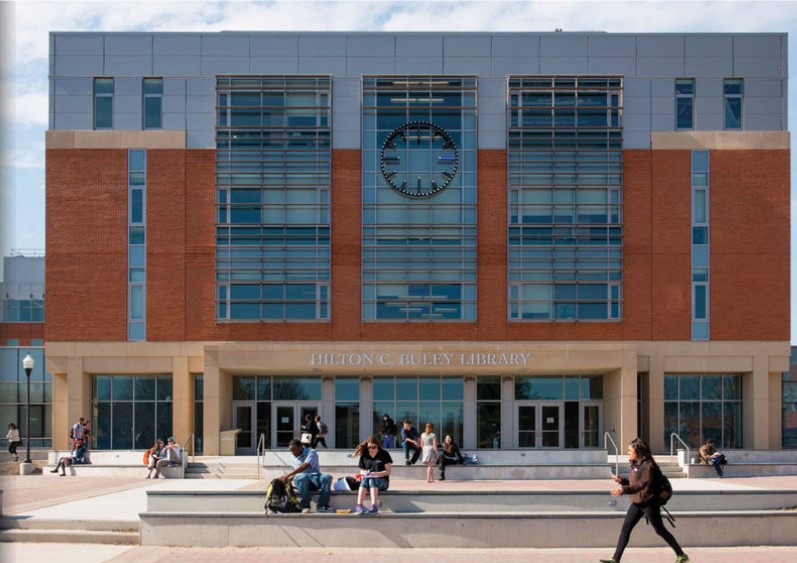
“This truly is an exciting and energizing time for Southern because we are gaining the physical resources to prepare our students for success in the 21st century knowledge-based economy,” said SCSU President Mary A. Papazian. “The students already have claimed this library as their own.”

Among the other amenities in the four-story complex is a “learning commons”-- an area on the first floor that includes a computer lab, lounge seating, email stations, a reference help desk and an IT help desk. The library houses space for media collections and special collections, on the ground floor. Three classrooms, two computer teaching labs, a seminar room and a conference room also are part of the new Buley.  In addition, a cyber café and a Student Success Center that includes tutoring rooms, a computer lab and conference space are scheduled to open in the fall.
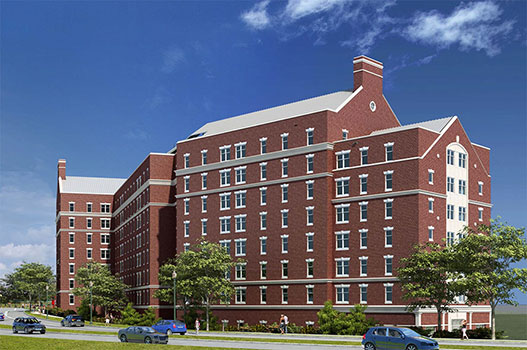
New-Residence-HallAt Central Connecticut State University in New Britain, there is a Fall 2015 target date for completion of a new on-campus residence hall and food services dining facility. That will follow by just two years the opening of a major new classroom building on the CCSU campus.  The four-story academic building houses classes and faculty offices for the sociology, history, anthropology, geography and political science departments, according to university officials.  It includes 17 classrooms, five seminar rooms, seven labs and 71 offices for faculty and administrators.  Now completing construction at the corner of Harold Lewis Drive and Ella Grasso Boulevard, the new $82.3 million, eight-story 220,000 square foot residence hall "will keep CCSU in the vanguard of higher education in operations and facilities," points out CCSU President Jack Miller, noting its ideal fit into the university's strategic plan for the recruitment and retention of new students.

easterbOpening this fall on the campus of Eastern Connecticut State University in Willimantic is a Fine Arts Instructional Center - a 118,000 square foot building that will contain three main performance venues; an auditorium; a procenium theater and a black box theater.    In addition to the performance spaces there will be instructional labs and other spaces in support of the Performing Arts Department.   There will be design studios for the Visual Arts Department including Printmaking, Sculpture, Painting and Drawing. The building will also have three general purpose classrooms and a gallery.  Construction  has been underway for the past two years.

The new residence hall at CCSU will be the school’s tenth, and the largest on any of the four Connecticut state university campuses, according to CCSU officials. Features include over 600 beds, a 2,000 square foot fitness facility, a kitchenette on each floor, a large kitchen and living room on the main floor, and will house approximately 150 suite-style rooms, each with a living room and bathroom shared by four students. Each floor will also have a computer room, a game room and group study rooms and alcoves for one-on-one studying and socializing.  Construction is also scheduled to begin soon on a new food services dining facility located near the north end of campus near the existing residence halls.  The planned $10.3 million, 22,000 square ft. food services dining facility will include areas for food preparation, serving, and accommodate dining for approximately 1,200 residents.

Renovations are also underway at Willard and DiLoreto Halls at CCSU, among the oldest academic buildings on campus. The $61,085,000 project calls for both of the academic buildings to be completely renovated, including the development of a new main entrance with elevators, bathroom facilities, and additional offices and classroom space, along with new heating, ventilation and air conditioning systems, with the interiors of the buildings also receiving enhanced lighting, computer technology and classroom/office upgrades.

Last September, Western Connecticut State University opened its new Visual and Performing Arts Center. Students, faculty and staff were on hand to “put the building through its paces” in a multitude of spaces, including the Concert Hall, Studio Theatre, Art Gallery, Painting Studio, Recording Studio, Scene Shop, Dressing Rooms, Sculpture Studio, and M.F.A. Studios. Since the gala opening, the new facility has enhanced the artistic and academic experience for students, faculty, staff and patrons - and received positive notice in regional and national publications.

At 130,000 square feet, this uniquely designed facility is divided into three distinct wings: Theatre Arts, Music and Visual Arts, all connecting together. Students taking courses in the art wing benefit from light shining through double-height, northern-exposed windows in the spacious painting and sculpture studios. They work in photography and graphic design studios equipped with both the latest computer technology and the legacy technology of traditional film development.Two theater rehearsal studios, both equipped with audio/visual technology and sprung dance floors complement the university’s increasingly popular musical theater program. Dressing rooms, practice rooms and individual Master of Fine Arts in Visual Arts studios are all incorporated into the spaces, designed for students so they may experience a professional-quality arts education.
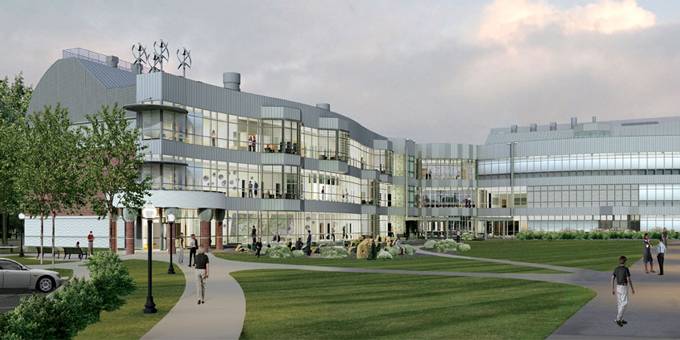
2SCSU-South-ViewThe next major opening among the CSCU institutions will likely be a Science and Laboratory Building at Southern Connecticut, due later this year.  Southern's ongoing expansion of its science programs will be greatly enhanced with the construction of a 103,608-square-foot, four-level academic and laboratory science building. Situated adjacent to Jennings Hall, the current home for the sciences, the new building will enhance the ongoing expansion of Southern’s science programs and the university’s capacity to educate more students in the STEM disciplines – science, technology, engineering and mathematics.

According to Southern's website description, the building will be configured in the shape of an “L,” the new building will work in concert with two pre-existing science buildings — Jennings and Morrill halls — to enclose a new “science enclave.” Bedecked with scientific displays and instrumentation visible from within and outside the building, the new center will house teaching and research training laboratories for nanotechnology, physics and optics, the earth sciences, the environmental sciences, cancer research, astronomy, molecular biology and chemistry.  The building’s two wings will be connected at each of its four floors by an alluring connector windowed along its southern exposure and encircling the newly formed science enclave outside. It is along the glass-enclosed path that built-in displays of optical phenomena, the natural environment, nanotechnology, geological formations, biological specimens, and astronomical observations will be interspersed among sun-filled lounges, all to advance interaction among the different scientific disciplines housed within.

https://youtu.be/Gb-22XsNVGg

https://youtu.be/irCxZNZk9Rg