Housing, Education, Poverty Among Greater Hartford Region's Challenges, Report Reveals
/Of the 4,000 affordable housing units added to the 38-town Greater Hartford region over the past five years, nearly half (47 percent) have been in Hartford and New Britain – almost as many as were added in all of the other 36 towns in the region combined.
That stark statistic is among the points emphasized in the second edition of Metro Hartford Progress Points, an analysis of data compiled by the Hartford Foundation for Public Giving and a coalition of community and regional organizations. The inaugural report was released last year, and the new edition updates some of that initial data, as well as revealing new information about the region’s demographics, opportunities and challenges.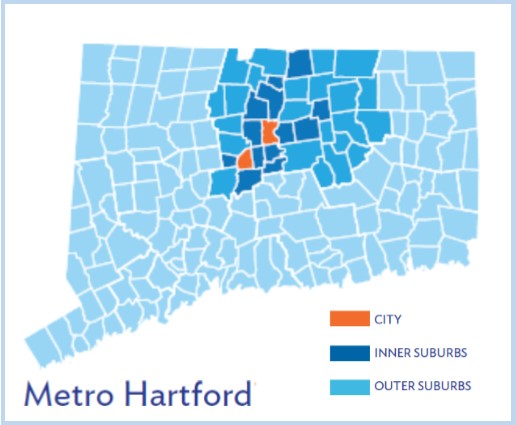
Regarding the fact that much of the housing is being developed in municipalities that face considerable economic challenges, the report notes that those 36 towns have lost over 9,000 students in local schools during the past five years, despite having school districts that perform more than 30 points higher and standardized testing than those in Hartford and New Britain. The report indicated, for example, that for every 100 children born in the region’s outer ring suburbs (such as Glastonbury), 113 enroll in local public school five years later, as opposed to 81 who enroll in city schools and inner ring suburbs (such as Bloomfield).
The second edition of Progress Points “takes a deeper look at key issues impacting our communities and how they are connected. The report asks how we can build on our strengths and fully utilize the assets that the region has to provide access to opportunity for all,” officials explained. Using key indicators to identify opportunities for action, the 2015 report focuses on three regional priorities: 1) Access to better schools, 2) Access to better jobs, and 3) Access to stronger neighborhoods.
 Looking at five year trends, the report found that the region’s population of about 1 million people has grown by 2 percent, which translates to about 20,000 people or about 4,000 families. Regional job growth, 3.5 percent, is on par with the state, but remains about 8,000 jobs below pre-recession levels. The crime rate across the Greater Hartford region has been reduced by about 18 percent during the past five years, faster than the state (-16%) and national (11%) trends.
The study determined that there are more people living in poverty in the region than 10 years ago. “Suburban communities have seen a major increase in the population living in low-to-mid-poverty neighborhoods,” the report said. “Poverty is a regional, not an urban, problem. Addressing poverty requires improved coordination among towns to better connect transportation and other services to increase access to opportunity.”
In education, the report also notes that about 4 percent more third-graders are reading at or above grade-level goals, a faster improvement than statewide (1.3 percent). There has been no change in the percentage of kindergartners in the region starting school with pre-K experience. That level, 78 percent, is the same in the region as statewide. Focusing on declining enrollment, officials indicated that some of the region’s highest-performing school districts are seeing the greatest decrease in enrollment as a result of declining birth rates: Simsbury at 13 percent, Tolland at 16 percent, Granby at 14 percent. Avon and Glastonbury both are experiencing a decline of 8 percent.
Metro Hartford Progress Points was introduced “in order to identify and better understand the critical education, income and opportunity gaps that exist in our region. This year, we’re continuing the discussion, looking for ways to improve access to better schools, better jobs and stronger neighborhoods for everyone in the region,” officials indicated. “Access to better jobs builds stronger neighborhoods. Stronger neighborhoods help to connect families to better schools. And better education ensures that workers are ready to take on those jobs — increasing prosperity, growth and quality of life for all.”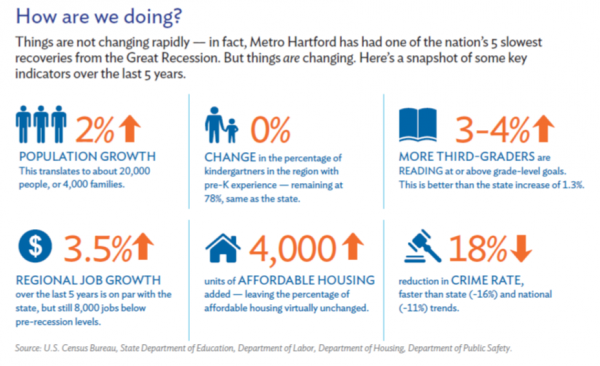
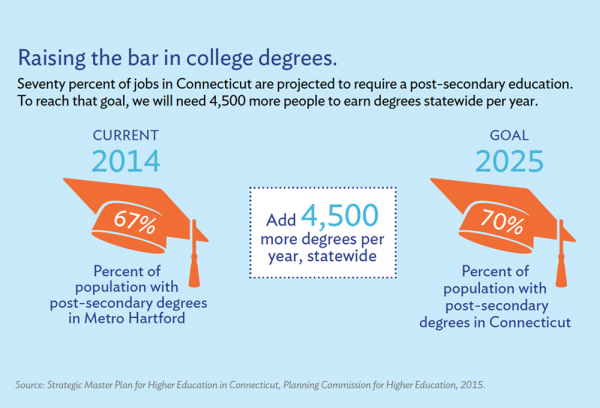
Regarding preparation for college, the report indicates that “almost 50 percent of all students entering community college or Connecticut state universities require remedial coursework and training, even those from high-performing districts.” The report notes “this means paying for additional courses, which only increases student debt.” The report indicates that 70 percent of jobs in Connecticut are projected to require a post-secondary education by 2025. To reach that level, it is estimated that an additional 4,500 people will need to earn degrees statewide per year. Currently, 67 percent of the population in Greater Hartford has a post-secondary degree.
 Partner organizations in developing the report include the Hartford Foundation for Public Giving, Capital Workforce Partners, Capital region Council of Governments, Metro Hartford Alliance, Hispanic Health Council, United Way of Central and Northern Connecticut, Urban League of Greater Hartford, Center for Urban and Global Studies at Trinity College, and the City of Hartford.





 The survey noted that more than two-thirds of consumers (68 percent) looking to purchase their first home are interested in move-in ready homes while one-third would like to buy a fixer-upper. And when it comes to amenities, respondents are most interested in their first home having a backyard or pool and an attractive design, followed by energy efficient / smart homes technologies.
 U.S. Commerce Secretary Penny Pritzker honored a total of 45 American companies and organizations, many of which are small- and medium-sized enterprises (SMEs), at the 2015 President’s “E” Awards ceremony, held earlier this year. The six Connecticut businesses were among the 45 honored.
 Proton Onsite makes hydrogen and nitrogen generators. Mutualink manufactures equipment used to facilitate collaborative communication between public safety and first response teams at the scene of emergencies. Jonal Laboratories makes sealant used in the aerospace industry. Dymotek manufactures custom injection molded plastic and silicone parts for electronics, plumbing valves and juice dispensers.
 t assist and facilitate export activities were honored with the “E” Award for Export Service. Four firms received the “E” Star Award for Exports, which recognizes previous “E” Award winners who have reported four years of additional export growth. And, three companies were awarded the “E” Star Award for Export Service, which recognizes previous “E” Award winners that have shown four years of continued support of exporters since first winning the “E” Award.
 This year marks the 53rd anniversary of the
 using, residents between 35 and 44, and the percentage of residents under age 9. The final two categories used in the calculation, access to day care and access to grocery stores, were weighted at 5 percent.
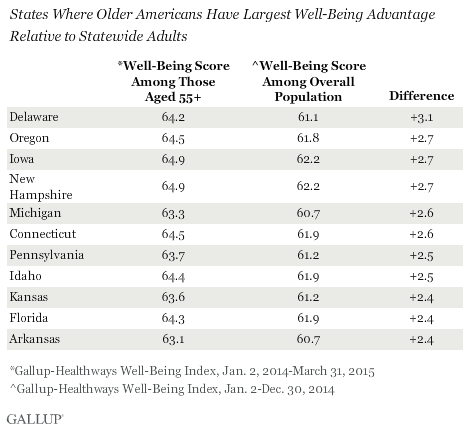 The Well-Being Index is calculated on a scale of zero to 100, where zero represents the lowest possible well-being and 100 represents the highest possible well-being. Connecticut’s well-being score was 64.5 for those age 55+, compared with 61.9 for the overall adult population. The difference of 2.6 was the sixth highest among the states.

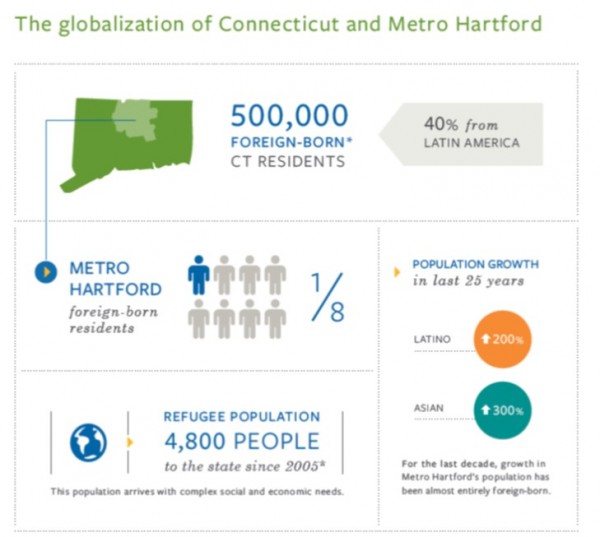 “The Latino Endowment Fund has offered this report as a means to expand the important discussion on efforts to support English Language Learners in our communities,” said Luis Cabán, chair emeritus of the Latino Endowment Fund Steering Committee. “This document provides us with an opportunity to reframe how we think about our increasingly global community and recognize the advantages of people speaking more than one language to enhance the richness of our community and create stronger links to the global marketplace.”