Remarkable Tenacity, Inspiring Music Distinguish CT’s New State Troubadour

It is a singular distinction.  Singer-songwriter Kate Callahan, a native of West Hartford and current  Hartford resident, has been selected as State Troubadour, to serve a two-year term beginning this month. Connecticut is the only state in the nation that honors a singer-songwriter with a formal position. The State Troubadour serves as an ambassador of music and song and promotes cultural literacy among Connecticut citizens.

IMG_0652Callahan’s extensive touring, public speaking, and teaching make her a natural fit for the position. “Connecticut Roads,” her original composition, tells a story of Connecticut people and places, and is a joyous, melodious remembrance of growing up in the Nutmeg State.   “This is where I’ve gotten my start and I see friends on the road of life… we do it here in this place we call home.”

With the new statewide platform, she plans to bring therapeutic music to Connecticut inmates, perform at State and local ceremonies, start her own grassroots record label, and share her experiences with the healing power of music.

At the age of nineteen, she sustained traumatic brain injury in a skiing accident. She had to withdraw from college and rehabilitate five days a week for a year until her insurance ran out. Her doctors told her she had plateaued. Callahan knew she had more desire to heal than the doctors could see, so she took up acoustic guitar lessons.

Her short-term memory was so impaired that she couldn’t remember that she was taking lessons from week to week. Over time, however, she began to remember and saw improvements in her coordination, eyesight, and guitar playing. She began writing songs soon after that and felt compelled to share them with small audiences at open mics. Open mics turned into features, opening sets, and headlining appearances at venues throughout New England.

In the years since her tenacious recovery, the 16th Connecticut State Troubadour has earned many accolades in her home-state, having been named Best Singer-Songwriter by the Connecticut Music Awards, Featured Artist of the Year by the Greater Hartford Arts Council, and Best Solo Performer by the Hartford Advocate. She was also awarded the Hartford Courant's "Woman of Character Award” for her involvement in schools and on stages.troubadour

Callahan began her two-year tenure as Connecticut State Troubadour at the State Capitol on Wednesday March 2.  Her performance of the original song, Connecticut Roads, concludde Connecticut Arts Day, the first of its kind in over ten years. The event brought together a broad cross section of policy makers, arts, cultural and creative industry organizations and individuals from across Connecticut.

The day-long event was sponsored by the Connecticut Office of the Arts in partnership with the Designated Regional Service Organizations, Connecticut Arts Alliance, Connecticut Arts Council, Culture & Tourism Advisory Committee and the Connecticut Arts Foundation.  The day included panel discussions, guest speakers, and a range of performances from individuals, groups and organizations from throughout the state.

The honorary position of Connecticut State Troubadour was established in 1991 by the State of Connecticut.  The Connecticut Office of the Arts (COA) appoints an individual resident singer-songwriter as State Troubadour based on the recommendation of a review panel.

Recent State Troubadors include Kristen Graves, a singer/songwriter and activist from Fairfield (2013-2015), Charles (better known as Chuck) Costa of Madison (2011-2012), Lara Herscovitch of North Guilford (2009-2010), and Pierce Campbell (2007-2008).

Callahan’s music has been described as soulful, inspirational, lyrical and mystical at times, and Callahan has been described as “unapologetically optimistic” in concert. The Boston Globe calls Callahan "an award-winning singer who rose from a calamitous injury to claim her creative life.”

During April, Callahan will be performing in Manchester, Hamden and Wethersfield as her tenure as State Troubadour, the 16th in state history, gets underway.   To learn more about Kate Callahan, visit her website www.Kate-Callahan.com

CT Residents Believe Economy, Business Conditions Have Improved, But Uncertain About Future

Connecticut residents are somewhat more upbeat about the state of the state’s economy, but less than convinced that good economic news will keep coming, according to the results of the Connecticut Consumer Confidence Survey for the fourth quarter of 2015, released this week.  The quarterly survey,  by InformCT, a public-private partnership that provides independent, non-partisan research, analysis, and public outreach to help create fact-based dialogue and action in Connecticut, is designed to generate an ongoing measure of consumer confidence in the Connecticut economy.CTConsumConfSurveyLOGO When asked to think about overall business conditions in Connecticut versus 6 months ago, respondents – for the first time in three quarters – said conditions are better now than 6 months ago.  The margin was narrow - with 27 percent saying “better” and 25 percent saying “worse”, but that’s a reversal from the past two quarters, when more people were of the view that business conditions has worsened (22%-24% and 24%-28% in the two previous quarters).

The percentage of respondents who feel that the Connecticut economy is improving increased from 23 percent in the 3rd quarter to 27 percent in the most recent survey, and the percentage expressing concern that their job, or their spouses’ job, is in jeopardy, has declined in each of the four quarterly surveys, from 38 percent in the first quarter of 2015, to 36 percent, 35 percent and now 33 percent.SURVEY-RESULTS-v2

Administered for InformCT by the Connecticut Economic Resource Center, Inc. and Smith & Company, the analysis is based on the responses of residents across Connecticut and addresses key economic issues.  The most recent consumer confidence survey also saw an uptick in key indicators, as the percentage who believe:

  • there are “plenty of jobs for anyone who wants to work (as compared with 6 months ago)” increased from 10 percent to 13 percent
  • the employment situation will be better still in 6 months increased from 15 percent in the 3rd quarter to 17 percent in the 4th quarter
  • their personal financial situation is better now than 6 months ago increased from 63 percent in the third quarter to 65 percent in the 4th quarter survey.

Even though Connecticut residents feel conditions are improved, they are increasingly divided when asked if they expect that will continue.

When asked to look ahead six months, respondents have consistently believed business conditions will improve, but by a narrowing margin in each of the past four quarters.  In the beginning of the year, 30 percent thought business conditions would improve, as compared with 19 percent who thought conditions would worsen – an 11 point differential.  In the following three quarters, that differential narrowed to 9 points, then 5, and now 4.

There were other positive outcomes in the final quarterly survey of 2015, as the percentage who anticipate:

  • making a major consumer expenditure for furniture or some other product in the next 6 months jumped from 26 percent to 34 percent, reversing a slide from 36 percent in the year’s first quarterly survey.
  • buying a new car also increased, from 22 percent in Q3 to 25 percent in Q4, the highest percentage of any of the quarterly surveys on that question.
  • taking a vacation outside Connecticut in the next 6 months also rebounded, from 51 percent to 56 percent, reversing a diminishing percentage in each of the past two quarters.

There remain some troubling signs amidst the generally upbeat news.

The percentage who agree that Connecticut is a good place to live and raise a family and dropped slightly, and is under 50 percent for the first time in the quarterly surveys, at 47 percent.   The percentage of respondents who say they are likely to move out of the state in the next five years has increased in three consecutive quarters, from 32 percent to 34 percent to 37 percent, but remains lower than in the first quarterly survey, when it stood at 39 percent.

InformCT is a public-private partnership that currently includes staff from the Connecticut Economic Resource Center and the Connecticut Data Collaborative.  More information about subscribing can be found at informct.org.  Based in Rocky Hill, the Connecticut Economic Resource Center, Inc. is a nonprofit corporation and public-private partnership that provides economic development services consistent with state strategies, leveraging Connecticut’s unique advantages as a premier business location.  Smith & Company LLC, is a Shelton, Connecticut-based market research firm.


Confidence in State Government Plummets in CT; Third Lowest in USA

In 2013, a majority of Connecticut residents expressed confidence in their state government.  Two years later, 6 in 10 residents, when asked if they had confidence in their state’s government, said no.no confidence In a survey of states nationwide, Illinois was at the bottom of the list, with only one in four Illinois residents indicating confidence in their state government, the lowest among the 50 states by a significant margin. Rhode Island (33%) and Connecticut (39%) join Illinois as states with less than 40 percent government confidence, according to data compiled by Gallup. North Dakota residents are the most trusting; 81 percent say they are confident in their state government.

Connecticut is joined among the states where residents expressed the least confidence in their government by New Jersey, Louisiana, Kansas, Pennsylvania, and New York.  Along with residents of North Dakota, people living in Wyoming, Nebraska, Montana, South Dakota, Utah and Minnesota expressed the most confidence in their state government.

In the Gallup survey in Connecticut, 39 percent of residents expressed confidence in state government, while 60 percent said they did not have confidence in state government.  The "no confidence" percentage has increased by 14 percentage points in two years.  The Gallup analysis noted that there is a strong relationship between residents' ratings of their state's economy and their confidence in state government. In addition to Illinois, Rhode Island, Connecticut, New Jersey and Kansas all rank among the states in which residents are the least positive about their state's economy.

The resul230px-Gallup_Corporate_logots are based on Gallup's 50-state poll, conducted March through December 2015. Gallup asked respondents whether they do or do not have confidence in their state's "government in general."

A similar poll by Gallup in 2013 brought very different results for Connecticut.  In that survey, a majority (52%) expressed a great deal or fair amount of confidence in state government.  That year, 46 percent expressed not very much confidence or none at all.

least confidence


Survey Says Hartford Residents Want Healthier Foods and Beverages, Action Steps Suggested

Two-thirds of Hartford residents believe that fresh, healthy foods are too expensive, and 4 in 5 believe that it is very important for local childcare programs to offer healthy food options. In a survey commissioned by the American Heart Association's Hartford Accelerating National Community Health Outcomes through Reinforcing (ANCHOR) Partnerships Program, a majority of women, parents and young adults in the city see healthy foods as too expensive.aha

"Making healthier food more accessible to all will greatly improve health outcomes and move us closer to our goal of reducing deaths from cardiovascular disease and stroke," said Dr. Seth Lapuk, pediatric cardiologist and American Heart Association of CT/Western Massachusetts board president. "Healthy food access is especially critical for our children. Obese children as young as 3 years old show indicators for developing heart disease later in life. These survey findings show the community wants the healthy choice to be the easy choice."

The survey was part of an overall initiative to improve access to healthy foods in underserved communities. It was conducted in September 2015 and included 400 Hartford residents.  The survey also revealed that 70 percent strongly support matching a portion of SNAP (Supplemental Nutrition Assistance Program) so people can spend more on healthy foods. Respondents would also like to see an increase in the number of farmers' markets and wider acceptance of SNAP at farmers' markets and mobile markets.      healthy-food

Based on the findings of this survey, the organization highlighted recommendations to address residents' concerns:

  • Encourage local community, government and business leaders to increase access to healthy foods
  • Present child care programs as an example of a key setting that has important influence on family nutrition and healthy food policy
  • Promote farmers' markets as a way to increase competition and drive down price

Hartford Mayor Luke Bronin said "As a mayor and as a parent of three young kids, I'm proud to say that our schools and our Department of Children & Families have been making great efforts to promote healthy foods. To keep Hartford healthy and strong, we need to continue working hard to make sure that healthy food and beverage options are available wherever our residents live, work, play and learn."

65Just over the city line in West Hartford, ShopRite supermarket (corner of Kane and Prospect Streets) is offering a series of free courses with a registered dietician to help individuals know “where to start on your path to becoming healthier.”  The “Eat Well Be Happy” Weight Management Series begins on February 24, and will be held every Wednesday from 6-7:30 p.m., for six weeks. Each class focuses on a different topic including: meal planning, portion control, importance of fiber, protein and hydration and controlling sugar cravings, among others.  Individual consultation is also available, and all nutritional services are available to customers free of charge.   (Interested individuals can contact shana.griffin@wakefern.com)
"Healthy food does not have to be out of reach on the basis of cost," said Martha Page, executive director of Hartford Food System and chair of the Hartford Advisory Commission on Food Policy.

"Based on the findings of this survey, I am glad to see that our residents view early childhood programs as a key opportunity to provide a positive influence on family health," said Jane Crowell, Assistant Director, Hartford Department of Families, Children, Youth and Recreation, Division for Young Children. "Hartford's Little City Sprouts program does exactly that by providing healthy foods and beverages to the children, encouraging community gardening, offering caregiver support and information to promote healthy food preparation through recipes and snack ideas."

The ANCHOR Project is a federally funded collaboration between the American Heart Association and the Centers for Disease Control and Prevention (CDC). The focus of the ANCHOR project is to improve access to healthy foods through the promotion of healthy food financing initiatives with grocery stores, healthful food and beverage contract arrangements among organizations and institutions, and farmers' markets. For more information on the American Heart Association's ANCHOR Partnerships Program, go to www.heart.org/ANCHOR .

Connecticut Among Five States with Highest Percentage of Foster Children in Group Homes, Report Says

The percentage of children in foster care in Connecticut who have not been placed with a foster family is among the highest in the nation, according to a report issued in 2015.  The report, from the Annie E. Casey Foundation, highlights the differing policies and practices among states, stressing that “kids should live with relatives or foster families when they have been removed from their own families, but one in seven nationally lies in a group placement.” In Connecticut there are 4,071 children in foster care, with 74 percent in family placement and 24 percent in non-family placement, exceeding the national average, according to the report.  That compares with 84 percent in family placement and 14 percent in non-family placement, nationally.  Only Colorado (35%), Rhode Island (28%) and West Virginia and Wyoming (27%), had a higher percentage of foster children than Connecticut in a non-family placement. states comparison

The state-by-state data from 2013, the most recent year available, shows use of group placements varies widely by state, ranging from 4 percent to 35 percent of children under the system’s care.  In Oregon, Kansas, Maine and Washington, only 4 to 5 percent of young people in out-of-home care are in group placements, the report points out.

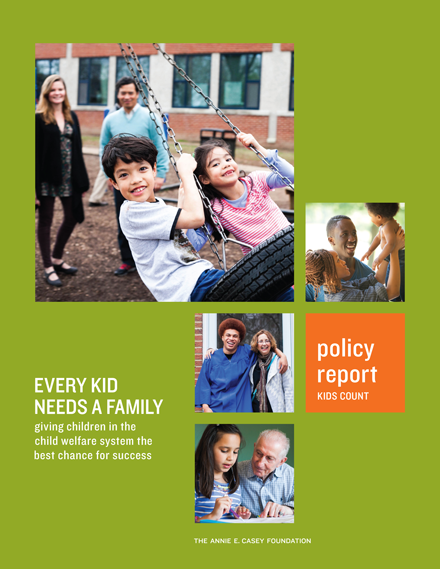
The Foundation’s policy report, Every Kid Needs A Family, highlights “the urgent need to ensure, through sound policies and proven practices, that everything possible is being done to find loving, nurturing and supported families to children in foster care.” The report highlights the promising ways that state and local government leaders as well as policymakers, judges and private providers can work together as they strive to help these 57,000 children who are living in group placements – and overall, the more than 400,000 children in the care of child welfare systems.

The report goes on to recommend how communities can widen the array of services available to help parents and children under stress within their own homes, so that children have a better chance of reuniting with their birth families and retaining bonds important to their development. And it shows ways in which residential treatment — a vital option for the small percentage of young people who cannot safely live in any family during treatment — can help those young people return to families more quickly and prepare them to thrive there.7 to 10 times

“We have an obligation to help all of our kids succeed,” said Patrick McCarthy, president and CEO of the Casey Foundation. “If our children couldn’t live with us, we would want them to live with someone close to us - and if that couldn’t happen, with a caring foster family who could provide them with as normal a life as possible during a turbulent time. This report shows more kids can live safely in families and get the nurturing they need while under the care and protection of our child welfare systems.”

Among the report’s findings across the United States:

  • One in 7 children under the care of child welfare systems live in group placements, even though federal law requires that they live in families whenever possible.
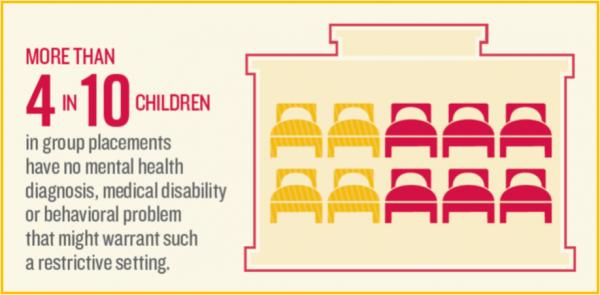
  • Fortaecf-everykidneedsafamily-cover-2015y percent of the children in group placements have no documented behavioral or medical need that would warrant placement in such a restrictive setting.
  • While research shows children who need residential treatment likely need to stay no longer than three to six months, young people are staying in group placements an average of eight months.
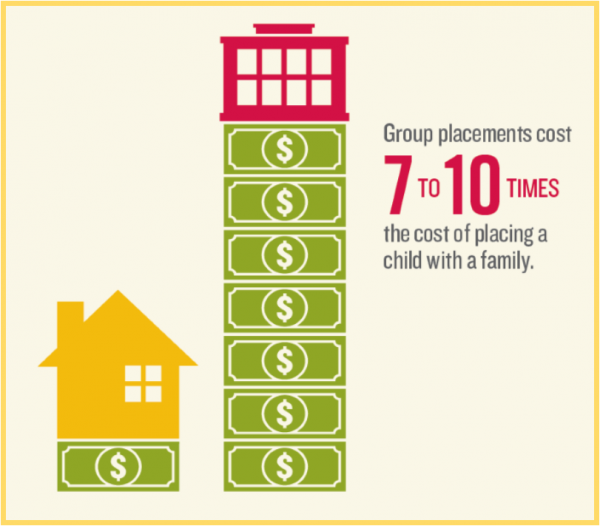
  • Group placements cost 7 to 10 times the cost of placing a child with a family.

The report also indicates that African American and Latino youth are more likely than white youth to be placed in group settings, and boys are more likely than girls to be in group placements.  Nationally, African American youth are 18 percent more likely than their white counterparts to be sent to group placements, and boys are 29 percent more likely than girls, according to data cited in the report.

4 in 10


Motor Vehicle Deaths Up 14 Percent in CT in 2015, Exceeding National Average

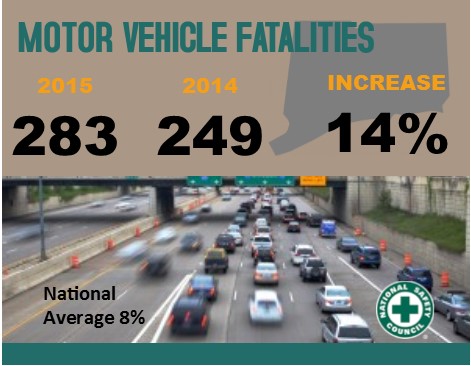
The death toll in Connecticut from motor vehicle accidents increased 14 percent in 2015 from the previous year, consistent with a nationwide increase but higher than the national average.  The increase in Connecticut ranked the state tied for 14th in the percentage increase in motor vehicle deaths from 2014 to 2015. fatalities CTNationally, 2015 saw the largest single-year percent increase in motor vehicle deaths since 1966. Estimates from the National Safety Council (NSC) show an 8 percent increase in 2015 compared with 2014 – with substantial changes in some states, including Connecticut.  There were 283 motor-vehicle related deaths in Connecticut last year, compared with 249 in 2014 and 276 in 2013.

While many factors likely contributed to the fatality increase, a stronger economy and lower unemployment rates are likely at the core of the trend.  The National Safety Council estimates 38,300 people were killed on U.S. roads, and 4.4 million were seriously injured, meaning 2015 likely was the deadliest driving year since 2008. The annual total of motor vehicle fatalities for 2014 was 35,398.

Over the last year at the state level, the National Safety Council estimates Vermont (30 percent), Oregon (27 percent), New Hampshire (24 percent), Georgia (22 percent), Washington (21 percent) and Florida (18 percent) experienced the largest percentage increase in fatalities, while only 13 states showed improvement. Among them were New Mexico (-20 percent), Kansas (-7 percent) and New Jersey (-2 percent).

Increases were also in Arizona (15%), Colorado (17%), Idaho (17%), Montana (17%), Maine (16%), Maryland (16%), and South Carolina (16%).  Also seeing 14 percent increases along with Connecticut were Arkansas, Minnesota, Missouri, and Nevada.  nsc_logo

“These numbers are serving notice: Americans take their safety on the roadways for granted,” said Deborah A.P. Hersman, president and CEO of the National Safety Council. “Driving a car is one of the riskiest activities any of us undertake in spite of decades of vehicle design improvements and traffic safety advancements. Engage your defensive driving skills and stay alert so we can reverse this trend in 2016.”

From 2013 and 2015, Connecticut had a 3 percent increase in traffic fatalities, according to the data.

The estimated cost of motor-vehicle deaths, injuries, and property damage in 2015 was $412.1 billion, according to NSC.  The costs include wage and productivity losses, medical expenses, administrative expenses, employer costs, and property damage.

The estimate is subject to slight increases or decreases as data mature, according to the National Safety Council. NSC has issued annual traffic fatality estimates since 1921. Over the last three years, preliminary estimates have fallen within 1 percent of final counts.

Average gas prices were 28 percent lower in 2015 than in 2014 and are projected to continue dropping this year, making driving more affordable for many Americans, NSC pointed out, noting that the U.S. Department of Transportation estimates a 3.5 percent increase in the number of miles driven in 2015 compared to 2014.

To help ensure motor vehicle accidentsafety, the National Safety Council recommends drivers:

  • Make sure every passenger buckles up on every trip
  • Designate an alcohol and drug-free driver or arrange alternate transportation
  • Get plenty of sleep and take regular breaks to avoid fatigue
  • Never use a cell phone behind the wheel, even hands-free
  • Stay engaged in teens’ driving habits, as teens are three times as likely to crash as more experienced drivers
  • Learn about vehicle safety systems and how to use them, including features such as adaptive cruise control, blind spot warning systems and backup cameras.

Founded in 1913 and chartered by Congress, the National Safety Council, nsc.org, is a nonprofit organization whose mission is to save lives by preventing injuries and deaths at work, in homes and communities, and on the road through leadership, research, education and advocacy.

Connecticut is Most Religious State in New England

Connecticut is the most religious state New England, ranked number 38 in the nation, according to a new Gallup poll.  The other New England states are all in the bottom ten, according to the survey, which covered the year 2015. New Hampshire is the least religious state in the nation, with 20 percent of residents considering themselves to be “very religious,” 24 percent “moderately religious” and 55 percent “non-religious.”  Just ahead of New Hampshire at the bottom of the list, are Vermont (22 percent very religious), Maine (26 percent very religious) and Massachusetts (27 percent very religious).  Rhode Island is ranked 43, with 32 percent of residents considering themselves to be very religious.CT religion

Connecticut, the only New England state ranked higher than the bottom ten, broke down this way:  33 percent very religious, 28 percent moderately religious, and 39 percent non-religious.

In the annual survey, Mississippi (63 percent) has extended its eight-year streak as the most religious state, followed closely by neighboring Alabama (57 percent), according to Gallup.  Rounding out the top ten “very religious” states were Utah, Louisiana, Tennessee, Arkansas, Georgia, South Carolina, North Carolina, Kentucky and Texas.

The state-by-state results are based on over 174,000 interviews conducted as part of Gallup Daily tracking in 2015, including more than 480 interviews in every state and more than 1,000 interviews in most states.  In Connecticut 1,919 interviews were conducted, according to Gallup.framed church Lee, MA

Gallup classifies Americans into three religious groups based on their responses to a question measuring religious service attendance and how important religion is in their daily life. Very religious Americans are those who say religion is important to them and who attend services every week or almost every week. Nonreligious Americans are those for whom religion is not important and who seldom or never attend religious services. Moderately religious Americans meet just one of the criteria, either saying religion is important or that they attend services almost every week or more.

Nationwide, the percentage classified as very religious on the basis of their attendance and view on the importance of religion has stayed remarkably stable since the survey began seven years ago. In 2008, 41% of Americans were very religious, 29% moderately religious and 30% nonreligious. In 2015, those same percentages are almost identical: 40%, 29% and 31%, respectively.

religion USA

Connecticut’s Presidential Primary Ballot to Take Shape for April 26

In the roller-coaster that is the presidential nomination process, with its progress of caucuses and primaries in states across the country, Connecticut’s card does not come up until late-April.  Who will reach the Connecticut ballot, and the order in which they will be listed, will be determined in the coming weeks by Secretary of the State Denise Merrill, in accordance with criteria outlined in state law. That process begins this Tuesday, February 16,  with the announcement of presidential candidates who have qualified for the Connecticut primary ballot.  The order in which candidates will appear on the ballot for the Republican and Democratic parties will not be known until March 22, when Secretary Merrill will “determine the order of all candidates by lot in a public ceremony.”  Connecticut law also requires that “Uncommitted” appear last on each party’s ballot.

april 26When Connecticut voters go to the polling places on Tuesday, April 26, voters in nearly two-thirds of the states will already have made their preferences known.  The same day as Connecticut, presidential primaries will also be held in Delaware, Maryland, Pennsylvania and Rhode Island.  The previous week, primaries will be held in New York, a state called home, at various times, by three of this year’s leading contenders – Hillary Clinton, Bernie Sanders and Donald Trump.

March 1 and March 15 are major dates on the presidential primary calendar this year.  Dubbed Super Tuesday, March 1 will see votes cast in Alabama, Alaska, Arkansas, Colorado, Georgia, Massachusetts, Minnesota, Oklahoma, Tennessee, Texas, Vermont, Virginia and Wyoming.  Two weeks later, the spotlight will fall on Florida, Illinois, Missouri, North Carolina, and Ohio.

Also prior to Connecticut, the states of Wisconsin, Wyoming, Washington, Hawaii, Arizona, Utah Idaho, Michigan and Mississippi will conduct their presidential primaries, according to the Council on State Governments.

According to Connecticut’s Office of Legislative Research, in August 2010, the Democratic National Committee and the Republican National Committee adopted rules prohibiting states, other than Iowa, New Hampshire, South Carolina, or Nevada from holding a presidential primary before the first Tuesday in March in the year in which a national convention is held (Democratic National Committee, Delegate Selection Rules, Rule 11(A) and Republican National Committee Rules, Rule No. 16(c)(1)).  In response, Connecticut delayed the date of its presidential primary from the first Tuesday in February to the last Tuesday in April (CGS § 9-464).voting

Reaching the Primary Ballot

In Connecticut, the political parties with the largest and second largest number of enrolled members conduct presidential preference primaries, according to the website Ballotpedia. There are two methods by which candidates can access the primary ballot:

  • The Connecticut Secretary of the State can order that a candidate's name be printed on the primary ballot if he or she "determines ... that the candidacy of such person for such party's nomination for president is generally and seriously advocated or recognized according to reports in the national or state news media." The secretary of state must publish a listing of such candidates at 10:00 a.m. on the 74th day preceding the primary.  (This year, that is Tuesday, February 16.)
  • A candidate who is not included on the Secretary of the State’s list can petition for placement on a party's primary ballot. A candidate may request the requisite forms from the secretary of the state’s office beginning at 12:00 p.m. on Tuesday. The petition must contain signatures equaling at least 1 percent of the total number of enrolled members in the candidate's party in the state, and must be submitted to "the registrar of voters of the party holding the primary in the town of voting residence of the signers thereof" by 4:00 p.m. on the 53rd day preceding the primary (March 4). The registrar of voters must verify the signatures and forward the petition to the secretary of state by 4:00 p.m. on the 49th day preceding the primary (March 11).

Among the states holding presidential primaries after Connecticut in May and June are Inpres primariesdiana, New Mexico, California, New Jersey, Nebraska, West Virginia, Oregon and Montana.  Most states have their Democratic and Republic primaries on the same day, although a handful hold party primaries on different days. South Carolina’s Republican primary will be on February 20, for example, and its Democratic primary on February 27.

Should any candidate whose name is set to appear on the Connecticut April 26 primary ballot decide to withdraw from the race, the deadline is March 21.  A letter indicating withdrawal must be received by the Secretary of the State by 12 Noon.  Petitioning candidates may not withdraw, according to state officials.

Absentee ballots for military and overseas voters become available on March 12.  Absentee ballots will be available as of April 5.  Only registered voters in a particular political party can vote in the presidential primary of that party.  The deadline for new voters, and for unaffiliated voters to mail in party affiliations is April 21.  The in-person deadline is April 25, the day before the primary, at 12 Noon.  On primary day April 26, the polls are open from 6 AM to 8 PM.


Firsthand Accounts of Effects of Hunger in Connecticut On Display at State Capitol

Hunger in Connecticut is described as a pervasive problem: one in seven Connecticut residents struggle with hunger; 14.3 percent of Connecticut families do not have adequate resources to purchase enough food; 68 percent of Connecticut food pantry and soup kitchen clients at one point had to choose between food and medical care. Those stark statistics come alive through the firsthand accounts of individuals in Witnesses to Hunger CT, a photovoice exhibit showcasing firsthand accounts of hunger in Connecticut, which has opened in the lower level concourse of the Legislative Office Building in Hartford and will run through Thursday, February 11.stats

“Connecticut is one of the wealthiest states in the nation but there are many who struggle every day to put food on the table,” Lucy Nolan, Executive Director, End Hunger Connecticut!, said. “The Witnesses recruited to participate in this project have been faced with choices that are hard to fathom – whether to eat low cost foods that could be harmful to their medical conditions or not eat at all, whether to pay for prescriptions or put food on the table, and whether to feed themselves or give extra food to their children. We hope this exhibit can serve as a reminder that many among us, often hidden, need the state’s support.”

The 15 Witnesses to Hunger CT come from Connecticut’s cities, suburbs and rural communities. Kimberly’s picture told the story of her teenage son who while grateful to have something to eat wished there was meat on the plate. Randy from Westport had a good job until struck by cancer and now gets many meals from the soup kitchen and pantry. In his photo he holds a grocery bag in his hands and says while he is grateful for that safety net he wishes there were more fresh foods available. The photos tell a story of everyday choices that must be made to survive.

The project is a collaboration of Connecticut nonprofit organizations, anti-hunger and anti-poverty advocates, and state agencies inspired by Witnesses to Hunger, a project of the Center for Hunger Free Communities at the Drexel University Dornsife School of Public Health.  Advocates point out that limited access to food leads to poor health outcomes, including stress, obesity, and inability to succeed in work or school.hunger map

“There are four main themes that emerged from this project and tell me a compelling story,” said State Senator Marilyn Moore, Bridgeport. “The Witnesses to Hunger CT show everyday struggles with health and wellness, food and nutrition, transportation and adequate shelter. If we want people to succeed we need to make sure we support them. I appreciate their bravery in shining a light on these themes.”

Connecticut is the last in the nation for the number of schools with a school breakfast program, according to End Hunger Connecticut! officials. They point out that 64.6 percent of schools participate, and 45 percent students participate in free and reduced price breakfast for every 100 in lunch.  Connecticut would receive an additional $9.6 million federal dollars if the participation rate of school breakfast reached 70 percent.

Connecticut’s SNAP (formerly Food Stamps) participation rate is 72 percent and 53 percent of the eligible working poor participate in the SNAP program. Many go to food pantries instead for food, organization officials said. They indicated that for every $1 spent on WIC funding, Connecticut saves $1.77-$3.13 on future medical costs.

“The members of Witnesses to Hunger are the real experts on hunger and poverty,” said Dr. Mariana Chilton, an associate professor at Drexel University’s Dornsife School of Public Health and founder of Witnesses to Hunger. “Too many decisions today are made without consulting with the people that are affected most by policies made in Washington. We are thrilled to have families from Connecticut join in the national movement of families speaking from first hand experiences to inform policy makers and the public about the true realities of America’s struggles and how to solve them.”

They noted that 11.9 percent of Connecticut residents are food insecure and 4.7 percent are very food insecure — a slight increase from 2008.

“Data shows the food insecurity rate among those living with a severe mental illness is 475 percent higher than those who are not battling mental illness,” said Billy Bromhunger exhibitage, MSW, Director of Community Organizing, Yale Program for Recovery and Community Health. “We know that good nutrition plays a key role in mental health and that’s why the mental health community is here today to support the Witnesses.”
Witnesses to Hunger CT is the second exhibit of its kind in the state. The first took place in New Haven in 2014 and was championed by Congresswoman Rosa DeLauro.  Witnesses to Hunger CT is a collaboration of:  Advocacy Unlimited, Connecticut Association for Basic Human Needs (CABHN), Center for Hunger Free Communities at the Drexel University Dornsife School of Public Health, Connecticut State Department of Mental Health and Addiction Services (DMHAS), Connecticut Food Bank, End Hunger Connecticut!, Foodshare, Immanuel Congregational Church/UCC, Hispanic Health Council, New Haven Food Policy Council, and the Yale Program for Recovery and Community Health.

The exhibit will be in the lower concourse of the Legislative Office Building (LOB) through February 11th. A booklet prepared for the exhibit can be found at http://www.endhungerct.org. The LOB is located at 300 Capitol Avenue, Hartford and is open weekdays 8:00 am to 5:00 pm.  Free parking is available (first come first served) at the LOB Garage, which is located directly behind the LOB.

https://youtu.be/e-9M4byq90w


Connecticut Leads the Nation in Preventative Health Care

Among the nation’s 34 most populous states, the rate of preventive health care visits was higher in Connecticut than any state in the nation.  Data released this month from the Centers for Disease Control and Prevention National Center for Health Statistics also found that the rate of preventive care visits to primary care physicians, among the 34 most populous states, exceeded the national rate in Connecticut more than elsewhere. Preventive care visits such as general medical examinations, prenatal visits, and well-baby visits give physicians and other health professionals the opportunity to screen for diseases or conditions, as well as to promote healthy behaviors that may delay or prevent these conditions and reduce subsequent use of emergency or inpatient care.nchs_fb_identifier

In this report, the rate of preventive care visits to office-based physicians is examined by state, patient demographics, and physician specialty. Estimates are based on data from the National Ambulatory Medical Care Survey (NAMCS), a nationally representative survey of visits to office-based physicians.

Overall, preventive care visit rates were higher for children under age 18 years (73.2 per 100 persons) and for those aged 65 and over (81.1 per 100 persons) than for adults aged 18–44 (53.2 per 100 persons) and 45–64 (51.8 per 100 persons).  The preventive care visit rates for women aged 18–44 (87.1 per 100 women) and 45–64 (60.5 per 100 women) exceeded the rates for men in those age groups (18.5 and 42.5 per 100 men, respectively).

doctorThe rate of preventive care visits in the 34 most populous states ranged from 33.1 visits per 100 persons in Arkansas to 120 visits per 100 persons in Connecticut.  Among those 34 states, the rate of preventive care visits was lower than the national rate in 11 states (Arkansas, Indiana, Iowa, Michigan, Missouri, North Carolina, Oklahoma, Oregon, Pennsylvania, South Carolina, and Washington).  The national average was 61.4 visits per 100 persons.  The data is from 2012, the most recent year available from the National Ambulatory Medical Care Survey.
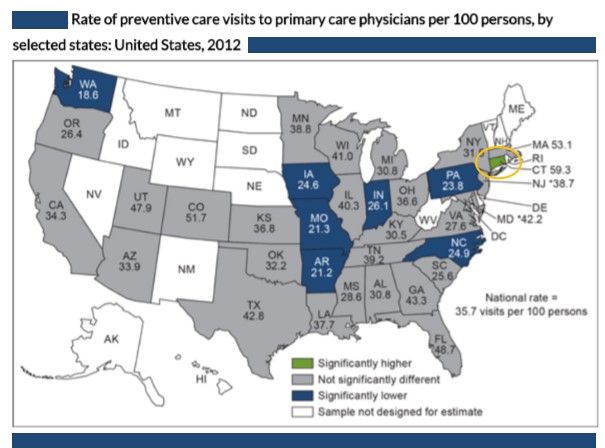
In 2012, 35.7 preventive care visits were made to primary care physicians for every 100 persons across the United States.  In Connecticut, primary care physician preventative care visits were made 59.3 times per 100 people, the highest percentage in the nation.  In Massachusetts, the rate was 53.1, in Colorado 51.7, in Florida 48.7 in Georgia 43.3, in Texas 42.8 and in Maryland 42.2.  Overall, 58.2 percent of preventive care visits were made to primary care physicians, according to the CDC data.  Primary care physicians include office-based physicians in the specialties of family or general medicine, internal medicine, and pediatrics.1u1-c15ecce858

The female rate (76.6 visits per 100 females) of preventative care visits exceeded the male rate (45.4 visits per 100 males) by 69 percent. The percentage of preventive care visits to primary care physicians, however, made by males (76.3%) exceeded those made by females (48.0%). The data suggests that women tend to make their preventative care visits to physicians other than their primary care physician, with the report’s summary suggestion. this “may be related to gynecological or obstetric care for women.”

In 2012, the NAMCS survey sample size was increased fivefold to allow for state-level estimates in the 34 most populous states for the first time.

preventative health map