CT’s Has Nation’s Third Lowest Rate of People Killed by Police; National Data Reveals Glaring Disparities Among States, Cities
/Between January 2013 and April 2016, the rate of individuals killed by police in Connecticut was the third lowest in the nation, according to the website mappingpoliceviolence.org The website indicates that during that period, there were 20 people killed by police in the state, for a rate of 5.60, based on the state’s population. The only states with lower rates were New York, at 5.26, and Rhode Island, at 3.80.  The highest rates were in New Mexico (31.5), D.C. (28.25), Oklahoma (24.52), Arizona (23.31), Nevada (21.85) and Wyoming (21.29).
Key findings highlighted on the website include:
- 28 percent of U.S. police killings between Jan 2013 - Apr 2016 were committed by police departments of the 100 largest U.S. cities.
- Black people were 39 percent of people killed by these 100 police departments despite being only 21 percent of the population in their jurisdictions.
- In only 3 of the 100 largest city police departments was there no one killed between January 2013 and April 2016 (Buffalo, Irvine, and Plano), according to the website.
- The majority (51%) of unarmed people killed by the 100 largest city police departments were Black. These police departments killed unarmed Black people at a rate 4 times higher than unarmed White people, the data indicated.
- Rates of violent crime in cities did not make it any more or less likely for police departments to kill people. For example, Buffalo and Newark police departments had low rates of police violence despite high crime rates while Spokane and Bakersfield had relatively low crime rates and high rates of police violence, the website points out.
The site is designed to “help hold state policy-makers accountable for police violence,” and highlight “how police violence disproportionately impacts black people in many states.” It offers a number of mapping tools to allow users to review and contrast data, and also offers a database of gathered information.
 Looking at the rate at which Blacks were killed by police during the period January 2013 – April 2016, Connecticut was among the lowest, at 8.3, which reflects three deaths. In New Hampshire, Vermont, North Dakota, Maine, Idaho and South Dakota, largely reflecting the population in those states, there were no deaths of African Americans, according to the data.
In 2015, among the 100 largest police departments, there were 14 police departments in which 100 percent of the individuals killed were Black (St Louis, Atlanta, Kansas City, Cleveland, Baltimore, Washington D.C., Raleigh, Milwaukee, Detroit, Philadelphia and Charlotte) and five departments in which all of those killed were White. Connecticut’s largest cities were not included in the list.
The research indicated that “while some have blamed violent crime for being responsible for police violence in some communities, data shows that high levels of violent crime in cities did not appear to make it any more or less likely for police departments to kill people.”
The report defines a “police killing” as “a case where a person dies as a result of being chased, beaten, arrested, restrained, shot, pepper sprayed, tasered, or otherwise harmed by police officers, whether on-duty or off-duty, intentional or accidental.”
The website Mapping Police Violence is a “research collaborative collecting comprehensive data on police killings nationwide to quantify the impact of police violence in communities,” as described by the website. The research team indicates that “the data represented on this site is the most comprehensive accounting of people killed by police since 2013.”


 The quarterly survey is released by
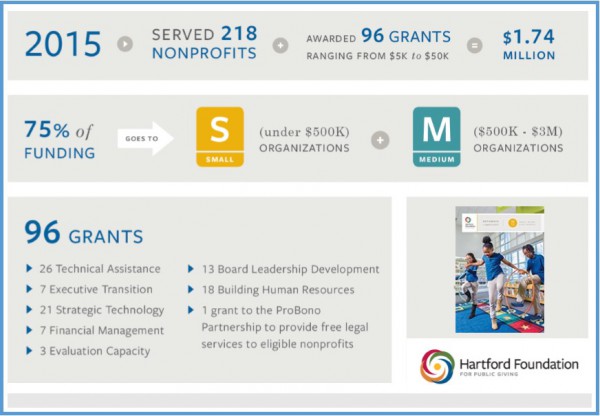
 The Foundation invested 30 percent of its grants in education from birth through high school, and new and renewed college scholarship, according to the report. Grants for family and social services received 20 percent; health – 11 percent; arts and culture – 11 percent; community and economic development – 19 percent, general – 5 percent and summer programs – 4 percent.




 Overall in Connecticut, the chronic absenteeism rate dropped from 11.1 percent in 2011-12 to 10.6 percent in 2014-15. The State Department of Education website explains that “improving and sustaining good attendance requires the active engagement of district and school-based leaders and administrators along with a clear articulation of roles and responsibilities.”

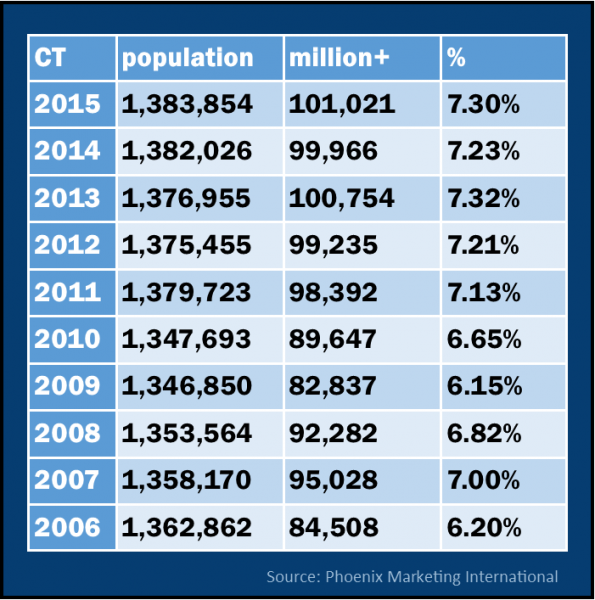 He added, “We advised him that there are ways to be close to family and friends in Connecticut on occasion that are perfectly legal. We're trying to send a more welcoming message to the high earners as a group." Homeowners who spend more than 183 days in the state are considered residents for tax purposes.
 wealthiest individuals, had relocated from Greenwich to Florida, the second individual in that tax bracket to do so recently. The exits, the Courant reported, “leave Connecticut with 13 billionaires, including Ray Dalio ($15.6 billion) and Steven Cohen ($12.7 billion), both hedge fund owners who live in Greenwich.” Eight of those 13 state residents list Greenwich as their home address, according to



 The Child Care metrics included Day-Care Quality, Child-Care Costs, Access to Pediatric Services, and WalletHub’s “Best School Systems” Ranking. The Professional Opportunities category included Gender Pay Gap, Ratio of Female Executives to Male Executives, Median Women’s Salary, Percentage of Families in Poverty, Female Unemployment Rate, and Gender-Representation Gap in Different Economic Sectors. The Work-Life Balance category included Parental Leave Policy, Length of the Average Woman’s Work Week, and Women’s Average Commute Time.
 The recommendations are drawn from the experiences of nine communities in Connecticut that explored researched-based strategies over the past year, to link supports for social-emotional and literacy skills. The effort was part of the Connecticut Peer Learning Pilot on Social-Emotional Development and Early Literacy, developed and led by the Campaign for Grade-Level Reading, in partnership with the National Center for Children in Poverty and with support from the Irving Harris Foundation and others.