Enfield, Backed by Western Mass., Goes After Amazon HQ2

The State of Connecticut is throwing its muscle behind Hartford and Stamford in their bids to become the home of Amazon’s second headquarters.  The Economic Development Council of Western Massachusetts, however, has issued a letter supporting a bid by the town of Enfield. In addition to Enfield, the cities and towns of Bridgeport, Fairfield, New Haven and Stratford submitted a joint proposal; Danbury also applied.

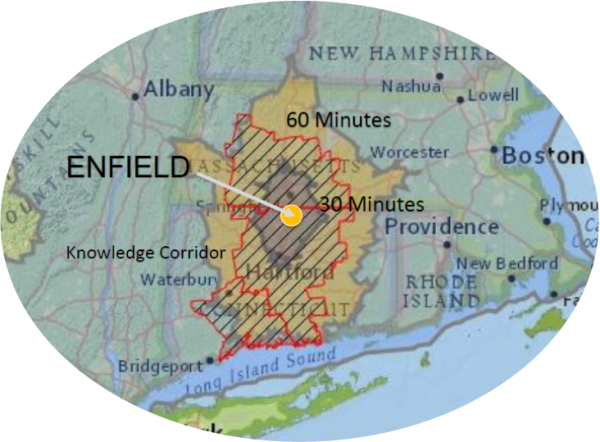
The bid by Enfield is perhaps the most ironic, as the Boston Globe pointed out in a front page article .  The central location being proposed is currently the Enfield Square Mall, which has seen its anchor stores – Macy’s, JC Penney’s and Sears – leave in recent years, followed by numerous smaller retailers.  The proposal is on the agenda of the next town Economic Development Commission, scheduled for Wednesday morning.  The Enfield proposal suggests Hartford, West Hartford, Windsor, Meriden and New Haven and Springfield as "potential satellite campuses" and stresses Enfield's place at the center of the Knowledge Corridor, which runs from Springfield to New Haven.

“It’s a scene repeating itself in dying suburban malls around the country,” the Globe reported, “a sweeping economic disruption known as the Amazon effect.”  Industry analysts have predicted that 20 percent of the 1,200 shopping malls in the U.S. will “meet their demise,” the Globe indicated.

Amazon.com has received 238 proposals from cities and regions across North America.  Amazon said Monday that 54 states, provinces, districts and territories in the United States, Canada and Mexico were represented in the bids. The number of applicants underscores the interest in the contest, which Amazon announced last month. The world’s largest online retailer said it would invest more than $5 billion and create up to 50,000 jobs for “Amazon HQ2”. The deadline for submitting proposals was last Thursday.

"There are no state boundaries for our region's workforce, company supply chains and students," Rick Sullivan, president and CEO of the Economic Development Council, wrote in a letter supporting Enfield.  The town is along the so-called "Knowledge Corridor," the economic region that includes Springfield as well as Hartford and New Haven, and follows the Interstate 91 corridor in Massachusetts and Connecticut.  The corridor is expected to benefit from the introduction of regular commuter rail service, being introduced next year; the Enfield proposal provides Amazon with a map of the new Hartford Line rail route.

The Enfield bid touts its proximity to higher education, Bradley International Airport and major highways, as well as arts and culture. Also highlighted are major businesses located in the community, including Lego, MassMutual, Brooks Brothers, and Eppendorf, according to published reports. The Enfield proposal opens with a stylized newsletter of the future, including facts about Enfield and the region, led by the headline “Internet Retail Giant Pumps Life Back into Dying Mall!”

"With a population of nearly 50,000, Enfield’s 33 square miles are at the center of the New England Knowledge Corridor, Enfield provides quick and easy access to several US Highways, airports and rail systems," the 12-page Enfield proposal explained.  "Tax Increment Financing (TIF) districts are being created in Enfield and surrounding towns to support new development and growth. Abatements and Regional Revenue Sharing are all available to sweeten the deal. Connecticut has the lowest corporate tax rate in the North East."
After having received more than a dozen potential bids, state economic development officials opted to promote Hartford and Stamford as its leading candidates to land the headquarters, developing a website to promote the two regions, under the headline “The Talent You Need.  The Lifestyle They Want.”  The submission noted that "if Connecticut were a country, we’d be the sixth most productive in the world—ahead of Germany, Japan and Hong Kong."
A letter of support jointly signed by the state’s seven-member Congressional delegation and included with the state’s submission did not indicate a preferred location in the state, advocating “full support of Connecticut as the home of your second headquarters.”  A similar letter was signed by legislative leaders of both political parties, along with the co-chairs of the state’s Commission on Economic Competitiveness.  That letter noted that “Connecticut has already made a major commitment to Amazon, with facilities in Windsor and Wallingford, and another planned for North Haven.”

The Hartford bid was supported by the Mayors of Hartford, East Hartford, and West Hartford, along with Chip Beckett of Glastonbury, Chair of the Capital Region Council of Governments.  A joint letter was included in the state’s overall package.  A similar letter supporting Stamford came from that city’s Mayor.

An additional letter of support for the state’s bid was signed by 57 business leaders from throughout the state, accompanied by another from nearly three dozen higher education leaders from public and private institutions.

It was, some have suggested, a show of unity that has been generally lacking during the four months that the state has operated without an approved state budget, the longest such period in the state’s history.

Some communities, most notably the joint proposal by the cities of Bridgeport and New Haven, along with their immediate suburban neighbors, didn’t make the state cut, but submitted proposals nonetheless.  The Enfield proposal touts the entire region, along the I-91 corridor.  Locations in Enfield, including the mall, are suggested, as are other communities north and south of the state line that could host various divisions of an Amazon headquarters, according to reports on the proposal.
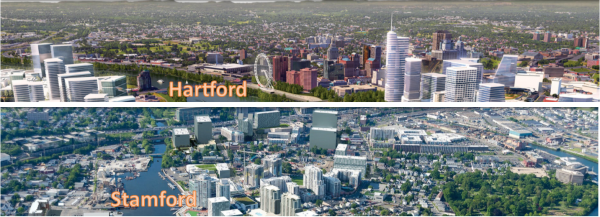
Portions of artists renderings included in State of Connecticut proposal advocating for Stamford and Hartford.

With Varied Stories to Tell, State Authors Win 2017 Connecticut Book Awards

The Connecticut Book Awards returned from a five-year hiatus with a rousing ceremony and the selection of winners from among finalists in four categories:  Fiction, Non-Fiction, Poetry and Young Readers.  The competition was coordinated by Connecticut Humanities and the Connecticut Center for the Book, and the awards ceremony was held Sunday at the Mark Twain House & Museum in Hartford. West Hartford author Okey Ndibe was awarded the 2017 Connecticut Book Award for Non-Fiction for Never Look an American in the Eye, published by Soho Press.  The Fiction winner was Robert H. Patton of Darien for Cajun Waltz, published by Thomas Dunne Books.  In the Young Readers, The Weight of Zero, written by Karen Fortunati and published by Delacorte Press, was selected. The Poetry winner was Fugitives by Danielle Pieratti, published by Lost Horse Press.

One hundred nine titles were submitted as candidates for the Book Awards between January 1 and April 19, 2017 and after review against the guidelines, one hundred titles were admitted into the judging process. Books published in 2016 were eligible for the awards.

Each category had five judges with expertise in the literary arts. They reviewed the titles over three months using criteria appropriate to the category.  Seventeen titles made it to the finalist list. Nominated authors must currently reside in Connecticut and must have lived in the state at least three successive years or have been born in the state, or the book must be substantially set in Connecticut.

In accepting the award, Ndibe, a journalist and educator, said that “literature is central to what binds us together as a community.”  Ndibe’s funny, charming, and penetrating memoir tells of his move from Nigeria to America, examines the differences between Nigerian and American etiquette and politics; recalls an incident of racial profiling just thirteen days after he arrived in the US, in which he was mistaken for a bank robber; considers American stereotypes about Africa (and vice-versa); and juxtaposes African folk tales with Wall Street.

Fortunati, who described her debut novel as a “story of hope and resilience” in accepting the award, recently completed Trinity College’s master’s program in American Studies.  She recalled that as part of her studies, she visited the Mark Twain House & Museum, which made the ceremony location especially fitting.

The book’s subject is mental illness, specifically bipolar disorder, and “it explores the shame, stigma and anxiety that often complicate the management of this chronic condition,” Fortunati explains on her website.  “The issue is personal to me having witnessed the impact of depression and bipolar disorder in relatives and friends.  My goal was to write a story of hope for teens who struggle with mental illness.”

Pieratti, who teaches English at South Windsor High School, relocated to Connecticut from upstate New York five years ago.  She said “I have been nurtured by this state since I moved here,” and expressed appreciation to her colleagues in South Windsor.  She has taught at the college and high school level, and was recipient of the Idaho prize for Poetry in 2015.  Her poetry “explores the mundane moments and materials that make up ordinary days and finds there the ambiguities of mystery, shadow, and song,” the CT Center for the Book indicated.

Cajun Waltz, the Fiction winner by Robert H. Patton, is set in southwest Louisiana, a "tale of family, music, love, and picturesque mayhem" that explores “three generations of the volatile clan” as they “grapple with the region’s economic struggles and racial tensions.”

In addition to the award recipients, Gray Jacobik, University Professor Emerita at Eastern Connecticut State University, received Lifetime Achievement recognition in Poetry.

The awards were presented annually between 2002 and 2011, and were re-established by CT Humanities this year.  The nominated books for the 2017 Connecticut Book Awards, by category:

Fiction

  • Back Lash by Chris Knopf
  • I’ll Take You There by Wally Lamb
  • Shadows of Paris by Eric D. Lehman
  • Cajun Waltz by Robert H. Patton
  • Beneath a Shooting Star by Susan Harrison Rashid

Non-Fiction

  • Rare Light by Anne Dawson
  • Never Look an American in the Eye by Okey Ndibe
  • The Lost White Tribe by Michael Robinson

Poetry

  • The Banquet by Gray Jacobik
  • Barrel Children by Rayon Lennon
  • The Meeting House by Marilyn Nelson
  • Fugitives by Danielle Pieratti

Young Readers

  • All Rise for the Honorable Perry T. Cook by Leslie Connor
  • The Weight of Zero by Karen Fortunati
  • Ada’s Violin by Susan Hood
  • The Unexpected Everything by Morgan Matson
  • Good Night, Bat! Good Morning, Squirrel! by Paul Meisel


Images above (L to R): Okey Ndibe, Karen Fortunati, Danielle Pieratti, Robert H. Patton

Three Foundations Join Forces to Advance Obesity Prevention Efforts in Connecticut

If an ounce of prevention is truly worth a pound of cure, efforts in Connecticut may hold the key to turning around the nation’s obesity epidemic – especially among children. Connecticut has the 10th lowest adult obesity rate in the nation, according to a study released earlier this year. The state’s adult obesity rate is 26 percent, up from 16.0 percent in 2000 and from 10.4 percent in 1990.  That places Connecticut 42nd among the 50 states.  The childhood obesity rate is 30 percent for 10-17 year olds, ranking 29th among the states, and 15 percent for 2-4 year olds qualifying for federal nutrition assistance, the 12th highest obesity rate in the country.  And that is where the focus of three Connecticut-based foundations will be, as they combine forces to award $194,884 in grants for obesity prevention projects in Connecticut.

The grants are being funded with contributions from the Children's Fund of Connecticut ($139,884), the Connecticut Health Foundation ($30,000), and Newman's Own Foundation ($25,000) and will be administered by CFC's non-profit subsidiary, the Child Health and Development Institute (CHDI).

Funded projects will inform and advance efforts to prevent obesity by improving early feeding practices for diverse socio-economic, racial, and ethnic groups across various early childhood settings.

"Childhood obesity is a wide-spread public health crisis disproportionately impacting racial and ethnic minorities and low-income children. Once obesity sets in it is very difficult to reverse; however, we are still searching for effective ways to prevent it," said Judith Meyers, President and CEO of the Children's Fund of Connecticut.

"New research on infant and toddler feeding practices shows promising results. These grants to improve infant and toddler feeding practices will help us learn more about what works so we can get ahead of the curve."

The competitive application process administered by CHDI yielded the following funded projects:

  • Healthy Eating through Group Well Child Care: $59,904, Yale University

Under the direction of Marjorie Rosenthal, MD, MPH, the project examines the impact of embedding a healthy eating curriculum within group well child care, an evidenced-based model of primary care delivery at the Yale New Haven Hospital Primary Care Center. Expected outcomes include less rapid weight gain for infants in the first six months and improvement in mothers' weight over the first year of her child's life.

  • Barriers to Participation in CACFP in CT: $64,998, UConn, Rudd Center for Food Policy and Obesity

Tatiana Andreyeva, PhD, Associate Professor at the UConn Rudd Center, will lead a study that documents and addresses barriers to participation in the federal Child and Adult Care Food Program (CACFP) among Connecticut child care centers serving infants and toddlers from low-income families. Connecticut has one of the lowest CACFP participation rates in the nation. The project team will use surveys and stakeholder interviews to assess perceived and actual barriers to CACFP participation and assess outreach and recruitment strategies currently used in Connecticut to increase center enrollment in CACFP.

  • Supporting Healthy Eating in Low-Income Toddlers: $64,982, UConn, Allied Health Sciences

Under the direction of Valerie B. Duffy, PhD, RD and Jennifer L. Harris, PhD, MBA, the project will develop and assess a coordinated communications program to deliver consistent messages to low-income parents in East Hartford about best practices for feeding toddlers (1-2 year olds). The messages will be delivered through pediatric clinics, WIC offices, and Family Resource centers in East Hartford. The project will coordinate infant feeding messages and promote responsive feeding across diverse populations and settings.

Funding is also supporting Connecticut Children's Medical Center's Office for Community Child Health to develop and disseminate training for pediatric primary care providers. The training will address key messages to educate parents about best practices in feeding infants and toddlers.

These projects represent the second cycle of funding from CFC in the early childhood obesity prevention arena. Since 2015, CFC has awarded more than $420,000 to advance early childhood obesity prevention.

The work of the first round of grantees helped CFC and CHDI identify public policies that contribute to obesity prevention, test the effectiveness of messages promoting obesity prevention in infants and toddlers, support breast feeding strategies for hospitals, and harness existing medical record data to identify early childhood obesity risks.

The current round of funding was informed by the Robert Wood Johnson Foundation's recently released Feeding Guidelines for Infants and Young Toddlers: A Responsive Parenting Approach, which highlights new areas of research and practice in obesity prevention.  The data-rich State of Obesity: Better Policies for a Healthier America, published earlier this year, was a project of the Robert Wood Johnson Foundation and the Trust for America’s Health.


Philanthropic Giving Levels in Connecticut Among Nation’s Lowest As Percentage of Income

Connecticut ranked 47th among the 50 states in philanthropic giving as a percentage of income, with a “giving ratio” of 2.4 percent, 25 percent lower than the national average, according to a new analysis by the Chronicle of Philanthropy. The giving ratio is the total of a locality’s charitable contributions as a share of its total adjusted gross income. Among the states in the region, Vermont ranked 45th, Massachusetts was 46th, and Rhode Island was 50th.

Nationally, the Chronicle report “How America Gives” highlighted the growing influence of the affluent in charitable giving across the country.  Although charitable donations rose for the third straight year in 2016, reaching $390.1 billion, according to "Giving USA," the Chronicle study indicates the sources of those donations are changing.

Donations from households earning $200,000 or more now total 52 percent of all itemized contributions. In the early 2000s, that number was consistently in the 30s, the Chronicle reported.  The report raises questions about the traditional habit of charitable donations among middle and low income individuals lessening, perhaps as a lingering after-effect of the recession.

Connecticut ranked 20th in total giving, despite having the 29th largest population among the states, with average giving per itemizer of $5,229, which placed the state squarely in the middle, ranking 25th.

The Chronicle provides an analysis of the giving patterns of Americans who earn $50,000 or more annually and who itemize charitable deductions on their income-tax returns. The itemized giving of these taxpayers, in 2015, represents nearly 80 percent of all individual charitable contributions and offers the best possible view into giving at local and regional levels, the Chronicle explains.

Nationally, only 24 percent of taxpayers reported a charitable gift, according to the Chronicle analysis of Internal Revenue Service data. That’s down from 2000 to 2006, years when that figure routinely reached 30 or 31 percent.  The Chronicle’s conclusion: “The number of households making room in their budgets for charitable giving is shrinking.”

In all but six states – including Connecticut – the percentage of those in the $200,000 plus bracket increased in 2015, the most recent year in which data was available. Only in Connecticut, South Dakota, Nebraska, Oklahoma, Texas, and Rhode Island was the percentage of those giving in that earnings bracket less that year, compared with 2012.

In Connecticut, individuals earning more than $200,000 gave 66.4 percent of all Connecticut giving, down 1.7 percent from 2012, according to the Chronicle analysis.  The portion of all givers in this income bracket in Connecticut down 0.2 percent while the giving per itemizer is down 20.6 percent.  In looking at the state’s major metropolitan areas, greater Bridgeport, Hartford, and New Haven, the analysis round that giving rates for taxpayers at four income levels fell below the average for the size group in each of the metropolitan areas.

The Chronicle reports that “Charity leaders say government funding has dwindled as corporate support has grown finicky. At the same time, America’s wealth has become more concentrated among the wealthy.”  The publication noted that “groups traditionally fueled by small gifts are also jumping into big-gift fundraising,” adding that “Middle-class woes and the country’s widening income disparity are undoubtedly partly to blame. But some fear that organizations are contributing to the problem by courting the well-heeled and slighting the small donor.”

The giving percentage varied across the state:  the Fairfield County giving ratio was 2.8%, New Haven County and Litchfield counties 2.1%, Hartford County 1.9%, New London County 1.8%, Middlesex and Tolland Counties 1.7%, and Windham County 1.6%.

With Continued Funding in Doubt, Gov. Rell, Former Legislators to Reprise Campaign Finance Reforms

Former Governor M. Jodi Rell, who supported and signed Connecticut’s landmark campaign finance reforms into law just over a decade ago, will be the keynote speaker later this month at a day-long conference that will bring many of the key players in that debate together again.  The October 26 event at Central Connecticut State University (CCSU) comes the same week that the state legislature may be voting on a new state budget for the fiscal year that began on July 1, with the continued existence of public financing of state political campaigns – a core component of the reforms - in serious doubt. Among the panelists will be former Senate President Pro Tempore Don Williams, former House Speaker James Amann, former Senate Minority Leader John McKinney, and former House Minority leader Lawrence Cafero. They will be joined by former House member Tim O’Brien, who served on the Government Administration and elections Committee, and Senate Co-Chair of that committee, Sen. Michael McLachlan.

In addition to the legislators, key players in the debate including Karen Hobart Flynn, President and CEO of Common Cause, Jeffrey Garfield, former Executive Director of the Connecticut State Elections enforcement Commission Tom Swan, Executive Director of the Connecticut Citizen Action group, will be part of a second panel.

A week ago, in an op-ed published in Connecticut, Flynn criticized those who would now eliminate public funding of campaigns, known as the Citizens Election Program (CEP), which she described as “a remarkably successful alternative to the corrupt system that earned our state the unfortunate moniker ‘Corrupticut’ in 2004.”  A budget narrowly approved by the legislature and vetoed by Gov. Malloy late last month would have eliminated funding.  It has been estimated that $40 million would be disbursed to statewide office and legislative candidates in 2018, surpassing the $33.4 million distributed to qualifying candidates in 2014.  Recent studies suggest that the program has been effective in reducing special interest money in campaigns.

Flynn added that the law, passed in 2005, “allows candidates and officeholders to look out for the interests of all their constituents rather than being consumed with the needs of their major campaign contributors. It gives talented, motivated citizens who've never had the money or the connections traditionally required for success in politics a chance to seek and win public office with neither big money nor connections.  Now, nearly 80 percent of all candidates for legislative and state offices use the program.”  Qualifying candidates must raise $5,000 to $250,000 — depending whether they are seeking a statewide office or legislative seat — in $100 increments or less in order to receive a grant of public funds from the CEP.

Rell, in signing the plan into law at an Old State House ceremony flanked by legislators from both political parties in 2005, said "This is the bipartisan spirit that people want.  It takes special interests out of elections and is putting elections where they should be, in the hands of the people."

At the time, Connecticut was the first state to pass a public financing system that affects all statewide races including the legislature. The law took effect on Dec. 31, 2006.  Additional reforms were passed by the legislature in 2008, designed to strengthen the 2005 law by expanding the authority of the State Elections Enforcement Commission (SEEC) and enabling the state’s public financing system to operate more smoothly, Gov. Rell’s office said at the time.

The Oct. 26 program is coordinated by the Center for Public Policy and Social Research (CPPSR) at CCSU. The CPPSR has been designated a Connecticut Higher Education Center of Excellence, and is noted for offering innovative academic research and outreach programs which promote a greater understanding of the history, structure, processes, personnel and policies of State government. The center incorporates the Governor William A. O'Neill Endowed Chair in Public Policy and Practical Politics.

The program, "Campaign Finance Reform  in Connecticut," will be held in the Constitution Room of Memorial Hall on the CCSU campus in New Britain, from 8:30 to 1: 30.

Hartford Region Ranks 49th Among 50 Largest Metropolitan Areas in Charitable Giving

The average percentage of income given to charity by residents of the Hartford metropolitan region ranked 49th among the top 50 largest metropolitan regions, according to a new survey by the Chronicle of Philanthropy.  Only residents of the metropolitan Providence, Rhode Island region donated less. Greater Hartford residents, on average, donated 1.9 percent of their income to charity according to the analysis.  The average amount given, among those itemizing gifts, was $2,994.  The total in Itemized contributions among the region’s 1.2 million people was $600 million.

In Providence, $600 million was donated with an average gift of $2,748, or 1.8 percent of individual income.  The Providence region includes 1.6 million people.

Both cities are among the 60 of America's 100 largest metropolitan areas that give less than the national average of 3.1 percent.

The Chronicle used 2015 Internal Revenue Service data on individuals who earn $50,000 or more annually and who itemize charitable deductions on their income-tax returns to create a snapshot of giving in every county and metropolitan area in the country. Only donations of taxpayers who took a deduction are included, the publication noted. The key measure, according to the Chronicle, is the giving ratio: the total of a locality’s charitable contributions as a share of its total adjusted gross income.

The metropolitan regions with the largest average percentage of income to charity:  Memphis (5.6%), Salt Lake City (5.5%), Birmingham (5.4%), Atlanta (4.6%), San Jose (4.6%), Jacksonville (4.2%), Nashville (4.0%), and Oklahoma City (4.0%).

Five years previously, in 2012, Hartford ranked last among the 50 largest metropolitan regions.  The giving rate that year was also 1.9 percent, reflecting an 89.9 percent decline in giving rate since 2006.  Providence was 49th that year.

Overall in 2015, only 24 percent of taxpayers reported on their tax returns that they made a charitable gift according to the new analysis of Internal Revenue Service data. A decade earlier that figure routinely reached 30 or 31 percent, the Chronicle pointed out. Study authors suspect the numbers come from economic fears in the wake of the Great Recession, and a higher cost of living.

Forum on Bankruptcy Planned as Budget Eludes State, Hartford Nears Decision

If the state legislature remains deadlocked on approval of a state budget and the level of municipal aid that would be sent to the City of Hartford, a public forum planned for next Thursday, October 19, may offer a sneak preview of what will come in the days after the headline “Hartford Declares Bankruptcy.” In a program organized by the City of Hartford with support from the Hartford Foundation for Public Giving, the front-burner topic will be “What Does Municipal Bankruptcy Mean and What Can We Learn From Other Cities.”  Insight will be offered by Kevyn Orr, former Emergency Manager for the City of Detroit; Don Graves, former Deputy Assistant to President Obama and Counselor to Vice President Biden; and Mayor James Diossa of Central Falls, Rhode Island.  Moderator for the forum will be Jay Williams, recently installed as President of the Hartford Foundation for Public Giving, and a former U.S. Assistant Secretary of Commerce for Economic Development, and Mayor of Youngstown, Ohio.

The purpose of filing Chapter 9 bankruptcy is to provide a financially distressed government body protection from its creditors while it reorganizes to make itself more fiscally stable.  Opinions differ on its impact and effectiveness.  In Connecticut history, the city of Bridgeport filed for bankruptcy in 1991, but the filing was withdrawn by a new administration after the incumbent Mayor was defeated.  Years later, action by the state legislature to take over fiscal management of Waterbury prevented a possible bankruptcy declaration.

The 90-minute program on October 19 will be held beginning at 8 a.m. at The Society Room on Pratt Street in downtown Hartford.  The conversation continues at a late-afternoon public forum, with the same panelists, at Hartford Public High School.  

Central Falls, the first city in Rhode Island history to declare bankruptcy, in 2011, came out of bankruptcy in a relatively short 13 months.  Described as one of the hardest hit communities in the great recession, with unemployment reaching 16 percent between 2010 and 2012, Central Falls was considered by 2015 as among communities in the state that, although still struggling, were on the rise.

On July 18, 2013, Detroit, Michigan, became the largest municipality in United States history to file for Chapter 9 bankruptcy.  Detroit’s highly visible bankruptcy is today credited by some observers as a key element in the city’s ability to rebound in more recent years, attracting new investment after shedding considerable liabilities through bankruptcy court.  It is even using its bankruptcy as a plus as it goes after Amazon’s second headquarters – a competition that Hartford also looks forward to entering.

Out of nearly 89,500 municipalities in the country, there were just 239 municipal bankruptcy filings between 1980 and 2010, according to the American Legislative Exchange Council.  That number picked up considerably in the aftermath of the recession, including Detroit, Central Falls, San Bernardino and Stockton, CA; and Jefferson County, AL.

Hartford Mayor Luke Bronin said earlier this month that Hartford would seek Chapter 9 protection if additional state aid was not forthcoming by November. The city is seeking at least $40 million more this year — on top of the $260 million the city is already due to receive -also now in doubt due to the state's budget stalemate.  The city, facing a $65 million deficit, is expected to run into cash-flow problems this fall, with shortfalls of $7 million in November and $39.2 million in December, according to published reports.

A week ago, in a newsletter to bond holders and other investors, Municipal Market Analytics noted some of the issues that a Chapter 9 petition could pose not only to Hartford, but to jurisdictions beyond the city’s borders, including steeper interest rates when towns in the region borrow for infrastructure projects, and a possible adverse impact on the state’s bond rating.  The report was speculative, but could have an impact on decisions made at the State Capitol in the coming weeks.

Concerns Raised That U.S. Census Count Changes, Funding Cutbacks May Hurt Connecticut

It occurs once every decade – the U.S. Census aims to count everyone in the United States, and is the foundation upon which a plethora of funding and policy decisions are based for much of the decade that follows.  The next nationwide census, in 2020, is already raising red flags, here in Connecticut and across the country. The Connecticut Council for Philanthropy is encouraging local participation in a national webinar about the role that philanthropy in ensuring a fair and accurate count in the U.S. Census in 2020.  The webinar, on October 30, 1:00 – 2:00 pm, is one of the early efforts to raise awareness of potential implications for the census if Congress, in an effort to keep costs in check, makes fiscal decisions that turn out to be penny wise and pound foolish – potentially jeopardizing levels of federal aid to communities and states, including Connecticut, that will last a decade.

"If you underfund the Census, you get an undercount," says Kenneth Prewitt, who directed the bureau during the 2000 Census. "And if you don't count people, they are politically invisible, in effect," he said earlier this year in Time magazine.

Announced plans by the U.S. Census Bureau, that it will be “introducing significant innovations to conduct the 2020 Census,” is spurring concerns even as the planning process is being refined and funding and operational decisions are being made.  The Bureau is focusing on “four key innovation areas… with cost reductions in mind.”  Among them is “re-engineering address canvassing,” a critical first stage in the census counting process.

Policy and administrative decisions, such as the changes outlined in the latest Census Bureau plan, will carry significant implications for census accuracy and outcomes, point out webinar organizers the United Philanthropy Forum and Funders' Committee for Civic Participation (FCCP). It is imperative, the organizations emphasize, that philanthropy take action now to support a fair and accurate count.  Speakers on the webinar will include:

  • Terri Ann Lowenthal, Census Consultant with Funders' Committee for Civic Participation's Funders Census Initiative 2020
  • Debbie McKeon, Senior Vice President of Member Services, Council of Michigan Foundations
  • Daranee Petsod, President of Grantmakers Concerned with Immigrants and Refugees (GCIR)

Officials point out that “Data from the census drive key decisions made by government, business, nonprofits and philanthropy. Unfortunately, the Census has historically missed disproportionate numbers of people of color, immigrants, young children and low-income and rural households.”

In a commentary article earlier this month in CT Mirror, Aparna Nathan and Mark Abraham of New Haven-based DataHaven raised concerns not only about the impact on nonprofit organizations from a less-than-accurate census, but about the across-the-board dangers of a census that does not provide an accurate count – particularly for Connecticut.

The culprit: underfunding. 

In 2012, according to Nathan and Abraham, Congress told the Census Bureau to spend no more for the 2020 Census than they spent on the 2010 Census, and even encouraged them to spend less. Carrying out the same operation as in 2010 would cost a projected $17.8 billion overall, but the 2020 Census Operational Plan aims for $12.5 billion.  Already, a number of dry-runs and field tests have been postponed or cancelled outright, potentially undercutting plans for the census, now littler more than two years away.

“An underfunded 2020 Census is likely to systematically undercount some of the state’s more vulnerable populations and undermine efforts to create a more equitable, opportunity-rich state,” they wrote.  “Since population distributions are used to draw voting districts and determine the number of representatives each state or neighborhood gets in our legislative bodies, undercounting hard-to-count groups means that their vote may count less and their voice might not be heard at the state level or in Congress.”

The U.S. Census Bureau’s 2020 Census Operational Plan, dubbed “A New Design for the 21st Century,” increases reliance on technology to determine its count, considered to be a most cost-effective approach.  But others say technology has its limits, especially among certain populations, and overreliance can lead to an incomplete and inaccurate count.

The document itself acknowledges that possibility, noting that “As the Census Bureau continues to evaluate the 2020 Census operational design, an analysis of the impact on the quality of the census results is required to ensure that innovations designed to reduce cost do not have an unacceptable impact on quality.”

Sizeable immigrant populations throughout much of the state, and refugee populations in Hartford and New Haven, might find themselves questioning the confidentiality and importance of the census, especially in the current climate of fear and anti-immigrant rhetoric, pointed out Terri Ann Lowenthal, a consultant and former congressional staffer who directed the House’s census oversight subcommittee and now lives in Stamford, Connecticut.

Because individuals in urban and immigrant communities tend to respond at lower rates to census inquiries received by mail, the more costly personal visits be census officials are necessary to obtain more accurate population and demographic counts.  If those visits are reduced in order to cut costs, the accuracy of the census itself is likely to diminish, observers say.  Connecticut, which does not have independent counts of its entire population, depends heavily on data derived from the U.S. Census for a host of policy and funding decisions.

Fred Carstensen, Professor of Finance and Economics at the University of Connecticut and director of the Center for Economic Analysis at the school, commented recently that “In the face of its fiscal/budget crisis, an accurate census and vastly improved understanding of demographics is crucial. But in all likelihood, Connecticut will fly blind--and lose significant federal dollars.”

The National Committee for Responsive Philanthropy recently pointed out that "Counting every person in the United States is an extraordinarily complex endeavor – it is the nation’s largest peacetime mobilization of personnel and resources. Even with careful planning, a perfect count is virtually impossible: Some people are missed, some are double-counted, and some do not respond fully. But, because the accuracy of the census directly affects our nation’s ability to ensure equal representation and equal access to public and private resources, achieving a fair and accurate census must be regarded as one of the most significant civil rights and social justice priorities facing the country."


Municipal Leaders to Urge Community Involvement at Rell Center Forum

Municipal leaders from Essex, Hampton, Norwich, West Hartford, and Wethersfield will gather to discuss how citizens can make a difference in local communities at a panel discussion, “Better Government Begins at Home: How to Make a Difference in Your Community,” presented by the Governor M. Jodi Rell Center for Public Service at the University of Hartford. The discussion, to be held on Thursday, October 12, at 6 p.m. in the Harry Jack Gray Center’s 1877 Club on university campus, will include:

  • Anne Gruenberg, the President of the Connecticut Association of Boards of Education and a member of the Hampton Board of Education;
  • Norwich Mayor Deb Hinchey;
  • Essex First Selectman Norm Needleman;
  • former Wethersfield Planning and Zoning Commission Chairman Rich Roberts.

West Hartford Town Manager Matt Hart will serve as moderator and lead a discussion about the importance of public involvement in local politics and how residents can take an active role in town governance.  Hart became town manager this summer, moving from Mansfield, where he was town manager since 2006.

Deb Hinchey was elected in November of 2013 and took the oath of office in December of 2013, becoming Norwich’s first female Mayor. Prior to being elected Mayor, Hinchey served on the city council.  She is not seeking re-election this year.  Norm Needleman is serving his third term as First Selectman, and is a successful local business owner.  He is currently seeking re-election.

Attendance at the program is free. More information is available at www.hartford.edu/rellcenter or 860.768.4234.

The program will focus on the many ways that individuals can get involved in local government service.  Some communities, such as Wethersfield, list individuals serving their local communities on the town website, also including vacant positions that need to be filled.

The mission of The Governor M. Jodi Rell Center for Public Service at the University of Hartford is to provide a community and academic forum for the discussion of ethics in government, the importance of civil discourse in politics, and citizen involvement in public service and government.

This fall, Leslie Smith of Hartford was named director of the Rell Center. Smith has taught American government at the University of Hartford since 2000 and directed the Politics, Economics, and International Studies Department’s internship program since 2005.  The Center seeks to encourage students and others to pursue careers in public service and to assist in providing a clearinghouse for student public service internships.


New Area Codes Becoming More Prevalent in Connecticut; 475 and 959 Grow in Usage

Do the numbers 475 and 959 sound familiar?  If they don’t yet, they likely will in the relatively near future. There was a time, long ago but not far away, when residents in the entire state of Connecticut shared one Numbering Plan Area, better known as an area code.  All across Connecticut, it was 203.  Then, after about 50 years, it became more complicated.

First, with advances in technology and the exponential growth of communications devices, the state was split into two area codes in 1995, with Fairfield and New Haven counties retaining 203, and the other six counties shifting to the new 860. 

But that quickly proved to be insufficient.  Within the past decade, two “overlay” area codes were added.  Beginning in December 2009, residents or businesses in the 203 area code could be assigned a 475 area code.  And telephone customers in the 860 area could be assigned the 959 area codes as of August, 2014.

Commonly known as an area code, an NPA is the first three digits of a 10-digit North American phone number. In areas that have run out of phone numbers and a new area code has been introduced, some – including Connecticut - have chosen to overlay the new area code over the same area as the old one, instead of splitting the area in half. This avoids anyone having to change area codes, but does require that everyone in that region dial all ten digits for each call.

According to the North American Numbering Plan Administration (NANPA), which has jurisdiction for assigning area codes (Numbering Plan Areas) in Connecticut and beyond, as of June 30, 2017 telephone carriers reported approximately 57,000 numbers have been assigned using the 959 area codes, and nearly ten times that number, 523,000, have been assigned the 475 area code in Fairfield and New Haven counties.  The numbers are assigned to carriers, who then dole them out to customers. 

One of them is the Odyssey Early Learning and Enrichment Program in Norwalk, assigned a 475 number.  The New Haven Public Schools Office of Choice & Enrollment also was provided a 475 number, in the midst of all the 203’s across the city.  In Bridgeport, St. Vincent’s Medical Center Federal Credit Union has introduced customers to their 475 area code phone number.  The Hartford Correction Center began using a 959 area codes in January, and the UConn School of Social Work received a 959 number when they relocated to Hartford this year.

So, don’t be surprised if a new neighbor or a local businesses shares a phone number with an unfamiliar prefix.  It’s the wave of the future, and it’s here now.

It is still possible for the “old” 203 and 860 prefixes to be assigned to new customers by the carriers.  NANPA reports that there remain 200 blocks of one thousand numbers that may still be provided to various carriers for them to assign to customers.

Of course as reliance on land lines continues to diminish and people tend to keep their cellular phone numbers as the relocate across the country, the connection between where a person lives and the telephone area code becomes less meaningful. But for land lines in Connecticut what was once one area code is now four.  At least for the immediate future.