Economic Impact of Travelers Championship Doubles in Past Six Years, Analysis Finds; 2017 Tournament is PGA Tour’s Best

The Travelers Championship has an annual economic impact on the state of $68.2 million, according to a recent study by Connecticut Economic Resource Center, Inc.(CERC)  – and the recognition of its success is not only local, but national.  The tournament has been selected by the PGA tour as recipient of the prestigious “Tournament of the Year” award for 2017. The Travelers Championship also won awards for “Most Fan-Friendly Event,” “Best Sales” and the inaugural “Players Choice.” CERC first conducted an impact analysis of the tournament in 2011, and completed another impact analysis for the Travelers Championship in 2017.  The results were compared, to look at the changes over time and factors that may have influenced changes in the tournament’s economic effects.

The results: The economic impact had more than doubled between 2011 and 2017, due to two primary factors; a much larger total number of spectators, especially the increased number of individuals from outside the state, and increased spending by the tournament in preparing for and administering the increased number of events that occur during the tournament week.

“The Tournament activities and events, along with all of its associated events throughout the year has grown substantially over the past few years, which has resulted in a large increase in the number of spectators from Connecticut and beyond its borders,” said Alissa DeJonge, Vice President of Research, CERC. “Attendance increased dramatically, which increased spending at the event and among the local businesses.”
With record attendance, sales and fan engagement, the 2017 Travelers Championship raised the bar across the board through a strategic approach that focused on providing a first-class experience for fans, players, sponsors, volunteers and charity, officials pointed out. This marks the first time that the Travelers Championship has been recognized as “Tournament of the Year.”

The Travelers Championship, which donates 100 percent of its net proceeds to charity, announced last month that the 2017 tournament generated $1.72 million for more than 165 local charities, including The Hole in the Wall Gang Camp, the primary beneficiary of this summer’s tournament. With approximately 4,000 volunteers worked over 80,000 hours.

It is the largest core amount raised in the history of the tournament, officials pointed out. The record-setting 2017 total brings the total money generated to $14.7 million since Travelers became title sponsor in 2007. More than 750 charities have received funds from the tournament over that time.

“We’re proud of the partnerships we’ve built with local organizations that need help,” said Travelers Championship Tournament Director Nathan Grube. “Handing out these checks to so many worthy charities is the highlight of our year. We won’t forget the week we had at TPC River Highlands, with Jordan Spieth winning in such dramatic fashion and the celebration that ensued. But knowing that more than $1.7 million is being given to such a wide spectrum of nonprofits this year reminds us why we do this. It inspires us.”

As the “Most Fan-Friendly Event,” the tournament provided options for fans of all ages, including affordable access, more than 18 food and beverage locations, fan and kid zones and public on-site concerts. The tournament increased fan engagement by 441 percent through creative video and dynamic content, and following Spieth’s thrilling hole-out to win, the tournament handle trended on Twitter for nearly four hours and the video reached YouTube’s front page within 24 hours.

The tournament continued to enhance the player and caddie experience, providing a complimentary charter flight from the preceding event, healthy food options and a variety of special features including caddie appreciation day, a performance by Kevin Nealon and multiple off-site events. To determine the new “Players Choice” category, TOUR players were asked to vote for one event based on tournament services, hospitality, player and family amenities, community support and attendance.

“We work hard on making sure everyone who attends or participates in our event has a world-class experience, so no detail toward that goal is too small,” said Andy Bessette, Executive Vice President and Chief Administrative Officer of Travelers. “We are proud to associate our brand with the PGA Tour and this event, and are honored by this tremendous recognition. The best part is that any success we have means more money and attention raised for so many local charities that partner with the tournament.”

The 2018 Travelers Championship, will be held June 18-24 at TPC River Highlands in Cromwell.
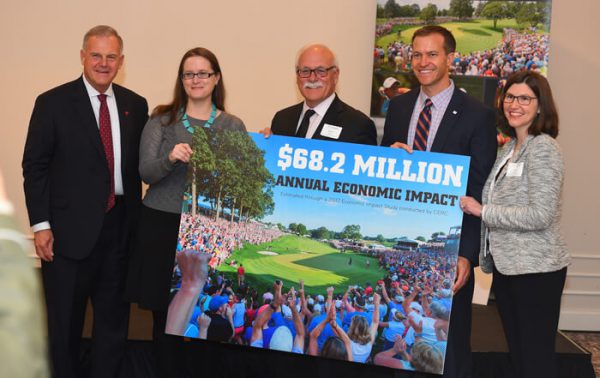
Andy Bessette, Executive Vice President and Chief Administrative Officer of Travelers; Sarah Ficenec and Bob Santy, CERC; Nathan Grube, Tournament Director at Travelers Championship; and Alissa DeJonge, CERC

CT's Mattress Recycle Program Collecting 14,000 Per Month

Connecticut mattress recycling program collected more than 162,000 mattresses and diverted more than 2,300 tons of material from disposal during the 2016-17 fiscal year, according to a recently released report on the state's program. The mattress industry created the Mattress Recycling Council (MRC), a non-profit organization, in 2013 to develop and administer a recycling program, which was dubbed the Bye Bye Mattress Program.  It is  funded through a $9 fee collected from consumers on all mattress and box spring sales in the state.

The program officially began operating on May 1, 2015 in accordance with a new state law. It now averages recycling 14,000 mattresses a month. MRC collects mattresses from 125 communities and 169 public and private entities that dispose of large volumes of discarded mattresses.

On average, 70 percent of a mattress is recycled.  Officials are pushing to increase that percentage to 75 percent.  Program materials suggest that 80 percent of a mattress can be recycled.  In the program’s first two years, a total of 313,661 mattresses were collected for recycling.

Among the leading municipalities, according to the 54-page report:  Hartford - 336 tons, Bridgeport - 197 tons, Manchester - 138 tons, East Hartford - 84 tons, and Southington - 62 tons.

MRC’s education and outreach efforts are designed to inform consumers, mattress retailers, and other stakeholders about the Bye Bye Mattress Program, that the fee is mandated by state law, why the fee is needed, what the fee funds, how to recycle through the Program, and that some parties have obligations.

In addition to Connecticut, MRC operates programs in Rhode Island and California.

Among the many locations across making use of the program is the Naval Submarine Base in New London.  The Base used the program to assist with the recycling and transportation of 692 mattresses from barracks, submarines, and Navy hotel lodging facilities connected to the Base. MRC collected mattresses from the Base in New London three times during the fiscal year.

Despite the program’s achievements to date, one objective is not being met.  Based on MRC’s experience during the past two years, the report points out, it became clear that the healthcare facility goal was “impractical.”

Mattresses discarded by healthcare facilities are not recycled for two primary reasons: biological contamination and mattress residual value, according to the report. In addition, a strong secondary markets exist for specialty hospital mattresses discarded by healthcare facilities. As a result, discarded units are frequently resold domestically or exported, the report explained.

“Therefore, those units are not being landfilled or incinerated in Connecticut and are not available for recycling. Furthermore, healthcare mattresses with breached outer ticking or physical contamination may pose health risks, and are instead disposed of as solid or biological waste due to liability concerns,” the report points out.

https://youtu.be/L9QMPy4VT_Y


Best States for Aging? CT Ranks #18, Study Shows

Connecticut’ senior citizen population ranks 7th in the nation, but the state places at number 18 in an analysis of the nation’s “best states for aging.” As baby boomers move into their elder years, the nation's population – and Connecticut’s - is aging quickly. By 2050, the older adult population is expected to almost double to more than 87 million from 43 million in 2012, U.S. News points in an article highlighting the analysis, which was developed for the magazine by McKinsey & Company.

The Best States for Aging ranking determines which states are most effectively serving their senior citizens by keeping them healthy, financially secure and involved in their communities. States are scored relative to each other in 12 factors that average into one overall score.

The top 10 states were Colorado, Maine, Hawaii, iowa, South Dakota, Wisconsin, Minnesota, Vermont, New Hampshire and Florida.  Massachusetts ranked #12, and Rhode Island was #21.

Among the categories, Connecticut ranked first in "able-bodies", fourth in life expectancy and primary care, 44th in cost-of-living and 49th in cost of care.

Between 2010 and 2030, Connecticut's population of adults age 65 and older will increase by 57 percent, the state’s Legislative Commission on Aging testified in 2016. At least 20% of almost every town's population in Connecticut will be 65 years of age or older by 2025, with some towns exceeding. 40 percent, officials said.  The state has the 3rd longest-lived constituency and is home to more than 1 million baby boomers.

Data sources include: Centers for Disease Control and Prevention, Centers for Medicare and Medicaid, Genworth Cost of Care Survey, Kaiser Family Foundation, Missouri Economic Research and Information Center, U.S. Bureau of Labor Statistics, United Health Foundation.

To Combat Teen Driving Deaths, Video Contest Theme is “Could This Be You?”

The problem is not surprising, but the solution remains elusive.  Young drivers account for a disproportionate number of motor vehicle crashes and these crashes are the leading cause of death for this age group. In fact, the risk of motor vehicle crashes is higher among 16-to 19-year-olds than among any other age group. Data indicate that per mile driven, teen drivers ages 16 to 19 are nearly three times more likely than drivers aged 20 and older to be in a fatal crash, according to the Centers for Disease Control and Prevention. Fatal crashes involving teen drivers jumped 10 percent between 2014 and 2015, the most recent year-to-year data available, according to a report by the Governors Highway Safety Association.

In an ongoing effort to reduce those numbers in Connecticut and better alert teens and their parents of the dangers, the Connecticut Department of Motor Vehicles and Travelers are once again launching their annual Teen Safe Driving Video contest for high school students.

The theme this year is: “Teen Safe Driver: Could This Be You? Every Second Matters.” The stated goal is to create peer-to-peer education and influence about developing safe driving habits. A panel of judges comprised of safety advocates, health experts, and state officials will select the winners.  Entries are due by December 15, 2017.  Travelers will award up to $26,000 in cash prizes to the winning students and their high schools.

The theme of this year’s contest calls for video submissions showing positive examples of how to prevent tragedies, crashes, injuries and deaths. Studies have shown that positive influences can have the most effect on changing behavior.

“We fully support the Connecticut DMV’s program that educates teens about the importance of safe driving,” said Michael Klein, executive vice president, and president of Personal Insurance at Travelers. “Teenagers talking to other teenagers about good driving habits can carry more weight, and we hope the contest sparks conversation and encourages young drivers to take precautions behind the wheel.”

“This year’s theme calls attention to the great responsibilities teen drivers have, the challenges they face when getting behind the wheel and how to create a positive outcome that promotes safety,” said DMV Commissioner Michael Bzdyra. “Each year the contest generates amazing work by students across the state, and we want the new theme to inspire the creative juices of students to promote safe driving.”

The contest is open to all public, private, and home-schooled high school students in Connecticut. Submissions must be submitted electronically or postmarked no later than December 15, 2017.  Travelers will award up to $26,000 in cash prizes to the winning students and their high schools. In addition, a cash prize of $1,000 will go to the school with the video showing the best multicultural message, which has been underwritten by Yale-New Haven Children’s Hospital.

The requirements for submissions include:

  • PSA must be no longer than forty-five (:45) seconds in length. • It must demonstrate the theme: “Teen Safe Driver: Could This Be You? Every Second Matters.” • PSA must show on it the hashtag  #CouldThisBeYou • It must also address two specific teen driving laws. • The PSA must have a multicultural or diversity component because driving involves teens from all backgrounds, including race, color, national origin, ancestry, age, sex, disability, sexual orientation, religious beliefs, culture, etc.  Bi-lingual/multi-cultural videos are welcomed and encouraged. • Teams of students are limited to a maximum of 5 members, including the student director. • The PSA must feature at least two teens, along with any other teens or adults considered necessary for the creative safety message.

Other promotional contest partners include the Connecticut Police Chiefs Association; the Connecticut Association of Schools (CAS); AAA; the Connecticut State Police; Mourning Parents Act (!MPACT); the Connecticut Children's Medical Center; Yale-New Haven Children's Hospital; Saint Francis Hospital and Medical Center; the Connecticut Emergency Nurses Association; the state Department of Public Health; the state Department of Insurance; the state Department of Transportation; the state Department of Education; and the state Division of Criminal Justice.

A group of 18 student advisors to the Connecticut DMV helped create the theme focused on the teen driver because that single person can control the fate of himself or herself, as well as others, in the vehicle. Often their fate rests on whether they follow the rules of the road with responsible decision making, safe driving and by obeying state laws, especially those aimed at 16- and 17-year-old drivers.

Student advisors who worked on the project are Kenny Bigos of Suffield High School; Taurean Brown and Salma Tapkirwala, both of the Sport and Medical Science Academy in Hartford; Michael Dellaripa, Roham Hussain and Connor Silbo, all of Xavier High School in Middletown; Jalen Fontanez of East Hartford High School; Samantha Getsie of Berlin High School; Madison Massaro-Cook of Newington High School; Alex Proscino and Daniela Violano of Hamden High School; Esha Shrivastav of Kingswood-Oxford in West Hartford; Tess Chang and Rachel Saal of Hall High School in West Hartford; Maggie Silbo of Mercy High School in Middletown; Cole Wolkner and Evan Wolkner of Farmington High School; and Emma Zaleski of Wethersfield High School.

The complete set of rules can be found at http://ct.gov/teendriving/contest.   Past contest winners can be found on YouTube at: http://www.youtube.com/teensafedriving12.  Since the annual contest began more than a decade ago, nearly 3,500 students across the state have participated, representing more than 100 high schools. More information about the contest can be found at http://ct.gov/teendriving/contest.


Connecticut Among Leaders in Addressing Cyberbullying, Bullying Among Youth

Connecticut's anti-bullying laws and relatively low number of reported cyberbullying incidents have earned it a spot as one of the top three safest states from cyberbullying, according to a new national survey.   Nationwide at least 34 percent of kids have been cyberbullied, but the precise percentages vary from state to state. A new survey developed by Frontier Communications, marking Child Safety & Prevention Month, assesses the relative safety across the nation.  Based on an analysis of six weighted factors (including school sanctions for cyberbullying, existing state bullying laws, school discipline for off-campus behavior, and the percentage of students in grades 9–12 that have reported being cyberbullied), ten states are said to be addressing the issue head on: Florida, Arkansas, Tennessee, Michigan, Pennsylvania, New York, Vermont, Massachusetts, Connecticut, and Washington, DC.

In contrast, Washington, Oregon, Montana, Utah, Arizona, Colorado, Iowa, Wisconsin, and Ohio provide the fewest legal protections against cyberbullying. For example, most of these states don’t have a specific state statute that allows schools to discipline students for off-campus behavior, according to the survey analysis.

The U.S. Department of Health (DOH) defines bullying as repeated “unwanted, aggressive behavior among school children that involves a real or perceived imbalance.” Bullying can involve making threats, spreading rumors, physically attacking someone, or purposely excluding someone from an activity.

Bullying and cyberbullying are major problems - over 3 million students are bullied every year, which contributes to over 160,000 days of absences by students from school, according to Derek Peterson, CEO of Digital Fly, a technology company based on Long Island.

“This is bad for the student, schools, communities, states and our nation,” he said, emphasizing that states have the ability to lead, create policies for reporting, tracking, educating, preventing and punishing those involved in bullying and cyber bullying.

Connecticut’s “An Act Concerning the Strengthening of School Bullying Laws,” Senate Bill 1138 signed into law in 2011, defines "Cyberbullying" as any act of bullying through the use of the Internet, interactive and digital technologies, cellular mobile telephone or other mobile electronic devices or any electronic communications…” The law states that school policies must “include provisions addressing bullying outside of the school setting if such bullying (A) creates a hostile environment at school for the victim, (B) infringes on the rights of the victim at school, or (C) substantially disrupts the education process or the orderly operation of a school…”

Testifying in support of the Connecticut legislation, state Victim Advocate Michelle Cruz said “we now know the long lasting and devastating effects that bullying behavior can have on victims, bystanders and even bullies.”  She cited a study by the Family and Work Institute that reported one-third of children are bullied at least once a month, while six out of ten teens witnessed bullying at least once a day.

Attorney General George Jepsen noted that “Students no longer have the refuge of home.  Technology makes students easily accessible through cell phones, social networking sites, and online gaming systems long after school closes.”  In advocating for the legislation, he said efforts must aim to prevent school from being a “hostile environment for the student” that “impacts their ability to learn and thrive.”  And, he added, those efforts must continue when the student leaves the school building.

The DOH defines cyberbullying as “bullying that takes place over digital devices like cell phones, computers, and tablets” and can include any number of activities:

  • Spreading rumors online or through texts
  • Posting hurtful or threatening messages on social networking sites or web pages
  • Posting a mean or hurtful video or picture
  • Pretending to be someone else online to hurt another person
  • Taking unflattering pictures of a person and sharing them online
  • Sexting, or circulating sexually suggestive pictures or messages about a person

Recent statistics show that more than a third of children and teens have experienced cyberbullying, according to the Frontier analysis.  Data is available from the National Center for Education Statistics and the Cyberbullying Research Center.

State Budget Woes Impacting Nonprofits, Grantmakers

The impact of the state’s ongoing fiscal crisis is reverberating through the state’s nonprofit community.  The Connecticut Council for Philanthropy (CCP), in a recent survey, found that about 25 percent of nonprofits answering the survey are currently responding to the state’s fiscal crisis. The vast majority of these grantmakers, responding with increased grant support to non-profit organizations. Some grantmakers, about 33 percent, are supporting conversations about non-profit mergers. And a smaller number, about 20 percent each, are offering learning programs and/or advocating. The survey results were shared in the CCP’s latest newsletter by president Karla Fortunato.

In analyzing the survey responses, CCP reports that many more foundations, about 44 percent of respondents, report that they plan to respond to the state's fiscal crisis. Again, the majority, about 50 percent, are planning to increase their grant support to non-profits. Even more, 57 percent, report they will support conversations about non-profit mergers, and still others, 42 percent, will offer learning programs to non-profits. A smaller number, 21 percent, plan to advocate or lobby.

“We think that the time is now to bring the philanthropic community together - to deepen our collective understanding of the current fiscal crisis, projections for out-years, and what roles philanthropy can play to mitigate short-term pain, to support evolution in the state's non-profit landscape, and to start developing longer-term strategies,” Fortunato said.

Most respondents reported that they are hearing from their grantees and that many of them are adjusting their work based on the state budget.  Among the actions being taken:  cutting programs and services, requesting bridge loans or gap funding, reducing or laying off staff, dipping into reserves, and reducing staff.  Concerns are also being raised about potential tax law changes that would impact nonprofits and concerns about meeting current needs, or possible reversal of past gains in providing services.  Grantees also report hearing from organizations seeking support that had not requested support previously, being driven by state cutbacks or anticipated cutbacks.

While many respondents noted that they are having conversations internally at their organizations or with their colleagues, most acknowledged that more information is needed and more conversations need to be had. They noted that discussions among foundations, and in collaboration with nonprofits or other partners, are critical. Fortunato reported that suggestions for CCP leadership highlighted three areas of focus, described as advocacy, inform and convene.

Advocacy includes helping to organize a unified response; advocating for a responsible, equitable budget; and making sure legislators understand that philanthropy cannot fill government's gaps. CCP members also look to the organization to keep them up-to-date on budget matters and other policies impacting nonprofits, sharing what others are doing, and exploring and sharing possible solutions.  They also look to CCP to convene forums to deepen understanding; bring nonprofits together to learn together what funders can consider doing; and help nonprofits understand what is needed immediately to mitigate short-term harm and assist in the development of a long-term strategy.

Fortunato joined CCP in May as the organization's president, after 13 years at the Health and Environmental Funders Network (HEFN), a national alliance of 60 philanthropic organizations based in Rockville, Md.  At her departure from HEFN, the organization commended her "professionalism, pragmatism, and persistence" in advancing and extending the organization's mission and objectives.


Hartford Residents Younger, Danbury’s Older, Among State’s Largest Cities

The median age in Danbury is the highest among Connecticut’s largest cities, just slightly older than Stamford, and nearly nine years older than New Haven, according to a new analysis by TIME magazine. Across the country, Boca Raton, Fla., has a median age just over 50 years old — much higher than America’s median age of 37.9. At the opposite end of the spectrum, the college towns of Flagstaff, Ariz. and College Station, Texas have median ages near 23 years old, according to 2016 Census data for cities with more than 65,000 people.

Connecticut’s largest cities, by population, are Bridgeport, New Haven, Stamford, Hartford, Waterbury, Norwalk, Danbury, and New Britain.

Danbury, at 39.7, and Stamford’s at 37.9, the oldest among Connecticut’s largest cities, based on median age of their residents.  Stamford’s median parallels the U.S. as a whole.  The median age or residents of Norwalk is just slightly lower, at 37.7.

The median age in New Britain is 36, in Bridgeport and Waterbury it is 34.  Somewhat younger median ages are in Hartford, at 31, and in New Haven, nearly identical at 30.8.

Among the cities, Norwalk and New Britain have the largest percentage of their populations between age 60 and 79, both with 17 percent.  New Britain and Stamford each of 4 percent of their population age 80 or older; in Danbury it is 5 percent, the highest percent among the cities.

Hartford has the largest percentage of residents age 20-39, at 33 percent, and under age 19, at 30 percent.  That’s 63 percent of the population, nearly two-thirds, under age 39.  In Bridgeport that  percentage is 58 percent, in Norwalk it is 53 percent and in Danbury, just over half at 51 percent.

In each of the eight largest cities, with the exception of Danbury, the largest population block is those age 20-39.  The largest is in New Haven, at 34 percent.  Danbury’s largest block of residents is in the 40-59 age group, at 29 percent.

While college towns and retirement communities represent extremes, there are also age trends in urban and suburban areas, says William Frey, a senior fellow at the Brookings Institution’s Metropolitan Policy Program.

“Suburbs are aging more rapidly than cities, due to the fact that baby boomers were a big part of the suburbanization of the United States in the ’50s and ’60s,” he told TIME. “They grew up there, and now they’re like anchors of the suburbs.”

Cities, meanwhile, continue to draw millennials, though Frey believes that’s less about preference, and more about barriers to home ownership following the recession. “I think the jury’s still out on whether the millennial generation will move to the suburbs,” Frey says.

Cybercrime Attacks on CT Residents, Businesses Ranked Midway Among States

Connecticut is among the 25 states that have seen residents lose the most as targets of criminal activity on Cyber Monday, the busiest on-line day of the year, according to a new analysis released just before this year’s edition of the annual on-line shopping spree known as CyberMonday. OpenVPN, Inc. released details on a groundbreaking study that ranks how age, sex and where an individual lives could predict their likelihood to become a target of criminal activity on Cyber Monday.

"Connecticut is generally thought of as a very safe state with low crime rates. That's the unique thing about cybercrime and identity theft - you can live in the nicest house on the block and still be very vulnerable," says Francis Dinha, CEO of OpenVPN.

California is ranked the worst state in the country for total reported cybercrimes, fraud, and identity theft per capita in 2015 and 2016.  Connecticut was the 21st worst in the analysis, just about in the middle of the pack.

The study data was culled from the FBI’s IC3, or Internet Crime Complaint Center, as well as the federal government’s Consumer Sentinel Network (CNS) databases.

In 2016, the state’s residents lost $6,960,531 total to internet crime, an average of $2,734.98 per person. Overall, 28,595 state residents reported cybercrime of some sort in 2016 — mainly men and people in their 50’s, the study found. Internet crime complaints totaled 2,545, total fraud complaints reached 21,117 and identity theft complaints totaled 4,933, according to the data compiled.

"Connecticut follows national trends in that more men than women are victimized, and older individuals have been more deeply affected,” Dinha added.  “OpenVPN encourages all Connecticut citizens to educate themselves about how cybercriminals gain access to private information and stay safe this Cyber Monday."

“What came as a surprise in this report,” said Gary McCloud, VP of Business Development for OpenVPN, “Is that men actually fall victim to cybercrime 75 percent more often than women.”

Men and women have different shopping habits. The study noted that men actually spend more than women online, so that fact alone may the reason men fell victim to cybercrime more often to women - and may continue to do so. In fact, men fell victim to cybercrime more 75 percent more often than women—falling victim in 38 of America’s 50 states – including Connecticut - and Washington D.C.

The state’s male ranking is seventh worst among the states, female ranking is fourteenth worst.  By age group, the state’s best showing is among those age 20-29, ranking Connecticut 28th among the states; the worst showing, a ranking of 13th, in the 50-59 year old age group.

The safest states cited in the study include South Dakota, North Dakota, West Virginia and Maine, with Vermont ranking as the safest at #51.  The worst states were California, Florida, Nevada, Texas, New Mexico, New York, Arizona and Virginia.

All 50 states and the District of Columbia were ranked from most to least total victims of cybercrime, equally weighted per 100,000 people for the total number of internet crime victims, fraud victims, and identity theft victims.  The study also took into account the average dollar loss per victim of internet crime and average dollar loss per victim of fraud.

Among the recommendations to improve safety and deter cybercrime:

  1. Do NOT use a public wifi signal unless you have a Virtual Private Network (VPN) which will encrypt information on your computer, hiding it from online predators.
  2. If shopping from home, make certain your home wifi signal is password-protected. Otherwise, someone simply driving down the street could access the private information on your computer.
  3. When shopping online, look for verification you’re on a secured site. This may be something as simple as a padlock in your internet window.
  4. When possible, use a credit card as opposed to a debit card which is linked directly to your bank account.

All of the data used for total cybercrime compilations based on age and gender was pulled from the 2015 FBI crime database; 2016 was not available.


Statewide Sustainability Initiative to Launch Nov. 28 As Municipalities Take the Lead

With momentum to accelerate sustainability practices in Connecticut,  local and regional representatives from Connecticut’s 169 towns and cities, along with key agencies and businesses, have spent the past year developing Sustainable CT.  The new statewide initiative will be formally launched at the end of this month with expectations of influencing sustainability practices across the state. Meeting for much of the past year, an Advisory Committee, consisting of state and municipal leaders , developed the initiative and adopted the overarching concept, “Sustainable CT communities strive to be thriving, resilient, collaborative and forward-looking.  They build community and local economy.  They equitably promote the health and well-being of current and future residents.  And they respect the finite capacity of the natural environment.”

Created by towns and for towns, Sustainable CT aims to be a voluntary certification program to recognize Connecticut municipalities for making their communities more vibrant, resilient and livable. It includes approximately 55 best practices along with opportunities for grant funding. Towns may choose which actions they will implement to achieve differing certification levels. The program is designed to support all Connecticut municipalities, regardless of size, geography or resources.

Organizers say that sustainability actions, policies, and investments deliver multiple benefits and help towns make efficient use of scarce resources and engage a wide cross section of residents and businesses. The official launch of Sustainable CT will occur at the Annual Convention of the Connecticut Conference of Municipalities on November 28.

“Sustainable CT will foster creative thinking and problem solving within and between municipalities.  It will be the tool communities can use to bring together seemingly divergent stakeholders for the common goal of sustainability,” said Laura Francis, First Selectwoman, Durham, and Vice-Chair of the Advisory Group.

Officials indicate that all of Connecticut’s 169 towns and cities have been represented in Sustainable CT’s development in some way, either by directly by a municipal official or staff person, by a highly engaged local volunteer, or by a regional entity charged with representing member municipalities.

The Sustainable CT framework includes:

  • Sustainable CT is a roadmap of voluntary actions that will help municipalities be more sustainable.
  • Resources and support, including funding, help local communities apply the actions that fit them best.
  • The Sustainable CT Certification publicly recognizes municipalities for their sustainability achievements.
  • Sustainable CT is flexible. Any Connecticut municipality can find ways to become more sustainable – urban or rural, big or small, coastal or inland.

Municipal leaders and residents from across the state, the Connecticut Economic Resource Center (CERC), Connecticut Conference of Municipalities (CCM) and others from key agencies, non-profits and businesses all partnered to help create the program. Burlington First Selectman Ted Shafer chaired the effort.  A CCM Task Force on Sustainability, which included 15 mayors, first selectmen, and municipal officials, assisted the Advisory Committee.

CERC’s Courtney Hendricson, Vice President of Municipal Services, served on the Local Economies Working Group, chaired by Patrick Carleton, Deputy Director of the Metropolitan Council of Governments, and Thomas Madden, Director of Economic Development in Stamford. The working group helped to define actions municipalities can take to create or enhance economic development that fosters energy-efficient and clean-powered commercial and industrial buildings, supports local products and businesses, increases local jobs and revenues and promotes environmental and community well-being.

The Institute for Sustainable Energy at Eastern Connecticut State University coordinated the initiative. Support was provided by a funding collaborative composed of the Emily Hall Tremaine Foundation (EHTF), Hampshire Foundation and Common Sense Fund.  Advisory Board members included, in addition to Shafer and Francis, Carl Amento, David Fink, Bryan Garcia, Emily Gordon, Donna Hamzy, Scott Jackson, John Kibbee, Rob Klee, Kurt Miller, Kristina Newman-Scott, Christine Schilke and Christina Smith.


Local Foundation Receives Major Grant to Expand Suicide-Prevention Program Nationally

The Hartford-based Jordan Porco Foundation has been selected as one of 13 non-profit organizations to receive a $100,000 grant from the Alkermes Inspiration Grants program. The grant will support Fresh Check Day, which is an uplifting mental health fair that builds a campus community around mental health and suicide prevention through engaging peer-to-peer education. Fresh Check Day, the foundation’s signature program, creates an approachable atmosphere where students are encouraged to engage in dialogues about mental health, and it helps to build a bridge between students and the mental health resources that exist on campus, in the community, and on a national level. Research supports that peer-to-peer education is one of the most effective ways to educate students, especially when the subject is suicide and mental health.

Since the first event in 2012, Fresh Check Day has grown exponentially, expanding throughout Connecticut, New England and nationwide.  There are now 26 colleges and universities in Connecticut that offer the program, and nearly 150 schools in 37 states.

“We are thankful to be awarded this grant in support of our signature program, Fresh Check Day. It helps in our national expansion and efforts to reach more young adults with our critical message of hope,” said Marisa Giarnella-Porco, President and CEO of the Jordan Porco Foundation.

The mission of the Jordan Porco Foundation, a 501(c) (3) public charity, is to prevent suicide, promote mental health, and create a message of hope for young adults. They accomplish this by providing engaging and uplifting peer-run programs. Their programs strive to start a conversation about mental health that reduces stigma while encouraging help-seeking and supportive behaviors.

“Addiction and mental illness affect millions of people and their families every day, and require an integrated approach to treatment that is scalable in communities across the country,” said Richard Pops, Chief Executive Officer of Alkermes. “Medicines play a role, but importantly, it is the innovative programs, like the Jordan Porco Foundation, designed to support people affected by these diseases and led by passionate leaders on the front lines that will ignite sustainable and meaningful change for patients.”

The primary goals of Fresh Check Day are to:

  • Increase awareness of mental health resources and services available to students
  • Challenge stigma and misconceptions around mental health and suicide that often deter individuals from seeking help
  • Empower peers to be gatekeepers by understanding warning signs and knowing what to do if a friend is exhibiting signs of suicide or a mental health concern
  • Increase willingness to ask for help if experiencing emotional distress

Now in its second year, Alkermes Inspiration Grants focuses on two key areas: improving or enhancing support or resources for people affected by mental health concerns or substance use disorder, and/or integrating the perspective of people affected by mental health concerns or addiction into drug development or care delivery. Alkermes is a global biopharmaceutical company with a “steadfast commitment” to developing innovative medicines for central nervous system (CNS) diseases.  The company has facilities in Ireland and the United States.

https://youtu.be/z_AQ5LJgVnQ