Hurricanes v. Whalers: Words and Numbers Tell Different Stories

In the midst of the war of words between unrelenting fans of the former Hartford Whalers (joined by Governor Malloy) and the Raleigh News & Observer, which has aimed a cease and desist order at Hartford, it may be worthwhile to delve into the data. It prove to be a distinction without a difference, however. Gov. Malloy’s February 8 letter to Thomas Dundon, a Dallas businessman and new owner of the Carolina Hurricanes, urged that the team return to the Nutmeg State for a regular season game at Rentschler Field or the XL Center so the team could be “embraced by a grateful fan base.”  Doing so, Malloy pointed out, “would make clear that Hartford is a far more viable long-term home for the team than Raleigh.”

When asked days ago by The Sporting News about the 'Canes future in Raleigh, Dundon said: “As long as I’m involved, this is where we’re going to be. One of the best things about this is the people. They’re just nice people here. They care. There’s no reason to be anywhere else.”

In an editorial, the Raleigh newspaper added that if a game were to be played in Hartford, it would be preseason, not regular season, and only because it would be “a chance to hoover some money out of the pockets of long-suffering Whalers fans desperate to see NHL hockey again…  But that’s not going to happen.”

Last season, the Hurricanes had the league’s lowest attendance, averaging 11,776 per home game.  It was their second consecutive season at the bottom of the league in attendance.  In the 2015-16 season, average attendance was 12,203. Midway through this season, after 27 home games, the Hurricanes are averaging 13,039, 29th out of 31 teams in the league.

In the Whalers’ final season in Hartford, 1996-97, attendance at the Hartford Civic Center had grown to 87 percent of capacity, with an average attendance of 13,680 per game.  Published reports suggest that the average attendance was, in reality, higher than 14,000 per game by 1996-97, but Whalers ownership did not count the skyboxes and coliseum club seating because the revenue streams went to the state, rather than the team.

Attendance increased for four consecutive years before management moved the team from Hartford. (To 10,407 in 1993-94, 11,835 in 1994-95, 11,983 in 1995-96 and 13,680 in 1996-97.)  During the team’s tenure in Hartford, average attendance exceeded 14,000 twice – in 1987-88 and 1986-87, when the team ranked 13th in the league in attendance in both seasons.

During the 15 years prior to the past two seasons at the bottom, Carolina has been among the league’s bottom-third in  average attendance eight times, and the bottom-half every season but one.

The Sporting News has reported that Dundon purchased a 61 percent stake in the franchise last month, with Peter Karmanos, who relocated the Whalers to North Carolina in 1997, retaining a 39 percent minority stake. Dundon reportedly has an option to purchase the remainder in three years. He is a New York native, and lived in New Jersey and Houston before Dallas.

The arena's lease in Raleigh expires in 2024.  The team's current playoff drought is the longest of any team in the NHL - nearly a decade.

In the interview, Dundon pointed out “We have a really passionate, loyal season ticket base. The number is just smaller than you’d like it to be, but you have one. Every year that’ll grow. So the only challenge is just the amount of people that you have to touch. It’s inevitable that we’re going to touch them all and we’re going to get them.”

SeeClickFix is Only CT Business to Reach GovTech 100

New Haven-based SeeClickFix is the only Connecticut business to make the 2018 GovTech 100, an annual compendium of 100 companies focused on, making a difference in, and selling to state and local government agencies across the United States. SeeClickFix was launched ten years ago this month, according to co-founder Ben Berkowitz: “It began as a ‘nights and weekends’ project between friends with a goal of fixing some small problems locally and a big problem globally. SeeClickFix has become something much bigger than I could have ever imagined.”

Described as “a service to make communities stronger,” the key benchmarks the company points to include: a full time job for 33 employees, a platform that has helped facilitate the resolution of 4 million issues, a space for aspirations in tens of thousands of communities, and the official digital channel for service request resolution for hundreds of governments and tens of millions of their residents.

The annual list, compiled and published by Government Technology,  highlights leaders in the government technology sector – a marketplace that the publication says has ”brought bigger deals, more investment, new companies and many fresh new innovations that moved the needle in the public sector.”

Overall, 32 of the 100 companies are based in California, seven are based in New York, and six are headquartered in Massachusetts.  Rhode Island placed one company, Providence-based software company Utilidata.  There were no other companies based in New England.

“State and local governments have become more willing to try implementing new systems using agile methodologies that fit better with the modern tech world,” the publication pointed out. “They are striking up pilot projects and demonstration agreements that let them try out new ideas before taking the kind of big-dollar risks that government is not amenable to taking.”

“It is no secret that SeeClickFix was built from a place of distrust in the existing bureaucratic process that existed in 2007 for handling citizen concerns,” Berkowitz noted. “The three hundred governments and the thousands of officials that leverage SeeClickFix daily to engage in transparent and responsive communication has more than reversed our distrust.”

SeeClickFix is proving effective in small towns as well as big cities.  The town of Wilton in Southern Connecticut went live with SeeClickFix this past fall and used it at a Winter Carnival and Ice Festival in town this week.

The SeeClickFix blog highlighted the town, explaining that “They are a model town — they have done everything right! They have sustainable marketing, well-crafted goals and benchmarks, a responsive set of municipal departments, a champion in town leadership, and the flexibility necessary to add in request categories when citizens underscore a need.”

SeeClickFix co-founders include Miles Lasater, Kam Lasater, Jeff Blasius.  The company holds an annual User Summit every fall in New Haven, drawing local government customers from throughout the country to share best practices.

https://youtu.be/NYKo5koU_jI

Million Dollar Homes? CT Ranks 6th in USA

There has been discussion during Connecticut’s ongoing state budget shortfall about the disproportionate impact of the state’s wealthiest residents, and how overall state revenues are affected when some of those residents decide to relocate to lower-tax states. Now, national data analyzing million dollar homes is underscoring Connecticut’s standing as being among the states where the ultra-wealthy have roots.

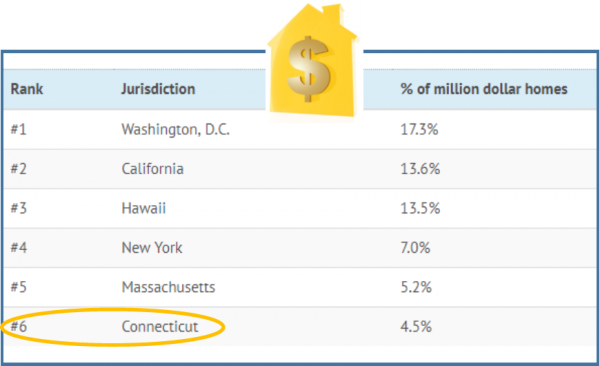
An analysis by Overflow Data and Visual Capitalist ranks Connecticut in the top ten among states with the highest percentage of homes worth more than one million dollars.  Connecticut ranks sixth, with 4.5 percent of homes surpassing that threshold.

Ahead of Connecticut are only Washington, D.C. (17.3%), California (13.6%), Hawaii (13.5%), New York (7%), and Massachusetts (5.2%).

Connecticut’s standing may slip in the coming years.  In a review of cities where million dollar listings have “skyrocketed,” increasing over the past three years, the leaders were Denver, Santa Rosa (CA), Boulder, Truckee (CA), Fredericksburg (TX), Heber (UT) and Boston.

The share of homes valued at more than $1 million has surged more than fourfold since 2002, according to recent data compiled  from real estate site Trulia, which analyzed the luxury real estate market in the top 100 U.S. metropolitan areas, and reported by CBS News.  Across those regions, about 4.3 percent of homes are now worth at least $1 million, compared with about 1 percent in 2002, said Trulia senior economist Cheryl Young told the network.

The five metropolitan areas with the largest share of homes worth $1 million in 2017, according to CBS News, are: San Francisco, San Jose, Los Angeles, Fairfield County, CT, and Long Island, New York.
The network reported that rising real estate values, tight inventory and a lack of new construction are contributing to the surge in million-dollar homes. Another factor may be at play: rising income inequality, which has benefited the bank accounts of America's richest families, the network report noted.

Among the Wealthy, CT’s Gender Pay Gap is 4th Widest in the U.S.

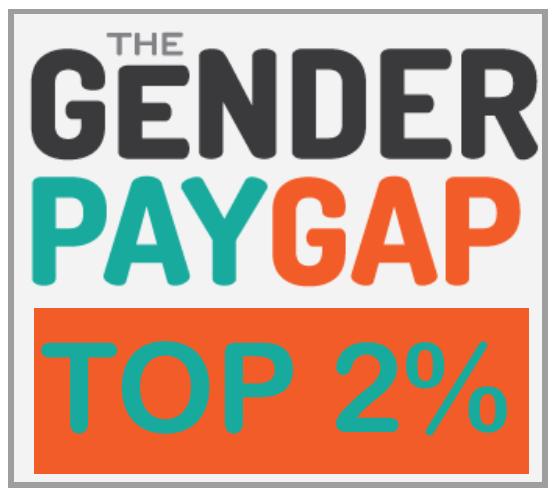
In Connecticut, among the top 2 percent of wage earners, men earn an average of $658,000 while women earn an average of $214,000, a gap of $444,000.  That’s 67 percent less earned by women in the top 2 percent.  It is the fourth largest wage gap in the nation, comparing people earning in the top 2 percent in all 50 states. The data, compiled by the website howmuch.net, used information from the United States Joint Economic Committee.  The analysis indicates that the pay gap is “enormous everywhere you look. There isn’t a single place in the country where it doesn’t exist. The best state for pay equality is Alaska, but even there, women make 25% less than men.”

The largest pay gap between wealthy men and women is in Wyoming, at 71 percent, followed by Nebraska (68.7%), Oklahoma (68%), Connecticut (67.4%) and New York (67.3%).

The website indicates that for people earning an average income, the gender pay gap is typically around 20 percent. “For the ultra-rich, however, women make 60-71.76% less than men in a whopping 37 different states.”

In 1963, only 44 percent of prime working-age women (ages 25 to 54) were in the labor force. Around that time, women held fewer than one in three jobs. Today, about 75 percent of prime working-age women are in the labor force and women hold almost half (49 percent) of all jobs, according to data compiled by the Bureau of Labor Statistics.

Connecticut’s average for men in the top 2 percent of wage earners - $658,000 – was the highest in the country, just ahead of Washington, DC ($637,000), New York ($613,000) and New Jersey ($555,000). Massachusetts was next, at $551,000.

For women in the top 2 percent, Washington, D.C. topped the list at $280,000, followed next by Connecticut at $214,000, and New York, New Jersey, Massachusetts and California at $200,000.

The website analysis concludes that the pay gap “gets worse the richer you are."

Insurance Department Recovers Almost $7 Million in 2017, Nearly Even with Previous Year; Industry Fines Increase

The Connecticut Insurance Department recovered nearly $7 million for policyholders and taxpayers in 2017, helping individuals, families and employers with their claims and complaints.  That’s slightly less than the $7.5 million recovered in 2016, but higher than the $6 million that was recovered for policy holders in 2015.  About $2 million in fines were issued against carriers, an increase from $1.6 million and $1.7 million during each of the previous two years. “Consumers have every right to expect that the promises made to them by their insurance companies will be kept and the Department is here to help them every step of the way. Protecting consumers is our mission and the Department makes certain that carriers adhere to all insurance laws and regulations are followed,” Insurance Commissioner Katharine L. Wade said. “We assist thousands of consumers every year who have brought their questions and concerns to us.”

The Department’s Consumer Affairs Unit (CAU) fielded 5,800 complaints and inquiries in 2017 and helped policyholders recoup nearly $4.8 million from January 1 to December 31, 2017. Also in 2017, the Department’s Market Conduct Division levied approximately $2 million in fines against carriers and returned that money to the state’s General Fund. The fines resulted from a variety of violations and settlements ranging from untimely claim payments to improper licensing.

The majority of the funds recovered for policyholders stemmed from complaints over health, accident, homeowners and life and annuities policies. The following is the breakdown of funds recovered in 2017:

  • Accident, Health - $2.9 million
  • Auto - $584,200
  • General Liability - $101,000
  • Homeowners and Commercial Property - $344,600
  • Life, Annuities - $739,000
  • Miscellaneous - $89,000

A year ago, in 2016, the Department’s recoveries were somewhat higher than in 2017 - recovering $7.5 million for policyholders and taxpayers.  The Department’s Consumer Affairs Unit (CAU) fielded more than 5,800 complaints and inquiries during the year.

In 2015, there were more consumer inquires and complaints, which resulted, however, in a lower total of money recovered with the department’s assistance.  The department recovered approximately $6 million for policyholders and taxpayers in 2015, when the majority of the funds recovered for policyholders stemmed from complaints over health, accident, homeowners and life and annuities policies. That year, the Department’s Consumer Affairs Unit (CAU) fielded more than 6,100 complaints and inquiries.

Officials explained that the Department calculates its consumer recoveries based on what the policyholder received as a result of the Department’s intervention. The inquiries and complaints also help the Department identify industry trends that may adversely affect consumers and trigger investigation by the Market Conduct division, they added.

The Insurance Department also highlighted three matters that were dealt with during 2017 which resulted in recoveries for policy owners.

  • When an individual who had health coverage through his employer complained about being overcharged for a visit to the emergency room, intervention by the Department’s Consumer Affairs Unit resulted in corrective action not only for that individual but for nearly 200 people whose employers used that same health insurance company for their health plans. The Department required the carrier to review similar claims for that plan, resulting in $47,000 in total recoveries for those affected individuals. As a result, the Department’s Market Conduct Division is investigating to determine if this was an isolated incident or is a systemic issue with the carrier.
  • The Department intervened when a family was denied a $100,000 death benefit because the life insurance company said the deceased had pre-existing health issues that disqualified the payment. The Department determined the company issued the policy without first looking into the individual’s health history despite having the opportunity to do so and therefore was obligated to make good on the claim. The family received the full death benefit plus interest.
  • The Department helped expedite a damage claim for a widow who was trying to get her husband’s gravestone replaced when it was one of several damaged by a car that crashed in a cemetery. The auto insurance company for the driver had the claim for three months but once the Department got involved, the carrier settled it within 10 days and paid nearly $30,000 to repair the cemetery damage.

Complaint data also help determine topics for consumer education and serve as tools to help the Department monitor the industry, officials noted. The Market Conduct enforcement actions are posted on the Department’s website at www.ct.gov/cid.


Harp Stands Out as Number of Big-City Black Mayors Diminishes Nationally

Last April, New Haven Mayor Toni Harp was sworn in as the first woman selected as president of the African American Mayors Association (AAMA).  In November, she was elected to a third two-year term leading the Elm City, earning more than 70 percent of the vote. In doing so, she ran counter to an apparent national trend – fewer African American Mayors in the nation’s largest cities.  According to an analysis by Governing magazine, in 2000, 19 of the largest cities in the country by population either had, or would soon have, black mayors.  By 2017, that number had fallen to six. Today, the Wall Street Journal recently reported, that number is four.

African Americans, and African American women, continue to be elected to City Hall.  Charlotte and New Orleans both elected their first black women mayors in November.  St. Paul and a number of smaller cities elected their first black mayors ever, the publication reported.

Among Connecticut’s largest cities, the mayors of Bridgeport, Hartford, Stamford, Waterbury, and Danbury are white males.  Hartford, which elected Thirman Milner and Carrie Saxon-Perry decades ago, hasn’t elected an African American since, but has seen two Latino men hold the office.

Carrie Saxon Perry was the first black woman to be elected mayor of a major New England city – in 1987. Milner was the first black mayor in all of New England, elected in Hartford in 1981. There hasn’t been a black mayor leading the Capitol City since Saxon-Perry’s term ended in 1993.

Were the current office-holder, Luke Bronin, to resign the office (a scenario that could result if he decides to run for Governor and if he is elected later this year) the newly elected City Council President, Glendowlyn Thames, could change that, if she succeeds to the office.

New Haven’s first black Mayor was John Daniels, who served from 1990 to 1993.  Like Harp, he previously served in the State Senate.

Across the country, Jacksonville, Memphis, Philadelphia and San Antonia had black mayors until recently, Governing reported.  Detroit elected its first white mayor in 40 years in 2013. The nation’s largest cities – New York, Los Angeles and Chicago – have each has one black mayor, years ago. Atlanta elected a black female as mayor in a run-off election, winning with just over 50 percent of the vote.

Harp is the only member of the AAMA from Connecticut.  The organization was formed in 2014.  Fifty years ago, the election of Carl Stokes in Cleveland in 1967 put him on the cover of TIME magazine as the first black elected mayor of a major U.S. city. Richard Hatcher, also African American, was elected mayor of Gary, Indiana that same year.


Norwalk, New Haven Among Communities Receiving Free Home Smoke Alarms

With the Connecticut Home Fire Campaign, the American Red Cross is working to reduce death and injury from home fires by 25% by 2020.  “Sound the Alarm. Save A Life.”, a series of home fire safety and smoke alarm installation events in Connecticut and nationwide, is deploying volunteers will install 100,000 free smoke alarms in high risk neighborhoods. In Connecticut, the initiative has been to 76 cities and towns, replacing nearly 1,000 smoke alarm batteries and installing more than 12,000 smoke alarms.  The program has conducted more than 700 in-home visits, making an estimated 4,400 households safer, according to officials.

Norwalk was the center of activity last month, and New Haven is next in line. 

Teams make visits to homes sharing fire safety and preparedness information and install smoke alarms in homes as requested. Volunteers help families understand the importance of fire safety and help them develop personalized family escape plans to use in the event a fire breaks out in their home.

The program was in Norwalk in December in conjunction with the City of Norwalk, and will be in New Haven in the spring.  A large-scale event is scheduled for New Haven to install 1,000 smoke alarms in and around the city on April 28, 2018.

“Our mission at the American Red Cross is to prevent and alleviate human suffering caused by disasters,” said Mario Bruno, CEO, American Red Cross Connecticut and Rhode Island Region. “Home fires are the biggest disaster threat faced in the U.S. On average, in our region, we respond to about two home fires each day. Our goal is to reach as many homes as we can with this program to help ensure people know what to do and are prepared in the event they experience a home fire. We want people to be safe.”

Nationally, the Red Cross just installed its one millionth smoke alarm last fall.  Since October of 2014, the Red Cross has worked with fire departments and community groups across the country as part of a multi-year campaign to reduce the number of home fire deaths and injuries.

Officials indicate that 60 percent of house fire deaths occur in homes with no working smoke alarms. The campaign initiative is in direct response to that “dire threat,” with the Red Cross committing to install 2.5 million free smoke alarms in neighborhoods at high risk for fires, and to educate those residents about fire prevention and preparedness.

Officials estimate that as of November 2017 the Red Cross and partners have saved more than 285 lives nationwide as part of the campaign.  In Connecticut, individuals can make an appointment by visiting http://www.redcross.org/local/connecticut/home-fire-safety-visit or by calling 877-287-3327 and choosing option 1 on the menu to request a smoke alarm installation.

Eversource Hartford Marathon Brought $14.5 Million in Economic Benefit to Region in 2017

Just four years ago, in 2014, there was a title sponsor changing-of-the-guard at Connecticut’s premier spectator sporting events, as Eversource took over sponsorship of the Hartford Marathon, Travelers stepped in to save the state’s PGA Tour event (now the Travelers Championship), and United Technologies took the lead sponsorship that same year of what had been the Pilot Pen tennis tournament, now renamed as the Connecticut Open. Aside from a source of pride in maintaining marquee sporting events, the economic impact of the events continue to underscore the significance of local corporations coming through to sustain the events.

The latest evidence comes with news that the Hartford Marathon Foundation’s 2017 Eversource Hartford Marathon, Half Marathon, Team 26.2 Relay and Charity 5K brought an estimated $14.5 million of economic value to the area over the course of race weekend.  That figure is up from an estimated $13.6 million in 2015.  Eversource is signed on as title sponsor through 2019.

Official indicated that the Hartford Marathon Foundation (HMF) spent approximately $1 million to produce the Saturday, October 14th race in 2017, primarily working with local vendors and service providers.

In addition to a local economic boost to the city of Hartford and surrounding communities, the marathon drew 71,780 spectators, participants and volunteers to the area. Officials point out that runners, friends and families stayed in Hartford lodging, shopped in the area and dined in local restaurants. Significantly, 87 percent of participants visited Hartford primarily for the event. Of those traveling from out of state, 44 percent were visiting the city for the first time, officials specified.

Thousands of runners are motivated to use the race to raise funds on behalf of various charities and causes. Through these efforts more than $288,000 was raised and reported by the event’s 20 official charities and other groups, although charity fundraising is not required to be reported, so the true numbers may be higher.

The annual Travelers Championship has an annual economic impact on the state of $68.2 million, according to a recent study by Connecticut Economic Resource Center, Inc. (CERC). An economic impact study conducted a decade ago, in 2008, found that the tennis tournament predecessor to the Connecticut Open contributed approximately $26 million to the regional economy, including $10 million in local economic impact.

The Hartford Marathon will mark its 25th running on October 13, 2018.  The 2018 Travelers Championship, will be held June 18-24 at TPC River Highlands in Cromwell.  The Connecticut Open, at the Connecticut Tennis Center at Yale, will be held August 17-25 in 2018.
“We’re proud to host people from across the country to achieve personal goals and celebrate their accomplishments,” said Beth Shluger, CEO of the Hartford Marathon Foundation and Race Director of the Eversource Hartford Marathon and Half Marathon. “We are able to highlight the best of what the capitol region has to offer in a positive and truly inspiring event that allows tens of thousands to run, walk, volunteer or spectate. We are excited to be celebrating our 25th running in October 2018 and hope to create an even bigger positive impact through this milestone event.”

The Hartford Marathon Foundation also produces more than 30 events through the year, many that contribute to other organizations’ community fundraising goals.  The 2017 Mystic Half Marathon and 10K in May 2017 generated $28,000 to benefit the charitable works of the Mystic Rotary Club.  Additional fundraising events HMF was contracted to produce races for in 2017 include the Mahoney Sabol 5K to benefit Hospital for Special Care, CT Race in the Park to benefit CT Breast Health Initiative, Zero Prostate 5K to benefit ZERO - The End of Prostate Cancer, Achilles CT Hope & Possibility 5K & 10K to benefit Achilles International – CT Chapter, Pumpkin Run/Walk to benefit Youth & Family Services of Haddam-Killingworth, Inc. and the Norwich Winterfest 5K to benefit Reliance Health, Inc.

Hartford Rail Line May Bring Jobs, Opportunity for Key Populations, Study of Public Transit Suggests

As Connecticut moves closer to a significant increase in rail service connecting communities from New Haven to Springfield, MA, with the introduction of the Hartford line, anticipated in May, a report by Demos underscores the potential impact on economic opportunity and segments of the state’s population. The report, “To Move is to Thrive:  Public Transit and Economic Opportunity for People of Color,” which looked at public transportation in metropolitan areas across the country, presents a series of findings on the use of public transit by people of color and on the potential jobs benefits that people of color can gain from investments in public transit.

Its key findings on the use of public transit are:

  • Racial, ethnic, and class inequities in the access to and funding of public transit continue today.
  • Latino and Asian-American workers are twice as likely as white workers not to have a vehicle at home. African American workers are three times as likely. These disparities are heightened in certain metropolitan areas; Latino and black workers lack a private vehicle at as much as six times the rate of white workers in some areas.
  • Asian-American and African-American workers commute by public transit at nearly four times the rate of white workers. Latino workers commute by public transit at nearly three times the white rate.
  • Workers of color are overrepresented among public transit commuters with “long commutes”—one-way commutes of 60 minutes or longer.

The key findings on the jobs benefits from investment in public transit are:
  • America’s employment rates are still low relative to 2000, and there is a strong racial hierarchy in employment rates.
  • The majority of the jobs created from infrastructure investments can be non-construction jobs.
  • All racial and ethnic groups gain jobs from large infrastructure investments and, generally, the larger the investment, the more jobs for each group.
  • Investments in public transit show good returns in terms of the shares of the total jobs going to workers of color.

The report also noted that “growing numbers of Americans rely on public transit in their daily lives. In 2015, passengers took 10.5 billion trips on transit systems, up 33 percent from 20 years ago. Public transit ridership has grown faster than the population. But our public transit infrastructure, like much of our infrastructure generally, is old and decrepit. And many of our transit systems were not designed to handle such heavy use.”

While Connecticut’s cities are not as large as many of the nation’s largest metropolitan areas, they do have populations with larger numbers of people of color than mnay surrounding suburbs.  Providing greater ease of mobility to station stops along the Hartford line could offer impacts suggested by the study.

The Hartford line, which is focused on increasing the frequency of station stops from Springfield to New Haven, will also see additional stations constructed in the coming years.  When the CTrail Hartford Line service launches in May, it will consist of both expanded Amtrak service and new regional trains operated by the Connecticut Department of Transportation and will offer more frequent, convenient and faster passenger rail service between New Haven, Hartford and Springfield.

Plans call for an increase in the number of round trip trains from six daily Amtrak intercity and regional trains to a total of 17 round trip trains a day to Hartford, and 12 trains per day to Springfield. In addition, trains will operate at speeds up to 110 mph, reducing travel time between Springfield and New Haven. Stops are to include rail stations in Windsor Locks, Windsor, Hartford, Berlin, Meriden, Wallingford and New Haven.   New stations are to be added, refurbished or relocated in North Haven, Newington, West Hartford, Windsor, Windsor Locks and Enfield by 2020.

Projections include more than 4,500 construction related jobs and over 8,000 total jobs, including both direct and indirect jobs.  Transit-oriented development, including housing is also anticipated along the route. Recently, plans to convert a long-vacant factory into housing was announced in Windsor Locks.

The national data indicates that workers of color are roughly 2 to 3 times as likely as white workers not to have a private vehicle at home: only 2.8 percent of white workers do not have a vehicle at home, but 6.9 percent of Asian-American workers, 7 percent of Latino workers, and 9.5 percent of African-American workers do not have a vehicle at home.

Nationally, 3.1 percent of white workers use public transit, while 7.8 percent of Latino workers, 11 percent of Asian-American workers, and 11.1 percent of African-American workers commute using public transit. In other words, Latino workers are almost 3 times as likely, and Asian-American and African-American workers are almost 4 times as likely as white workers to commute by public transit, the report indicated.

Based in New York, Boston and Washington D.C., Demos is a public policy organization “working for an America where we all have an equal say in our democracy and an equal chance in our economy.”

Hartford, New Haven See Diminishing Car Ownership Among Households; Hartford Ranks 8th in U.S. in Percentage Without Cars

Owning a car isn’t what it used to be – at least it isn’t as necessary as it used to be.  Demographics, fuel prices and where people live also play a role in whether a household goes car-free, according to a recent analysis by Governing magazine. Research also suggests younger families and one-person households are more likely to not own a car. The publication reports that several mid-sized cities recorded notable increases in shares of car-free households when averages from the 2015 and 2016 American Community Surveys are compared with those for 2009 and 2010. Those cities include New Haven.

According to the Census Bureau estimates, only 8.7 percent of U.S. households reported not having any vehicles available in 2016, about the same level as before the Great Recession.

In New Haven, the trend is stronger.  About 30 percent of New Haven households are without access to vehicles, an increase from about 27 percent in 2009-2010, Governing points out.  Part of the reason so many residents can go car-free stems from the city’s fairly residential downtown and pedestrian-friendly street grid layout, the publication explains, adding that New Haven’s high poverty rate is also a likely contributing factor, with many families unable to afford cars.

Other cities earning a spot on the list of for rapidly dropping car ownership are Paterson, N.J.; Davenport, Iowa; Elizabeth, N.J.; and Peoria, Ill.

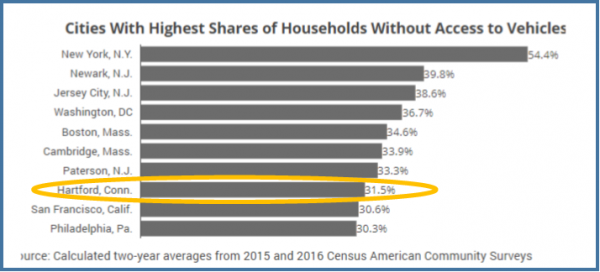
Hartford has a presence in the top 10 cities that already have among the highest share of households without a car, at a 31.5 percent two-year average.  Hartford ranks 8th.  The list is led by New York City at 54.4 percent, with Newark, Jersey City, Washington, Boston, Cambridge and Paterson in between.  San Francisco and Philadelphia round out the top 10 after Hartford.  Hartford increased from 30.3% in 2015 to 32.6% in 2016.

Among other Connecticut cities, Stamford’s households without vehicles is at 10 percent; Waterbury at 20.5 percent; and Bridgeport at 21.1 percent.

Data was calculated using two-year averages from 2015 and 2016 Census survey estimates.