

CT Ranks 15th Among Best States for Millennials, Analysis Reveals
/The only state in the nation with a higher percentage of millennials living with their parents than Connecticut is New Jersey. That is just one finding in a study of the best and worst states for millennials, in which Connecticut ranked fifteenth overall. Why do so many millennials in Connecticut live with mom and dad in Connecticut? Analysts say that high housing costs are to blame. Pushing Connecticut toward the top is the state’s third place ranking in the Education & Health category. Pulling the state down are rankings of 41st in Affordability, 29th in Economic Health and 23rd in Quality of Life. The state ranked 17th in Civic Engagement among the 50 states and the District of Columbia.
The best states for millennials, according to the analysis by the website WalletHub, are the District of Columbia, North Dakota, Minnesota, Massachusetts, Iowa, Wisconsin, Utah, Nebraska and Colorado. Among the other New England states, New Hampshire came in at #12, Vermont at #14, Rhode Island at #26 and Maine at #28.
Connecticut's #15 ranking is filled with plusses and minuses in the component elements of the study. The state, for example, has the 7th highest average annual cost of early childcare as a share of average earnings for millennials, at 23.85 percent. In housing cost for millennials, Connecticut ranks 38th, the average two-bedroom rent being 36.99 percent of this age group's average earnings, WalletHub analyst Jill Gonzalez points out.
The state has the second highest percentage of millennials who visited a dentist in the past year at 74.60 percent; the 8th highest percentage of millennials who had a routine checkup in the past year at 66.37 percent; and the 7th smallest percentage of millennials with no doctor visits in the past year due to cost, at 11.70 percent.

According to the Pew Research Center, millennials are expected to overtake Boomers in population in 2019 as their numbers swell to 73 million and Boomers decline to 72 million. Generation X (ages 36 to 51 in 2016) is projected to pass the Boomers in population by 2028.
 The five dimensions, mentioned above, were weighted to determine an overall score on a 100 point scale using thirty relevant metrics including the cost of living, rate of home ownership and insurance, average student loan debt, voter turnout rate, unemployment rate, percentage diagnosed with depression and the average price of a latte at Starbucks.
Data used to create the rankings were collected from the U.S. Census Bureau, Department of Housing and Urban Development, Council for Community and Economic Research, Centers for Disease Control and Prevention, United Health Foundation, TransUnion, Corporation for National and Community Service, Indeed, Child Care Aware of America and WalletHub research.

 Topping the national rankings were Falls Church, Virginia; Douglas County, Colorado; Broomfield County, Colorado; Los Alamos County, New Mexico; and Dukes County, Massachusetts.

 In comparing the average annual opioid-related death rates per 100,000 population in 2012-13, 2014-15, and 2016-17, the dramatic increases across communities statewide is quite evident. The data analysts point out that data are where deaths from 'any opioid' (meaning some type of opioid were found in the person) take place. Therefore, they explain, one would expect to see higher rates in places with large hospitals (hence high rates in cities). They add that one can also not discount that these places are also seeing higher rates among its residents.

 The Connecticut Data Collaborative has posted on its
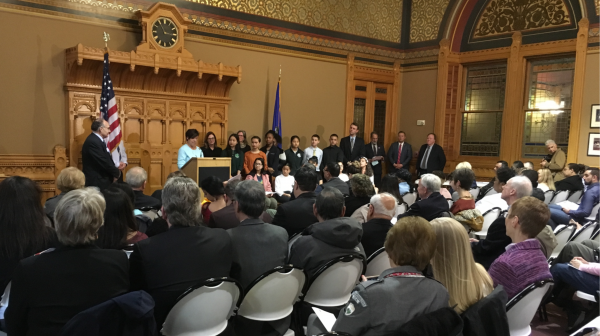
 Sixth-graders from the Interdistrict School for Arts and Communication in New London were recognized for their project, “Community Faces-Humanizing the Immigrant Label,” parts of which were on display at the Capitol. The second group was Teens4Citizenship, a Hartford Public Library and Hartford Public Schools collaborative program. As "Citizenship Guides," these high school immigrant students support family and community members on the path to Citizenship and upon turning 18 pursue their own citizenship.

 Instead of honoring Christopher Columbus, the Indigenous Peoples’ Day recognizes Native Americans, who were the first inhabitants of the land that later became the United States of America. Advocates for the switch to Indigenous Peoples Day argue that Columbus did not “discover” America in 1492 but instead began the colonization of it.
 The analysis brought together three recent surveys: Best State to Raise a Family, by WalletHub; Best Livability from Gallup; and “Best state” by U.S. News & World Report. The analysis included each state’s overall rankings plus the subcategory scores that helped produce the three scorecards, the newspaper reported.
 hers. Predictability was not necessarily reflective of high regard. West Virginia, for example, finished near the bottom of two of the three surveys, and thus was “predictable,” finishing high in predictability because of finishing predictably low in the various surveys.


 The plan at the
 The Gold Star Memorial Bridge, described as “Connecticut’s most iconic structure,” is the largest bridge in the State of Connecticut. It is 6,000 feet long and over 150 feet tall at the center span. The bridge is actually a pair of steel truss bridges that span over the Thames River, between New London and Groton, according to the project website.

 “Repairs and maintenance of the bridge’s structural steel includes steel girder end repairs, bolt replacements, and bearing replacement and maintenance. Repairs to the substructure include concrete repairs and crack sealing,” the website explains.
 teachers and administrators are armed,” 85 percent said they would not; 15 percent thought they would.





















