308 Structurally Deficient Bridges Across CT: Average Age 69 Years
/Just last month, it was revealed that more than 1,500 of California’s bridges are structurally deficient, meaning there is significant deterioration of the bridge deck, supports or other major components. More than half – 56 percent – of California’s bridges are at least 50 years old – the eighth highest rate in the nation.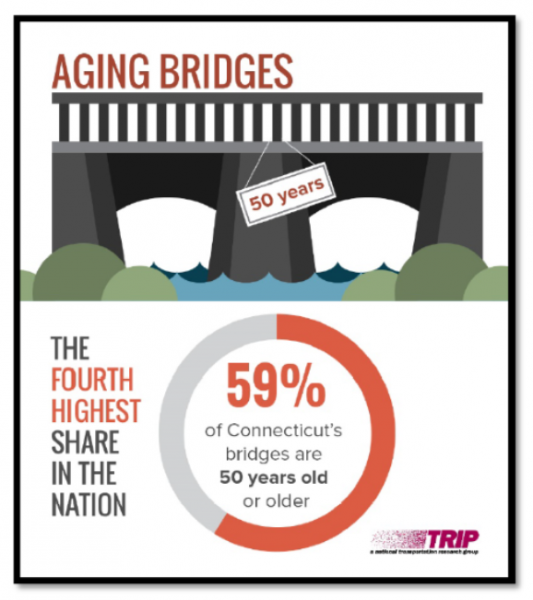 Yesterday, it was announced that 59 percent of Connecticut’s more than 4,000 bridges are 50 years or older, the fourth highest rate in the nation. The average age of all Connecticut’s bridges is 53 years, while the average age of the state’s 308 structurally deficient bridges – seven percent of the total - is 69 years. Structurally deficient bridges in Connecticut are crossed daily by 4.3 million vehicles.
Both reports were done by TRIP, a national transportation research group, based on an analysis of Federal Highway Administration National Bridge Inventory (2017). The organization did a similar report about Wisconsin, also released this week. It found that nine percent of Wisconsin’s locally and state-maintained bridges are structurally deficient.
Connecticut has 4,252 bridges (20 feet or longer), compared with 14,253 in Wisconsin and 25,657 in California.
The 20-page Connecticut report indicated that “To retain businesses, accommodate population and economic growth, maintain economic competitiveness, and achieve further economic growth, Connecticut will need to maintain and modernize its bridges by repairing or replacing deficient bridges and providing needed maintenance on other bridges to ensure that they remain in good condition as long as possible.”
 The report also noted that “annually, $489 billion in goods are shipped to and from sites in Connecticut, largely by truck,” adding that “approximately 731,000 full-time jobs in Connecticut in key industries like tourism, retail sales, agriculture and manufacturing are completely dependent on the state’s transportation network.”
Hartford, Fairfield and New Haven counties each have 60 or more structurally deficient bridges, with 65, 61 and 60 respectively. Litchfield County has 39; New London County has 32. The report listed Middlesex County with 22, Windham County with 17 and Tolland County with 12.
The report also sounded an alarm for Connecticut, a state seeking to attract and retain businesses to bolster a sluggish economy: “Increasingly, companies are looking at the quality of a region’s transportation system when deciding where to re-locate or expand. Regions with congested or poorly maintained roads may see businesses relocate to areas with a smoother, more efficient and more modern transportation system.”
Highway accessibility, the report pointed out, was ranked the number one site selection factor in a 2017 survey of corporate executives by Area Development Magazine.
“Without a substantial boost in federal, state and local funding, numerous projects to improve and preserve Connecticut’s bridges will not be able to proceed, hampering the state’s ability to improve the condition of its transportation system and to support economic development opportunities in the state,” the report concluded.
This summer, CT by the Numbers reported on a ranking developed by CNBC, found that 73 percent of Connecticut roads are in bad shape, giving the state a grade of D, while noting that nearly 8 percent of Connecticut’s bridges are deficient.

 Obesity is a problem in virtually every city and town, and every income and social sector. But its impact is most serious in communities where conditions make access to healthy foods and regular physical activity more difficult, such as lower income and rural areas, including many communities of color. The national costs of obesity are enormous, officials point out. Obesity drives an estimated $149 billion annually in directly related healthcare spending, and an additional $66 billion annually in lowered economic productivity. Also, one in three young adults is ineligible for military service, due to being overweight, officials noted.

 According to the magazine, full price tuition is $65,900; the estimated price with the average grant is $41,400. More than 8 in 10 students with need receive grants. Early career earnings are estimated at $57,100, and average student debt at graduation is $27,000.


 Among the report’s other key findings: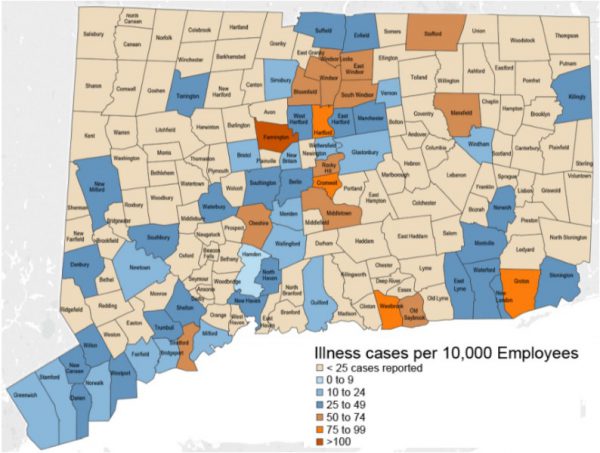
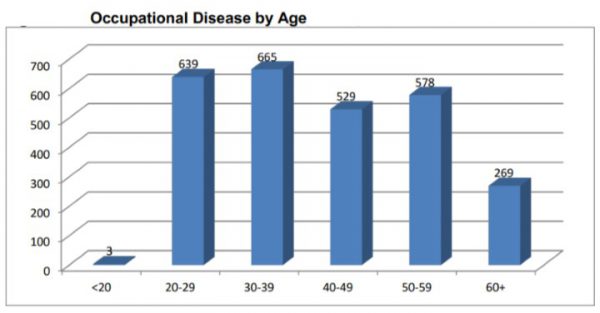 These higher town rates often reflect the locations of large employers in higher hazard industries, and may also reflect better reporting of cases, since cases of occupational illness are often not reported, the study points out.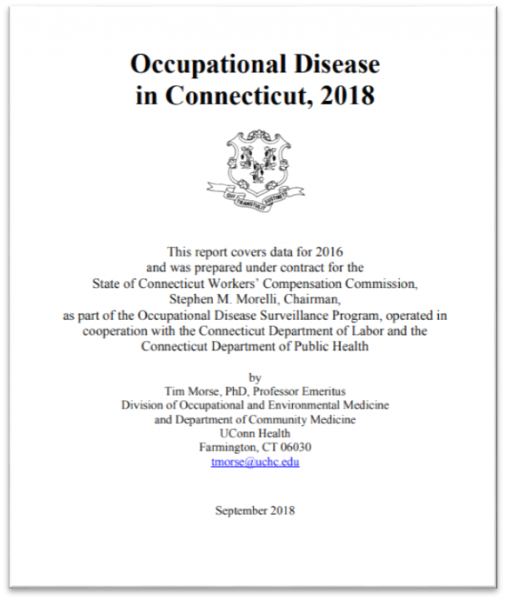

 Trumbull First Selectman Vicki Tesoro has expressed reservations, encouraged public comment, and kept an open mind. In a public
  The Bridgeport-Stamford-Norwalk metropolitan area also ranked fifth in the nation in the percentage of bachelor’s degree holders and the percentages of graduate or professional degree holders. The regions with higher percentages in both categories are Ann Arbor, Washington D.C., and San Francisco, joined by San Jose for bachelor’s degrees and Durham-Chapel Hill, NC for graduate or professional degrees.