Suicide Numbers Increasing; Efforts Intensify to Respond, Prevent

The Centers for Disease Control and Prevention (CDC) released a report this year that suicide rates nationally jumped by 25 percent since 1999, a finding that “shocked” even experts who believed the rate had been flat. Each year, more than 41,000 individuals die by suicide, leaving behind their friends and family members to navigate the tragedy of loss, according to the National Alliance on Mental Illness. Connecticut's rate, 9.7 deaths per 100,000, rose 20 percent during that time, and 49 states saw an increase, according to the CDC. Connecticut’s suicide rate, is ranked number 46 in the country.

Suicide is the 10th leading cause of death in the U.S. with one occurring on average every 13.3 minutes. September is National Suicide Prevention Month.

For every suicide, there are 30 people who made the attempt, Dr. James F. O'Dea, vice president of the Behavior Health Network of Hartford Healthcare, recently told the Meriden Record-Journal.  The U.S. Health Resources & Services Administration reports that “approximately 45% of suicide victims had contact with primary care providers within 1 month of suicide.”

“Connecticut suicide rates may have not have increased as much in comparison to other states, but isn’t the real question, ‘Why is it increasing at all?’” Luis Perez, president and CEO of Mental Health Connecticut, told The Hartford Courant earlier this year.

“It’s been well-researched that most people who die by suicide do so because they want the pain to stop — and they don’t see any other way,” Perez said. “Prevention is critical. Knowing the safe and right way to talk to someone who may have thoughts of suicide and letting people know they are not alone, that millions of people struggle with suicide ideation is key.”

According to the state Department of Public Health, approximately 31 percent of victims had a history of treatment for mental illness and 42 percent had previously attempted or thought about suicide or disclosed their intent to commit suicide. The CDC offers 5 steps to help someone at risk: 1. Ask. 2. Keep them safe. 3. Be there. 4. Help them connect. 5. Follow up.

The U.S. government’s anti-bullying website, stopbullying.com, points out that “many issues contribute to suicide risk, including depression, problems at home, and trauma history. Additionally, specific groups have an increased risk of suicide, including American Indian and Alaskan Native, Asian American, lesbian, gay, bisexual, and transgender youth.”  The site indicates that “this risk can be increased further when these kids are not supported by parents, peers, and schools. Bullying can make an unsupportive situation worse.”

Matt Riley, Chief Operating Officer of the Connecticut-based Jordan Porco Foundation, recently told WTNH-TV that suicide is the second leading cause of death for Americans ages 15 to 24. One in ten college students and one in five high school students consider suicide. Young people considering suicide are most likely to talk to peers, so the Jordan Porco Foundation focuses on peer-to-peer outreach and awareness, with a series of successful program initiatives on college campuses in Connecticut and across the country.

In recent years, a new student-driven primary prevention program was piloted to help high school students develop positive coping skills and enhance protective factors in preparation for life beyond high school. Schools and organizations participating included Manchester High School, Immaculate High School in Danbury, Enfield Public Schools, Capital Preparatory High School in Hartford, Institute of Living in Hartford, Jewish Family Services in West Hartford, Wilton High School, Boys & Girls Club of Bristol, and Guilford Youth & Family Services.

Numerous organizations across Connecticut offer Mental Health First Aid, an 8-hour training to teach participants how to help someone who is developing a mental health problem or experiencing a mental health crisis. The evidence behind the program demonstrates that it helps trainees identify, understand and respond to signs of mental illnesses and substance use disorders.  The course is often offered to participants free of charge.

https://youtu.be/TT_HLG5FkKA

https://youtu.be/jl87bmuCTdM
308 Structurally Deficient Bridges Across CT: Average Age 69 Years

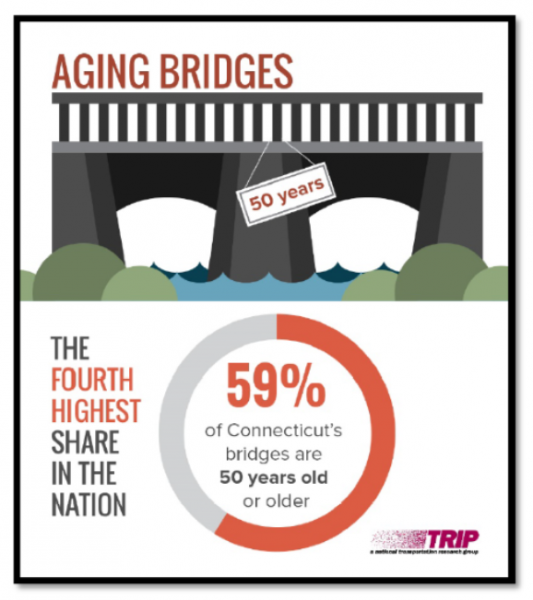
Just last month, it was revealed that more than 1,500 of California’s bridges are structurally deficient, meaning there is significant deterioration of the bridge deck, supports or other major components. More than half – 56 percent – of California’s bridges are at least 50 years old – the eighth highest rate in the nation. Yesterday, it was announced that 59 percent of Connecticut’s more than 4,000 bridges are 50 years or older, the fourth highest rate in the nation. The average age of all Connecticut’s bridges is 53 years, while the average age of the state’s 308 structurally deficient bridges – seven percent of the total - is 69 years.  Structurally deficient bridges in Connecticut are crossed daily by 4.3 million vehicles.
Both reports were done by TRIP, a national transportation research group, based on an analysis of Federal Highway Administration National Bridge Inventory (2017).  The organization did a similar report about Wisconsin, also released this week.  It found that nine percent of Wisconsin’s locally and state-maintained bridges are structurally deficient.

Connecticut has 4,252 bridges (20 feet or longer), compared with 14,253 in Wisconsin and 25,657 in California.

The 20-page Connecticut report indicated that “To retain businesses, accommodate population and economic growth, maintain economic competitiveness, and achieve further economic growth, Connecticut will need to maintain and modernize its bridges by repairing or replacing deficient bridges and providing needed maintenance on other bridges to ensure that they remain in good condition as long as possible.”

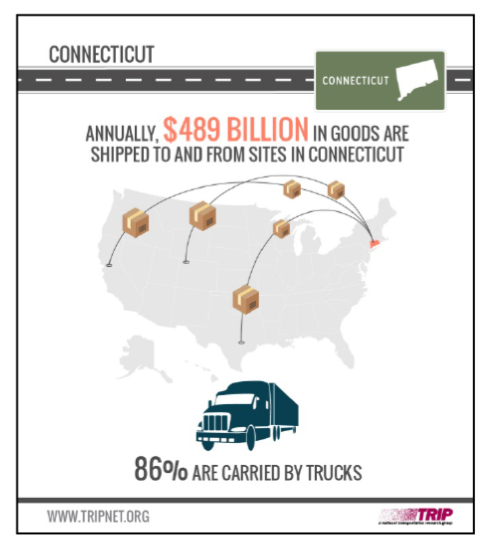
The report also noted that “annually, $489 billion in goods are shipped to and from sites in Connecticut, largely by truck,” adding that “approximately 731,000 full-time jobs in Connecticut in key industries like tourism, retail sales, agriculture and manufacturing are completely dependent on the state’s transportation network.”

Hartford, Fairfield and New Haven counties each have 60 or more structurally deficient bridges, with 65, 61 and 60 respectively.  Litchfield County has 39; New London County has 32.  The report listed Middlesex County with 22, Windham County with 17 and Tolland County with 12.

The report also sounded an alarm for Connecticut, a state seeking to attract and retain businesses to bolster a sluggish economy:  “Increasingly, companies are looking at the quality of a region’s transportation system when deciding where to re-locate or expand. Regions with congested or poorly maintained roads may see businesses relocate to areas with a smoother, more efficient and more modern transportation system.”

Highway accessibility, the report pointed out, was ranked the number one site selection factor in a 2017 survey of corporate executives by Area Development Magazine.

“Without a substantial boost in federal, state and local funding, numerous projects to improve and preserve Connecticut’s bridges will not be able to proceed, hampering the state’s ability to improve the condition of its transportation system and to support economic development opportunities in the state,” the report concluded.

This summer,  CT by the Numbers reported on a ranking developed by CNBC, found that 73 percent of Connecticut roads are in bad shape, giving the state a grade of D, while noting that nearly 8 percent of Connecticut’s bridges are deficient.

CT Has 10th Lowest Obesity Rate in the Nation, Research Finds

Connecticut has a lower adult obesity rate than most other states, according to new national data, which found that 26.9 percent of adults living in Connecticut have obesity, ranking the state 42nd among the 50 states and the District of Columbia.  The state has slipped slightly from four years ago - the obesity rate was 25 percent and ranking was 9th lowest in the nation in the 2014 edition of the annual survey. The state's top 10 least obsese status was in the new report came in the 15th annual State of Obesity: Better Policies for a Healthier America report  by Trust for America’s Health (TFAH) and the Robert Wood Johnson Foundation (RWJF).  Findings include:

  • Adult obesity rates vary considerably from state to state, with a high of 38.1 percent in West Virginia and a low of 22.6 percent in Colorado. No state had a statistically significant improvement in its obesity rate over the past year.
  • Adult obesity rates are at or above 35 percent in seven states; for the first time in Iowa and Oklahoma, and at least the second time in Alabama, Arkansas, Louisiana, Mississippi, and West Virginia.
  • Six states — Iowa, Massachusetts, Ohio, Oklahoma, Rhode Island, and South Carolina — saw their adult obesity rates increase significantly between 2016 and 2017.
  • Adult obesity rates are between 30 and 35 percent in 22 states and 19 states have adult obesity rates between 25 and 30 percent.
  • Over the past five years (2012 – 2017), 31 states had statistically significant increases in their obesity rate and no state had a statistically significant decrease in its obesity rate.
  • There continue to be striking racial and ethnic disparities in obesity rates. In 31 states, the adult obesity rate among Blacks is at or above 35 percent.  Latino adults have obesity at a rate at or above 35 percent in eight states.  White adults have obesity rates at or above 35 percent in one state. Nationally, the adult obesity rates for Latinos, Blacks and Whites are 47.0 percent, 46.8 percent and 37.9 percent respectively.

The least obese states are Colorado (22.6 %),District of Columbia (23.0%),  Hawaii (23.8 %), California (25.1%), Tie Montana and Utah (25.3%), New York (25.7%), Massachusetts (25.9%), Nevada (26.7%) and Connecticut (26.9%).

“Obesity is a complex and often intractable problem and America’s obesity epidemic continues to have serious health and cost consequences for individuals, their families and our nation,” said John Auerbach, president and CEO of Trust for America’s Health. “The good news is that there is growing evidence that certain prevention programs can reverse these trends.  But we won’t see meaningful declines in state and national obesity rates until they are implemented throughout the nation and receive sustained support.”

Obesity is a problem in virtually every city and town, and every income and social sector.  But its impact is most serious in communities where conditions make access to healthy foods and regular physical activity more difficult, such as lower income and rural areas, including many communities of color.  The national costs of obesity are enormous, officials point out.  Obesity drives an estimated $149 billion annually in directly related healthcare spending, and an additional $66 billion annually in lowered economic productivity. Also, one in three young adults is ineligible for military service, due to being overweight, officials noted.

The report offers 40 recommendations for federal, state and local policymakers; the restaurant and food industries; and the healthcare system.  Among them:

  • Medicare should encourage eligible beneficiaries to enroll in obesity counseling as a covered benefit, and, evaluate its use and effectiveness. Health plans, medical schools, continuing medical education, and public health departments should raise awareness about the need and availability of these services.
  • Food and beverage companies should eliminate children’s exposure to advertising and marketing of unhealthy products.
  • Hospitals should no longer sell or serve sugary drinks on their campuses; they should also improve the nutritional quality of meals and promote breastfeeding.

Read This: Finalists Announced for 2018 CT Book Awards

Connecticut Center for the Book, a Connecticut Humanities program, has announced the finalists for its 2018 Connecticut Book Awards. The awards recognize and honor authors and illustrators who have created the best books in or about our state in the past year.  A total of 140 books were submitted this year, up 28 percent over last year, as the returning awards program gains momentum. The annual awards returned last year after a multi-year hiatus, to solid reviews. Between three and five finalists have been selected in each of five categories: Fiction, Nonfiction, Poetry, Young Readers – Young Adult, and Young Readers – Juvenile. Five distinguished judges per category read each entry and reviewed works using rigorous criteria.

Winners will be announced at the 2018 Connecticut Book Awards ceremony on Sun., Oct. 14, from 2:00-3:00 p.m. at Staples High School in Westport.  Okey Ndibe, the 2017 Connecticut Book Award winner for nonfiction, will deliver the keynote speech. He has taught at Brown University, Connecticut College, Simon’s Rock College, Trinity College, and the University of Lagos (as a Fulbright scholar). He is the author of two novels, Arrows of Rain and Foreign Gods, Inc., and a memoir, Never Look An American In the Eye, for which he won the 2017 Connecticut Book Award for nonfiction.

A reception and book signing with this year’s winners, finalists, and Mr. Ndibe will immediately follow from 3:00-4:00; all finalists’ and winners’ books will be available for purchase.  Connecticut Humanities (CTH) is the state affiliate of the National Endowment for the Humanities and administers the Connecticut Center for the Book.  Established by Congress in 1977 to “stimulate public interest in books and reading,” the Center for the Book in the Library of Congress is a national force for reading and literacy promotion.

The finalists:

Fiction

  • Abby Fabiaschi, of West Hartford, Conn., “I Liked My Life”
  • Jane Green, of Westport, Conn., “The Sunshine Sisters”
  • Georgia Hunter, of Rowayton, Conn., “We Were the Lucky Ones”
  • Rene Denfeld, of Portland, Oregon, “The Child Finder”
  • Courtney Maum, of Norfolk, Conn., “Touch”

Nonfiction

  • Virginia DeJohn Anderson, of Boulder, Colo., “The Martyr and the Traitor – Nathan Hale, Moses Dunbar, and the American Revolution”
  • Duo Dickinson, of Madison, Conn., and Steve Culpepper, of New Haven, Conn., “A Home Called New England”
  • David Hays, of Chester, Conn., “Setting the Stage: What We Do, How We Do It, and Why”
  • James C. Scott, of Durham, Conn., “Against the Grain: A Deep History of the Earliest States”

Poetry

  • Gina Athena Ulysse, of Middletown, Conn., “Because When God is too Busy”
  • Jose B. Gonzalez, of Quaker Hill, Conn., “When Love was Reels”
  • John Surowiecki, of Amston, Conn., “Martha Playing Wiffle Ball in Her Wedding Dress”
  • Charles Rafferty, of Sandy Hook, Conn., “The Smoke of Horses”

Young Readers – Young Adult

  • Jake Burt, of Hamden, Conn., “Greetings from Witness Protection!”
  • Karen Romano Young, of Bethel, Conn., “Whale Quest”
  • Sarah Albee, of Watertown, Conn., “Poison”

Young Readers – Juvenile (includes authors and illustrators)

  • Gigi Priebe, of New Canaan, Conn., “The Adventures of Henry Whiskers”
  • Lauren Baratz-Logsted, of Danbury, Conn., “I Love You, Michael Collins”
  • Susan Hood, of Southport, Conn., “Double Take! A New Look at Opposites”
  • Deborah Freedman, of Hamden, Conn., “This House, Once”
  • Andrea Wisnewski, of Storrs, Conn., “Trio, The Tale of a Three-legged Cat”


The awards ceremony and reception are open to the public, and conclude Saugatuck StoryFest, a three-day literary festival and writers’ conference. Tickets purchased online before Sept. 15 are $20; then $25 through Oct. 11. Tickets will also be available at the door for $30.

Fairfield University Seen as "Transformative" Institution, Analysis Shows

When Money magazine ranked the 727 “Best Colleges For Your Money,” 2018 edition, Fairfield University ranked number 160.  But when the focus narrowed to the nation’s “most transformative” schools, Fairfield rose into the top 10, landing at number seven. Fairfield’s ranking as among the most transformative institutions, which is “when a college helps students do far better than would be expected from their academic and economic backgrounds,” recognizes the institution’s commitment to holistic formation and places it as the highest ranking Jesuit university in that category, according to school officials.

In the “most transformative” category, the list is led by Massachusetts College of Pharmacy and Health Sciences (MCPHS) in Boston, Babson College in Wellesley, MA, Bentley University in Waltham, MA, San Jose State University, Mount Saint Mary’s University in Los Angeles, and Manhattan College. 

Money magazine indicates that Fairfield “stands out for its comparatively high graduation rate. The school admits students of all faiths, but the curriculum does require some religious studies for all of the roughly 4,000 undergrads.”

“Of the school's 44 majors, the most popular courses of study include accounting, business, marketing, and the social sciences. The university also places an emphasis on community service and social justice.”

According to the magazine, full price tuition is $65,900; the estimated price with the average grant is $41,400. More than 8 in 10 students with need receive grants.  Early career earnings are estimated at $57,100, and average student debt at graduation is $27,000.

Money’s annual “Best Colleges for Your Money” ranking places Fairfield among the Top 100 private universities in the country.

In the magazine’s overall rankings, Yale University was #15, University of Connecticut ranked #50, Wesleyan University was #111, Connecticut College placed at #245 and Quinnipiac University was #341 on the list of Best Colleges for Your Money.


CT's Blockchain Working Group Strives to Drive State Policy in Emerging Field

It was established in the final hours of the 2018 legislative session, and held its first meeting the following month, back in June.  Special Act 18-8 created Connecticut’s Blockchain Working Group, with little fanfare and less notice.  The objective:  make recommendations to the incoming 2019 legislature that will “help promote innovation and economic growth by reducing barriers to and expediting the expansion of the state's blockchain industry.” While the Task Force was getting started, another blockchain initiative was grabbing headlines.  Seven Stars Cloud announced in early  July that it was planning to purchase the former University of Connecticut campus in West Hartford to develop a $283 million financial technology hub that would attract more than 50 companies, along with a research institute and training center, with blockchain technology being the centerpiece.

Local zoning approvals are pending, and the state has agreed to loan the company $10 million for renovations to the 58-acre property, and to forgive the loan if the company employs 330 people there over five years. In late August, the company changed its name to Ideanomics.

The legislation calls for the leaders of the legislature’s Commerce Committee – Republicans and Democrats – to  jointly appoint and convene a working group to develop a master plan for fostering the expansion of the blockchain industry in the state and recommend policies and state investments to make Connecticut a leader in blockchain technology. It calls for the “master plan” to:

  • Identify the economic growth and development opportunities presented by blockchain technology;
  • assess the existing blockchain industry in the state;
  • review workforce needs and academic programs required to build blockchain expertise across all relevant industries; and
  • make legislative recommendations that will help promote innovation and economic growth by reducing barriers to and expediting the expansion of the state's blockchain industry.

A final report and recommendations is due on January 1, 2019.

The Working Group, which met initially on June 28 in Stamford, is chaired by Nick Kammerman of Westport-based Chateaux.  Members include David Noble (UConn Business School), Don Tirea (Checkmate Inc.), Jamil Hasan (Blockchain Consultant), Kevin Hart (Green Check Verified), Emily Goodman Binick (Blockchain Consultant), Margaret Feeney (Nat West Markets), Bryant Eisenbach (DappDevs), Spencer Curry (Trifecta Ecosystems), Philip Bradford (UConn Engineering School) and Stephen Ehrlich (Crypto Trading Technologies).  Legislators participating in the Working Group are Senators Joan Hartley and L. Scott Frantz and Representatives Caroline Simmons and Dave Yaccarino.  State Economic and Community Development Commissioner Catherine Smith serves as an ex-officio member.

Among the tax treatments the Working Group discussed preliminarily at the meeting, according to the  official Minutes,  were creating “tax incentives for companies that create blockchain products or use them who are currently in the state or coming to the state,” “changing laws to give blockchain industries access to banks in order to pay taxes,” and “figuring out how the state of Connecticut can implement a system to help blockchain/cryptocurrency companies and individuals pay taxes and fees.”

Testifying in support of the legislature this spring, Spencer Curry, CEO and co-founder of Trifecta Ecosystems, explained that “blockchain stands to revolutionize global industries by creating new revenue models and driving costs down on existing revenue models, automating processes with smart contracts, increasing traceability/visibility, and hardening security to malicious attackers.”

Supriyo B. Chatterjee of West Hartford noted that “blockchain has arrived in the Connecticut industries andwith it brings high-vbalue jobs that will contribute significantly to the Connecticut economy.” He pointed out that blockchain will have a “profound effect on the health sciences industry,” as well as the insurance industry and STEM jobs, and will “fundamentally change the distribution of goods and services worldwide.”

Curry went on to suggest that “supporting this technology will benefit Connecticut’s workforce through an infusion of excellent talent from around the world.  If the State does not embrace blockchain technology, it … will only hasten the corporate flight from our state.”  He said that “if the State chooses to empower companies exploring blockchain technologies, then a new wave of prosperity and success awaits these tried and true Connecticut industries,” such as insurance, advanced manufacturing, healthcare, financial, agriculture and military supply chain.

Commissioner Smith, one of the seven people to submit testimony on the bill, told the Commerce Committee at the March public hearing that the department lacks “the in-house expertise to conduct an informed analysis” of “all facets of blockchain technology.” The original version of the bill included $200,000 allocation for the Department of Economic and Community Development to conduct the study.  The Senate amendment eliminated the funding allocation.

Don Tirea of DappDevs indicated that a blockchain initiative that “incentivizes research and development for enterprises and startups, coupled with a highly skilled tech talent pipeline is a recipe for economic revitalization across Connecticut’s historic industries.  He added that embracing blockchain technology would create a “shift in our nation’s perspective of Connecticut’s ability to innovate”

Co-sponsors of the original legislation (Senate Bill 443), which was later amended in the Senate, included Senators Michael McLachlan, Heather Somers, Scott Frantz, and George Logan.  House co-sponsors included Caroline Simons, Michael Winkler, Livvy Floren, Laura Devlin and Linda Orange.

DataHaven to Launch Innovation Awards to Recognize Data-based Initiatives in CT

In conjunction with its 25th anniversary celebration this year, New Haven-based DataHaven has announced plan to launch the DataHaven Innovation Awards, which will be open to nominees from throughout the state. Winners will be selected in a number of education and community impact categories. Nomination will be accepted through October 1, and the award recipients will be announced at DataHaven’s 25th Anniversary Celebration on November 19, 2018. DataHaven is a non-profit organization with a history of public service to Greater New Haven and Connecticut. The organization’s mission is to improve quality of life by collecting, sharing, and interpreting public data for effective decision making.

“We are proud to highlight the creativity and ingenuity of those who employ data to make Connecticut a better place,” explained DataHaven Executive Director Mark Abraham. The awards will recognize organizations, groups and individuals who have demonstrated the ability to use data to improve the well-being of Connecticut communities.

The inaugural Data in Education Awards will recognize the outstanding use of data for projects developed within a classroom or educational setting. Nominations will be accepted in two categories, University and Graduate Level and K-12 Level.  Nominees can include teachers, students, school-based organizations, and non-profits working with youth.

The Data for Community Impact Awards will recognize the outstanding use of data to make a positive difference in one or more Connecticut communities. Nominations will be accepted in two categories: Large Organization, with more than 20 employees, and Small Organization, with less than 20 employees.  Nominees can include nonprofits, for-profits, funders, unincorporated groups, and municipal/state agencies.

Liberty Bank Foundation is underwriting the DataHaven Innovation Awards.

DataHaven maintains extensive economic, social, and health data, including information collected through the DataHaven Community Wellbeing Surveys in 2012 and 2015. DataHaven is a formal partner of the National Neighborhood Indicators Partnership of the Urban Institute in Washington, DC.

“We believe that data is a powerful force, uniting our state and helping make life better in Connecticut communities,” says Abraham. “Our statewide survey provides neighborhood-level data in key areas such as health, education, civic engagement and economic opportunity, so that programs and resources can be deployed to change lives for the better. Our goal is still to make life better for our neighbors.”

Presenting sponsors for the organization’s 25th anniversary year are the City of New Haven, Yale University, Yale New Haven Health and The Community Foundation for Greater New Haven.  Nomination forms for the DataHaven Innovation Awards can be found at http://www.ctdatahaven.org/anniversary and are due by October 1, 2018.

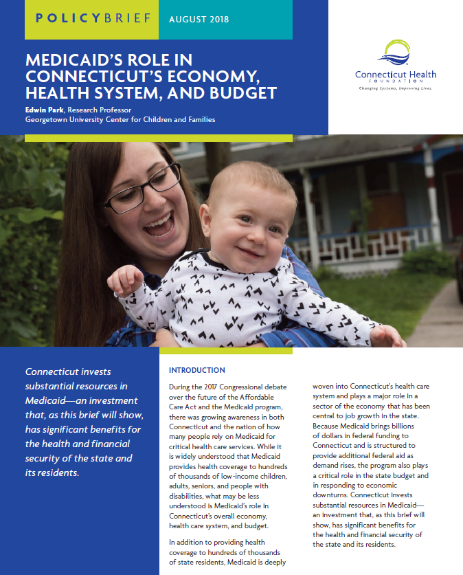
Report: Medicaid's Impact Goes Beyond Health Care to Economy

Medicaid is, at its core, a health insurance program that provides coverage to low-income Connecticut residents.  A new report in Connecticut finds that the program also plays a key role in the state’s economy, budget, and ability to weather economic challenges. The report was developed for, and released by, the Connecticut Health Foundation. In Connecticut, Medicaid is known as HUSKY and covers approximately one in five state residents – close to 800,000 people. HUSKY covers more than one third of Connecticut children, nearly 47 percent of non-elderly adults with disabilities, 15 percent of seniors, and 70 percent of nursing home residents.

The report, developed by the Georgetown University Center for Children and Families, finds that the program is deeply woven into Connecticut’s health care system and plays a major role in a sector of the economy that has been central to job growth in the state. Health care makes up nearly 15 percent of the state’s gross domestic product. Medicaid finances about 20 percent of health care expenditures in Connecticut.

“It is important for policymakers to understand the full impact of Medicaid in the state, particularly as they face difficult budget decisions,” said the report’s author, Edwin Park, research professor at the Georgetown University Center for Children and Families. “Medicaid plays a key role in the state’s economy and is linked to long-term positive outcomes for children like better health, obtaining a college degree, and higher earnings.”

Among the report’s other key findings:
  • Research has linked Medicaid coverage of children and pregnant women to long-term health and economic benefits when children reach adulthood: better health outcomes, greater educational attainment such as completing high school and obtaining a college degree, and higher employment and earnings.
  • Medicaid can help states cope with recessions and economic downturns because it automatically increases federal funding in response to higher state costs, such as those resulting from enrollment increases as people lose their jobs and health insurance.
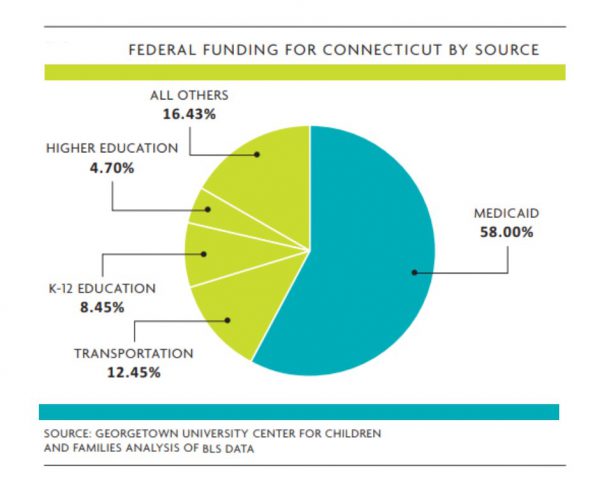
  • Medicaid contributes the majority of the federal funding spent through Connecticut’s state budget – 58 percent in the 2016 fiscal year. The federal government pays more than half of the state’s Medicaid costs. For every $10 spent on Medicaid in Connecticut, approximately $5.92 comes from the federal government.

“Connecticut invests significant resources in HUSKY and the findings of this report underscore the impact of this investment,” said Patricia Baker, president and CEO of the Connecticut Health Foundation.

The report also indicted that “research has found that Medicaid eligibility during childhood is tied to higher wages and cumulative higher tax payments made as young adults. It also increases employment and reduces the need for public assistance, especially assistance needed due to disability. According to the report, in 2016 Medicaid covered:

  • 4 percent of the nearly 400,000 hospital discharges and 12.9 percent of hospital payments.
  • 63 percent of the 373,200 patients who received care at community health centers.

The Connecticut Health Foundation is the state’s largest independent health philanthropy dedicated to improving health outcomes for people of color. Since its creation in 1999, the foundation has awarded more than $62 million to nonprofit organizations and public entities to expand health equity, reduce health disparities, expand health coverage, and improve the health of all Connecticut residents.

Occupational Illnesses Remain High in Connecticut, Report Finds

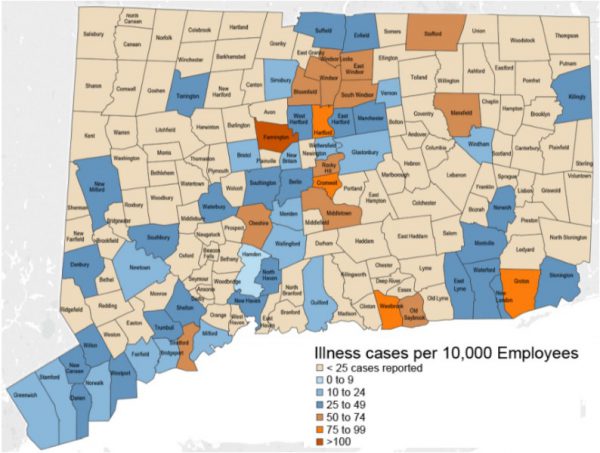
Occupational illnesses remain a serious and under-reported issue in Connecticut, with a rate 6 percent higher than the national average, according to a new report issued by UConn Health.  The latest data shows a reporting of over 7,500 occupational illnesses, with up to an estimated 25,000 cases going unreported. The highest number of cases reported were in Farmington, Hartford and Cromwell. The newly published Occupational Disease in Connecticut, 2018 report examined the latest 1997-2016 data, based on reports of individuals filing for workers’ compensation, physician reports to the Occupational Injury and Illness Surveillance System, and the ConnOSHA/BLS survey of employers.

Connecticut’s illness rate ranked 15th highest out of 41 states with publishable data (fourteen states had higher rates and 26 had lower rates). Maine had the highest rate of 38.8 and Texas had the lowest at 9.8. Private sector rates for occupational illness were 15.0 in Connecticut and 14.1 nationally. Connecticut’s public sector rate was 35.7; the U.S. public sector rate was 31.6, according to the report.

The Connecticut data revealed reports of 7,675 unique occupational illnesses.  Most frequent were 3,430 musculoskeletal cases (such as sprains, Carpal Tunnel Syndrome, and tendonitis), and 2,408 infectious diseases (such as bloodborne diseases and exposures, meningitis, and Lyme Disease).  In addition, the data indicated there were 431 respiratory illnesses (such as chemical exposures, asthma, and poisonings), 313 skin disorders (such as poison ivy and chemical dermatitis), 115 cases of hearing loss, and 978 “other illnesses” (such as heart conditions, stress, and dizziness).

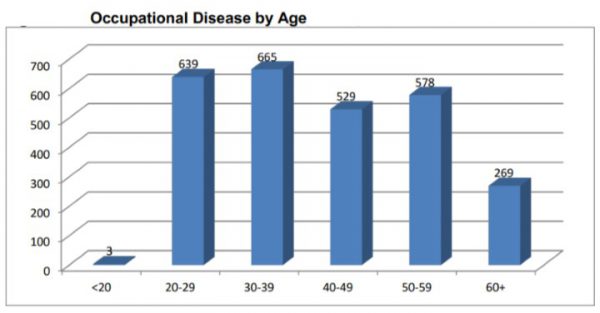
The OSHA/BLS survey shows a rate of 17.4 cases per 10,000 workers in Connecticut, 6 percent higher than the national rate of 16.4. The report focuses on chronic job-related illnesses, and does not include acute traumatic injuries. Overall, approximately 49% were for women, but this varied by type of case, with women accounting for 66% of infectious cases. Based on workers’ compensation reports of occupational illnesses, there were similar proportions (between 20%-25%) for workers in their 20’s, 30’s, 40’s and 50’s.

Rates of occupational illnesses varied widely across Connecticut towns and cities. Based on workers’ compensation reports from towns with at least 25 cases, the 10 highest rates were found in Farmington (126 cases per 10,000 workers - almost 4 times the rate as the state average), Hartford (89), Cromwell (89), Groton (85), Westbrook (84), Windsor Locks (73), East Windsor (63), Cheshire (61), Stratford (60), and Middletown (58). The town average across the state was 33 cases per 10,000 workers.

These higher town rates often reflect the locations of large employers in higher hazard industries, and may also reflect better reporting of cases, since cases of occupational illness are often not reported, the study points out.
Based on workers’ compensation reports, the highest rates of occupational illnesses were found in the industries of beverage and tobacco product manufacturing (170 cases per 10,000 workers), computer and electronic product manufacturing (131), primary metal manufacturing (112), state government (103), local government (81), transportation equipment manufacturing (59), electrical equipment manufacturing (57), miscellaneous retail stores (51), fabricated metal product manufacturing (49), and hospitals (46).

The highest specific sector rate, according to the report, was State Government with 41.8, with the highest rates for skin conditions (17.7) and lung conditions (7.9).  Local Government was second with 32.1, and Utilities third highest rate with 31.8.

Each year the report is prepared for the Connecticut Workers’ Compensation Commission by occupational and environmental health expert Tim Morse, professor emeritus at UConn Health. The 53-page report is part of the Occupational Injury and Illness Surveillance System, a cooperative effort of the Connecticut Workers’ Compensation Commission, the Connecticut Department of Public Health, and the Connecticut Labor Department.

The system is designed to track occurrences of work-related disease, with an eye to understanding patterns and developing approaches to prevent occupational illness.

“We must take stronger actions to improve the employee work safety experience and environment, with improvements in ergonomics, safe needle devices in health care, reducing mold and increasing fresh air flow in indoor environments, providing education on toxic chemicals, and increasing the recognition of such hazards as poison ivy,” Morse told UConn Today.

Morse and UConn Health researchers analyze survey responses and occupational illness reports from the State Labor Department/Bureau of Labor Statistics (BLS) survey; the first reports of injury to the Connecticut Workers Compensation Commission; and health provider reports to the Connecticut Departments of Labor and Public Health under the Occupational Illnesses and Injury Surveillance System.

Want to Live at the Mall? It Could Happen – in Trumbull

The Westfield Trumbull mall’s unusual request for a zoning change that would allow it to build 290 apartments on its 76-acre site may be the harbinger of things to come for suburban malls.  The plan was the subject last month of a Trumbull Planning & Zoning Commission hearing; a final decision is pending. The 290 units are planned to be one or two-bedroom apartments, with the opportunity to rent a garage and/or a storage space. The buildings will be on slabs, four stories high, with elevator access. Developers are hoping for a clubhouse, with a gym and common meeting room, and a pool.

The units would be marketed to professionals, young couples and older couples looking to stay in Trumbull, but not in a single-family home.  The plan is a trimmed down version of a proposal floated in the spring that would have developed 580 units.

Mall housing?  Nina Fuhrman, head of retail strategy at global design company IDEO, noted that “As we see the lines blurring between where you work and where you play and where you live, we’re going to see more residences and office spaces attached to malls.”

Trumbull may provide a glimpse into a trend gaining traction.  In a feature article last May in Business of Fashion, Westfield’s development of mall-adjacent residential properties was described as “a no-brainer because doing so will not only create a revenue stream from rent, but will also increase foot traffic to stores.” Already, Chief Operating Officer Bill Hecht told the publication, “the residential buildings in close proximity to our malls can charge slightly above market rent, because they have access to all our amenities close by.”

Trumbull First Selectman Vicki Tesoro has expressed reservations, encouraged public comment, and kept an open mind. In a public statement, she “expressed an understanding that malls throughout the country are reinventing themselves out of necessity. We, as a town, should work with them to the extent possible in that process. The mall is our largest taxpayer, and its success is a shared goal.”

In Bethesda, Maryland, Westfield plans to close a Sears store at the Westfield Montgomery Mall within the next year and is looking to launch a major mixed-use development on its piece of the property. The first phase, according to a report published by Bisnow, is expected to be completed by 2022, and would create 170K SF of new retail space with 350 to 360 apartments above, plus a health club. After that, Westfield would build an additional 300 units and 130K SF of retail and hotel space.

Jim Agliata, Westfield’s vice president of development, told Bethesda magazine earlier this year that the project represents the next phase of Westfield Montgomery’s emergence as a “lifestyle destination.”