ConnectiCare, First Health Insurer to Open Retail Store, Adds More

Holiday shoppers may encounter something new amidst the traditional retail stores vying for attention.  Last month, ConnectiCare opened its first storefront location, a 6,000-square-foot standalone building in Manchester. The company plans to open outlets in Bridgeport, Newington and Orange in the coming days, according to David Gordon, ConnectiCare's senior vice president for strategy and product innovation. "The impetus for taking this step came from listening to our customers," Gordon said. "The key thing that we consistently heard was how they want a choice in how they engage with us."  It is a way of “providing face-to-face interactions with our members and our nonmembers, who feel their relationship with us would work better if we were sitting across a table from each other."retail-tn

ConnectiCare is apparently the first health insurance company in the state to offer services from a retail storefront location.  Manchester was chosen after a study of ConnectiCare members, traffic and drive-time patterns and general population figures. The selection of Bridgeport also was based on proximity to significant numbers of ConnectiCare members, and the surrounding population, and are tied to a new partnership with CliniSanitas to offer bilingual facilities for the state's growing Hispanic population.

The flagship Manchester location, near Buckland Hills mall, is staffed by 12 people and includes an area for seminars on various health topics as well as space for yoga and Zumba classes.   ConnectiCare's stores in Bridgeport, Newington and Orange will be smaller than the Manchester flagship, which opened in October.

The ConnecticutCare storefronts will be adjacent to CliniSanitas Medical Center locations.  The centers will offer primary care, specialty care, urgent care, laboratory and diagnostic imaging, as well as health education and wellness services. All three centers – Bridgeport, Newington and Orange - will offer extended evening and weekend hours, with walk-ins welcome. The centers are to be staffed with medical and administrative staff who are bilingual in English and Spanish.

This expansion is the result of a strategic alliance between GuideWell Sanitas and ConnectiCare to serve the health care needs of Connecticut's growing multicultural population, while helping to address the long-standing disparities in the health status of people from culturally diverse backgrounds, officials said. ConnectiCare is the only health insurance plan being accepted by the CliniSanitas Medical Centers, which will also serve those paying directly for health care services and those with traditional Medicare coverage, the companies recently announced.410725logo

CliniSanitas has more than 40 years of health care experience with over 200 facilities in South America. In 2015, the first stateside CliniSanitas centers were opened in Florida. The company explains that their  model is focused on improving access to quality primary care services, and delivering the best health outcomes while preventing unnecessary high medical costs, encouraging longer appointments aimed at strengthening the doctor-patient relationship.

CliniSanitas Medihealth-inscal Centers is a joint venture between two leading health care organizations – GuideWell Mutual Holding Company and Organización Sanitas Internacional. GuideWell is a U.S.-based not-for-profit mutual holding company and the parent to a family of forward-thinking companies focused on transforming healthcare.
"We're excited to start our journey in Connecticut in partnership with ConnectiCare and GuideWell to bring our proven model of patient-centered care to the diverse community of Connecticut. These new medical centers will build on our successful centers in Miami, Florida, and our experience transforming healthcare in South America," said Dr. Fernando Fonseca, Chief Executive Officer of CliniSanitas.

"The CliniSanitas Medical Centers will help us deliver on our brand promise to make it easy for our members to get the care they need. ConnectiCare is pleased to help bring the people of Connecticut access to the high quality and culturally relevant health care provided by the CliniSanitas Medical Centers," said Michael Wise, ConnectiCare's President and Chief Executive Officer.

A local company for 35 years, ConnectiCare, a subsidiary of Emblem Health,  has a full range of products and services for businesses, municipalities, individuals and those who are Medicare-eligible.  In September, ConnectiCare, the single-largest insurer on the state’s health exchange, announced it would participate in the exchange in 2017.

Absenteeism Continues to Decline in CT Schools, Nation Looks to CT Approach

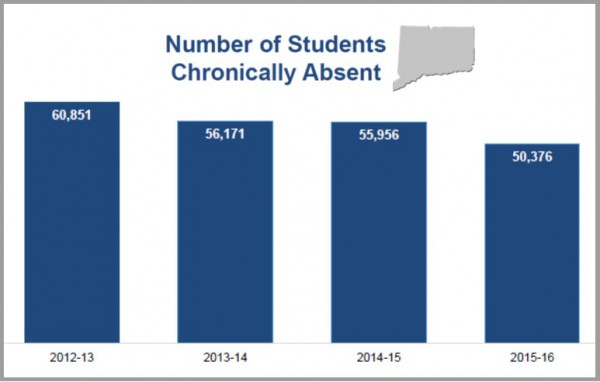
Chronic absenteeism is down across the state, according to new data released by the State Department of Education (SDE), a trend that is gaining notice beyond Connecticut and a sign that collaborative efforts to keep students across Connecticut in school and engaged are having a positive impact. The number of chronically absent students in Connecticut dropped to 9.6 percent in 2015-16, down from 10.6 percent the year before and down from a high of 11.5 percent in 2012-13. The decline in Connecticut’s chronic absenteeism rate means that over 10,000 more students are attending school on a daily basis than four years ago. Nationally, missing too much school is a coast-to-coast crisis that affects more than 6.5 million students.

Connecticut's work is gaining attention at the national level, and was subject of an article in the education publication Kappan Magazine.  The article, “Chronic early absence: What states can do” was co-authored by Hedy Chang, executive director of Attendance Works, Charlene M. Russell-Tucker, chief operating officer of the Connecticut State Department of Education, and her colleague Kari Sullivan,  state attendance lead at SDE.missing

The data also shows that while minority students have disproportionately high rates of chronic absenteeism when compared with their white peers, rates of chronic absenteeism are decreasing for black and Hispanic students in Connecticut.

In 2015-16, the chronic absenteeism rate for Hispanic students was 15.7 percent, down from 19.1 percent in 2012-13. For black students, the rate was 14.5 percent in 2015-16, down from 16 percent in 2012-13. (The new data is available on the CSDE’s data portal, EdSight. The data was released as part of a Chronic Absenteeism presentation delivered this month to the State Board of Education.)  The magazine article notes that “Low-income students are four times more likely to be chronically absent than others, often for reasons beyond their control, such as unstable housing, unreliable transportation, and a lack of access to health care.”

Chronic absenteeism is defined as missing 10 percent or more days of school for any reason, including excused absences, unexcused absences, suspensions, and other disciplinary actions.

“We have identified several areas where we are shifting our focus to fulfill our promise of an excellent public education for every Connecticut child. One of those focus areas is chronic absence,” said Commissioner of Education Dianna R. Wentzell. “We want every public school student in our state to be in school and engaged. That means we have to work with families, educators, and community stakeholders to decrease the number of days that students are out of school.”

Earlier this year, the State Board of Education adopted its Next Generation Accountability System, which uses multiple academic and non-traditional indicators to assess how well a school is performing toward the goal of preparing all students for success in college, career, and life. Chronic absenteeism is one of the new indicators included in the system, which means school districts will have to pay close attention to the problem of chronic absenteeism and take steps to ensure more students attend school on a daily basis.graph

Research shows that chronic absenteeism is inextricably linked with student performance, and students who are chronically absent are less likely to read on grade level, are less likely to perform well academically, and are at a greater risk for dropping out of high school. Risk factors for chronic absence include poverty, homelessness, chronic health conditions, frequent moves, and disabilities.

The article notes that “Most school districts and states don’t look at all the right data to improve school attendance. They track how many students show up every day and how many are skipping school without an excuse but not how many are missing so many days in excused and unexcused absence that they are headed off track academically.”

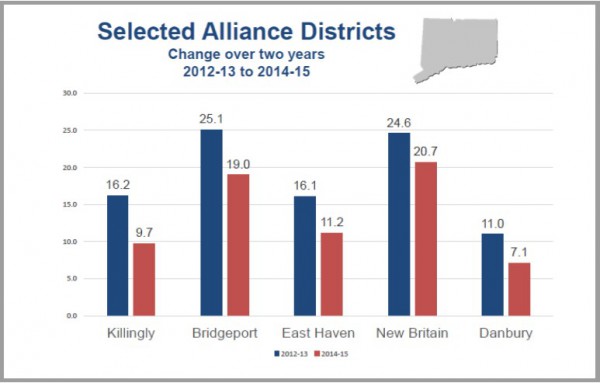
Among the communities being highlighted by SDE are Killingly, where chronic absenteeism dropped from 16.2% to 9.7%; Bridgeport, where the reduction was from 25.1% to 19.0%; East Haven, where the drop was from 16.1% to 11.2%; New Britain, where absenteeism was reduced from 24.6% to 20.7%; and Danbury, which saw a reduction from 11% to 7.1% between 2012-13 and 2014-15.  Attendance Works,  a national and state initiative that promotes awareness of the important role that school attendance plays in achieving academic success, is also highlighting specific Connecticut districts where progress is being made, including New Britain, Middletown and Vernon.  alliance

The SDE has been working with key partners such as the Governor’s Prevention Partnership, Attendance Works, the Campaign for Grade-Level Reading, and the Legislature’s Committee on Children. Chronic absenteeism is addressed in the annual Alliance District grant application for participating districts. The state is also expanding restorative justice programs, such as the Connecticut School-Based Diversion Initiative, and positive behavioral interventions and supports. Additionally, districts are increasing utilization of the Department of Children and Families’ Emergency Mobile Psychiatric Services to respond to mental health crises.

“It is critical that we all understand the importance of daily school attendance. Even in the early grades, lost time in school can put students at risk of becoming disengaged or dropping out of school down the road,” said Commissioner Wentzell.  The state approach focuses on six "high-impact" strategies:

#1: Build Awareness #2: Use Data to Promote Action #3: Cultivate Champions to Build a State-Level Infrastructure #4: Build Capacity #5: Identify and Leverage Bright Spots #6: Foster Accountability

The magazine article co-authors stress that “By monitoring chronic absence in grades K-12 — and paying particular attention to the youngest students — states can address the needs of students and their families before they require more expensive intervention and remediation.”

UConn Study Questions Marketing, Ingredients in Food Advertised to Young Children

It would be disingenuous to describe the results as surprising, but a new study has found that marketing for baby and toddler food and drinks often contradicts the advice of health professionals. According to the study by the Rudd Center for Food Policy and Obesity at the University of Connecticut, companies tend to use marketing messages that may lead parents to believe that these commercial products are healthier alternatives to breastmilk or homemade food.baby-facts

The new Baby Food FACTS report found that companies spent $77 million in 2015 to advertise infant formula, baby food, and toddler food and beverages to parents, primarily through TV, magazines, and the internet. By comparison, companies spent $98 million to advertise fruits and vegetables in 2015 – products intended for the entire U.S. population.

“Our analysis shows that marketing for baby and toddler food, infant formula, and toddler milk and nutritional supplements often contradicts expert guidance and in some cases encourages parents to feed their young children products that may not promote healthy eating habits,” said Jennifer Harris, UConn Rudd Center Director of Marketing Initiatives and the report's lead author.

The report analyzed companies spending $100,000 or more in total advertising in 2015 and documented changes in advertising over the past five years. Eight brands from three companies (Nestle, Abbott and Mead Nohnson) were responsible for 99 percent of advertising spending. Four additional baby and toddler food brands spent $100,000 or more in advertising in magazines and online, including Plum Organics (Campbell Soup Company), Beech-Nut (Hero A.G.), and Happy Baby and Happy Tot (Nurture Inc.).rudd-logo-300x77

Among the findings:

  • Infant formula brands had the most internet advertising and were most active in social media and on mom blogs.
  • Nearly 60 percent of advertising dollars promoted products that are not recommended for young children, including sugar-sweetened toddler drinks and nutritionally poor snack food.
  • Beech-Nut and Gerber marketed their baby food products in a way that supported most expert recommendations on best practices for feeding infants.
  • Toddler milk products including Enfagrow, Gerber Good Start Grow, Nido 1+, Similac Go & Grow, and Happy Tot Grow & Shine, contained added sweeteners, including sugar, glucose syrup solids, honey, and corn syrup solids.
  • Pediasure Grow & Gain, a nutritional supplement aimed at toddlers, had 240 calories per serving and as much sugar as an 8-ounce sports drink.
  • In contrast to nutritious baby and toddler fruit, vegetable, and meal products, just four of 80 baby and toddler snack foods, such as cookies, cereal bars, puffs, and fruit snacks, were nutritious choices for young children.
  • Fifty percent of baby and 83 percent of toddler snacks contained added sugars.

kids-eatingThe findings included in this report “provide policymakers, health professionals, public health advocates, industry representatives, and parents an opportunity to address misinformation conveyed through marketing of baby and toddler food and drinks.”

The study also found that traditional advertising spending (primarily on TV and magazines) by infant formula brands declined substantially—from more than $30 million in 2011 to less than $10 million in 2015.

Among the recommendations, the Rudd Center researchers indicated that toddlers’ diets should help them develop gross and fine motor skills and learn to enjoy the taste, flavors, and textures of real fruits and vegetables. By age two, toddlers should be eating the same food as the rest of the family. For all children, they stated, a healthy diet should include a variety of fruits and vegetables every day, and limited consumption of saturated fat and sodium. Children under two should not consume any food with added sugars.

The report called on the U.S. Food and Drug Administration to issue final guidance on claims on infant formula packaging, including claims that compare infant formula to breastmilk, and also regulate claims on toddler milk packaging. The Federal Trade Commission should similarly regulate claims made in advertising, the report advised. The food industry was also urged to expand the Children’s Food and Beverage Advertising Initiative (CFBAI) self-regulatory program for improving food advertising to children to incorporate marketing of baby and toddler food and drinks.

The study was funded by a grant from the Robert Wood Johnson Foundation and presented Nov. 1 at the American Public Health Association’s 2016 Annual Meeting and Expo in Denver.  The Rudd Center for Food Policy & Obesity at the University of Connecticut is a multi-disciplinary research center dedicated to promoting solutions to childhood obesity, poor diet, and weight bias through research and policy. For more information, visit www.UConnRuddCenter.org.

Diverse Hispanic Workforce More Likely to Face Challenges, Report Finds

There are about 24 million workers of Hispanic descent in the United States. While this group is frequently referred to as a single entity, the reality is that these workers come from a variety of ethnic backgrounds, each with their own challenges in the labor market. A new report from the Center for Economic and Policy Research (CEPR) provides an overview of the diverse backgrounds of the Hispanic workforce, and shows how each group experiences unique challenges in the labor market, specifically in terms of unemployment, wages, poverty, language barriers, and access to health and retirement benefits.workforce

The report, “Hispanic Workers in the United States” also shows that union representation has helped to address some of these challenges. Some highlights from the report include:

  • Workers of Mexican descent are by far the largest subgroup of the Hispanic workforce (14.9 million);
  • Women make up only 43.3 percent of the overall Hispanic workforce, but they are a majority of several subgroups, including Panamanians (58.1 percent), Bolivians (53.2 percent), and Paraguayans (51.0 percent);
  • sq-social-media-logo-gray200pxby200pxAbout two-thirds of Hispanic workers are U.S. citizens – Puerto Ricans (98.7 percent) and Spaniards (90.9 percent) are the groups most likely to be citizens;
  • Hispanic workers in general are more likely than workers of any other race/ethnicity to be in poverty. Among Hispanics, Guatemalans are most likely to be members of the working poor (19.1 percent);
  • About 30 percent of Hispanic workers do not have health insurance, but over half of Guatemalan and Honduran workers lack health insurance.

hispanics-ctConnecticut’s population is 15 percent Hispanic, the 11th largest Hispanic statewide population share nationally, according to the Pew Hispanic Center.  The Latino population increased by 50 percent in Connecticut from 2000 to 2010. The highest percentage of Hispanics in Connecticut municipalities are in Hartford, Willimantic, Bridgeport, New Britain, Waterbury, Meriden, New Haven, New London, Stamford and Danbury, according to Zip Atlas. In Connecticut, Mexicans are the second largest Hispanic community in the state behind Puerto Rican residents, CT Mirror has reported. Willimantic, New Haven and Norwalk have the three highest Mexican populations in Connecticut, with 5.24 percent, 2.8 percent and 2.28 percent, according to 2013 data.

The American Immigration Council reports that the Latino share of Connecticut’s population grew from 6.5% in 1990, to 9.4% in 2000, to 14.7% (or 527,163 people) in 2013. In 2009, 94.4% of children in Latino families in Connecticut were U.S. citizens.

Orlando Rodriguez, former legislative analyst at the now-defunct state Latino and Puerto Rican Affairs Commission, told ctlatinonews.com last year that Connecticut’s future is largely dependent on how successful Latinos are in getting into the middle class, and how successful the state is in being able to create middle class jobs for them.

“Simply put,” he said, “The numbers are growing, and if Latinos don’t enter the middle class of Connecticut in large numbers, the state’s economy will feel it negatively…and if they do enter it in large numbers, the economy will grow.”

Cherrie Bucknor, author of the CEPR report explained, “Understanding the diversity and challenges faced by Hispanic workers is key to making better policy decisions.”  The Center for Economic and Policy Research (CEPR) is an independent, nonpartisan think tank that was established to promote democratic debate on the most important economic and social issues that affect people's lives.

Children Who Primarily Attended Early Childcare Centers Before Kindergarten Start School Stronger in Math, Reading

Young children who attended day care, preschool and other types of center-based care in the year before kindergarten earned higher scores in math and reading and had stronger learning and cognitive flexibility skills than their peers who did not participate in such activities, according to a national report by Institute of Education Sciences (IES). The study revealed racial and ethnic disparities in early care arrangements. The percentages of first-time kindergartners who received center-based care as their primary early care and education arrangement the year before kindergarten were lower for Hispanics (48%) and Pacific Islanders (28%) than for whites (58%), blacks (56%), Asians (62%), American Indians/Alaska Natives (57%) and kindergartners of two or more races (61%).cover

About 36 percent of kindergartners from households where a primary language other than English was spoken had no regular early care and education arrangement in the year before kindergarten, compared with 18 percent of kindergartners whose primary home language was English. The data of the study, released this year, is from the fall of 2010.

The 60-page report, produced by the American Institutes for Research (AIR) for the U.S. Department of Education’s National Center for Education Statistics (NCES), drew from a nationally representative sample of U.S. kindergartners as they entered school.

Connecticut's Office of Early Childhood, established in 2014, notes that "Study after study confirms the value of high-quality early childhood education for developing the cognitive, social and emotional skills that children need to succeed in kindergarten."

Major findings from the study, which examined children’s performance as they entered kindergarten in fall 2010, include the following:

childrenReading: children who had no regular early care and education arrangements the year before kindergarten and those whose primary arrangements were home-based relative care or non-relative care tended to score lower than children who were primarily in center-based care or who spent the same amount of time in multiple care arrangements.
Math: children who had no regular early care and education arrangements the year before kindergarten tended to score lower than children who attended any type of arrangement outside of parental care. Children who were primarily in home-based relative care scored lower than children who were primarily in home-based non-relative care, center-based care or multiple care arrangements for equal amounts of time.

Cognitive flexibility scores were lower, on average, for children who had no regular early care and education arrangements the year before kindergarten and for those whose primary arrangements were home-based relative care than for children who primarily attended center-based care. (These scores measure a child’s ability to adjust behavior or attention in response to changes in the environment.)

Approaches to learning—in which teachers rated students on attentiveness, task persistence, eagerness to learn, learning independence, flexibility, organization and ability to follow classroom rules—tended to be lower for children who had no regular early care and education arrangements the year before kindergarten than for those who were primarily in home-based non-relative care, center-based care or multiple care arrangements for the same amount of time.

The report examined five categories of primary early care and education arrangements for children:

  1. center-based care, including day care centers, Head Start programs, preschool, prekindergarten and other early childhood programs;
  2. home-based relative care;
  3. home-based non-relative care;
  4. multiple arrangements for equal amounts of time;
  5. no regular early care arrangement (i.e., mainly parental care only)

It found that the percentage of children who attended center-based care as their primary arrangement before kindergarten has increased only slightly over nearly two decades, from 55 percent in 1995 to 58 percent in 2012.

The American Institutes for Research (AIR) is a nonpartisan, not-for-profit organization that conducts behavioral and social science research and delivers technical assistance both domestically and internationally in the areas of health, education and workforce productivity.


https://youtu.be/bs_Svx6JPro

CT Has Nation's 10th Lowest Rate of Cigarette Smoking

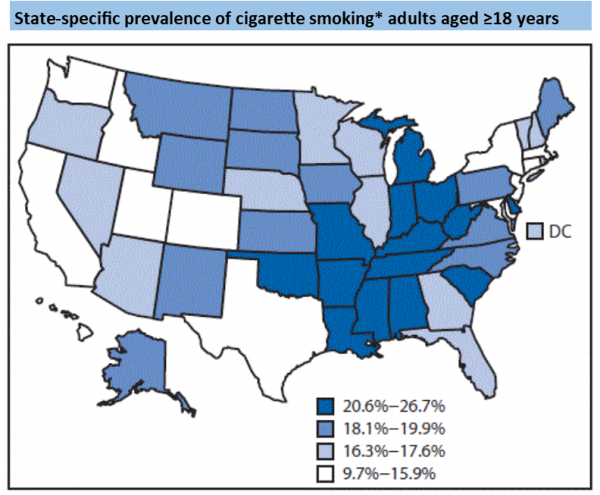
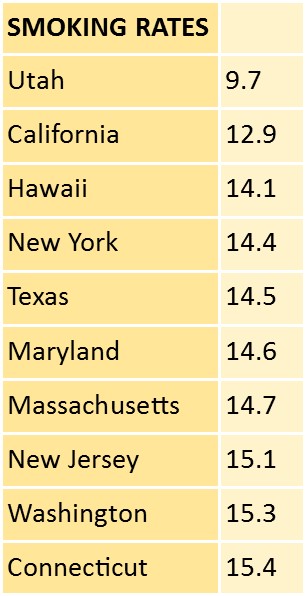
West Virginia had the highest prevalence of cigarette use in the United States, according to a new CDC study.  Utah had the lowest, and Connecticut had the 10th lowest rate. Using data from the 2014 Behavioral Risk Factor Surveillance System, CDC determined that the prevalence of cigarette use in West Virginia was 26.7%, while the lowest rate was 9.7% in Utah.  In Connecticut the rate of cigarette use was 15.4 percent.map

CDC recommended that continued implementation of proven population-based interventions, such as increasing tobacco product prices and enforcing comprehensive smoke-free laws, and increasing access to evidence-based clinical interventions can help reduce tobacco use.

"These findings highlight the importance of enhanced implementation of evidence-based strategies to help smokers and other tobacco users quit completely," CDC said.

Cigarette smoking was significantly higher among males than females in 34 states. Among males, cigarette smoking ranged from 11.2% (Utah) to 27.8% (West Virginia), and among females, from 8.2% (Utah) to 25.6% (West Virginia).

The report also indicated that the prevalence of smokeless tobacco use ranged from 1.4% (Hawaii) to 8.8% (Wyoming). It was 1.8 percent in Connecticut.

ratesPrevalence of any cigarette and/or smokeless tobacco use ranged from 11.3% (Utah) to 32.2% (West Virginia).  Connecticut was 15.3 percent.

The CDC also indicated that the prevalence of any cigarette and/or smokeless tobacco use differed significantly by race/ethnicity in 21 states. Prevalence was highest among whites in eight states (Arizona, Delaware, Georgia, Maryland, New York, North Carolina, Texas, and Virginia), followed by adults of non-Hispanic other races in six states (Arkansas, Florida, Kansas, Nebraska, Oklahoma, and South Carolina), blacks in five states (California, Illinois, Indiana, New Jersey, and Wisconsin), and Hispanics in two states (Connecticut and Michigan).

The report was issued last week from the CDC.  The report concluded that “continued implementation of proven population-based interventions, including increasing tobacco product prices, implementing and enforcing comprehensive smoke-free laws, warning about the dangers of tobacco use through mass media campaigns, and increasing access to evidence-based clinical interventions (including behavioral counseling and FDA-approved medication), can help reduce tobacco use, particularly in populations with the highest use prevalence.”

smoke-that-cigarette


Obesity Rate Climbs in Connecticut, Is Among the Nation's Lowest

Connecticut now has the 10th lowest adult obesity rate in the nation, according to The State of Obesity: Better Policies for a Healthier America. Connecticut's adult obesity rate is currently 25.3 percent, up from 16.0 percent in 2000 and from 10.4 percent in 1990.42

reportAccording to the most recent data, adult obesity rates now exceed 35 percent in four states, 30 percent in 25 states and are above 20 percent in all states. Louisiana has the highest adult obesity rate at 36.2 percent and Colorado has the lowest at 20.2 percent.
U.S. adult obesity rates decreased in four states (Minnesota, Montana, New York and Ohio), increased in two (Kansas and Kentucky) and remained stable in the rest, between 2014 and 2015. This marks the first time in the past decade that any states have experienced decreases — aside from a decline in Washington, D.C. in 2010.

The data, released in September 2016 by the Trust for America’s Health and the Robert Wood Johnson Foundation, reflects information compiled nationwide in 2015.

Connecticut’s childhood obesity rates are 15.8 percent for 2-to-4 year olds from low-income families, 15 percent of 10-17 year olds, and 12.3 percent of high school students.

Regarding obesity-related health issues, Connecticut ranked 31st among the states in the current adult diabetes rate, which is 9.3 percent, and 30th in hypertension at 30.4 percent of the population. rate

In 1985, no state had an adult obesity rate higher than 15 percent; in 1991, no state was over 20 percent; in 2000, no state was over 25 percent; and, in 2006, only Mississippi and West Virginia were above 31 percent.  Nationwide, obesity rates are higher among women (40.4 percent) compared to men (35.0 percent).


CT Families Continue to Struggle Financially, United Way Report Reveals

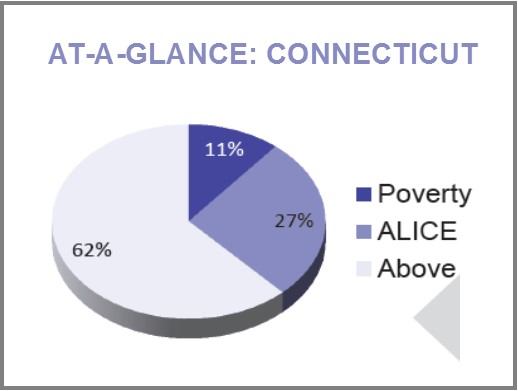
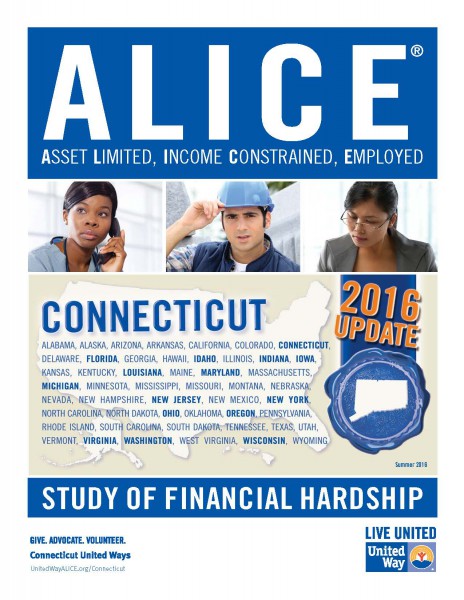
More Connecticut households are struggling to pay for their most basic needs, according to a new report from United Way.  More than one out of four households - in one of the wealthiest states in the U.S. - are employed, yet still fall below what is needed to thrive financially.  That is an increase in both the number and percentage of such households in 2014 as compared with 2012, according to the updated ALICE report. Two years ago, United Ways introduced ALICE, which stands for - Asset Limited Income Constrained Employed - to place a spotlight on a large population of residents who are working, but have difficulty affording the basic necessities of housing, food, child care, health care and transportation.pie

In those two years, the problem has grown worse, even has the recession has given way to a slow economic recovery, in Connecticut and nationwide.  ALICE and poverty households combined account for 38 percent of households in the state that struggle to make ends meet.

A total of 361,521 Connecticut households fall into what the study describes as the ALICE population. These are households earning more than the official U.S. poverty level, but less than the basic cost of living. This is more than 2.5 times the number of households that fall below the federal poverty level. ALICE households make up 20% or more of all households in 114 (67%) of Connecticut’s 169 cities and towns.

The highest levels (ALICE and poverty households) were in Hartford (74%), New Haven (65%), Waterbury (63%), Bridgeport (63%) and New Britain (63%).  Also above 50 percent are Meriden, West Haven, East Hartford and New London.  From 2007 to 2014, two cities, Danbury and Waterbury, saw their total household population decrease, by 7 and 9 percent respectively, while the rest experienced an increase in households, with the largest increase of 8 percent in Stamford, according to the report. The number of household below the ALICE Threshold increased in every one of the nine largest cities and towns with Norwalk seeing the largest percent increase (38 percent).

2016-alice-report-update-coverWhile the prevalence of low-wage jobs still defines Connecticut’s economy for ALICE, for the first time in the past decade, the percent of jobs paying less than $20 per hour fell below 50 percent of all jobs.  The report also highlights a number of trends in Connecticut, including:

  • The population is aging, and many seniors do not have the resources they need to support themselves.
  • Differences by race and ethnicity persist and ethnicity persist, creating challenges for many ALICE families, as well as for immigrants in Connecticut.
  • Low-wage jobs are projected to grow faster than higher-wage jobs over the next decade.
  • Technology is changing the workplace, adding some jobs, replacing many others, while also changing where people work, the hours they work, and skills required. The report notes that technology creates opportunities as well as challenges for ALICE workers.

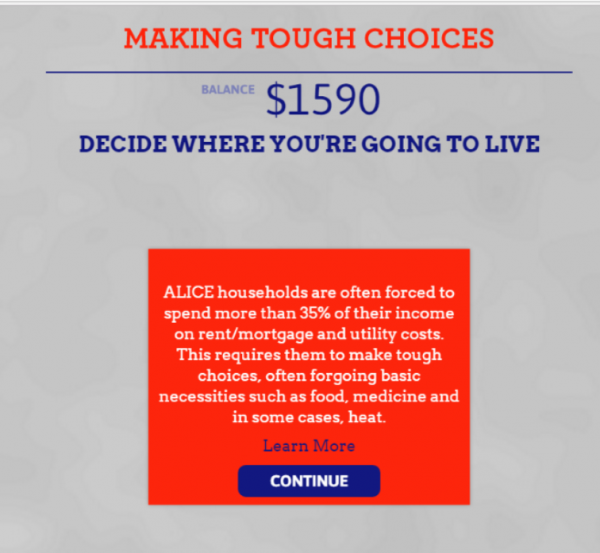
For the first time, an online simulator is also available to experience the financial challenges that ALICE households in Connecticut face at www.MakingToughChoices.org.  The updated Report uses data from a variety of sources, including the U.S. Census and the American Community Survey to provide tools that quantify the number of households in Connecticut's workforce that are struggling financially. The updated United Way ALICE Report reveals:

  • The composition of the ALICE population is men and women, young and old, of all races.
  • The breakdown of jobs in Connecticut by hourly wage (51% of jobs pay more than $20/hour) compared to what it costs to survive for a family of four (2 adults, 1 infant, 1 preschooler) - $70,788.
  • Every city and town in Connecticut has ALICE households. More than two-thirds of Connecticut's cities and towns have at least 1 in 5 households that fit the ALICE definition for financial hardship.cropped-alicemicrositelogo2

Poverty and ALICE households exist in every racial and ethnic group in Connecticut, but the largest numbers are among White non-Hispanic households. There were about one million White households in 2014, compared to 328,000 households of color (Figure 4 shows the populations of color for whom there is income data: Hispanic, Black and Asian). However, these groups made up a proportionally larger share of households both in poverty and ALICE: 64 percent of Hispanic households, 58 percent of Black households, and 30 percent of Asian households had income below the ALICE Threshold in 2014, compared to 31 percent of White households.

The largest population of color in Connecticut, Hispanics, has been growing since 2007, totaling 156,837 households in 2014, a 25 percent increase. As the number of Hispanic households increased, so did the number and proportion of Hispanics living below the ALICE threshold. The percentage of Hispanic ALICE households rose from 34 percent in 2007 to 39 percent in 2010 and then to 43 percent in 2014. Together Hispanic households in poverty and ALICE made up more than two-thirds of Hispanic households in 2014.

making-tough-choicesThere are some signs of improvement in the education gap among racial and ethnic groups, suggesting that some structural changes are occurring in Connecticut. In K-12 education, the Education Equality Index (EEI) shows that the achievement gap – the disparity in educational measures between socioeconomic and racial or ethnic groups – narrowed slightly between 2011 and 2014 in Connecticut.

Achievement gaps impact graduation rates and college performance. Among the Class of 2013, 64 percent of Black students and 59 percent of Hispanic students in the state went on to college within a year after graduating from high school, compared to 78 percent of White students. They also had lower 6-year college graduation rates: While 54 percent of White students got a college degree within 6 years, only 24 percent of Black students and 21 percent of Hispanic students did the same (Connecticut State Department of Education, 2015).

The updated ALICE Report recommends both short-term and long-term strategies to help ALICE families and strengthen our communities. United Ways work with many community partners to provide support to ALICE families to help them get through a crisis and avoid a downward spiral into even worse circumstances such as homelessness as well as assisting with financial literacy, education and workforce readiness.

Further, United Ways in Connecticut have invested more than $8.5 million in child care and early learning; $1.3 million in housing and homeless prevention work; $5 million in basic needs programs; and, have assisted working families in obtaining nearly $40 million in EITC and tax refunds and credits in 2016.

The updated Connecticut ALICE Report was funded by the 16 Connecticut United Ways. For more information or to find data about ALICE in local communities, visit http://alice.ctunitedway.org.  Connecticut United Ways are joining with United Ways in fifteen other states to provide statewide ALICE Reports. The updated Connecticut ALICE Report provides analysis of how many households are struggling in every town, and what it costs to pay for basic necessities in different parts of the state (Household Survival Budget).

https://youtu.be/u7gPJGu2psw

 [2014 ALICE introductory video]

Heart Disease, Cancer Leading Causes of Death in CT; Septicemia Deaths Among Highest in USA

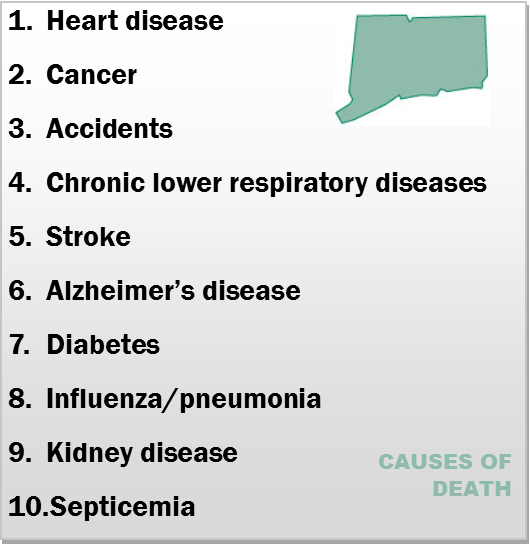
Heart disease, cancer and accidents were the leading causes of death in Connecticut according to data released by the National Center for Health Statistics of the Centers for Disease Control and Prevention.  The other major causes of death in Connecticut include chronic lower respiratory diseases, stroke, alzheimer’s disease, diabetes, influenza/pneumonia, kidney disease and septicemia. In all but two instances, Connecticut ranked in the lowest quintile among the states, ranking 40th in the rate of heart disease deaths, 43rd in cancer deaths, 48th in dCDC_logo2eaths due to diabetes, and 48th in deaths caused by stroke.  The state ranked 15th, however, in deaths caused by septicemia and 35th in accidental deaths.
Septicemia, or sepsis, is a life-threatening complication of an infection in the bloodstream. Sepsis is the body’s overwhelming response to infection which can lead to tissue damage, organ failure, and death. It kills 258,000 Americans each year, according to the Sepsis Alliance, but remains largely unknown. Although it is among the 10 most frequent causes of death nationwide, in a 2015 online survey of 2,000 participants, only 47 percent of Americans were aware of sepsis, the Alliance reported. The deaths this year of actress Patty Duke and boxing legend Muhammad Ali have brought some increased attention to sepsis.causes

Connecticut had 578 recorded deaths caused by septicemia, a rate of 12.6 per 100,000 total population, in 2014, according to the CDC data.  The United States rate was 10.7.  The highest death rates from septicemia were in Mississippi, Louisiana, Alabama, Texas, New Jersey, Kentucky, Arkansas, Maryland, Georgia, and Virginia.

There were 7,018 deaths from heart disease and 6,621 from cancer in Connecticut in 2014, according to the data.  The next most frequent cause of death, accidents, totaled 1,642, followed by chronic lower respiratory diseases, which caused, 1,368 deaths, and stroke, which caused 1,266.

Connecticut’s rate of deaths per thousand population by stroke, 26.3, is among the nation’s lowest.  The national rate is 36.5.  The only states with lower rates of stroke deaths are Rhode Island and New York.  Connecticut is tied with Arizona, just ahead of Massachusetts, New Hampshire and Wyoming.  The highest rate of deaths from stroke are in Mississippi, Alabama, Tennessee, Louisiana and Arkansas.

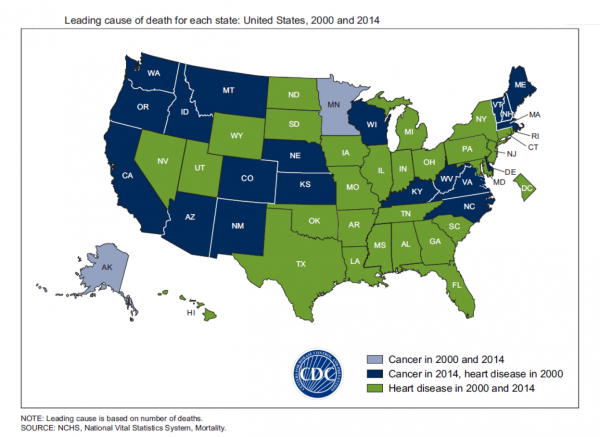
Heart disease has long been the leading cause of death for all U.S. states, with cancer as the second leading cause, according to the CDC. In 1990, Alaska became the first state to experience a switch in ranks between these two causes. In 2000, Minnesota experienced the same switch. As of 2014, there are now 22 states with cancer as the leading cause of death.  Heart disease remains the leading cause in Connecticut.

In 2013, the leading causes of death in Connecticut were heart disease (7.090), cancer (6,619), chronic lower respiratory diseases, accidents, stroke, alzheimer's disease, diabetes, influenze/pneumonia, kidney disease and suicide.

cdc-map

Connecticut Public Accounting Firms Reach National Rankings

The largest Connecticut-based public accounting firm, BlumShapiro, earned the #54 position in the nation’s top 100, according to the publication Inside Public Accounting.  It is one of a handful of Connecticut firms to make the annual top 300 list, in addition to regional firms with offices in Connecticut. BlumShapiro is the largest regional business advisory firm based in New England providing accounting, tax and business consulting services. The firm serves clients from six offices offices in Connecticut (West Hartford and Shelton), Massachusetts and Rhode Island. BlumShapiro ranked #53 last year. 2016_ipa-300_web-147x150

Noted among the nation’s top 200 public accounting firms is Hartford headquartered Whittlesey & Hadley.  The firm, ranked at #155 this year, up from #178 a year ago, and #192 in 2014, has two additional offices, located in Hamden, CT and Holyoke, MA. The firm provides a comprehensive array of accounting, auditing, tax, and advisory services to a broad range of businesses and individuals.

Ranked #285 is Reynolds & Rowella LLP, which maintains offices in Ridgefield and New Canaan.  “We are proud to be counted among the top-ranked accounting firms nationwide on a list that includes Deloitte, PwC, Ernst & Young and KPMG,” Frank Rowella, Reynolds & Rowella’s managing partner, told the Fairfield County Business Journal. “The IPA list is known as one of the most thorough and accurate sets of rankings in the accounting profession. Our inclusion reflects our determination to provide the very best quality compliance and financial services solutions to our valued clients.”

blum At #296 is Glastonbury-based Fiondella Milone & LaSaracina.  FML was founded in 2002 “for the purpose of providing professional auditing, tax and business consulting services to a wide range of clients and industries throughout the Northeast,” the company’s website indicates.  After working together at Ernst & Young, the firm’s founding partners, Jeff Fiondella, Frank Milone and Lisa LaSaracina launched FML.

Inside Public Accounting (IPA), founded in 1987, is published by The Platt Group. The Platt Group publishes both the award-winning Inside Public Acwhcounting newsletter and the award-winning National Benchmarking Report.

Beginning in 1994, INSIDE Public Accounting’s Survey and Analysis of Firms and the resulting national benchmarking report on the nation’s largest accounting firms has served as a barometer of the overall health, challenges and opportunities of the profession, according to the publication.

Annually more than 500 accounting firms across the North America complete the in-depth financial and operational survey. The data is then used to compile the annual ranking of the nation’s largest accounting firms, which is unveiled in August of each year. The annual IPA rankings are considered to be among the longest-running, most accurate and up-to-date for the nation’s largest accounting firms.

Leading the list nationally were Deloitte, PricewaterhouseCopers, Ernst & Young, KPMG, RSM, and Grant Thornton.  Ranked at #11 is New York based CohnReznick, which has offices in Hartford.  Marcum LLP ranked #16, Citrin Cooperman & Company, also based in New York and ranked #21, has offices in Fairfield County.