Harp Stands Out as Number of Big-City Black Mayors Diminishes Nationally
/Last April, New Haven Mayor Toni Harp was sworn in as the first woman selected as president of the African American Mayors Association (AAMA). In November, she was elected to a third two-year term leading the Elm City, earning more than 70 percent of the vote.
In doing so, she ran counter to an apparent national trend – fewer African American Mayors in the nation’s largest cities. According to an analysis by Governing magazine, in 2000, 19 of the largest cities in the country by population either had, or would soon have, black mayors. By 2017, that number had fallen to six. Today, the Wall Street Journal recently reported, that number is four.
African Americans, and African American women, continue to be elected to City Hall. Charlotte and New Orleans both elected their first black women mayors in November. St. Paul and a number of smaller cities elected their first black mayors ever, the publication reported.
Among Connecticut’s largest cities, the mayors of Bridgeport, Hartford, Stamford, Waterbury, and Danbury are white males. Hartford, which elected Thirman Milner and Carrie Saxon-Perry decades ago, hasn’t elected an African American since, but has seen two Latino men hold the office.
 Carrie Saxon Perry was the first black woman to be elected mayor of a major New England city – in 1987. Milner was the first black mayor in all of New England, elected in Hartford in 1981. There hasn’t been a black mayor leading the Capitol City since Saxon-Perry’s term ended in 1993.
Were the current office-holder, Luke Bronin, to resign the office (a scenario that could result if he decides to run for Governor and if he is elected later this year) the newly elected City Council President, Glendowlyn Thames, could change that, if she succeeds to the office.
New Haven’s first black Mayor was John Daniels, who served from 1990 to 1993. Like Harp, he previously served in the State Senate.
 Across the country, Jacksonville, Memphis, Philadelphia and San Antonia had black mayors until recently, Governing reported. Detroit elected its first white mayor in 40 years in 2013. The nation’s largest cities – New York, Los Angeles and Chicago – have each has one black mayor, years ago. Atlanta elected a black female as mayor in a run-off election, winning with just over 50 percent of the vote.
Harp is the only member of the AAMA from Connecticut. The organization was formed in 2014. Fifty years ago, the election of Carl Stokes in Cleveland in 1967 put him on the cover of TIME magazine as the first black elected mayor of a major U.S. city. Richard Hatcher, also African American, was elected mayor of Gary, Indiana that same year.

 For three decades, since 1979,
 The key findings on the jobs benefits from investment in public transit are:

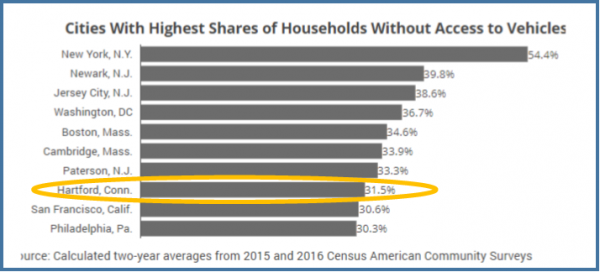 Hartford has a presence in the top 10 cities that already have among the highest share of households without a car, at a 31.5 percent two-year average. Hartford ranks 8th. The list is led by New York City at 54.4 percent, with Newark, Jersey City, Washington, Boston, Cambridge and Paterson in between. San Francisco and Philadelphia round out the top 10 after Hartford. Hartford increased from 30.3% in 2015 to 32.6% in 2016.
 Compared with other states, the percentage of women in Connecticut’s legislature has been dropping, in real numbers and as compared with other states. In 2015, the percentage was 28.3 percent; in 2013 it was 29.4 percent; in 2011 Connecticut’s legislature was 29.9 percent women. In 2009, Connecticut’s legislature included 31.6 percent women, which was the seventh highest in the nation.
 The Yale School of Public Health also


 Of the more than 330,000 senior households, an estimated 76 percent are homeowners and 24 percent are renters. This represents higher home ownership rates than the state as a whole (67% of 1.35 million households).

 he Division of Pediatric Surgery since 2007 and is an associate professor of pediatrics and surgery at UConn Health. In announcing her appointment, Connecticut Children’s pointed out that through her research, Finck “revolutionized outcomes of pediatric and neonatal diseases, most specifically leading efforts focused on identifying and treating those that affect the lungs, esophagus and brain.” She was honored by The Group on Women in Medicine and Science, who awarded her the Outstanding Clinical Scientist Woman Faculty Award, last year.