New London Harbor Light Recognized as State's Leading Lighthouse in USPS Stamp

The U.S. Postal Service has unveiling a stamp featuring the New London Harbor Light, the oldest and tallest lighthouse on Long Island Sound. The USPS indicates that it was originally established in 1761, financed by a lottery held by the Connecticut colonial legislature. The present lighthouse, built in 1801, was one of the earliest American lighthouses with a flashing beacon.

The lighthouse, which is owned by the New London Maritime Society, is the featured lighthouse for Connecticut in the 2013 United States Postal Service’s New England Coastal Lighthouses series. The stamp series highlights lighthouses from throughout the country.

New England Coastal Lighthouses also features the lighthouses at Portland Head, Maine; Portsmouth Harbor, New Hampshire; Point Judith, Rhode Island; and Boston Harbor, Massachusetts. Each stamp shows a close-up view of one of the five lighthouses that captures not only the down-to-earth aspect of the tower but also the mysteriouNew Londons qualities that compel us to come closer.

These five lighthouses are among the oldest in the U.S., and each is on the National Register of Historic Places. Boston Harbor Light is also a National Historic Landmark.  Howard Koslow created original paintings for New England Coastal Lighthouses stamp art-and for the entire lighthouse series. Howard E. Paine and Greg Breeding served as art directors.

The New England Coastal Lighthouses stamps are being issued as Forever® stamps. Forever stamps are always equal in value to the current First-Class Mail one-ounce rate.  The USPS has also developed a short video about each of the lighthouses.

Previously, the Connecticut state 34 cent stamp from the Greetings From America commemorative stamp series featured the state. The United States Postal Service released this stamp on April 4, 2002. The retro design of this stamp resembled the large letter postcards that were popular with tourists in the 1930's and 1940's.

Last fall, Westport Now reported that Westport holds a special place in U.S. Postal Service history with more of its artists (17) designing more postage stamps (161-plus) than any other community in the nation.

CT Businesses Report "Going Green" Worthwhile; Sustainability Has Multiple Impacts

Eight in ten Connecticut companies that have invested time and money in “going green” say the effort has been worthwhile, citing benefits on the bottom line as well as improved employee morale, public image, and client/customer relationships. According to a new survey,  the main barrier to going green is cost, the factor cited by 65% of businesses.  Among companies engaged in sustainability, the strongest areas of involvement are energy efficiency (90%), waste management (77%), and green purchasing (74%).

Those are among the findings of the Connecticut Business & Industry Association (CBIA) 2013 Sustainability and Connecticut Business Survey.  Sponsored by UIL Holdings, Inc., the survey gauges Connecticut companies’ commitment to environmental principles in their business operations and the impact of those efforts on business performance, stakeholder relations, and communities served.

The survey found that nearly two-thirds (66%) of Connecticut businesses engaged in sustainability. This is up from less than half (47%) in 2007, when CBIA first surveyed companies—but down from 74% in 2010, when the previous survey was conducted.

Mostt businesses (72%) find Connecticut’s environmental regulatory climate more restrictive than other states, according to the survey.  And nearly three-quarters of businesses surveyegoinggreen-icond (74%) say they would take advantage of state government incentives for going green, such as tax incentives and refunds for capital investments.

Among the other findings this yea, posted at www.cbia.com/business, include:

  • Renewable energy is the area of greatest interest among businesses for future activities.
  • Though slightly more than half (53%) of the companies surveyed say current economic conditions have not changed their level of commitment to sustainable business practices, 11% have stepped up their efforts, while 9% have made green practices less of a priority. Eighteen percent say green practices are part of their DNA.
  • Nearly one-third of businesses surveyed (32%) require others in their supply chain—manufacturers, suppliers, distributors, and retailers—to adopt green business practices; 28% say that their own customers have requested or stipulated that they incorporate green business practices into their supply chain; and 9% have received similar requests from vendors.

The 2013 Sustainability and Connecticut Business Survey was emailed to 5,035 businesses in late April and early May; 434 businesses took the survey, for a response rate of 9% and a margin of error of +/- 4.8 %.  Most respondents (77%) were small businesses employing fewer than 50 workers. Businesses represented include manufacturers (33%), professional services (23%), retail (9%), nonprofit associations (8%), construction (6%), wholesale (6%), healthcare (5%), finance, insurance, and real estate (5%), and technology firms (4%). Companies engaged in hospitality, tourism, arts, and entertainment accounted for the remainder of respondents.

Market Concerns, State Rankings May Yet Lead to Economic Growth

The reverberations from the Wall Street roller coaster of market highs and lows can have a significant impact on Connecticut’s budget balance, as tax revenues meet or miss projections due to fluctuations in tax revenue.  That, in turn, can create the need for unanticipated budget cuts - which then can affect a range of state services.

It can also take a toll on the state’s overall economy, in part because of the concentration of jobs in the financial services industry, and the significant wealth in Fairfield County impacted by the market.

Connecticut’s economic growth was ranked worst in the nation in 2012, with total state GDP dropping about $250 million compared to the previous year, according to data published this month by the United States Bureau of Economic Analysis.  Among the decline’s biggest factors, the report cited, were government austerity and challenges in real estate businesses, financial services and insurance.

Connecticut traditionally emerges slowly from national recessions, usually lagging other states - which appears to be true yet again, as the state’s unemployment rate of 8.0% remains above the national average.

All of which explains why recent market drops have been the cause of consternation and concern.  Last week, the Dow had dropped 6 percent since hitting its all-time high in May, accoarrowrding to CNBC, and the S&P 500 dropped more than 7 percent from its all-time high in May.  Stocks declined by more than 2 percent last Thursday, as the S&P 500 recorded its biggest daily decline since November 11, 2011, Reuters reported, and 94 percent of stocks traded on the New York Stock Exchange down for the day and more than four-fifths of Nasdaq-listed shares ending lower.

However, Joseph Matthews, First Vice President at Morgan Stanley Wealth Management, and supervisor of the firm's Fairfield office, says the disquiet in recent days, attributed to the Federal Reserve’s intention to eventually ease off in its monetary policy, is nothing more than a “mid-course” correction.  “Change creates anxiety,” he says, noting that while sluggish, the economy is grinding along.  Connecticut has gained jobs in four of the first five months of 2013, only losing employment during the blizzard-impacted month of February.

In responding to the state’s economic ranking this month, Governor Dannel Malloy pointed out that “one of the things that Connecticut has done, which is showing up in these numbers, is shrink the size of government faster than just about every other state.  That is not generally understood. So that has a negative impact [on the economy] and specifically had a negative impact in 2012."

Matthews concurs.  In his view, the decision to reduce the size of government provides an opportunity for the private sector to “drive growth” in the future – and he says the strategy may have the appearance of bad news but could ultimately improve the state’s economic prospects as the private sector steps up.

A graduate of Fairfield University with a B.S. in Accounting and an M.A. in Organizational Communication, Matthews assists institutions with the development and maintenance of definable and repeatable investment processes.  With both Chartered Financial Analyst (CFA) and Certified Financial Planner™ professional designations, he has a history analyzing the markets and living in the midst of the Connecticut economy.  He says a vacuum in consumer confidence – such as in the aftermath of the 2008 recession – “cuts very deeply here.”  He stresses that the “one-two punch” of jobs and housing, which brings a negative multiplier effect, citing homes not being purchased, moving companies not being hired, closing fees not being paid, painters and carpenters not being hired, and so on.  Reversing that cycle takes time.2011 graphic

Earlier this year, Stateline reported that many states were likely to see their income tax revenue increase for 2012 and then fall in 2013 because taxpayers decided to sell off capital assets before the end of 2012 in anticipation of higher capital gains rates imposed by the federal government. Nine states ended fiscal 2012 with tax collections that were anywhere between 10 percent and 20 percent lower than their high point before the recession, according to the latest figures from the Nelson A. Rockefeller Institute of Government. Topping the list are Arizona and Louisiana.  Connecticut is outside the top 10 most severely impacted states.

In 2011, the Wall Street Journal reported that “New York, New Jersey, Connecticut and Illinois—states that are the most heavily reliant on the taxes of the wealthy—are now among those with the biggest budget holes. A large population of rich residents was a blessing during the boom, showering states with billions in tax revenue. But it became a curse as their incomes collapsed with financial markets.”

Fast forward to 2013.  Matthews sees consumer confidence returning, and with it increasing tolerance for risk in the market.  That, combined with Connecticut’s policy to reduce government and incentivize business, could be a beneficial combination.

According to the state Department of Labor, overall, Connecticut has recovered 48.3% of the (seasonally adjusted non-farm) jobs that were lost in the state in the March 2008 to February 2010 employment downturn. The private sector, however, has been more upbeat and has recovered 59.2% of the private jobs that were lost during the same employment recession.

Matthews stresses he’d rather have investment dollars in the hands of businesses and consumers, rather than government – which appears to be what’s happening in Connecticut.  And uneasiness with revisions to Fed monetary policy notwithstanding, recent market drops may prove fleeting, as the Fed stays in the game and confidence builds – even in Connecticut.

Increasing International Exports is Key to State's Economic Development Plan

A recent update on Connecticut’s Economic Development Strategy includes a strong focus on international economic development, including upcoming efforts to extend business in Israel, Canada and France as part of broader plans to strengthen Connecticut’s brand in the global markets and grow the state’s trade footprint abroad.

As described by Beatriz Gutierrez, director of international business development efforts at the state Department of Economic and Community Development (DECD), the department’s vision is “to position Connecticut as the destination of choice for companies looking to establish North American presence with preference to those in the areas of bioscience, precision manufacturing, fuel cells and renewable, and those looking to establish North American headquarters.”

The primary geographic targets for the state are China (which Gov. Malloy visited last year and Secretary of the State Denise Merrill visited last month), Germany and Western Europe (including the Paris Air Show this month), Israel (a CT-Israel Tech Summit will be held in Connecticut on June 12), and Brazil.  Goals include developing an international brand for the state, building an “opportunity pipeline,” and strengthening the relationship management process.

Meetings have been held with more than 50 companies and cluster associations in key industry segments, and a “concierge” program has been introduced in Europe.  During fiscal year 2012, DECD assisted in business exports to 39 countries for 62 state coCT boothmpanies, according to the DECD update.  The total assisted value of $548.6 million would equate to 2,785 jobs, according to DECD.  The department’s presentation added that unreported dollar amounts could account for “another 300 to 400 jobs, or more.”

The state has also been working closely with the U.S. Small Business Administration on international business growth, including the State Trade and Export Promotion (STEP) program.  Among the initiatives in Connecticut are a SBA pilot-grant to help small businesses increase exports, and efforts to assist businesses with participation in regional and industry focused export opportunities and international business development opportunities. Connecticut received grant awards of $546,822 in the first year and $339,319 in the second year, supporting 178 Connecticut companies with partial reimbursements for international business initiatives.

At a trade show in Hannover, Germany in April, for example, the state’s booth featured five Connecticut hydrogen and fuel cell companies, which officials say produced strong leads from both Germany and Canada. Later this month, Connecticut will have a presence at the Hydrogen + Fuel Cells Conference in Vancouver, with three state companies on hand, and at the Paris Air Show in Le Bourget, with 13 companies slated to be present at Connecticut’s booth.  It is the state’s eighth consecutive year at the air show, and $162 million in new business has been reported by the companies who exhibit under the Connecticut display umbrella.

Earlier this year, DECD reported that Connecticut is home to “691 foreign affiliates” employing 106,500 in the state.  At the time, exports were said to exceed $16 billion annually. More recent data indicate that exports dropped about two percent between FY 2011 and FY2012, from $16.21 billion to $15.86 billion.  Next steps outlined by the state in the May 22, 2013 update include implementing a statewide international activity scorecard, monitoring global trends and identifying potential “sweet spots,” and strengthening strategic partnerships.

Rebranding of Tweed-New Haven Seen as Key to Airport Growth

For a time, it seemed as if Tweed-New Haven Airport would be handling flights without the benefit of air traffic controllers.  That altered state of reality was averted – at least for the time being – when Congress intervened, after federal sequestration budget cuts called for eliminating the control tower personnel this spring.

But at a news conference earlier this month, members of Connecticut’s Congressional delegation stressed that Tweed-New Haven and other regional airports are not out of the woods yet. That means the facility needs to more aggressively state its case – to lawmakers and the public.  Which is precisely what’s being done, with a reinvigorated public information effort including a recently developed website and logo.Tweed

Last July, officials at Tweed launched a new user-friendly website to meet the needs of its expanding customer base. The new website www.flytweed.com makes it easier to price and track flights throughout the world. In addition to the website, a new logo was created and Tweed mobile applications were launched.

The initiative to refresh the airport's identity and branding online was aimed at changing travelers' search habits, placing the airport's code ("HVN") into prominence as the first step at accomplishing that goal.  The tagline “Southern Connecticut’s Airport” is also featured with the revised logo.  The airport is served several times a day by US Airways Express, through connecting flights via Philadelphia to over 130 national or international destinations.

A report issued last year indicated that more airline passengers flew out of Tweed in 2011 than in 10 of the previous 11 years – including a jump of 11% in 2011 over 2010. Figures for 2012 were not immediately available.  Total 2011 departures exceeded the average annual number of departures over the last 12 years by a strong 24%.   It also marked the third consecutive annual increase in the number of passengers flying from Tweed.

In addition to Tweed, the six airports that would have been impacted by the federal cuts include Hartford’s Brainard Airport and the airports in Danbury, Bridgeport, Groton-New London, Waterbury.

Officials have pointed out that with competitive fares, convenient parking and easy access from downtown New Haven and I-95, Tweed’s popularity has grown  from a decade ago. The growth also reflects thedestination_banner-938x333-938x333 increasing vitality of the New Haven business community, reflected in a growing and vibrant retail community and greater demand for residential space in the city. Airport officials have said they will continue working with airline representatives to  seek additional service and destinations.

West Hartford, Farmington, Cromwell Earn "Top Town" Titles

 West Hartford has been ranked as the Greater Hartford region's number one community in a new analysis published in the June issue of Hartford magazine.   Rounding out the top 10, in order, are South Windsor, Glastonbury, Manchester, Bristol, Farmington, Simsbury, Middletown, Avon and Enfield. The publication is produced by CT1Media, which also publishes The Hartford Courant.

The rankings are based on information highlighting more than three dozen factors, from school test scores to crime rate, property taxes to median home price, voter turnout to number of retail establishments. In 12 overall categories, the data was weighted to determine rankings broken down by small, medium and large towns, in addition to the overall results.

 top towns

  • The top-ranked large towns (over 30,000 population) are West Hartford, South Windsor, Glastonbury, Manchester and Bristol.  
  • The leading medium-sized towns (15,000-30,000 population) are Farmington, Simsbury, Avon, Berlin and Southington.
  • The top small towns (under 15,000 population) are Cromwell, Granby, Canton, Burlington, and East Granby.

Here’s the breakdown of the champions, by category (and size), according to Hartford magazine:

  • Best for Families/Schools: West Hartford (large), Simsbury (medium), and Granby (small).
  • Best for Seniors: West Hartford (large), Farmington (medium), and Cromwell (small).
  • Young and Hip: Hartford (large), Southington (medium), and Hebron (small).
  • City Living: Hartford (large), Southington (medium), and Cromwell (small).
  • Country Living: Glastonbury (Large), Simsbury (medium), and Granby (small).
  • Bang for the Buck: Bristol (large), Windsor (medium), and Windsor Locks (small).
  • Most Affluent:  West Hartford (large), Avon (medium), and Granby (small).
  • Most Educated:  West Hartford (large), Farmington (medium), and East Granby (small).
  • Lowest Crime:  Glastonbury (large), Simsbury (medium), and Hartland (small).
  • Leisure Life:  Hartford (large), Simsbury (medium), and Hebron (small).
  • Fastest Growing: Hartford (large), Southington (medium), and Cromwell (small).

West Hartford, en route to earning the top spot, finished first in five categories, second place in four, along with two fifth place finishes (Country Living and Lowest Crime) and one sixth place (Bang for the Buck).  Among the medium sized towns, Simsbury won four categories, and Southington and Farmington each  won three.   Among the small towns, Cromwell won four categories and Granby won three.

In addition to the rankings, the magazine outlines how they arrived at the rankings, explaining that data was gathered from a number of sources, “including the schools (we parsed 84 individual test score results for each town), town profiles compiled by Connecticut Economic Resource Center (www.cerc.com), Connecticut State Department of Education, Connecticut Secretary of the State and Nielson Pop-Facts 2013.”

Remembering CT's Korean War Veterans, Advancing Opportunities for State Vets

Even as Memorial Day is observed throughout the state, many veterans and their families are looking ahead to July 27, 2013, which marks the 60th anniversary of the signing of the armistice to end the hostilities of the Korean War - often referred to as the Korean Conflict or the “Forgotten War.”

The armistice agreement, meant to be a temporary document until a peace agreement could be achieved, was signed by the United Nations, the North Korean People’s Army, and the Chinese People's Volunteers.  Even today, 60 years later, no peace agreement exists.

Through the remainder of 2013, commemoration events are planned in communities across the nation to honor and thank all veterans who served in the Korean War and the families who lost loved ones. Of the approximately 1.5 million Americans who served in Korea, an estimated 31,000 reside in Connecticut.  1112-Korean-War-vets-visit-school_full_600

The Veterans History Project at Central Connecticut State University and the Connecticut Department of Veterans’ Affairs are partnering to host a special event for all Korean War veterans on July 26, 2013 at Camp Niantic (formerly Camp Rell) in Niantic.

The state's Korean War veterans are invited to attend a remembrance ceremony at Nett Hall at 11:00 AM to honor the 326 Connecticut men killed in action.  A picnic to celebrate and thank the surviving veterans will immediately follow the memorial ceremony.  Korean War veterans are invited to attend with a guest free of charge.  For details or to contact  860-616-3603 or Tammy.Markik@ct.gov by Friday, July 19, 2013. Connecticut citizens who would like to attend to show their appreciation can also purchase tickets.

The honorary chairs of the event include Mrs. Nikki O'Neill (the widow of former Governor William A. O'Neill), Command Sergeant Major Robert Moeller and General James H. Throwe.

To view historic photographs and hear fascinating first-hand accounts of combat in Korea from Connecticut veterans, visit the Veterans History Project website at http://www.ccsu.edu/vhp where one can choose from more than 50 oral histories to explore.

Business Building Opportunities in Hartford, New Haven

Connecticut Public Broadcasting’s Veterans Vocational Training Program was launched earlier this month, offering a free opportunity for veterans to train for a career in media arts and video production.  For the pilot, CPBN is transforming its Hartford television studio into a learning facility that will use the power of digital media technology to inspire learning, spark innovation and develop workforce skills in post 9/11 veterans.

Completion of the program leads to industry-specific certifications in digital arts or video production and includes portfolio development.

Participants gain experience working with media professionals on digital projects and productions, ranging from live broadcasts to studio operations to web services. To ensure veterans attain employment opportunities, the program also plans to partner with local businesses.

In New Haven, there will be a free workshop for veterans on starting and growing a small business, on Wednesday, May 29 from 8:30 AM to 12:30 PM at Gateway Community College in Room S106.  To register (by May 27) call 203.285.2201 or email wparsons@gatewayct.edu  The workshop will feature experts sharing information on the first steps to start or grow a veteran-owned business in Connecticut, where to find start-up money, and how to use the discipline and planning s\kills that were learned in the military.

Women Veterans Documentary Airs Nationwide BWar Zone Comfort Zone image

A documentary by Connecticut filmmaker Lizzie Warren, produced with Connecticut Public Television, is receiving airplay nationally this weekend.  The program, WAR ZONE/COMFORT ZONE, will be seen on CPTV on May 26 at 10 AM, and on PBS affiliates around the country throughout the weekend.

Writing in the online publication Salon, Warren notes that homelessness among women veterans has riesn sharply in recent years, and that "women veterans are the fastest growing homeless population in the nation."

Here’s the program summary:  Women account for roughly 14 percent of the active-duty U.S. military and more than 24 percent of the National Guard, yet they often receive less than a hero's welcome upon their return to civilian life. Many face poverty, homelessness and joblessness; deal with the psychological and physiological effects of Post-Traumatic Stress Disorder from military sexual trauma and combat related injuries; and often receive poor service from a Veterans Administration ill-equipped and, in some cases, unwilling to help them.

The Emmy® -nominated documentary WAR ZONE/COMFORT ZONE uncovers the plight of these veterans through the intense and personal stories of four women veterans coping with life after their military service. Each seeks a sense of normalcy and peace without the benefit of a comprehensive support system. WAR ZONE/COMFORT ZONE weaves together intimate interviews with the story of two women - Shalini Madaras and Joy Kiss - struggling to establish transitional housing for homeless female veterans in Bridgeport, Connecticut, despite virulent community opposition.

Million Dollar Packages Routine Atop Connecticut Hospitals, CEO’s Receive Highest Pay at 26 of 30

Newly released data from the state Office of Health Care Access, which regulates hospitals in Connecticut, reflects that 18 Connecticut hospital executives received pay packages of over $1 million during fiscal year 2012.

Leading the top-compensated list – and exceeding $1.5 million in total compensation for their highest paid individual staff member - were William Backus Hospital ($3.4 million), Hartford Hospital ($3.3. million), and Yale- New Haven Hospital ($2.8 million).

In addition to the top three, there were seven other hospitals where the highest compensated official received a pay package exceeding one million dollars during FY2012.  Rounding out the top ten were officials at  Greenwich Hospital ($1.5 million), Saint Francis Hospital & Medical Center ($1.5 million), Stamford Hospital ($1.5 million), Hospital of Central CT ($1.5 million), Bridgeport Hospital ($1.1 million), Hospital of Saint Rafael ($1.8 million), and Middlesex Hospital ($1 million).

An analysis by Connecticut by the Numbers indicates that the top salary and benefit package at all but four of the state’s 30 hospitals went to top administrators, usually the President or CEO.  The exceptions included  Hospital signNew Milford Hospital, where the president’s total package ranked 5th and a lab physician led the list;  at Charlotte Hungerford Hospital, where the CEO also ranked 5th and a physician surgeon ranked first, and at Rockville General Hospital which was led by the Medical Director, with the CEO placing third in the salary hierarchy.    At Windham Community Memorial Hospital, the top administrator – the Vice President of Operations – placed 7th in salary and fringe benefits amongst hospital leadership.

Only five hospitals in the state saw the top ranked individual receive less than half a million dollars in compensation.  The lowest was at  Rockville General Hospital, where the Medical Director received $324,458, followed by Windham Community Memorial Hospital, where the top  Physician/Hospitalist earned $463,270, John Dempsey Hospital, where the CEO earned $477,518, New Milford Hospital, where the top package was $480,036 and Johnson Memorial Hospital, where the President’s pay package totaled $483,070.

The OHCA report did report the names of individual administrators, but listed the top 10 paid positions at the state's 30 acute care hospitals. The state's two largest hospitals—Hartford Hospital and Yale New Haven Hospital—each had four senior executives that received million-dollar plus pay packages last fiscal year, the Hartford Business Journal has reported, while Stamford Hospital had two administrators earn over $1 million.

The highest paid hospital executive in fiscal 2012 was the former president & CEO of William Backus Hospital, who received a total pay package of $3.4 million. That included $3.2 million in fringe benefits, the report said.  In addition, the President & CEO received compensation of $975,550 during the year.  The highest active paid hospital administrator was Hartford Hospital's vice president of academic affairs and chief academic officer, who received $3.4 million in compensation.

In 2007, there were seven hospital CEO’s earning in excess of $1 million in compensation, according to the Office of Legislative Research.  In fiscal year 2005, five of the top paid positions at the state’s 30 hospitals received more than $1 million, data from the Office of Legislative Research indicates – all of them CEO’s.

Hospitals are required to provide their top ten highest paid hospital positions annually to OHCA.  The full list for FY2012 is available on the OHCA website. The top salary at each hospital, according to the report:

Bridgeport Hospital, President & CEO: $1,101,139

Bristol Hospital, President & CEO: $605,526

Charlotte Hungerford Hospital, Physician Surgeon: $661,640

CT Children’s Medical Center, President & CEO : $748,347

Danbury Hospital, Chief Executive Officer: $955,838

Day Kimball Hospital, President & CEO: $514,375

Essent-Sharon Hospital, Chief Executive Officer: $736,907

Greenwich Hospital, President & CEO: $1,530,629

Griffin Hospital, Chief Executive Officer: $558,543

Hartford Hospital, VP, Academic Affairs & CAO: $3,351,507

Hospital of Saint Rafael, President  : $1,803,605

John Dempsey Hospital, CEO : $477,518

Johnson Memorial Hospital, President : $483,070

Lawrence and Memorial Hospital, President, CEO: $761,734

Manchester Memorial Hospital,CEO: $560,793

Middlesex Hospital, President/CEO:  $1,022,460

MidState Medical Center, President/CEO: $958,020

Milford Hospital, President: $579,475

New Milford Hospital, Lab-Physician: $480,036

Norwalk Hospital, President & CEO : $901,148

Rockville General Hospital, Medical Director:  $324,458

Saint Francis Hospital & Med Ctr., President: $1,521,090

Saint Mary’s Hospital, President & CEO: $791,256

Saint Vincent’s Medical Center, Chief Executive Officer:   $2,394,278

Stamford Hospital, President & CEO: $1,532,094

The Hospital of Central CT, President & CEO: $1,499,546

Waterbury Hospital, President: $520,298

William W. Backus Hospital, Former Pres. & CEO: $3,357,690

Windham Community Memorial Hospital, Physician/Hospitalist: $463,270

Yale-New Haven Hospital, President & CEO* : $2,803,228

*includes Yale-New Haven Hospital and Yale-New Haven Health System

Strategies to Advance Transit-Oriented Development Outlined by Coalition

Strategies including community engagement, placemaking, mixed-income housing, complete streets, parking configuration, green infrastructure and energy efficiency are outlined in a comprehensive 68-page “toolkit” focusing on opportunities to extend transit-oriented development in Connecticut, as the state moves forward with significant rail and bus initiatives.

 Working in partnership, Connecticut Fund for the Environment, Partnership for Strong Communities, Regional Plan Association and Tri-State Transportation Campaign have created a Transit-Oriented Development (TOD) Toolkit that highlights key strategies necessary for developing competitive and sustainable TOD in Connecticut.  The toolkit has been shared in recent weeks with interested officials  and organizations around the state, and discussed at two public forums in Bridgeport that brought together more than   80 municipal leaders from the region.TOD Toolkit

The document outlines the primary components of a TOD program that meets common community goals of strengthening town centers, supporting municipal budgets, expanding housing and commercial opportunities, and minimizing environmental impacts. Among the central components outlined:

  • The process and design for getting TOD built in a community, from developing a community vision and supportive zoning, to determining how accessible a station is for non-drivers.
  • The demographic trends that favor mixed-income, transit-accessible housing, the fiscal impacts of residential TOD, and mechanisms to include affordable housing within TOD development.
  • Complete Streets strategies that enhance streets and sidewalks to promote walking and biking to a station and to TOD built around it. Transit access, walking an bicycling, and the mix of uses in TOD mean that TOD districts require less parking than traditional development.
  • Best practices for managing parking, including parking maximums, shared parking, and transit incentives.  
  • Information and resources for incorporating green infrastructure and energy solutions in a community. Green infrastructure minimizes wastewater and pollutant impacts from development. Energy-efficiency, local energy generation and micro-grids help communities use less power and withstand disruptions to the regional energy supply. housing starts

Efforts are continuing by the organizations participating in the effort, and others pursuing a transit-oriented development agenda, to coordinate with key state agencies regarding strategies to move TOD forward in the state, especially along key transportation corridors.  Officials are working to secure funds for a new TOD position that would initially provide technical support to Meriden and other towns on the upcoming New Haven - Hartford - Springfield rail and CTfastrak bus lines and to develop a funding source to support financing and land acquisition for priority TOD sites.

 Transit-oriented development is described in the toolkit as “development that’s built to take advantage of the ability of people to access it with transit - a strategy for growth that produces less traffic and lessens impact on roads and highways.”  The overview also points out that “households located within walking distance of transit own fewer cars, drive less, and pay a smaller share of their income on transportation related expenses. Homes and businesses can be built with less parking, reducing the cost of development, making development more feasible in weak markets, and increasing local tax revenue.”


Northeast Homes are Older, Smaller than National Average

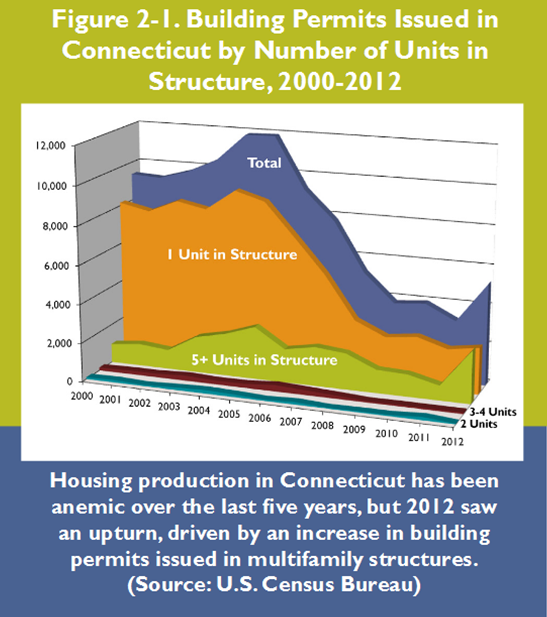
Applications for new home construction nationwide rose to a five-year high in April, offering evidence that the post-recession housing revival will be sustained, according to Associated Press reports on U.S. Commerce Department data.  Applications for building permits – considered an indicator of future demand - rose 14.3 percent to a rate of 1.02 million, the highest since June 2008.

The new construction data builds on a home ownership foundation that varies across regions.  There are 76 million owner-occupied homes in the United States, and three-quarters of them are in metropolitan areas.  The breakdown:  22 percent in central cities, 36 percent in urban suburbs, 17 percent in rural suburbs and only 25 percent outside of metropolitan areas.home size

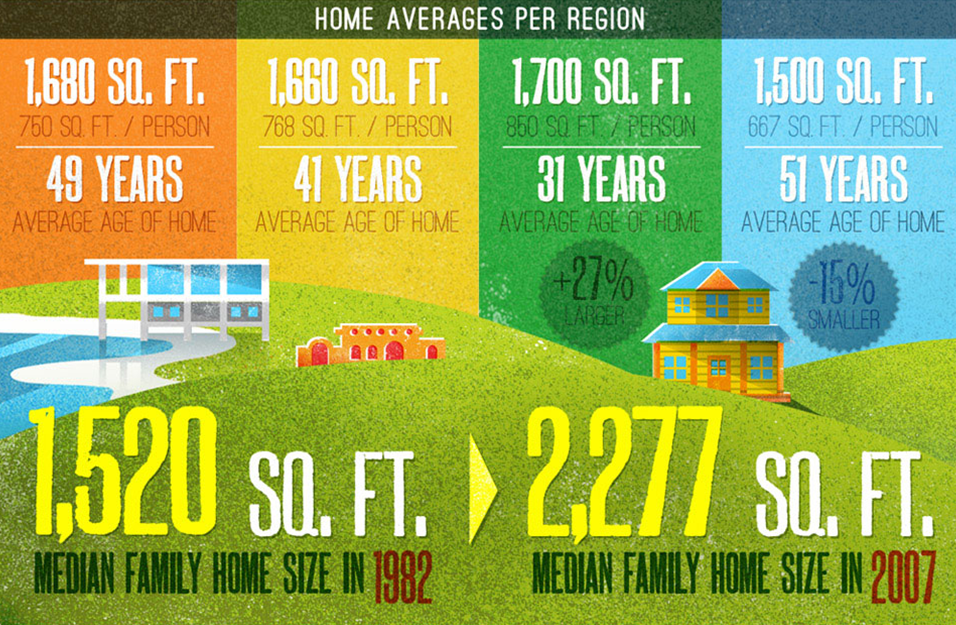
Not surprisingly, the oldest homes (51 years old on average) are found in the Northeast, where they are also 15 percent smaller than the national average; the newest homes are in the South – 27 percent larger than the national average and an average of 31 years old.  The average home in the west is 49 years old, in the Midwest 41 years old.

In Fairfield County, only 6.8 percent of homes were built after 2000, and in the entire state that figure is 7.1 percent, the Connecticut Post reported last month.

Nationwide, the median family home size has grown substantially in recent decades.  In 1982 it was 1,520 sq. ft.; by 2007, it was 2,227 sq. ft.

The data indicate an average of 2.6 people per household nationwide, with the percentage of households with children under age 18 greatest in the urban suburbs (37%), followed by rural suburbs (36%), central cities (33%) and those outside of metropolitan areas (30%).

The data, compiled by the websites of the National Association of Home Builders (nahb.org) and trulia.com, was featured in an infographic developed for Quicken Loans in partnership with Ghergich & Co.

The sites also compares Connecticut with national averages in key home-related categories:

  • Median Value of Owner-Occupied Housing Units: $166,900 [National Average $119,600]
  • Median Price Asked for Housing Units: $136,500 [National Average $89,600]
  • Median Household Income: $53,935  [National Average: $41,994]
  • Median Family Income $65,521 [National Average: $50,046]
  • Per-Capita Income: $28,766 [National Average: $21,587]

U.S. Census data featured by the state Department of Economic and Community Development indicates that Connecticut has 1,371,087 housing units occupied, led by the cities with the largest number of occupied housing units:  Bridgeport 51,255, New Haven, 48,877; Stamford, 47,357; Hartford, 45,124, and Waterbury, 42,761.