Health Care Seen as Economic Driver in Connecticut, Propelling Growth
/The first thought that comes to mind when someone mentions health care is likely not “economic driver.” If a new marketing initiative by the Connecticut Health Council succeeds, that may be changing.
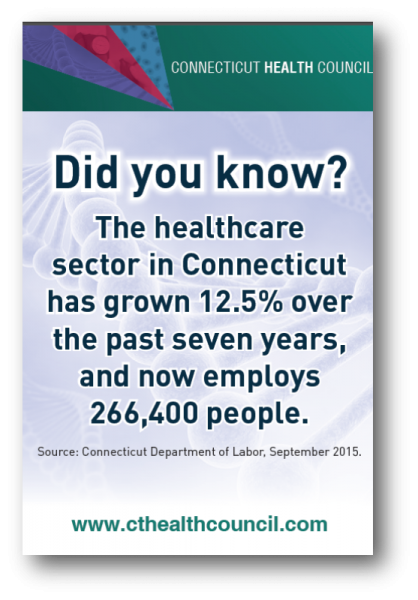
Newly launched in January 2016, the Connecticut Health Council's "Did You Know" campaign is a multichannel content marketing program designed to raise awareness of the health sector's importance as an economic and employment driver in Connecticut. The initiative highlights data that may have escaped widespread attention across the state, with the aim of “promoting Connecticut as a center of health excellence.”
The campaign includes a series of informational posters, now on display at the State Legislative Office Building in Hartford through the end of January, along with “traditional print and broadcast media content, social media alerts, and thought leadership.” Among the stats highlighted:
- The healthcare sector in Connecticut has grown 12.5% over the past seven years, and now employs 266,400 people.
- There are 20,434 registered healthcare employers in the State of Connecticut.
- From 2007 to 2014, healthcare and social services was the fourth fastest growing employment category in the state.
- Connecticut’s healthcare sector generated $29.6 billion in estimated total before-tax revenue in 2012.
 In addition, the marketing campaign also highlights that thee of the top 10 fastest growing companies headquartered in Connecticut in 2014 were healthcare related companies, and that Connecticut’s healthcare sector has the fifth highest number of sole proprietorships of any sector in the state, with the seventh highest revenues. Connecticut’s “unique base of health sector assets” include health insurance companies, hospitals, medical schools, research capacity, and specialty practices, according to the organization’s website.
Founded in 2012 by the MetroHartford Alliance, the Connecticut Health Council is an association of health sector leaders who work to advance the development of businesses, initiatives and technology that improve health care and wellness both nationally and in the State. The organization, which currently has 90 partners, fosters “collaboration, education, entrepreneurship and networking among leaders of for-profit and non-profit health sector entities.”
Speaking at this month’s Economic Summit & Outlook in Hartford, Oz Greibel, President & CEO of the MetroHartford Alliance, spoke to the need to highlight the data at the State Capitol, where the info-posters are on display. “(The campaign) is based on the notion of the health sector as an economic and employment driver – and a place for additional capital investment. Making sure that people at the legislature understand the importance of this sector, and that the actions that they take can be either helpful or detrimental, to long-term growth.”
 The Council's primary activity is to host programs focused on health sector topics that feature speakers of regional, national and international renown, the website points out. The Council also provides “a forum for a robust network of experts, professionals and other parties interested in promoting Connecticut as a center of health excellence and the health sector as a primary driver of economic and employment growth in our State.”
As Greibel described it, the Council’s activities are designed specifically “to leverage the extraordinary resources we have in Connecticut in the health care disciplines.”
Highlighting the impact of the state’s hospitals, the Council points out that Connecticut hospitals provide jobs to 55,000 full-time employees and spend $4.2 billion on goods and services. Overall, Connecticut hospitals contribute $21.9 billion annually to the state and local economies.
The Connecticut Health Council is co-chaired by Marty Gavin, President & CEO of Connecticut Children’s Medical Center, and Bob Patricelli, Chairman & CEO of Women’s Health USA. The executive director is Amy Cunningham.



 Since entering the Connecticut market in the summer of 2014, the company has been aggressively growing its customer base in a competitive market while working diligently to grow and expand its network of doctors. Harvard Pilgrim Health Care announced recently that its Connecticut membership has grown to more than 24,000, exceeding expectations for 2015. It now serves more than 800 Connecticut businesses. Twenty-nine of the state’s 30 hospitals are now in-network.
 With more than 500 business leaders in attendance at an annual Economic Summit & Outlook last week, brought together by the Connecticut Business and Industry Association and MetroHartford Alliance, Schmitt spent some time touting a new model launched in the state of New Hampshire that he believes may be a glimpse into the direction the industry is moving. Harvard Pilgrim Health Care’s footprint in New England now covers “where 90 percent of New Englanders live,” in Massachusetts, Connecticut, Maine and New Hampshire.
 Launched
 Congressional Districts, with the exception of the Fourth District, did better than the national average in the degree of income inequality.


 MassChallenge, an independent nonprofit organization, envisions “a creative and inspired society in which everyone recognizes that they can define their future, and is empowered to maximize their impact.” They note that “novice entrepreneurs require advice, resources and funding to bring their ideas to fruition. Currently there is a gap between the resources these entrepreneurs need and the ability of the entrepreneurial ecosystem to provide them.” To bridge that gap, the organization’s primary activities include running an annual global accelerator program and startup competition, documenting and organizing key resources, and organizing training and networking events. They “connect entrepreneurs with the resources they need to launch and succeed immediately.”
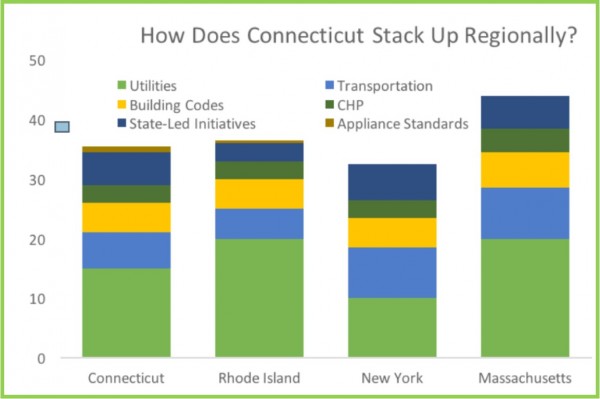
 nd compliance efforts, earned 3 points out of 4 for its combined heat and power policies and programs, 5.5 out of 7 points for state-led energy efficiency initiatives, and 1 point out of 2 for appliance standards.
 olar power in Connecticut has grown 221 percent per Capita since 2012, ranking the state 13th in the nation, the report points out. The top solar growth states in the nation, like Connecticut, have adopted renewable energy requirements, strong laws allowing solar customers to sell their excess power to the electric grid, and other policies encouraging growth of the industry, the report indicates. The industry is also adding jobs much faster than the overall economy, employing 1,600 people in Connecticut last year, according to
  ."
."

 "The Connecticut Council for Philanthropy along with other funding partners invested in the first ever statewide Community Wellbeing Survey, a scientific survey of the state’s entire adult population that will provide timely, powerful knowledge about our communities and enable us to better know the people and places we care about,” added Maggie Osborn, President of the Connecticut Council for Philanthropy.

 The
The  Plans for the new Academic Science & Laboratory Building at Southern began back in 2007 with a comprehensive 10-year capital improvement plan, dubbed CSUS 2020, for upgrading the four institutions of the Connecticut State University System. Approved by the state legislature and signed into law by Gov. M. Jodi Rell, the plan was developed during the administration of Chancellor David G. Carter. It included upgrades and repairs to existing facilities, as well as construction of a new Visual & Performing Arts Center at Western Connecticut State University, which

 The work, which has yet to be funded, is likely to include moving or eliminating some exits and entrances – and possibly adding others in new locations - to improve traffic flow. Cost estimates range from $4 billion to $12 billion, depending on the option selected. Upcoming public meetings are to be held in East Hartford on Dec. 2 and Hartford on Dec. 10.