CT is Nation’s 5th Most Innovative State, Ranks 4th in Productivity

Massachusetts is the nation’s most innovative state, with California scoring a close second and Washington, New Jersey and Connecticut rounding out the top five states, according to The Bloomberg U.S. Innovation Index, in findings that highlighted the connections between education, research and innovation.index "There are some things that state governments can do to make their states more attractive to research and development," including R&D tax credits, Nariman Behravesh, chief economist at IHS Inc. in Lexington, Massachusetts told Governing magazine. "State governments — if they carefully target areas where they think they have a bit of a competitive advantage — they could develop a cluster around their universities, as well."

Bloomberg scored each of the 50 states on a 0-100 scale across six equally weighted metrics: R&D intensity; productivity; high-tech density; concentration of science, technology, engineering and mathematics (STEM) employment; science and engineering degree holders; and patent activity.

Mississippi, West Virginia and South Dakota are the three least innovative states.

Reviewing Connecticut rankings by category, the state ranked 4th in productivity, 8th in R&D intensity, 10th in science & engineering degree holders, 11th in patent activity, 13th in STEM concentration and 22nd in high-tech intensity. innovation

Rounding out the top 10 most innovative states were Oregon, Maryland, Colorado, Delaware and Minnesota.  Among the other New England states, New Hampshire ranked 12th, Rhode Island was 14th, Vermont ranked 25th, Maine finished near the bottom at number 43.

The data analyzed by Bloomberg came from the Bureau of Economic Analysis, Bureau of Labor Statistics, National Science Foundation, StatsAmerica.org and the U.S. Patent and Trademark Office.

mpa

Four Connecticut Companies Among Most Innovative in National Rankings

Four Connecticut companies are among the most innovative, according to rankings published by Fast Company magazine.  Harman Industries, Oxford Performance Materials, Priceline Group and GE were named among dozens of the companies, in a range of industries, for noteworthy innovative business practices and systems. Overall, the top 10 most innovative companies of 2016, according to Fast Company, are Buzzfeed, Facebook, CVS Health, Uber, Netflix, Amazon, Apple, Alphabet, Black Lives Matter and Taco Bell.  The next 10 include, Robinhood, Universal Studios, Huawei, Cyanogen, InMobi, Novocure, Bristol-Myers Squibb, Amgen, Spotify and GE.fast company

Fast Company also announced Top 50 lists selecting the most innovative companies in more than two dozen sectors, including architecture, design, automotive, biotech, education, energy, fitness, enterprise software, gaming, healthcare, marketing & advertising, media, retail and robotics.

Stamford-based Harman International Industries reached the list of the most innovative companies in the world for vehicle technology, led by an auto sound system that creates individual “sound zones” within vehicles. Harman ranked seventh on the Fast Company ranking of the 10 most innovative companies in the automotive sector.HarmanLogo

According to published reports, Harman’s individual sound zone concept allows drivers and passengers to personalize their own audio experiences with limited disruption or interference from other vehicle occupants, with digital signal processing tuned to the vehicle cabin and speakers to reduce the signals from other zones, regardless of whether they are music, vocal or other sounds. The Harman system utilizes a vehicle’s existing speakersOPMlogo_no text with the addition of headrest and ceiling speakers.

A Connecticut-based biotechnology company, South Windsor-based Oxford Performance Materials (OPM), reached the biotechnology list, ranking seventh.  The company, founded in 2000, was recognized for developing spinal implants. OPM’s founder and CEO is Scott DeFelice.

A pioneer in personalized medicine, OPM Biomedical became the only company to receive FDA clearance to manufacture 3D printed patient‐specific polymeric implants when it received clearance for its cranial prostheses line for surgeons in 2013, the company website points out. The company reports it now has two additional FDA clearances, and is an original equipment manufacturer for maxillofacial implants as well as its first spinal implant line.The-Priceline-Group

In addition, Norwalk-based Priceline Group was recognized by Fast Company among hospitality companies for its Booking.com hotel reservation system. The Priceline Group is the world’s leading provider of online travel & related services, provided to consumers and local partners in over 200 countries through six primary brands:  Booking.com, priceline.com, KAYAK, agoda.com, rentalcars.com, and OpenTable.


https://youtu.be/rTrKd3vPyWk

Federal Transportation Funds to Increase As Connecticut Considers Long-Term Plan

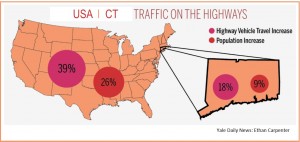
As Connecticut policy makers consider a long-term infrastructure investment in Connecticut’s transportation system, they do so just months after the federal government, after years of inaction, adopted the FAST (Fixing America’s Surface Transportation) Act at year’s end.  It is the first comprehensive transportation law since 2005, according to Connecticut’s Office of Legislative Research (OLR). The act includes $225.2 billion for highway investment, $61 billion for federal transit programs, and $10 billion for the Federal Railroad Administration and Amtrak.  States will get about a 5.1 percent increase in funding in FFY 16 and annual increases ranging from 2.1 percent to 2.4 percent in subsequent years, according to OLR.fast-act

State lawmakers are considering Governor Malloy’s proposed $100 billion, 30-year Let's Go CT! program, unveiled earlier this month, which included a call to enact a constitutional amendment creating a financial lockbox to protect transportation funds. Officials have said that 47 percent of state-maintained roadways are in “less-than-good condition”, and 35 percent of Connecticut's bridges are functionally obsolete or structurally deficient.  The Connecticut Business and Industry Association has said that 42 percent of businesses think the state's road congestion hinders their opportunities and growth.

As a result of the FAST Act, Connecticut will receive about $3.5 billion over five years, or about $700 million annually, for highway and transit programs, which is about $62 million more per year than Connecticut received in 2015.  The state Department of Transportation says the act’s importance isn’t in the amount of money it provides, which does not change dramatically from previous levels, but in the predictability and assurance of funding it provides, OLR Principal Analyst Paul Frisman points out in a report to state legislators. ct usa

The FAST Act’s transfer of the $70 billion into the federal Highway Trust Fund (HTF) was essential to keep the fund solvent. The federal government has not increased the federal 18.4 cent gas tax in more than 20 years, and this has reduced the HTF’s purchasing power and reduced its ability to keep pace with rising infrastructure costs and inflation. Decreased revenues because of more fuel efficient vehicles and the popularity of alternative fuel vehicles also cloud the HTF’s future, the report indicates.  There continue to be concerns that if revenues going into the fund are not increased, insolvency may await, as soon as 2020.

The FAST Act also includes two new freight initiatives, including a National Freight Program which authorizes $6.2 billion over five years for national and state projects to improve highway freight transportation. The OLR report indicates that to participate, a state must complete a State Freight Plan, which it must update every five years. The American Road and Transportation Builders Association (ARTBA) has said that participating states will be able to obligate up to 10 percent of this funding to improve freight rail services or ports, which may be of particular interest to Connecticut.  The other new program is aimed at highway, bridge, rail-grade crossing, intermodal, and freight rail projects that cost at least $100 million, improve movement of both freight and people, reduce bottlenecks, and improve connectivity.

The FAST Act also makes changes to several highway funding programs, with a focus on surface transportation, local roads and bridges, transportation alternatives such as bicycling.  To increase efficiency and speed up the project review process, ARTBA reports that the FAST Act encourages the use of a single environmental review document throughout the entire review process, instead of the current practice of having each agency involved in a project conduct a separate review.

cars connecticutThe OLR report also indicates that a Federal Highway Administration pilot program permits up to three states to toll existing Interstate highways that they could not otherwise adequately maintain or improve, and increase funding available for public transportation initiatives.  In addition, $2.6 billion is provided to Amtrak’s Northeast Corridor (and $5.4 billion to other Amtrak lines) over five years. It separates the Northeast Corridor, from Boston to Washington, D.C, from other Amtrak accounts to ensure that the amounts assigned to that Corridor are used there, OLR reports.

Even with the additional funding nationwide, transportation officials in Connecticut and around the country continue to warn that “long-term, sustainable funding for transportation is yet to be achieved,” as described by the American Association of State Highway and Transportation Officials.

Corporate Headquarters Headed Back to Cities, But Shrinking, Report Says

The departure of GE’s corporate headquarters for Boston reflects a growing trend for headquarters of major corporations to relocate back to cities, but a recent study indicates they not only move, but shrink, becoming a “reconstituted, smaller version”of their former corporate selves. Analyst Saskia Sassen, author of The Global City, describes such moves, which often consist of “only the most senior people” in the firm as “executive headquarters.”  A feature this month by Crain’s Business Chicago investigates the trend, as it has been evolving in Chicago.  Their report points out that “these headquarters make for great headlines, but they don’t nroundecessarily result in that many jobs,” according to the website newgeography.

“The notion of the corporate headquarters in the ‘Mad Men’ world when there were hundreds or thousands of people in a building with the company logo . . . those days are gone,” says David Collis, a professor at Harvard Business School who studies corporate headquarters.

The Crain’s article points out that “when Chicago landed ADM in 2013, it got 70 executives and white-collar employees, plus a promise of 100 technology jobs that never arrived. Two years later, Decatur still has 4,200 ADM workers.”

The story points to good news and bad news for Chicago.  The bad news, is that a “headquarters ain’t what it used to be. On the other hand, Chicago is winning the battle for them,” and the ripple effect they provide.  These smaller executive headquarters, particularly for major global businesses, benefit from being in a global city, the article explains. Chicago has lured a number of these from out of town, noting that agro-industrial firms are increasingly choosing Chicago: ADM, Con Agra, Mead Johnson Nutrionals, and Oscar Mayer in recent years.

The same may be said for GE and Boston, and the city’s technology-intensive environment. Some fear that Chicago's technology startups, the article reports, are particularly vulnerable to leaving for Silicon Valley, attracted by venture capital and a deep talent poolHQ_chicago.  Boston may be in the running for similar relocations.

A similar phenomenon is occurring in Pittsburgh.  After 70 years in a suburban location, Kennametal announced plans last fall to relocate its world headquarters to an urban location. “We’re a global business that’s making changes to stay competitive in a new industrial era,” said the company.  “We have more than 13,000 employees in 40 countries serving customers in more than 60 countries every day. An urban location puts us in closer proximity to major universities and the airport and will enable us to recruit more talent.”

The Wall Street Journal reported last year that online travel agency Expedia Inc. announced plans to relocate its headquarters from a Seattle suburb that it called home for nearly 20 years to the city’s downtown.

“In the late 60s and early 70s, CEOs in places like New York City fled the city and moved to the suburbs, leading to the growth of Westchester County, Stamford and Greenwich, Connecticut,” Ed McMahon, a senior resident fellow for the Urban Land Institute, told the newspaper. “In those days, the determining factor was where the CEO of the company wanted to live.”

Now, the Journal reported, “large companies are moving back into the city in an attempt to attract and retain workers—particularly younger workers who are postponing homeownership and favor renting in walkable neighborhoods with easy access to restaurants, shopping and cultural opportunities.”

“Connecticut has really been hammered by the trend away from suburban campuses,” writes Michael Brendan Dougherty in The Week. “Aetna demolished a 1.3 million-square-foot campus in Middletown in 2011. That site is vacant. Pfizer dumped a research campus in Groton after that. The suburbs around Chicago, which once gladly received Sears' corporate headquarters, may be hit next.”  It seems that they are.

Picture6The Crain’s article reports that headquarters began shrinking a decade ago, but the trend has accelerated in the past three years, according to Vinay Couto, a consultant in the Chicago office of Strategy&. In recent years, 16 companies have relocated their main headquarters to the city from the suburbs. Seventeen came from outside the metro area. The phenomenon, he points out, is driven by the outsourcing of shared services such as IT, accounting and human resources, as well as by a mindset borrowed from private equity to cut overhead and make every part of a business count toward profitability.

The website Investopedia defines “corporate headquarters” as “a business' most prestigious location,” adding that it may “bring prestige to the city it is located in and help attract other businesses to the area.”

Moving headquarters can also be a way for companies to break from the past and shed employees and positions, Couto says.  And the loss of a major headquarters doesn't necessarily stifle job gains. When Boeing moved to Chicago, Seattle's economy kept growing, Kevin Hively, founder of Ninigret Partners, a business and economic development strategy consulting firm in Providence, R.I., told Crain’s. In that case, however, the presence of Microsoft and Amazon helped.

Patent Trolls Target Nearly 50 Connecticut Businesses, Filing Suits in Friendly Texas Court

“I know firsthand how detrimental patent trolls can be to small businesses, as my Connecticut small business was recently the victim of abusive patent litigation in which bad patents were used as weapons of financial intimidation against my small business. $100,000 in legal fees and ten months of litigation later, we successfully defended against these frivolous lawsuits, explained Michael Skelps, General Manager of Middlefield-based Capstone Photography recently in a published report. The New York Times has described patent trolls as “people who sue companies for infringement, often using patents of dubious value or questionable relevance, and then hold on like a terrier until they get license fees. In recent years, patent trolls — they prefer “patent assertion entities,” or P.A.E.’s — have gone from low-profile corporate migraine to mainstream scourge.”

Skelps said that “a year later, my small company is still recovering from exorbitant legal fees, none of which we were able to recoup from the legal system.  As a result of the lawsuit, my mom-and-pop photography shop had to downsize from five full-time employees to three part-time. We spent the equivalent of a year’s worth of profit to defend ourselves, with no budget allocated before to legal defense.”
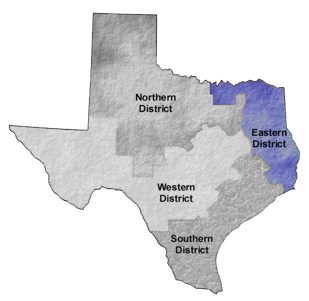
texasdistrictmapWhile action to combat the rapidly escalating challenge to businesses of every size has been unable to navigate through a divided Congress, the problem is growing.  One jurisdiction in particular is a hospitable home for the legal attacks.  Federal court in the Eastern District of Texas is the epicenter of patent troll litigation, and nearly 50 Connecticut companies are among those hauled into court there under dubious circumstances.

The Dallas Business Journal printed what read very much like a warning to American businesses, when a commentary noted that “the Eastern District of Texas’ misguided judicial system makes the towns of Tyler, Marshall, Beaumont and Texarkana the biggest patent-troll nest in the United States, filling the coffers of these tiny towns with money legally extorted from innovators that could otherwise be used to support business growth and create new jobs.”

The Connecticut businesses range from well-known names such as Xerox, UTC, Pitney Bowes, Aetna, Starwood, Priceline, WWE, Frontier Communications and Stanley Black & Decker to dozens of lesser known names lacking the deep pockets to fight what are usually unfounded allegations.  Small and medium-sized businesses – many in the tech fields - are frequently sued in East Texas even if they operate outside the state.  The goal appears to be either to force them to travel to the Lone Star State to defend their business practices, or to extract exorbitant settlements as the only way to avoid the travel and legal costs.

It is those out-of-court settlements that the trolls depend on, and which are bleeding some unsuspecting businesses virtually dry. The median compensatory-damage award by East Texas judges and juries in patent cases was $8.25 million, according to the article, written by the president and CEO of the Consumer Electronics Association, a U.S. trade association representing more than 2,000 consumer electronics companies.

Six months ago, in an effort to put an end to such activities, the Judiciary Committee in Congress approved legislation that would overhaul the nation’s patent laws.  That effort, however, has slowed, and ultimate passage in Congress is in doubt, according to published reports.patentsuit

In Connecticut, associations and organizations including The Credit Union League of Connecticut, Connecticut Food Association and the Connecticut Retail Merchant Association have called for federal action to end patent trolling.  The National Retail Federation has said that the cost of defending companies against the claims is so high — the average case costs $2 million and can take 18 months — that many victims settle out of court. The cases cost legitimate businesses close to $30 billion a year in direct costs and $80 billion indirectly, amounting to $943 a year for the average household when passed on to consumers.”

Small businesses bear the brunt of the litigation, but larger businesses are not immune.  About a year ago, it was reported that “Apple must pay a shell company $532.9 million because iTunes infringes upon three patents related to online patents, a jury in East Texas ruled.  The company in question … is also based in Texas and doesn’t make or do anything besides file patent lawsuits, as an Apple spokesperson pointed out, noting that the company “makes no products, has no employees, creates no jobs, has no U.S. presence, and is exploiting our patent system to seek royalties for technology Apple invented.”

By mid-2015, the U.S. District Court for the Eastern District of Texas was headed to a record year. An astonishing 1,387 patent cases were filed there in the first half of the year, according to published reports. This was 44.4 percent of all patent cases nationwide, and almost all of the growth is being “fueled by patent trolls.”  Reports indicate that in 1999, only fourteen patent cases were filed there. By 2003, the number of filings had grown to fifty-five. Ten years later, in 2013, it was 1,495.

Overall, patent disputes hit an all-time high of about 7,500 cases in 2015, largely driven by patent trolls who filed two-thirds of the lawsuits, according to a report from Unified Patents. The number of lawsuits filed by non-practicing entities (NPEs), known as “patent trolls,” increased by 25 percent.  Last year, patent troll filings made up 95 percent of the cases in the Eastern District of Texas.

While Congress is mired in inaction, at least one state is stepping into the fray.  Virginia Attorney General Mark Herring, a Democrat who took office in 2014, announced last week a new initiative to support Virginia businesses by combating patent trolling through a newly formed Attorney General’s Patent Troll Unit.

Herring’s announcement explained that “in recent years high-tech businesses, Main Street businesses, and everything in between have become frequent targets of “patent trolls” who send bad faith demand letters, request unjustified licensing fees, and threaten baseless lawsuits. Unchecked, patent trolls and their bad faith practices stifle innovation in the Commonwealth, have a negative impact on our innovation-driven economy, and tie up the courts.” Businesses are forced to “choose between paying unjustified licensing fees and engaging in costly litigation,” the  announcement stressed.

The federal Government Accountability Office (GAO), according to a Washington Post report, found that a disproportionate share of patent litigation concerns software patents. The non-partisan government agency found that the number of defendants in patent lawsuits more than doubling from 2007 through 2011. Notably, this increase is specifically related to software patents — software patents account for 89% of the increase, according to the GAO's calculations.

Said Skelps: “our current patent system is ripe for exploitation. Like the abusive patent litigation we endured, malicious actors are abusing the system and using it as a weapon against legitimate businesses, harming innovation, driving small companies out of business, and overtaxing our already overburdened litigation system.”

CT Ranks 20th in Dependence on Gun Industry, But 3rd in Firearms Output, 2nd in Industry Wages

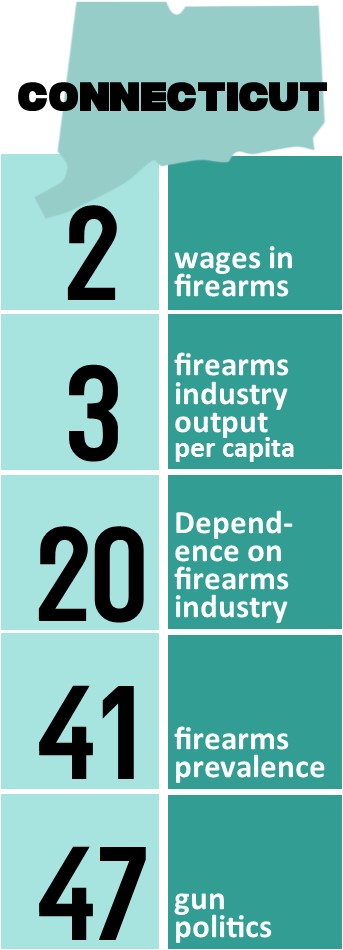
Connecticut’s place in the ongoing national debate about guns is reflected in a new analysis which ranks the state 20th in the nation in overall dependence on the gun industry, but also ranks the state 3rd in total firearms industry output per capita and 2nd in highest average wages & benefits in the firearms industry. Picture8With the gun debate center-stage in the presidential primaries and in Washington, D.C., the website WalletHub analyzed which states depend most on the arms and ammunitions industry both directly for jobs and political contributions and indirectly through firearm ownership. WalletHub’s analysts compared the 50 states and the District of Columbia across three key dimensions: 1) Firearms Industry, 2) Gun Prevalence and 3) Gun Politics and eight metrics.
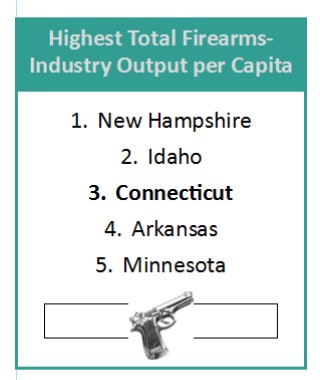
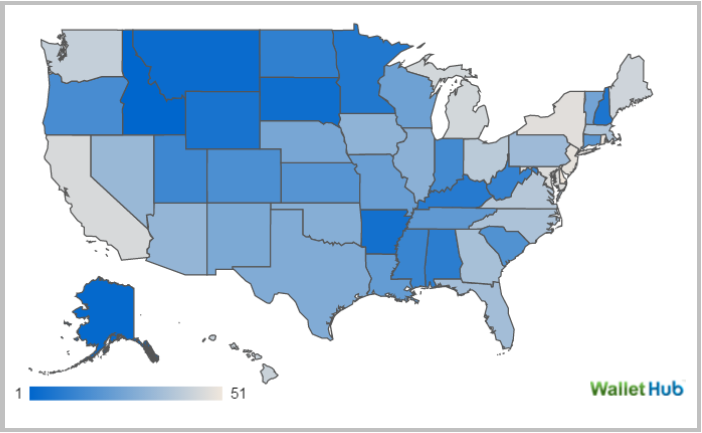
Connecticut also came in 41st in its "firearms prevalence rank" and 47th in "gun politics rank."

The states Most Dependent on the Gun Industry were Idaho, Alaska, Montana, South Dakota, Arkansas, Wyoming, New Hampshire, Minnesota, Kentucky and Alabama.gun stat chart

Officials point out that the gun industry plays an important role in the U.S. economy, and Connecticut is no exception. By one estimate, firearms and ammunitions contributed a total of nearly $43 billion to the national economy in 2014. That figure accounts for more than 263,000 jobs that paid $13.7 billion in total wages, according to the report from the Connecticut-based National Shooting Sports Foundation. In the same year, federal and state governments collected from the industry more than $5.79 billion in business taxes, plus an additional $863.7 million in federal excise duties, the WalletHub report indicated.

In the overall rankings, the states determined to be least dependent on the gun industry are Maryland, New York, New Jersey, Rhode Island and Delaware.

The analysis also found:

  • The number of firearms-industry jobs per capita is highest in New Hampshire, which is seven times greater than in the District of Columbia, where it is lowest.
  • The average wages & benefits in the firearms industry is highest in the District of Columbia, which is three times greater than in New Mexico, where it is lowest.
  • The total firearms industry output per capita is highest in New Hampshire, which is 18 times greater than in Hawaii, where it is lowest.
  • The total taxes paid by the firearms industry per capita is highest in Montana, which is six times greater than in Delaware, where it is lowest.
  • Gun ownership is highest in Alaska, which is 12 times greater than in Delaware, where it is lowest.

The eight relevant metrics utilized in the analysis and their corresponding weights were as follows:map

Firearms Industry – Total Points: 35

  • Number of Firearms-Industry Jobs per 10,000 Residents: (~14 Points)
  • Average Wages & Benefits in the Firearms Industry: (~7 Points)
  • Total Firearms Industry Output per Capita: (~7 Points)
  • Total Taxes Paid by the Firearms Industry per Capita: (~7 Points)

Gun Prevalence – Total Points: 35

  • Gun Ownership: (~17.5 Points)
  • Gun Sales per 1,000 Residents (approximated by using National Instant Criminal Background Check System data): (~17.5 Points)

Gun Politics – Total Points: 30

  • Gun-Control Contributions to Congressional Members per 100,000 Residents: (~15 Points)
  • Gun-Rights Contributions to Congressional Members per 100,000 Residents: (~15 Points)

Data used to create these rankings were collected from the U.S. Census Bureau, the National Shooting Sports Foundation, the Federal Bureau of Investigation, the BMJ Publishing Group and the Center for Responsive Politics, according to WalletHub.

Rockies, Yard Goats Extend Relationship; Among Top 10 Farm Systems in MLB

When the Hartford Yard Goats take up residence at the new Dunkin’ Donuts Park later this spring, they will continue to be a Double-A farm team of the National League’s Colorado Rockies, which run one of major league baseball’s top 10 farm systems, according to a pre-season analysis  by the website minorleagueball.com. At the top of the rankings – the “elite” organizations – are the Chicago Cubs, Boston Red Sox, Minnesota Twins, Los Angeles Dodgers and Texas Rangers.  The next five, described as organizations that “should be considered very productive with a chance to move into the top group soon,” include the New York Mets, Pittsburgh Pirates, Toronto Blue Jays, Colorado Rockies and Houston Astros.  The New York Yankees farm system was ranked at #13. Primary_Logo_for_the_Hartford_Yard_Goats

The Hartford Yard Goats Double-A baseball club will launch its inaugural season at home in Hartford on May 31, a delayed opening due to stadium-construction delays.  The team will begin its season playing on the road in April and May.  The Yard Goats will play the Boston Red Sox affiliate Portland Seadogs in June and July of 2016, the New York Yankees affiliate Trenton Thunder in August, and the Binghamton Mets in July and August.

When they finally arrive home, it appears that the Rockies-Yard Goats relationship will not be short-lived.  This week, the Colorado Rockies announced a player-development contract extension for another two years with the Hartford Yard Goats. It will keep the two teams together through the 2018 season.  The original agreement signed in the fall of 2014 was set to expire at the conclusion of this season.

The Yard Goats recently announced the addition of a third founding sponsor.  Stamford's Frontier Communications, which has expanded its Connecticut telecom offerings through its $2 billion acquisition of AT&T landline assets last year, will pay an undisclosed sum for the right to display its signage inside and outside the $66 million stadium under construction in the Downtown North neighborhood.Colorado_Rockies_logo.svg

The company's name will also be on the Frontier Communications Stadium Club, and the deal includes provision of free Wi-Fi for fans at home games.  Frontier joins founding sponsors Travelers and The Hartford Financial Services Group. In addition, Dunkin' Donuts owns the naming rights to the stadium.

Playing lwpopast season as the New Britain Rock Cats, the team finished with a record of 69-71, a fourth place spot in the six-team Eastern League’s Eastern Division.
The Hartford Yard Goats have also announced that all 142 games (home and away) will be broadcast live on News Talk 1410AM (WPOP) and will be available for fans to listen on iHeartRadio. News Talk 1410AM will serve as the Yard Goats flagship station over the next three seasons, through 2018. Veteran broadcaster Jeff Dooley will be the "Voice of the Yard Goats" and lead play-by-play announcer for the games.

$80,000 in Grants Boost Preservation Initiatives in 7 CT Communities

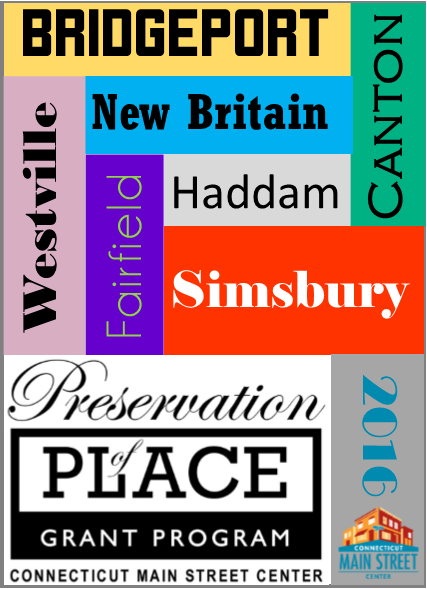
Connecticut Main Street Center (CMSC), the downtown revitalization and economic development non-profit, has selected seven organizations and municipalities to receive a share of $80,400 in 2016 Preservation of Place grants. The grants will be used to provide communities in Bridgeport, Canton, Haddam, Fairfield, New Britain, New Haven (Westville Village) and Simsbury with targeted resources to increase their capacity to plan for preservation and revitalization initiatives in their downtowns and neighborhood commercial districts. place

This year's awards are notable because two applicants, Canton and New Britain, sought the grant funds to pursue the creation of tax increment financing (TIF) districts, made possible through the passage of legislation in 2015 that was proposed by a coalition led by CMSC. TIF is a financing mechanism in which an investment in a specified area is repaid over time using the increased tax revenue generated by the investment.

"The projects funded through this year's Preservation of Place round have the potential to be transformative for these communities," said John Simone, CMSC's President & CEO.  "Canton and New Britain may very well become the models for creating successful TIF districts, while Haddam's award can help set the foundation for a unified, mixed-use commercial area that marries their historic charm with a modern, connected design. Certainly, all of the communities represented are as diverse in location as in their unique character, but each has something wonderful to offer, which will only be enhanced through the use of these grant funds."

The Preservation of Place grant program provides a source of funding for new initiatives that can be integrated into, and leverage, comprehensive Main Street preservation and revitalization programs.  The funds are meant to be flexible to meet individual community need.

The 2016 recipients of Preservation of Place grant funds are:BPT creates

  • Bridgeport Downtown Special Services District - Awarded $10,400 for Bridgeport CREATES, Phase II, to assist in the pre-development activities associated with the creation of a Maker Space/ Innovation Center.
  • Town of Canton - Awarded $10,000 for a Tax Increment Financing Master Plan for Collinsville Center & the Collins Company Complex to develop a viable TIF agreement, master plan and district to help develop the historic complex.
  • Town of Haddam - Awarded $10,000 for a Market Analysis & Village District Zoning Regulations for Tylerville in order to assess viable businesses and draft zoning regulations that will allow for and promote such businesses, as well as mixed-use development, in this historic area.
  • Town of Fairfield - Awarded $10,000 for a Signage & Wayfinding Program for Downtown & Neighboring Commercial Districts to help visitors and residents navigate their way around downtown Fairfield's many prominent cultural, tourist and academic attractions.
  • New Britain Downtown District - Awarded $10,000 to work in conjunction with the City on the Creation of a Tax Increment Financing District for transit oriented development around the CTfastrak terminus.
  • Westville Village Renaissance Alliance (New Haven) - Awarded $20,000 for the Westville Village Comprehensive Plan: The Visioning Phase, a comprehensive plan to guide a sustainable and place-based approach to long-term economic and physical development.
  • Simsbury Main Street Partnership - Awarded $10,000 for a Comprehensive Parking Study of Downtown to develop specific parking recommendations, including short- and long-term solutions.

Since 2008, the Preservation of Place grant program has leveraged over $1 million of investment in local Main Street initiatives. Connecticut Main Street Center and the Preservation of Place grant program receive support from the State Historic Preservation Office, with funds from the State of Connecticut through the Community Investment Act.

CT Ranked 14th Among Smaller States for Small Business Activity; MA Is 2nd Among Large States

Small business activity is on the rise in 49 of the 50 U.S. states, according to a new report from the Kauffman Foundation. The report provides a broad index measure of small local business activity, analyzing the states in peer groups of the 25 largest states by population and the 25 smallest states by population.  Connecticut ranked 14th among the smaller 25 states, for the second consecutive year, and was the lowest-ranked New England state.CT rank The density of established small businesses per 100,000 residents increased slightly from the previous year, from 1,147.3 to 1,167.4 in 2015.  Established small businesses are defined in the study as businesses over the age of five employing at least one, but less than fifty, employees.  The rate of small business ownership also grew slightly in Connecticut, from 6.14 percent to 6.34 percent.

Demographic trends for Connecticut noted in the report indicate an increase in native-born small business ownership, and upticks in the percentage of small businesses led by Latinos, 55 to 64 year-olds, 35-44 year-olds, high school graduates and college graduates.  More small businesses are run by men than women.

Overall, what the report describes as “Main Street entrepreneurial activity – an indicator of the number of established small businesses and the number of business owners in a location – experienced a large increase in 2015, reversing a six-year downward and stagnant trend in the U.S.”Kauffman logo

"Following a post-recession downward and stagnant trend in small business activity, we're now seeing Main Street Entrepreneurship begin to rise," said E.J. Reedy, director in Research and Policy at the Kauffman Foundation. "This obviously is good news given that these small businesses make up 63 percent of all employer firms nationally."

The Kauffman Index: Main Street Entrepreneurship State Trends report includes these findings:

Among the 25 largest states, the five states with the highest activity were Minnesota, Colorado, Massachusetts, New York and New Jersey. Among the 25 smallest states, the states with the highest activity were Vermont, Montana, North Dakota, South Dakota, Wyoming, Maine, Nebraska, New Hampshire, Rhode Island, Iowa, Oregon, Idaho, and Kansas.

Insights on business owner demographics for the 25 smallest states, including Connecticut:

  • States with the highest rates of female business owners were Vermont, Montana, Wyoming, Oregon, and South Dakota.
  • States with the highest rates of older adult business owners (ages 55-64) were South Dakota, Vermont, North Dakota, Montana and Nebraska.
  • States with the highest rates of young adult business owners (ages 20-34) were South Dakota, North Dakota, Montana, Wyoming and Vermont.

state ranksTennessee is the only state that did not show an increase in established small business activity in 2015 compared with 2014.

The new Main Street Entrepreneurship Index is an indicator of small business activity, presenting trends over the past two decades, focusing on established small businesses (firms older than five years with less than 50 employees) and trends in ownership rates. The Index measures business activity along two distinct and complementary dimensions: the rate of business owners in the economy – the percentage of adults owning a business in a given month, and established small business density – the ratio of established small employer businesses compared to population.

The Kauffman Index of Entrepreneurship is the first and largest index tracking entrepreneurship across city, state and national levels for the United States, and also presents demographic characteristics of the business owners.

In a companion study and report, focusing on the nation’s largest metropolitan areas, Small business activity is on the rise 38 of the top 40 largest metropolitan areas, the top five metropolitan areas for small business activity as measured by the Index were New York, Boston, Providence, San Francisco and Portland.  The report on metropolitan areas noted that “the one to experience the biggest increase in rankings was Providence, which moved up three spots to tie with Boston for second place in the 2015 Index.”

Health Care Seen as Economic Driver in Connecticut, Propelling Growth

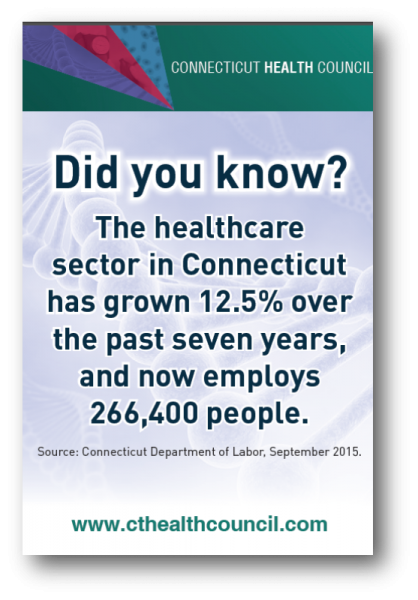
The first thought that comes to mind when someone mentions health care is likely not “economic driver.”  If a new marketing initiative by the Connecticut Health Council succeeds, that may be changing. Newly launched in January 2016, the Connecticut Health Council's "Did You Know" campaign is a multichannel content marketing program designed to raise awareness of the health sector's importance as an economic and employment driver in Connecticut. The initiative highlights data that may have escaped widespread attention across the state, with the aim of “promoting Connecticut as a center of health excellence.”connecticut-health-council-logo

The campaign includes a series of informational posters, now on display at the State Legislative Office Building in Hartford through the end of January, along with “traditional print and broadcast media content, social media alerts, and thought leadership.”  Among the stats highlighted:

  • The healthcare sector in Connecticut has grown 12.5% over the past seven years, and now employs 266,400 people.
  • There are 20,434 registered healthcare employers in the State of Connecticut.
  • From 2007 to 2014, healthcare and social services was the fourth fastest growing employment category in the state.
  • Connecticut’s healthcare sector generated $29.6 billion in estimated total before-tax revenue in 2012.

ozIn addition, the marketing campaign also highlights that thee of the top 10 fastest growing companies headquartered in Connecticut in 2014 were healthcare related companies, and that Connecticut’s healthcare sector has the fifth highest number of sole proprietorships of any sector in the state, with the seventh highest revenues. Connecticut’s “unique base of health sector assets” include health insurance companies, hospitals, medical schools, research capacity, and specialty practices, according to the organization’s website. hartford-logo

Founded in 2012 by the MetroHartford Alliance, the Connecticut Health Council is an association of health sector leaders who work to advance the development of businesses, initiatives and technology that improve health care and wellness both nationally and in the State.  The organization, which currently has 90 partners, fosters “collaboration, education, entrepreneurship and networking among leaders of for-profit and non-profit health sector entities.”

Speaking at this month’s Economic Summit & Outlook in Hartford, Oz Greibel, President & CEO of the MetroHartford Alliance, spoke to the need to highlight the data at the State Capitol, where the info-posters are on display.  “(The campaign) is based on the notion of the health sector as an economic and employment driver – and a place for additional capital investment.  Making sure that people at the legislature understand the importance of this sector, and that the actions that they take can be either helpful or detrimental, to long-term growth.”

posterThe Council's primary activity is to host programs focused on health sector topics that feature speakers of regional, national and international renown, the website points out. The Council also provides “a forum for a robust network of experts, professionals and other parties interested in promoting Connecticut as a center of health excellence and the health sector as a primary driver of economic and employment growth in our State.”


As Greibel described it, the Council’s activities are designed specifically “to leverage the extraordinary resources we have in Connecticut in the health care disciplines.”

Highlighting the impact of the state’s hospitals, the Council points out that Connecticut hospitals provide jobs to 55,000 full-time employees and spend $4.2 billion on goods and services.  Overall, Connecticut hospitals contribute $21.9 billion annually to the state and local economies.

The Connecticut Health Council is co-chaired by Marty Gavin, President & CEO of Connecticut Children’s Medical Center, and Bob Patricelli, Chairman & CEO of Women’s Health USA.  The executive director is Amy Cunningham.CT Health Council