Opponents to Natural Gas Pipeline Rally to Grow Public Interest
/A planned natural gas pipeline in Connecticut and neighboring states brought protesters out in Suffield and East Granby, calling attention to potential adverse environmental impacts. Kinder Morgan’s natural gas project, Connecticut Expansion, is scheduled to begin construction in Suffield and East Granby shortly, according to the Connecticut Sierra Club, which organized the protest and has been conducting a public education initiative opposing the plans.
The People Over Pipelines March, held Saturday, mirrors similar efforts held in Massachusetts, aimed at drawing attention the ratepayer subsidized gas pipeline expansion. Participants followed the Kinder Morgan pipeline route in Suffield and East Granby. Co-sponosrs of the effort included 350 CT, Toxics Action Center, Bethlehem Ecodefense and Berkshire Environmental Action Team.
At an accompanying rally, Sierra Club’s Martha Klein said, “We’re here today to fight for the future of our planet, but the real reason to oppose this new pipeline is that it’s expensive, unneeded and what’s worse we’re paying for it!” The high pressure, large diameter fracked gas pipeline is being built in three states Sierra Club officials point out, noting that methane (natural gas) causes global heating that is 100 times worse than carbon dioxide in the near term.
Diane Lentakis of 350 CT added, “I’m marching here today to oppose a new taxpayer-funded pipeline because natural gas presents many of the same problems as oil and coal: toxic emissions, huge transport costs, and huge risks of accidents. I want Connecticut to be a leader in our country’s transition to clean energy. We can take a major step towards this goal by opposing this costly pipeline and instead investing in renewable and clean energy. “
Sierra Club officials explain that Connecticut residents have been paying for the expansion of fracked gas in the state through ratepayer increases on their electric bill since 2013, as a result of state lawmakers approving a “Comprehensive Energy Strategy.” In 2015, the General Assembly passed a law that mandated future ratepayer subsidies for multi-state gas pipeline projects, which will lead to ratepayers subsidizing the construction of interstate gas pipelines.
The state Department of Energy and Environmental Protection (DEEP) “is the agency in the state that both procures large natural gas projects, and also issues permits for aspects of the construction. The aim of the State energy plan is to create thousands of new gas customers, through advertising and ratepayer subsidies. Only the two large corporations, Eversource and Iberdrola, will benefit from the expansion. They have a monopoly on gas distribution in the area,” Sierra Club pointed out in a news release highlighting the issue. Eversource owns Yankee Gas; Iberdrola owns Connecticut Natural Gas and Southern CT Gas.
Sierra Club officials indicate that it is “not likely” that Connecticut citizens will benefit from the pipeline, stating that “Natural gas is not cheaper, cleaner or safer than other fuels. Gas, which is methane, is currently more expensive than heating oil in Connecticut and according to the International Governmental Panel on Climate Change (IPCC), worse for the environment than oil or coal. Methane extraction (fracking), use, and transport produce significantly more greenhouse gas emissions causing worse climate change than other fossil fuels.”
 Studies show that there is no unmet demand for natural gas in Connecticut, opponents of the planned pipeline said, stressing that gas pipelines are routinely only half full now and electricity demand in New England has remained virtually flat over more than 10 years. Proponents have stated otherwise.
According to DEEP, there are approximately 590 miles of transmission pipeline in Connecticut, including 16 miles in Long Island Sound. These pipelines range in size from 2” to 36”. Pressures range from 750 pounds per square inch gauge (psig) to 1,440 psig. There are 5 compressor stations in Connecticut with a total of approximately 110,300 horsepower. The pipelines currently in place:
- Algonquin Gas Transmission (AGT - Spectra Energy Corporation) originates in New Jersey where it connects to Texas Eastern and runs from Danbury northeasterly to Thompson, with major spurs to North Haven and New London.
- Iroquois Gas Transmission System (IGT) starts at the Canadian border, enters Connecticut at Sherman and runs southeast through Milford, then offshore to Long Island.
- Tennessee Gas Transmission (TGP -Kinder Morgan) starts in the Gulf, enters Connecticut in Greenwich, runs northeasterly leaving Connecticut in Suffield, with a spur from Massachusetts to Torrington.
The Sierra Club will be conducting a public education session on the pipeline at Quinebaug Valley Community College on Thursday, Sept. 29 at 1 p.m.


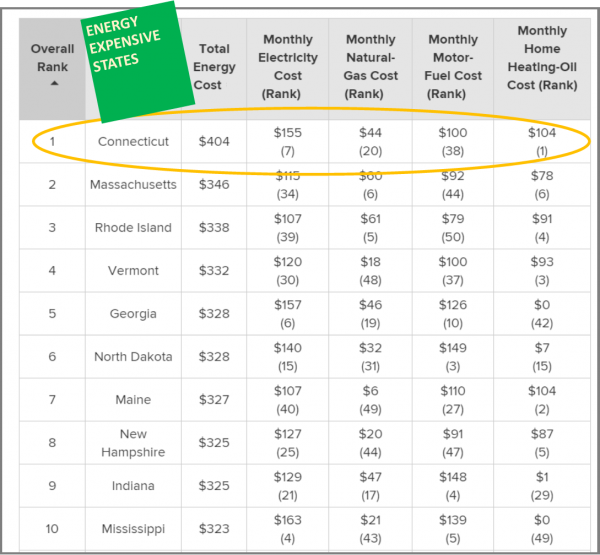
 necticut ranked as the most energy expensive state mainly due to its high retail prices for energy,” analyst Jill Gonzalez told CT by the Numbers. “The state has the third highest retail price for electricity and heating oil at $0.20 per kWh and almost $4 per gallon, respectively. Natural gas isn't cheap either, ranking 14th highest, at $14 per thousand cubic feet. These prices paired with high heating consumption in the winter months put Connecticut on top of these rankings."
 In addition to its impact on drivers, the AMA notes that blue-rich LED streetlights operate at a wavelength that most adversely suppresses melatonin during night. It is estimated that white LED lamps have five times greater impact on circadian sleep rhythms than conventional street lamps, the AMA indicated. Recent large surveys, according to the AMA, found that brighter residential nighttime lighting is associated with reduced sleep times, dissatisfaction with sleep quality, excessive sleepiness, impaired daytime functioning and obesity.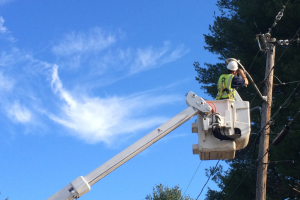
 The Conversation website is a collaboration between editors and academics to provide "informed news analysis and commentary that’s free to read and republish." It
  PHOTO: Traditional street lighting (left) vs. LED lighting (right).




 Also making the list were Evariant of Farmington, a software developer, at number 272, and HP One, a software company in Trumbull at number 307. Biopharmaceutical company Alexion, in the midst of moving its headquarters from Cheshire to New Haven, was ranked at number 349, and etouches, a Norwalk software company ranked at number 357. Rounding out the Connecticut companies on the list is Wallingford oil extraction technology company APS Tecnhology, at number 466.
 rough technology’s continued disruption and proliferation across industries,” said Sandra Shirai, principal, Deloitte Consulting LLP and US technology, media, and telecommunications leader.
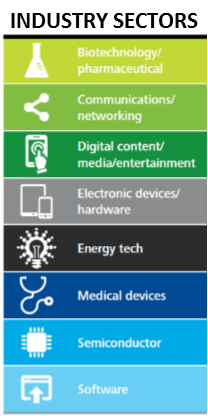 Overall, 283 of the 500 companies were in the software sector, and 67 percent of the 500 companies have received venture capital funding at some point in their company’s history. Topping the list was StartApp, with a growth rate of 21,984 percent from 2011 to 2014. Based in New York and founded in 2010, StartApp provides a free monetization and distribution platform that integrates with applications on mobile devices.


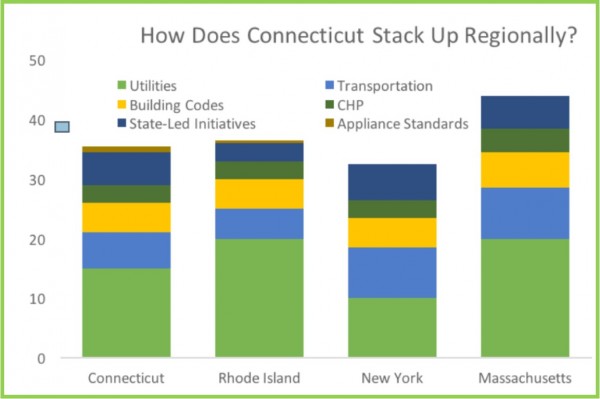
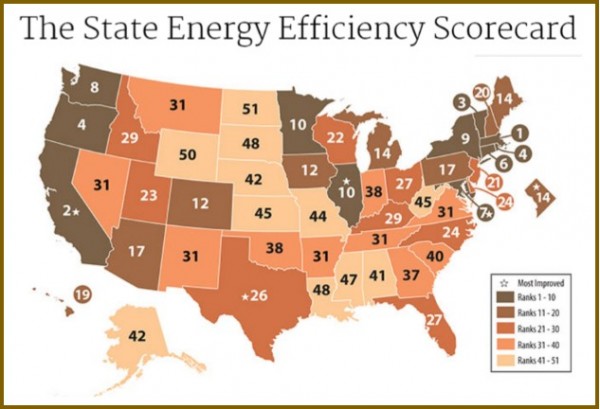 nd compliance efforts, earned 3 points out of 4 for its combined heat and power policies and programs, 5.5 out of 7 points for state-led energy efficiency initiatives, and 1 point out of 2 for appliance standards.
 olar power in Connecticut has grown 221 percent per Capita since 2012, ranking the state 13th in the nation, the report points out. The top solar growth states in the nation, like Connecticut, have adopted renewable energy requirements, strong laws allowing solar customers to sell their excess power to the electric grid, and other policies encouraging growth of the industry, the report indicates. The industry is also adding jobs much faster than the overall economy, employing 1,600 people in Connecticut last year, according to
  ."
."
 “I would like to congratulate all of the members of Stamford 2030 for joining together to make vital changes for our community," said Stamford Mayor David Martin. "The partners in Stamford 2030 have really stepped up for the success and sustainability of our city and the surrounding area. And they are not alone. For our part, the city is committed to improving storm resiliency and moving forward with the Energy Improvement District. We believe these efforts are tied to our economic development and ability to attract people to Stamford while conserving important natural resources, all necessary for sustained growth and prosperity.”
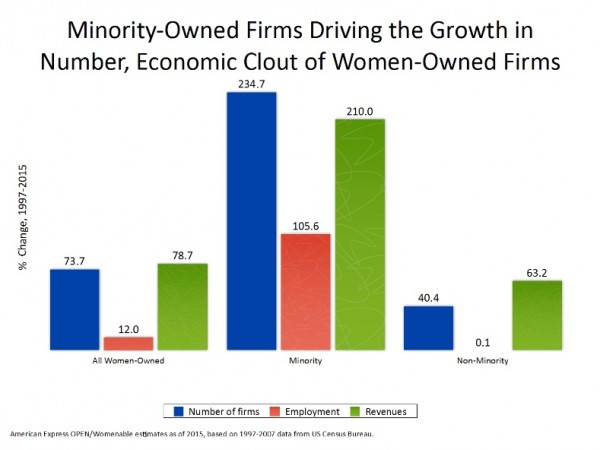
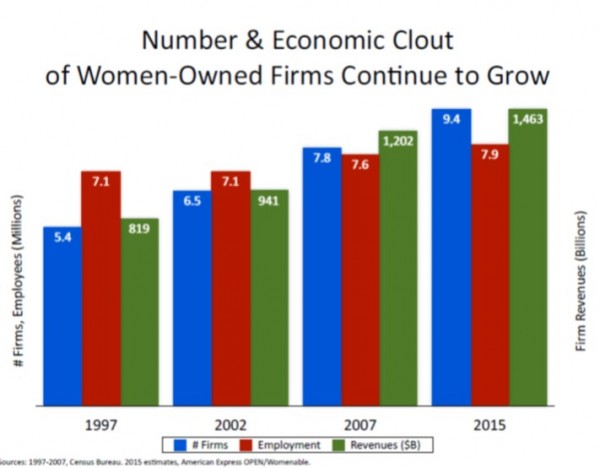 Of the nation’s women-owned businesses, African-American women own 1.3 million, Latinas 1 million, and Asian women more than 700,000. Businesses owned by women of color tend to be smaller in terms of their average employment and revenue, the report indicated. But their growth, both in numbers and in their economic clout—the combined average of their growth, revenue, and employment—continues to outpace that of their white peers, the data indicates.
 ow, there are an estimated 3.1 million minority women-owned firms, representing one in three (33 percent) women-owned firms,” pointed out Julie Weeks, President and CEO of