National Leader, Connecticut Green Bank Reaches Milestone in Project Financing
/The Connecticut Green Bank’s C-PACE program recently surpassed $100 million in closed project financing. Out of the 19 states with C-PACE (Commercial Property Assessed Clean Energy) programs, this project financing level is second only to California, according to officials.
The Connecticut Green Bank’s C-PACE program reached the milestone of $100 million in total closed project financing. The solar photovoltaic (PV) and energy efficiency projects, which vary in size and scope, are saving more than $9.29 million annually in energy costs for nearly 170 building owners across multiple sectors. 
The Green Bank, which administers the C-PACE program, seeks to make green energy more accessible and affordable to commercial and industrial property owners by providing no money down long-term financing for meaningful energy upgrades to their buildings.
C-PACE enables building owners to finance qualifying energy efficiency and renewable energy improvements through a voluntary assessment on their property tax bill. As the program grows, more Connecticut businesses can achieve lower energy costs. Reaching $100 million in closed project financing reaffirms Connecticut’s program as a national leader, officials indicated.
Since its inception in 2011, 166 C-PACE projects have been closed in 69 of the 128 municipalities that have opted into the program. C-PACE funds have been used in manufacturing facilities, non-profits, houses of worship, retail establishments, office buildings, and other business entities. The projects consist of solar installations, new 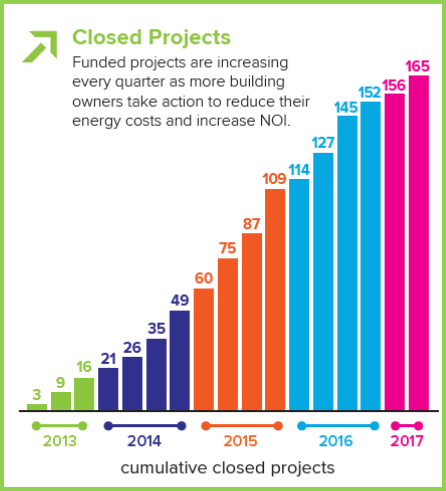 boilers, energy efficiency lighting measures, HVAC systems, and other energy improvements that help building owners to take control of their energy costs.
“Connecticut’s Green Bank has really been the national leader for C-PACE,” said David Gabrielson, the Executive Director of PACENation, the national non-profit that supports development of PACE programs nationwide. “The way they administer their program has really served as a great example for other program administrators throughout the U.S., and we congratulate the entire Green Bank team on this impressive milestone.”
The project that propelled the Green Bank over this milestone will be installed at Farmington Sports Arena (FSA). FSA is a 130,000-square foot modern indoor sports facility that is home to four indoor and three outdoor artificial turf fields as well as four natural grass outdoor fields. The project, which will be installed by 64 Solar, consists of two solar PV systems (170 kW total).
Connecticut’s C-PACE program maintains an open market approach, allowing private capital providers to finance projects for building owners, and, in 2015, the Green Bank reached an agreement that provided it access to up to $100 million in private funding for C-PACE projects. Today, nearly 70% of the funding in the program consists of private capital.
“The Connecticut Green Bank is a leader in the green energy movement, but the rapid growth of C-PACE wouldn’t be possible 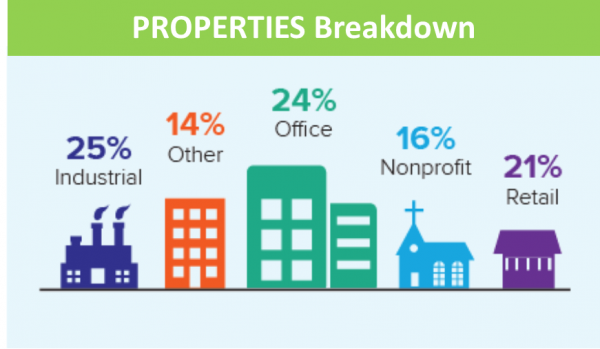 without the support of our contractors, capital providers, municipal officials, and other stakeholders who have contributed to the C-PACE movement,” said Mackey Dykes, Vice President of Commercial, Industrial and Institutional programs at the Connecticut Green Bank. “There is still significant potential for energy improvements for Connecticut businesses and non-profits, and we look forward to bringing cleaner and cheaper energy to more building owners across the state.”
The website Energy Collective noted recently that “states have and will continue to play a key role in leading the clean energy transition,” highlighting the work in Connecticut as among the national models.
“Connecticut has found a way to make the financing of clean energy deployment more accessible and affordable for consumers and businesses. In 2011 the state legislature created the Connecticut Green Bank, the nation’s first green bank. It uses public funds to attract private capital investment in green energy projects. By leveraging private investment, the Green Bank significantly increases the total amount of financing available for clean energy projects.
The site highlighted that “Among the Green Bank’s most successful initiatives is the Commercial Property Assessed Clean Energy (C-PACE) program, which allows commercial property owners to pay for clean energy or efficiency upgrades over time through their property taxes.
The Connecticut Green Bank is the nation’s first green bank. Established by the Connecticut General Assembly on July 1, 2011 as a part of Public Act 11-80, the Connecticut Green Bank evolved from the Connecticut Clean Energy Fund (CCEF) and the Clean Energy Finance and Investment Authority (CEFIA), which was given a broader mandate in 2011 to become the Connecticut Green Bank.
https://youtu.be/kPqO4QlTkDU

 Studies show that there is no unmet demand for natural gas in Connecticut, opponents of the planned pipeline said, stressing that gas pipelines are routinely only half full now and electricity demand in New England has remained virtually flat over more than 10 years. Proponents have
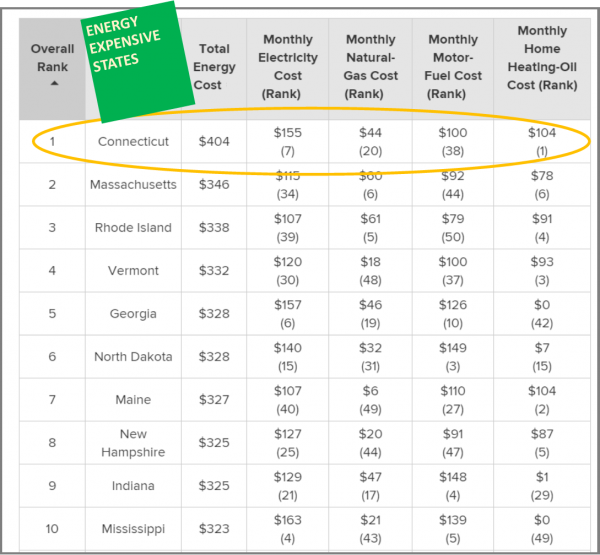
 necticut ranked as the most energy expensive state mainly due to its high retail prices for energy,” analyst Jill Gonzalez told CT by the Numbers. “The state has the third highest retail price for electricity and heating oil at $0.20 per kWh and almost $4 per gallon, respectively. Natural gas isn't cheap either, ranking 14th highest, at $14 per thousand cubic feet. These prices paired with high heating consumption in the winter months put Connecticut on top of these rankings."
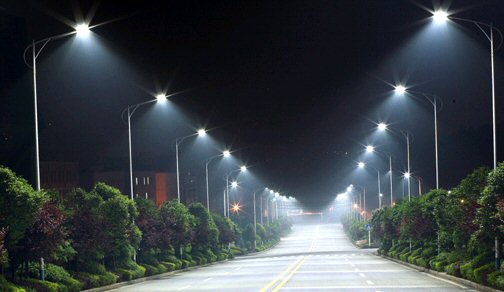
 In addition to its impact on drivers, the AMA notes that blue-rich LED streetlights operate at a wavelength that most adversely suppresses melatonin during night. It is estimated that white LED lamps have five times greater impact on circadian sleep rhythms than conventional street lamps, the AMA indicated. Recent large surveys, according to the AMA, found that brighter residential nighttime lighting is associated with reduced sleep times, dissatisfaction with sleep quality, excessive sleepiness, impaired daytime functioning and obesity.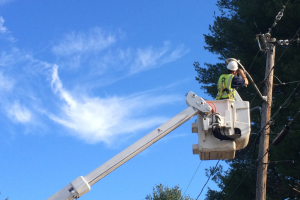
 The Conversation website is a collaboration between editors and academics to provide "informed news analysis and commentary that’s free to read and republish." It
  PHOTO: Traditional street lighting (left) vs. LED lighting (right).




 Also making the list were Evariant of Farmington, a software developer, at number 272, and HP One, a software company in Trumbull at number 307. Biopharmaceutical company Alexion, in the midst of moving its headquarters from Cheshire to New Haven, was ranked at number 349, and etouches, a Norwalk software company ranked at number 357. Rounding out the Connecticut companies on the list is Wallingford oil extraction technology company APS Tecnhology, at number 466.
 rough technology’s continued disruption and proliferation across industries,” said Sandra Shirai, principal, Deloitte Consulting LLP and US technology, media, and telecommunications leader.
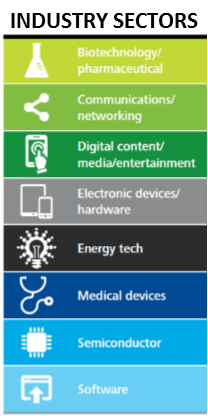 Overall, 283 of the 500 companies were in the software sector, and 67 percent of the 500 companies have received venture capital funding at some point in their company’s history. Topping the list was StartApp, with a growth rate of 21,984 percent from 2011 to 2014. Based in New York and founded in 2010, StartApp provides a free monetization and distribution platform that integrates with applications on mobile devices.


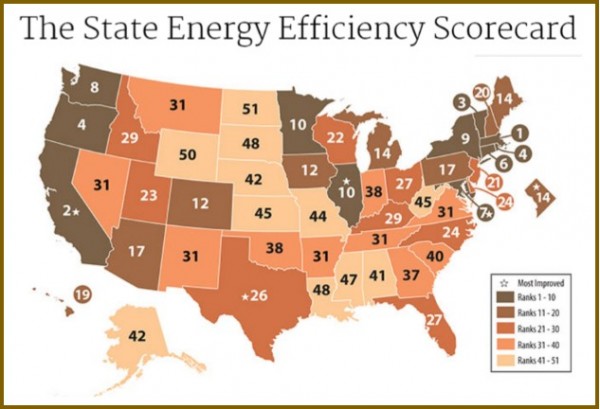 nd compliance efforts, earned 3 points out of 4 for its combined heat and power policies and programs, 5.5 out of 7 points for state-led energy efficiency initiatives, and 1 point out of 2 for appliance standards.
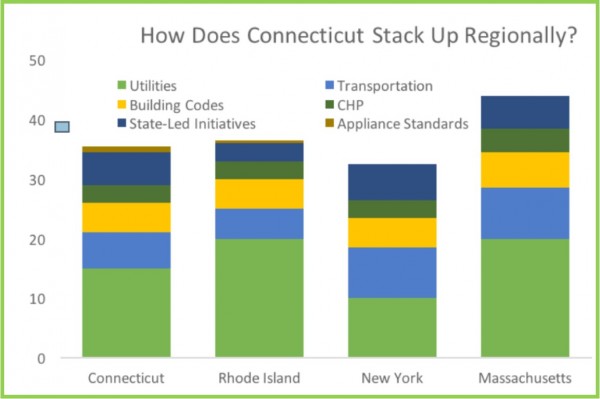 olar power in Connecticut has grown 221 percent per Capita since 2012, ranking the state 13th in the nation, the report points out. The top solar growth states in the nation, like Connecticut, have adopted renewable energy requirements, strong laws allowing solar customers to sell their excess power to the electric grid, and other policies encouraging growth of the industry, the report indicates. The industry is also adding jobs much faster than the overall economy, employing 1,600 people in Connecticut last year, according to
  ."
."
 “I would like to congratulate all of the members of Stamford 2030 for joining together to make vital changes for our community," said Stamford Mayor David Martin. "The partners in Stamford 2030 have really stepped up for the success and sustainability of our city and the surrounding area. And they are not alone. For our part, the city is committed to improving storm resiliency and moving forward with the Energy Improvement District. We believe these efforts are tied to our economic development and ability to attract people to Stamford while conserving important natural resources, all necessary for sustained growth and prosperity.”