The Green Book Has Hartford Debut - Documentary Tells Real Story of Guide to Freedom Through Segregated America
/Little known by most people - regardless of race - until recently, the Green Book has recently exploded into the public consciousness.
Described as "the essential travel guide for a segregated America," within just the past two days a popular movie by that name won the Academy Award for best picture, and a documentary relating the story of real people and places that inspired the popular motion picture debuted on the Smithsonian Channel.
The documentary, "The Green Book: Guide to Freedom," was shown at a special preview at the Wadsworth Atheneum in Hartford, in a showing coordinated by the Amistad Center for Art and Culture, Comcast, and the Smithsonian Channel. It marked the third year that Comcast has joined with the Amistad Center and Smithsonian Channel to bring a special presentation to Hartford during Black History month.
Nearly 100 people were on hand for the local premiere of the documentary, which was followed by a panel discussion including Kelli Herod, Vice President of Post Production at Smithsonian Channel, and Stacey Close, Associate Vice President for Equity and Diversity at Eastern Connecticut State University, moderated by Kara Sundlun of WFSB. Amistad Center Executive Director & Curator at Large Wm. Frank Mitchell, Brad Palazzo, Comcast Director of Community Impact and Hartford Mayor Luke Bronin also spoke briefly, with Bronin saluting the "resiliance, ingenuity and determination" of those who traveled through dangerous times.
 The documentary was produced by award-winning filmmaker Yoruba Richen. It premieres this week on Smithsonian Channel, telling the story of the Green Book, launched in the 1930's by Victor Green, a black postal carrier from Harlem who created a volume that was "part travel guide and part survival guide." It helped African-Americans navigate safe passage across a dangerously segregated nation, identifying towns, hotels, restaurants and businesses that would be hospitable to African-Americans, sometimes few and far between.
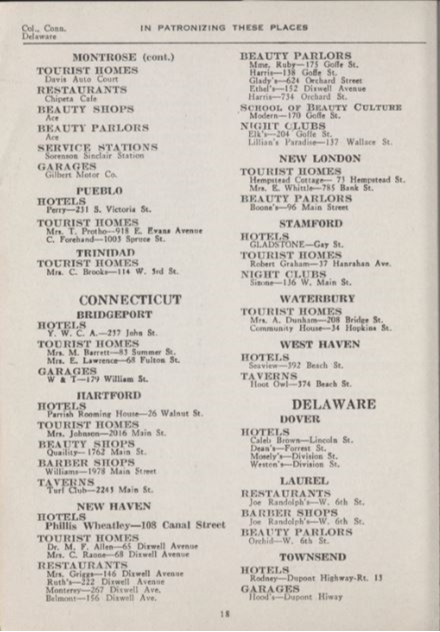
The challenges were not only in the South. In fact, a page in the 1948 Green Book, lists locations in Connecticut - and the list does not fill the page. The locations were in Bridgeport, Hartford, New Haven, New London, Stamford, Waterbury and West Haven. Included are restaurants, hotels, tourist homes, beauty parlors, barber shops, and night clubs. The 1967 edition also includes five Hartford locations, including one - the former Bond Hotel - that is still standing to this day.
"We are proud to tell the true story behind this remarkable guide and to shine new light on this disturbing yet important period in Amerian history," said David Royle, Smithsonian Channel's Chief Programming officer.
The documentary tells the story of the rise of the African American middle class in Detroit, and the iconic A.G. Gaston Motel in Birmingham, Alabama - a pivotal location in the civil rights movement. It also recalls that during its 1950s heyday, the Idlewild Resort in Michigan was a magnet for black culture and entertainment, with a booming nightlife featuring famous performers like Louis Armstrong, Sarah Vaughan and Dinah Washington. In the Q&A in Hartford following the advance showing, one audience member recalled her family owning property at the Idlewild - a local connection that the panel did not expect, but was clearly pleased to learn.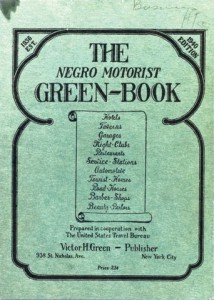
"At Comcast NBC Universal diversity and inclusion is a fundamental part of our company culture and are crucial components to all of our efforts to create and deliver the best and boldest technology and entertainment for our customers," noted Palazzo. "The Green Book: Guide to Freedom screening is another way for us to bring diverse entertainment and story-telling locally to Hartford-area residents." Comcast, with Connecticut offices in Berlin, has partnered with the Amistad on a number of initiatives over the years and "are proud to play a small role in helping them to tell their cultural story."
The Amistad Center for Art & Culture, located in the Wadsworth Atheneum, celebrates art and culture influenced by people of African descent through education, scholarship and social experiences.
Victor Green looked forward to the day people wouldn't need the Green Book. In the 1949 edition he wrote,
There will be a day sometime in the near future when this guide will not have to be published. That is when we as a race will have equal opportunities and privileges in the United States. It will be a great day for us to suspend this publication for then we can go wherever we please, and without embarrassment. But until that time comes we shall continue to publish this information for your convenience each year.
The year the Civil Rights Act passed, in 1964, was the Green Book’s last. As the panelists in Hartford noted, more than 50 years later, the struggle for equality continues.
 e the community a better place.”


 As he further established his career, Church traveled to remote places to sketch majestic scenes unfamiliar to his American audience, turning them into dramatic, large-scale paintings. These travels provided Church with ideas and material to produce major paintings for his wealthy patrons, including prominent American industrialists and financiers such as Hartford’s Timothy Mather Allyn, J. Pierpont Morgan and firearms manufacturer Elizabeth Hart Jarvis Colt.

 The plan at the
 The deadline for submission for the 2018 Connecticut Book Awards is April 20, 2018. Finalists will be announced in September and winners announced in October. For more information, visit:
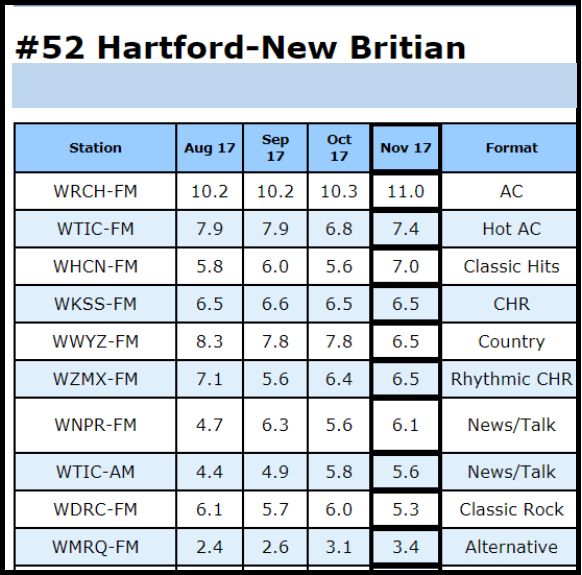 In the Stamford-Norwalk radio market, the dominance of New York based stations is apparent, after Bridgeport’s WEBE-FM, which tops the local ratings. The two top runners-up are WCBS-AM, New York City’s all-news station, and WHTZ-FM (Z100), with a contemporary hits format. WEZN-FM, New York sports station WFAN and Urban Adult Contemporary WBLS-FM rank next. Stamford-Norwalk is the 148th ranked market in the Nielsen Audio reports, with a population of 323,400.


 Pieratti, who teaches English at South Windsor High School, relocated to Connecticut from upstate New York five years ago. She said “I have been nurtured by this state since I moved here,” and expressed appreciation to her colleagues in South Windsor. She has taught at the college and high school level, and was recipient of the Idaho prize for Poetry in 2015. Her
 Food and beverage companies often target marketing for nutrient-poor products such as candy, sugary drinks, snack foods, and fast-food restaurants to Hispanic audiences, including youth, the researchers state. They cite previous research that has documented disproportionate exposure to unhealthy food marketing by Hispanic youth in their communities and on TV, but theirs is the first examination of the phenomenon on the internet.
 g vulnerable populations,” according to the publication’s website, “with the goal of providing optimal outcomes and ultimately health equity for all.” The journal intends to provide coverage ranging from translational research to prevention, diagnosis, treatment, and management of disease and illness, in order to serve as a primary resource for organizations and individuals who serve these populations at the community, state, regional, tribal, and national levels.