Hartford Skyline's Phoenix Boat Building Celebrates 50th Anniversary

Dubbed the "Boat Building," it is the world's first two-sided building and in 2013 celebrates its 50th anniversary. The headquarters of The Phoenix, located in downtown Hartford at One American Row, was an architectural original, and half a century later, continues to stand out amongst newcomers to the Hartford skyline.

Completed in 1963, the building is listed on the National Register of Historic Places, and is an exceptionally significant example of the Modernist architectural style.

Distinguished by its unique form and lenticular plan, the building was designed by Max Abramovitz, a recognized 20th century master. Abramovitz -- widely acclaimephotod for his role in designing two of New York City's landmarks, the United Nations and Lincoln Center -- envisioned the locally dubbed "boat building" as a reflection of a daring and progressive company.

The construction of One American Row cemented Phoenix's commitment to the renewal of Hartford, where the company was founded in 1851, and reflected its forward-thinking and innovative business approach. The company decided to remain in Hartford in the 1960’s – and since then – choosing neither to move to the suburbs or to the planned Constitution Plaza nearby, which was the first urban renewal project in Connecticut and one of the earliest in the nation.

The 13-story tower is properly called an elliptic lenticular cylinder and is 225 feet along its axis and 87 feet wide at maximum width. It is oriented so that its pointed ends face east and west and the sides face north and south. The building was designed by one of the nation's foremost architectural firms, Harrison & Abramovitz, of New York. Ground was broken in 1961 and the contractor, George A. Fuller Company, completed construction in November 1963.

In 2010, the building was awarded Silver Leed® certification from the U.S. Green Building Council, and is one of a small number of buildings that are both Leed® certified and listed on the National Register of Historic Places.

The Phoenix was named one of the region’s top workplaces by The Hartford Courant in 2012.

In 2013, th1381819_522913201135740_1394654112_ne plaza surrounding the building was renovated with environmentally friendly planted areas. The "green" plaza renovation was the first completed private property piece of Hartford's iQuilt Plan, which promotes creative urban design to strengthen pedestrian links between downtown destinations.

The Phoenix Companies, Inc. is a boutique life insurance and annuity company serving customers' retirement and protection needs. Insurance products are available through select independent distributors, supported by our wholesaling team at Saybrus Partners.  Founded in 1851, Phoenix is publicly traded on the New York Stock Exchange under the symbol PNX. Corporate offices are in Hartford, CT, and there is a customer service center in East Greenbush, NY. As of December 2012, they reportedly had approximately 600 employees.

 

1963

Good News, Bad News as Connecticut Seeks Economic Rebound

The assessment of the Connecticut Economic Resource Center (CERC) is good news, bad news for Connecticut’s economic recovery.  In a presentation to The Alliance for Nonprofit Growth and Opportunity, CERC Vice President of Research Alissa DeJonge and Research Analyst Carmel Ford reached two central conclusions:

  •  Connecticut has structural problems that continue to make its economy recover more difficult.  Structural problems include workforce and industry compositions that are not particular strengths in the overall U.S. ecnoCERC-300x100my.
  •  Connecticut has advantages in some areas such as healthcare employment, and we may see improvements in the state’s housing market as forecolousres start to diminish and inventory supply inequities become smaller.

Among the key stats that contributed to the overall analysis from CERC:

  1. Connecticut ranked 5th lowest among the states in per capita energy consumption in 2010.  However, Connecticut ranked 3rd highest in total energy prices and had the highest energy expenditure among all New England states.ctcounties
  2.    Connecticut’s youth unemployment rate was 17.1 percent in July 2013, compared with the national rate of 16.2 percent.
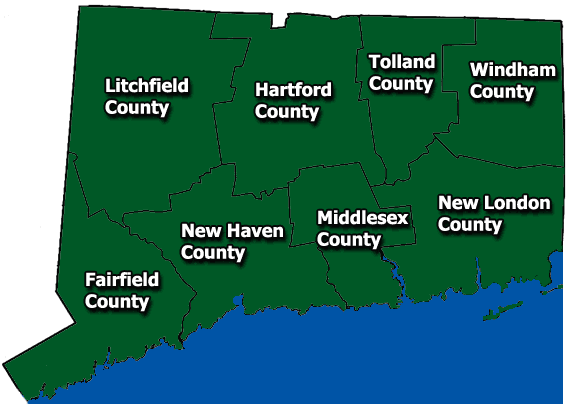
  3.   The unemployment rate in New London county hasn’t decreased significantly since 2010, and in Tolland County since 2011.  Overall, the states unemployment rate by county has been decreasing steadily in the state’s other six counties.
  4.   Median prices of single family homes in Connecticut increased 2.7% to $429,000, according to most recent data, and the inventory of single homes went down by 12.9% compared with a year ago.
  5. Newly issued housing permits in July 2013 incased slightly to 420 from 375 in July 2012.
  6. Connecticut remains the richest state with a per capita income of $58,908.

The CERC officials also pointed out that some of Connecticut’s leading industry categories, such as insurance and finance, are not performing well nationally, thus slowing the opportunities for the state’s economy to advance.

Based in Rocky Hill, CERC is a public-private partnership that provides economic development services consistent with state strategies, leveraging Connecticut’s unique advantages as a premier business location.  CERC was recognized earlier this month  for excellence in economic development marketing by key industry group, the Northeastern Economic Development Association (NEDA).  The award was presented at the recent NEDA annual conference in Portland, Maine among more than 130 economic development professionals from across the Northeast.

Big Trash Pick-Up: Volunteers to Clean Connecticut's Shoreline

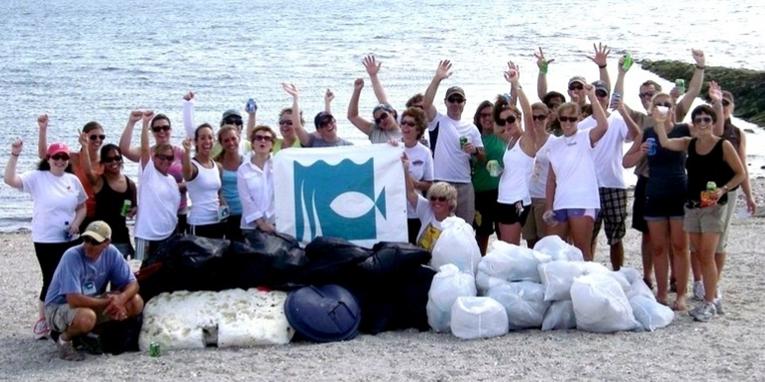
A year ago, 2,450 volunteers in Connecticut removed 16,310 pounds of trash from Long Island Sound’s shoreline and Connecticut waterways. This weekend, the effort continues, as bird watchers, fishermen, sailors, scuba divers, students, citizen groups and businesses will be cleaning up trash from Connecticut’s beaches, islands, and rivers as part of the International Coastal Cleanup (ICC).

Save the Sound, the Connecticut coordinator for the ICC for the past 11 years, has worked with cleanup captains to organize public clean-ups at 25 locations across the state this weekend. (See partial list below.)  The cleanups will continue throughout September and October.  Interested volunteepeoplecleanrs should check the calendar for listings of clean-ups and to register.

ICC, created by the Ocean Conservancy, is now in its 28th year and has participation in all 55 U.S. states and territories and 100 countries around the world. It is a unique event in that volunteers tally up all garbage they pick up on data cards, which are sent to Ocean Conservancy for analysis. They use the information to track trends in marine debris and help stop it at its source. Last year, more than 550,000 people picked up more than 10 million pounds of trash along nearly 20,000 miles of coastline worldwide.

Bank of America is Lead Sponsor of Save the Sound’s ICC Cleanups in Connecticut, and employees from the company are leading and participating in a cleanup at Jennings Beach in Fairfield on Saturday, as well as co-leading a cleanup with the New Haven Rotary club at Lighthouse Point Park.

Working in both New York and Connecticut, Save the Sound has established a 40-year track record of restoring and protecting the waters and shorelines of the Sound.  A program of Connecticut Fund for the Environment, Save the Sound recently received a $50,000 grant from the Fairfield County Community Foundation to support its green infrastructure work in partnership with the City of Bridgeport and the Bridgeport Water Pollution Control Authority. The grant will further Save the Sound's efforts to work with towns to implement innovative installations that act like sponges to absorb and filter stormwater runoff, thereby reducing flooding and improving the water quality of Long Island Sound.

For a complete list of the over 43 ICC cleanups happening in Connecticut throughout September and October, please visit http://www.ctenvironment.org/geshoret-involved/calendar.cfm. A Facebook page has additional information.

Saturday, September 21

NEW HAVEN, 9:00 AM – 12:00 PM

Bank of America, New Haven Rotary Club, and Save the Sound executive director Curt Johnson at Lighthouse Point Park.

FAIRFIELD,  9:00 AM – 12:00 PM

Bank of America cleanup at Jennings Beach.

NEW LONDON,10:00 AM – 11:30 AM

Local citizen cleanups at Ocean Beach and Alewife Cove Tidal Creek.

 Sunday, September 22

WESTPORT, 11:00 AM – 12:00 PM, 11:00 AM – 2:00 PM

 Friends of Sherwood Island State Park and National Charity League of Ridgefield will hold cleanups at Sherwood Island.

MILFORD, 4:00 PM – 5:30 PM

The Boy Scouts will hold two cleanups at Audubon Coastal Center and Gulf Beach.

Connecticut's Green Report Card: Needs Improvement

Connecticut’s state government received mixed grades in the new edition of the Connecticut Green Guide, published by Hartford Business Journal.  The publication reviewed state policy in our areas – microgrids, gasoline taxes, wind turbines and greenhouse gas reduction efforts – and graded the state’s efforts.

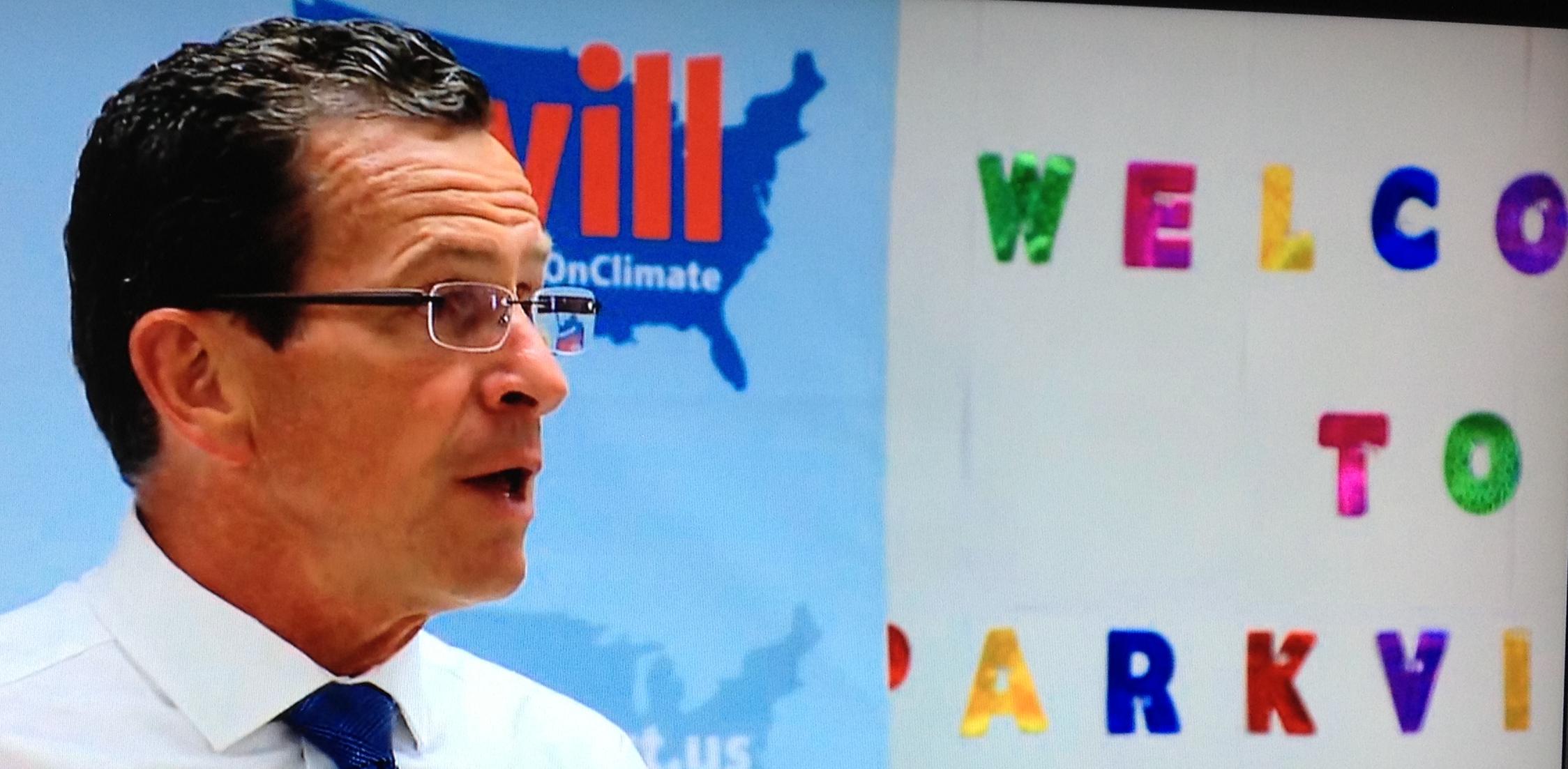
Connecticut received an “A” for recently announcing an $18 million grant program with nine microgrid projects in eight Connecticut communities, “adding protection from power outages and moving away from a centralized electriciMalloy aParkvillety system.”  Just a week ago, Gov. Malloy was joined by the White House Chair of the Council on Environmental Quality to highlight one of the state’s microgrid sites, in the Parkville neighborhood of Hartford.

The state received an “F” because of a moratorium on wind turbines, which has been in place since 2001, according to the Green Guide.  “Because of poorly written legislation and prolonged bureaucracy,” the publication explained, several projects have been delayed.  Another poor grade, a D+, was assigned because state taxes on gasoline rose 4 cents on July 1, “giving Connecticut the third highest taxes on motor vehicle fuel in the country.”  The publication noted that while “higher prices might egreen guilde logoncourage conservation, very little of the tax revenue goes toward fixing the aging transportation system, leading to vehicle inefficiencies and congestion.”

Connecticut fared better. earning a B+, in the analysis of the state’s participation in the Regional Greenhouse Gas Initiative, along with the other eight states in the region, which will “further lower the cap on power plant pollution,” which should, according to the publica50 statestion’s review, “make the air cleaner, and the proceeds will aid the clean energy industry.”

The publication also noted that Connecticut became the first state in the country to mandate mattress recycling, with a new law approved by the legislature this year, also adding a new paint recycling requirement to existing laws that call for recycling of electronic waste and mercury thermostats.  The state’s move toward a greater emphasis on “product stewardship,” is characterized by an increasing obligation imposed on consumers to recycle designated products, which helps the environment and provides business opportunities in the recycling of those products.

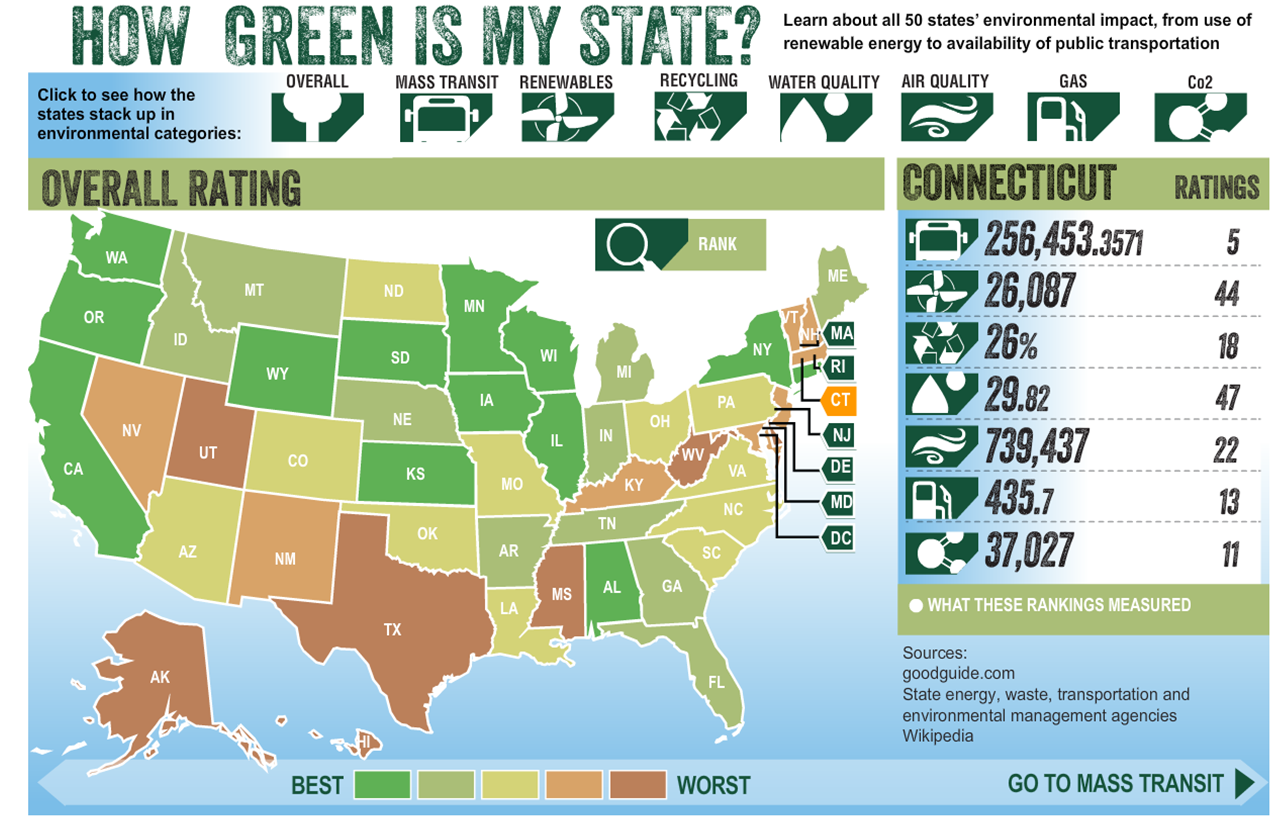
In a report on the green initiatives across all 50 states, published by Forbes magazine in July, Connecticut excelled in the areas of mass transit, ranking 5th among the states, in CO2 controls, ranking 11th, and recycling, ranking 18th.  The state was 44th in use of renewables and 47th in water quality.  That's according to this recent green ranking of states from MPHOline.org, a website that provides information on a variety of public health topics.

Data from the green product rating site GoodGuide was used to assess air and water quality, information from Wikipedia was the basis of the comparison on the number of mass transit systems in each state, and state agencies were used to provide information on the other categories.

CT Among Best in Nation with Lowest Toxic Air Pollution; KY, OH, PA Among Worst

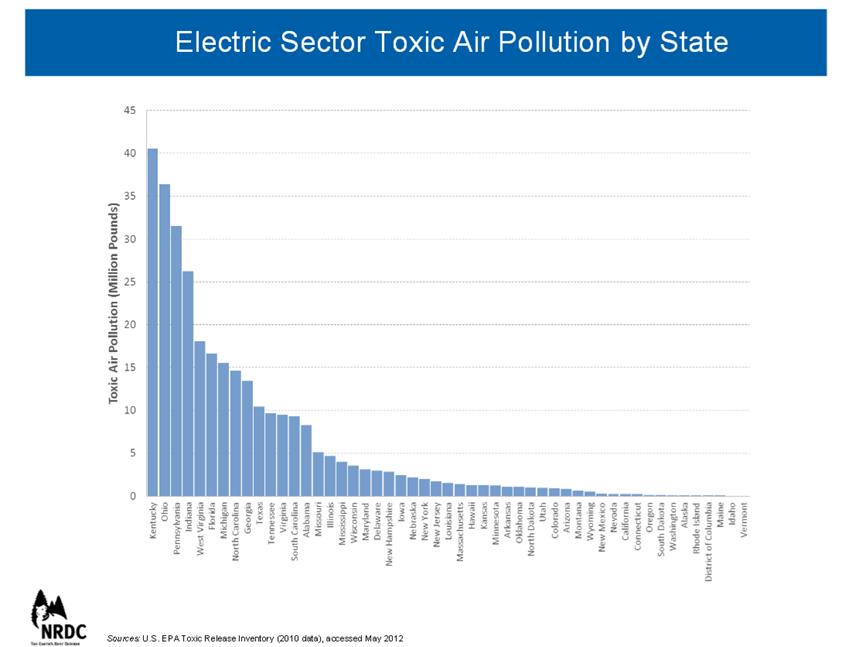
Residents of Kentucky, Ohio and Pennsylvania are exposed to more toxic air pollution from coal-fired power plants than in any other state, according to an analysis by the Natural Resources Defense Council (NRDC), leading the organization’s “toxic 20.”

At the same time, the report foundtoxic air pollution by state a 19 percent decrease in all air toxics emitted from power plants in 2010, the most recent data available, compared to 2009 levels. Connecticut ranks 42nd in toxic air pollution and 43rd in mercury air pollution according to the newly released data, among the lowest levels in the nation.

The drop in toxic levels nationwide is attributed to two factors: the increasing use by power companies of natural gas, which has become cheaper and is cleaner burning than coal; and the installation of state-of-the-art pollution controls by many plants--in anticipation of new health protections issued by the Environmental Protection Agency (EPA).

Finalized in 2011, EPA’s Mercury and Airby sector Toxics standards will cut mercury air pollution by 79 percent from 2010 levels, beginning in 2015. Connecticut is one of only 13 states to have electric sector mercury regulations that are at least as stringent as the EPA’s proposed utility air toxics rule, according to the report.

In the second edition of “Toxic Power: How Power Plants Contaminate Our Air and States,” NRDC also found that coal- and oil-fired power plants still contribute nearly half (44 percent) of all the toxic air pollution reported to the Environmental Protection Agency’s Toxics Release Inventory (TRI). The report also ranks the states by the amount of their toxic air pollution levels.

Among Connecticut’s neighboring states, New Hampshire at #21, New York at #24 and Massachusetts at #27 narrowly missed being included in the “toxic 20”.  Rhode Island was #47, Maine was #49 and Vermont was #50.

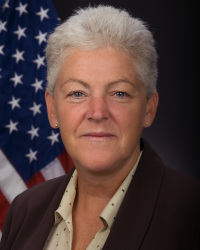
Newly installed EPA Administrator Gina McCarthy, a former Connecticut Commissioner of Environmental Protection, has spent the past four years with responsibility over EPA’s air pollution regulations as the assistant administrator of the EPA's Office of Air and Radiation.report

With pollution reductions resulting from the upcoming standard, it is estimated that as many as 11,000 premature deaths and 130,000 asthma attacks, 5,700 hospital visits, 4,700 heart attacks, and 2,800 cases of chronic bronchitis will be avoided in 2016. The public health improvements are also estimated to save $37 billion to $90 billion in health costs, and prevent up to 540,000 missed work or “sick” days each year.

Franz Matzner, NRDC associate director of Government Affairs, said:  “For too long, Americans have had no choice but to breathe toxic air pollution. Thanks to the EPA, the air is getting cleaner.”  Despite the overall reductions in total emissions, 18 of the Toxic 20 from 2009 remain in the 2010 list, although several states have made significant improvements highlighted in the report.  The states on the "Toxic 20" list (from worst to best) are:

  1. Kentucky
  2. Ohio
  3. Pennsylvania
  4. Indiana
  5. West Virginia
  6. Florida
  7. Michigan
  8. North Carolina
  9. Georgia
  10. Texas
  11. Tennessee
  12. Virginia
  13. South Carolina
  14. Alabama
  15. Missouri
  16. Illinois
  17. Mississippi
  18. Wisconsin
  19. Maryland
  20. Delaware toxic air


First McCarthy and Comey, Now Schwartz and Handelsman: Four CT Nominees for Obama Administration

All roads have been leading to Connecticut lately as President Obama has sought top talent for his administration.  Among key Presidential appointments announced by the White House last week was Linda Spoonster Schwartz, as nominee for Assistant Secretary of Veterans Affairs for Policy and Planning, in the Department of Veterans Affairs.  Schwartz is the fourth Connecticut resident and second who previously led a Connecticut agency, to be nominated recently by President Obama.

Linda Schwartz, a disabled veteran, has led the Connecticut Department of Veterans Affairs through Republican and Democratic administrations since 2003.  She concurrently serves as an Associate Clinical Professor of Nursing at the Yale School of Nursing, where she has been on Faculty since 1999 and was appointed Associate Research Scientist and Scholar.  From 1980 to 1993, she taught at several University and College Schools of Nursing and held leadership roles in Nursing organizations in Connecticut. Her nomination was sent to the Senate for confirmation on Aug. 1.

The White House alwhite hosueso announced last week that President Obama intends to nominate Jo Handelsman of Yale University as Associate Director for Science, Office of Science and Technology Policy.

 Dr. Jo Handelsman is the Howard Hughes Medical Institute Professor and Frederick Phineas Rose Professor in the Department of Molecular, Cellular and Developmental Biology at Yale University, a position she has held since 2010.  Previously, she served on the University of Wisconsin-Madison faculty as a Professor in Plant Pathology from 1985 to 2009 and Professor and Chair of the Department of Bacteriology from 2007 to 2009.

“The extraordinary dedication these individuals bring to their new roles will greatly serve the American people.  I am grateful they have agreed to serve in this Administration and I look forward to working with them in the months and years to come,” President Obama said in the formal announcement.

On July 17, the Senate confirmed the nomination of Gina McCarthy as Administrator of the Environmental Protection Agency.  McCarthy, gina-mccarthywhose nomination was held up for a time amidst political wrangling in Congress, has served as Connecticut’s Commissioner of Environmental Protection  prior to heading to Washington to join the EPA as assistant administrator earlier in the administration. McCarthy, is a 25-year veteran of state and local government in New England where she worked for Republicans including former Massachusetts Governor Mitt Romney and Connecticut Governor M. Jodi Rell.

The Boston Globe reported that the newly confirmed McCarthy told an audience at Harvard Law School that cutting carbon pollution will “feed the economic agenda of this country” and vowed to work with industry leaders on shaping policies aimed at curbing global warming.

In June, the President nominated James B. Comey, Jr., of Westport, to be Director of the Federal Bureau of Investigation for a term of ten years.  Comey was confirmed as the seventh director of the FBI on July 29 by a vote of 93-1 in the Senate.  He served in the Justice Department official in the Bush administration.

“To know Jim Comey is also to know his fierce independence and his deep integrity,” Obama said in making the nomination. “He’s that rarity in Washington sometimes: He doesn’t care about politics, he only cares about getting the job done. At key moments, when it’s mattered most,president-obama-nominates-james-comey-as-the-next-fbi-director he joined Bob in standing up for what he believed was right.”

Before serving as deputy attorney general, Comey was the U.S. Attorney for the Southern District of New York, where he helped bring down the Gambino crime family, and served as the managing assistant U.S. attorney in charge of the Richmond Division of the U.S. Attorney’s office for the Eastern District of Virginia, according to news reports.Handlesman

Handelsman is currently President of the American Society for Microbiology.  In 2011, Dr. Handelsman received the Presidential Award for Excellence in Science Mentoring.  From 2002 to 2010, Dr. Handelsman was the Director of the Wisconsin Program for Scientific Teaching.  In 2004, Dr. Handelsman co-founded the National Academies Summer Institute on Undergraduate Education in Biology.  She received a B.S. from Cornell University and a Ph.D. from the University of Wisconsin-Madison.

If confirmed by the U.S. Senate, Handelsman will help advise President Barack Obama on the impact of science on both international and domestic affairs.  “This is an enormous opportunity that I felt I just could not pass up,” she told the Yale  News.

“In addition to being a superb biologist, Jo Handelsman is nationally recognized as an exceptional mentor of young scientists and an effective champion for increasing diversity in the scientific work force,” Steven Girvin, deputy provost for science & technology at Yale told the News. “Her energetic devotion to improving science education is of critical importance to the nation.”

LindaSpoonsterSchwartzU.S. Sen. Richard Blumenthal released a statement calling Schwartz "a champion of veterans and a national star."  From 1979 to 1980, Schwartz was a caseworker in the Office of the Field Director of the American Red Cross at Rhein-Main Air Base in Germany.  Dr. Schwartz served in the United States Air Force (USAF) Nurse Corps from 1968 to 1986, both on Active Duty and as a Reservist.  She retired as a Flight Nurse Instructor, with the rank of Major after sustaining injuries in a USAF Air Craft accident.

In 2001, she served on the Board of Directors of the American Nurses Association and was elected to the American Academy of Nursing.  From 1996 to 2000, she served as a Member and Chair of the VA Advisory Committee on Women Veterans.  She received a B.S. from the University of Maryland, an MSN from Yale University School of Nursing, and a Dr.P.H from the Yale University School of Medicine.


Reducing Utensil Use on Campus Helps Sustainability Efforts

In a presentation earlier this year on the website TED, known for “Ideas Worth Spreading,” Dr. Michael Shaver of the University of Edinburgh suggested “saving the world one plastic fork at a time.”  Courtesy of Sodexo, the mammoth  international food service company, that’s exactly what Central Connecticut State University (CCSU) is doing.

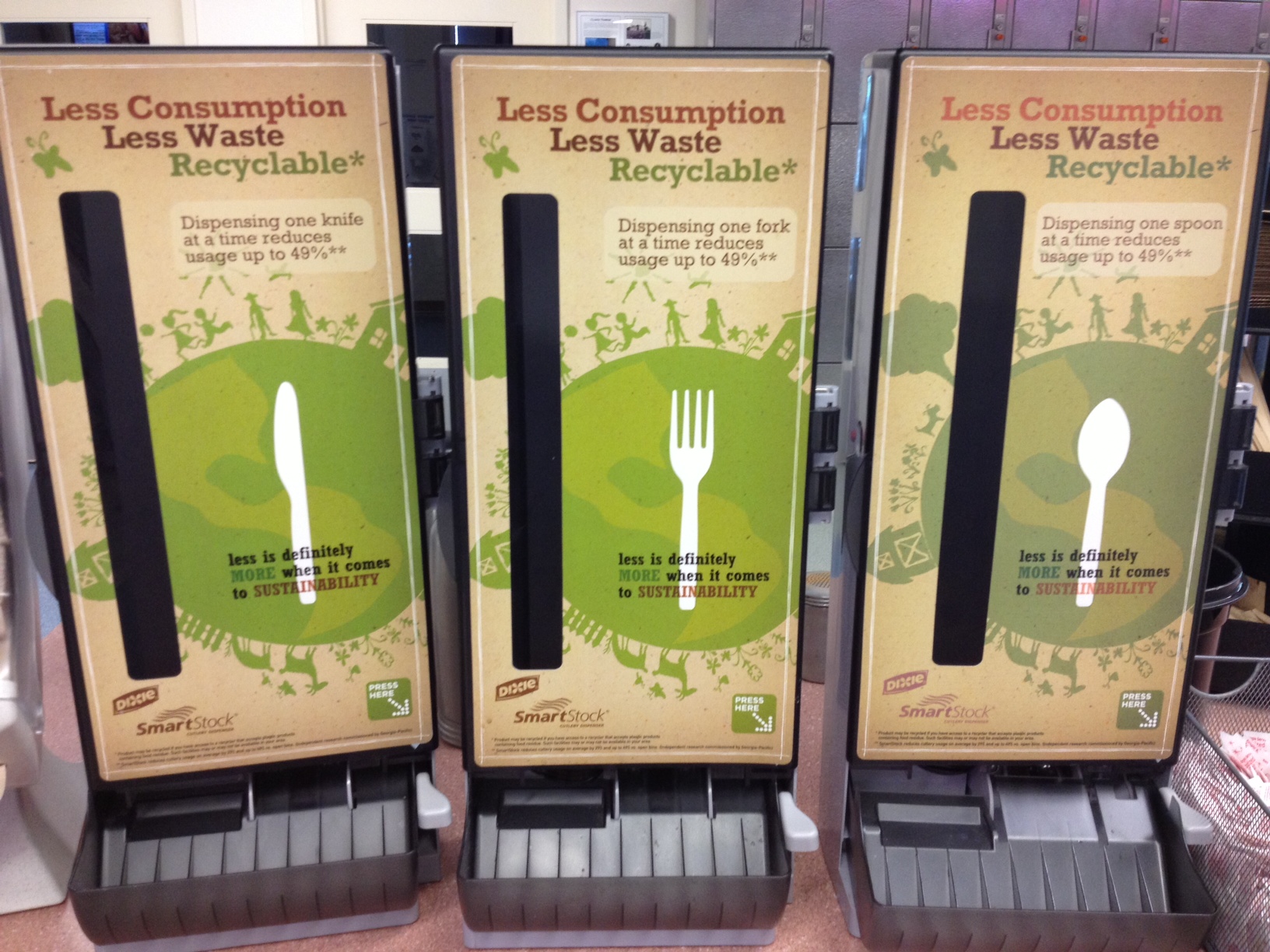
CCSU now features utensil dispensers in their student center dining area, replacing the traditional bins and bunches of forks, spoons and knives.  The dispensers operate at the simple push of a lever.  They only eject one fork, knife or spoon with each action of the lever, rather than having customers dip their hands into a bin, only to pull out a fist-full of utensils.

This simple change to the single-touch dispensers, according to Sodexo, reduces the number of wasted utensils by over 40 percent, thus reducing the amount of plastic used on campus – which firmly places the university on the right side of sustainability efforts.  The dispensers now in use at CCSU indicate that "dispensing one fork at a time reduces usage by up to 49%," pointing out that "less is definitely more when it comes to sustainability."

The “greening” of the campus food service – driven by Sodexo at facilities across the nation – also includes napkins, which switched to a single dispensing system years ago.  Iphoton fact,  Sodexo announced in 2008 that after only one year, the program resulted in a 25 to 50 percent reduction in the actual number of paper napkins used - thanks to the introduction of dispensers that dispense a single napkin at a  time.

A  switch to recycled napkins in the company’s 1,300 food service operations nationwide has resulted in saving nearly ten million gallons of water, more than 23,000  trees, half a million gallons of oil and five and a half million kilowatts  of energy, officials report. The company began using two types of recycled napkins as part of a commitment to leadership in sustainability and to providing.

Central, as the other state universities, and more than 600 public and private institutions in Connecticut and nationwide, is a signatory to The American College & University Presidents Climate Commitment.  The official commitment signed by all members says in part, "We believe colleges and universities must exercise leadership in their communities and throughout society by modeling ways to minimize global warming emissions, and by providing the knowledge and the educated graduates to achieve climate neutrality."

The Connecticut institutions participating include:plastics generation

  • Central Connecticut State University
  • Connecticut College
  • Eastern Connecticut State University
  • Fairfield University
  • Middlesex Community College (CT)
  • Norwalk Community College
  • Southern Connecticut State University
  • Trinity College
  • University of Connecticut
  • Wesleyan University
  • Western Connecticut State University

According to the corporate website, Sodexo touches the lives of 75 million consumers in 80 countries every day. In North America alone, the company serves more than 15 million consumers at 9,000 client sites. In 2012, named 89 Sodexo-served colleges and universities among the nation's most environmentally responsible "green colleges." They were named to The Princeton Review's Guide to 322 Green Colleges: 2012 Edition, which profiles institutions of higher education in the United States and Canada that demonstrate notable commitments to sustainability.

By the way, if you’re looking for a one-at-a-time fork or spoon dispenser for your business, you can pick one up for $27.29 on Amazon.  The Knife dispenser goes for $8.89.

New London Harbor Light Recognized as State's Leading Lighthouse in USPS Stamp

The U.S. Postal Service has unveiling a stamp featuring the New London Harbor Light, the oldest and tallest lighthouse on Long Island Sound. The USPS indicates that it was originally established in 1761, financed by a lottery held by the Connecticut colonial legislature. The present lighthouse, built in 1801, was one of the earliest American lighthouses with a flashing beacon.

The lighthouse, which is owned by the New London Maritime Society, is the featured lighthouse for Connecticut in the 2013 United States Postal Service’s New England Coastal Lighthouses series. The stamp series highlights lighthouses from throughout the country.

New England Coastal Lighthouses also features the lighthouses at Portland Head, Maine; Portsmouth Harbor, New Hampshire; Point Judith, Rhode Island; and Boston Harbor, Massachusetts. Each stamp shows a close-up view of one of the five lighthouses that captures not only the down-to-earth aspect of the tower but also the mysteriouNew Londons qualities that compel us to come closer.

These five lighthouses are among the oldest in the U.S., and each is on the National Register of Historic Places. Boston Harbor Light is also a National Historic Landmark.  Howard Koslow created original paintings for New England Coastal Lighthouses stamp art-and for the entire lighthouse series. Howard E. Paine and Greg Breeding served as art directors.

The New England Coastal Lighthouses stamps are being issued as Forever® stamps. Forever stamps are always equal in value to the current First-Class Mail one-ounce rate.  The USPS has also developed a short video about each of the lighthouses.

Previously, the Connecticut state 34 cent stamp from the Greetings From America commemorative stamp series featured the state. The United States Postal Service released this stamp on April 4, 2002. The retro design of this stamp resembled the large letter postcards that were popular with tourists in the 1930's and 1940's.

Last fall, Westport Now reported that Westport holds a special place in U.S. Postal Service history with more of its artists (17) designing more postage stamps (161-plus) than any other community in the nation.

CT Businesses Report "Going Green" Worthwhile; Sustainability Has Multiple Impacts

Eight in ten Connecticut companies that have invested time and money in “going green” say the effort has been worthwhile, citing benefits on the bottom line as well as improved employee morale, public image, and client/customer relationships. According to a new survey,  the main barrier to going green is cost, the factor cited by 65% of businesses.  Among companies engaged in sustainability, the strongest areas of involvement are energy efficiency (90%), waste management (77%), and green purchasing (74%).

Those are among the findings of the Connecticut Business & Industry Association (CBIA) 2013 Sustainability and Connecticut Business Survey.  Sponsored by UIL Holdings, Inc., the survey gauges Connecticut companies’ commitment to environmental principles in their business operations and the impact of those efforts on business performance, stakeholder relations, and communities served.

The survey found that nearly two-thirds (66%) of Connecticut businesses engaged in sustainability. This is up from less than half (47%) in 2007, when CBIA first surveyed companies—but down from 74% in 2010, when the previous survey was conducted.

Mostt businesses (72%) find Connecticut’s environmental regulatory climate more restrictive than other states, according to the survey.  And nearly three-quarters of businesses surveyegoinggreen-icond (74%) say they would take advantage of state government incentives for going green, such as tax incentives and refunds for capital investments.

Among the other findings this yea, posted at www.cbia.com/business, include:

  • Renewable energy is the area of greatest interest among businesses for future activities.
  • Though slightly more than half (53%) of the companies surveyed say current economic conditions have not changed their level of commitment to sustainable business practices, 11% have stepped up their efforts, while 9% have made green practices less of a priority. Eighteen percent say green practices are part of their DNA.
  • Nearly one-third of businesses surveyed (32%) require others in their supply chain—manufacturers, suppliers, distributors, and retailers—to adopt green business practices; 28% say that their own customers have requested or stipulated that they incorporate green business practices into their supply chain; and 9% have received similar requests from vendors.

The 2013 Sustainability and Connecticut Business Survey was emailed to 5,035 businesses in late April and early May; 434 businesses took the survey, for a response rate of 9% and a margin of error of +/- 4.8 %.  Most respondents (77%) were small businesses employing fewer than 50 workers. Businesses represented include manufacturers (33%), professional services (23%), retail (9%), nonprofit associations (8%), construction (6%), wholesale (6%), healthcare (5%), finance, insurance, and real estate (5%), and technology firms (4%). Companies engaged in hospitality, tourism, arts, and entertainment accounted for the remainder of respondents.

Connecticut Ranks 17th in Beach Closings/Advisories in 2012

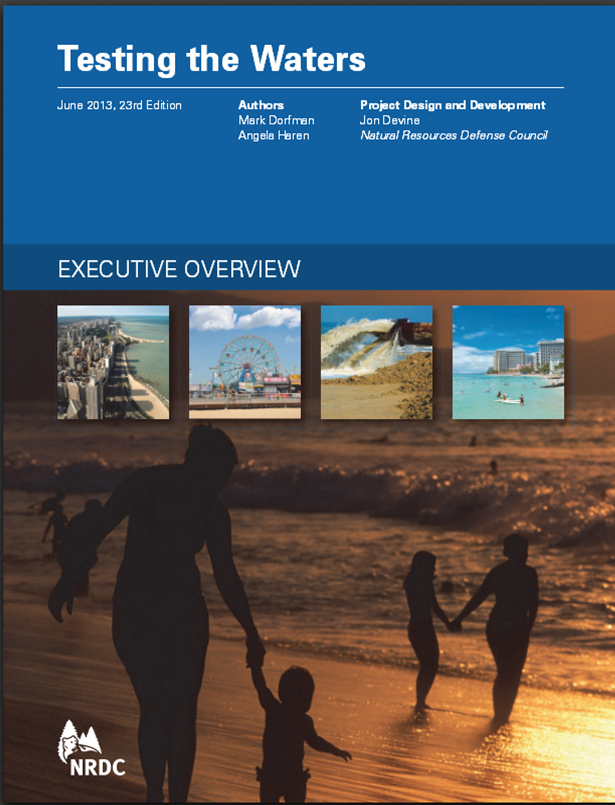
As the summer beach season moves into full swing, Save the Sound, a program of Connecticut Fund for the Environment, is calling attention to the number of days that Connecticut beaches had to be closed, or were under public advisories during 2012 due to environmental or related factors. The Natural Resources Defense Council’s (NRDC) annual “Testing the Waters” report, issued last week, found that Connecticut beaches were closed or under advisories for 198 days in 2012. That is down from 538 in 2011 but still more than twice the number of closings/advisories in 2010, 2009, or 2008.

The report analyzes beach closure and advisory statistics from beaches around the U.S.; Connecticut ranked 17th out of the 30 states listed.testing the waters

According to the NRDC report, 22 percent of Connecticut’s closing/advisory days last year were due to monitoring that revealed elevated bacteria levels and 29 percent were preemptive due to heavy rainfall, which can overwhelm outdated stormwater systems and wash untreated sewage into rivers and the Sound. The remaining days were preemptive due to wildlife.

The beaches with the worst records for exceeding the state's daily maximum bacterial standard were Pear Tree Point Beach in Fairfield County and Seabluff Beach in New Haven County, which tested above the maximum 28 percent of the time; Oak Street B Beach in New Haven County at 20 percent; and Fairfield County’s Calf Pasture Beach, Weed Beach, and Rowayton Beach, all at 19 percent.

“When it comes to clean water, being ‘middle-of-the-pack’ is not good enough,” said Leah Schmalz, director of legislative and legal affairs for Save the Sound. “One out of every ten American citizens lives within an hour’s drive of Long Island Sound, and they deserve clean, safe beaches—even one closing because of bacteria and pollution is too many.”

“Just an inch of rain in 24 hours causes many local health departments around the Sound to shut down beaches. Drought conditions may provide the perfect beach weather—no rain means no contamination from stormwater runoff—but we can’t rely on Mother Nature to do our pollution control for us. If we want to enjoy our coastline, eat local seafood, and promote tourism along the shore, rain or shine, we have to be proactive. That means stopping pollution at the source by upgrading our sewage treatment plants, separating the combined sewer overflows that dump almost two billion gallons of untreated sewage into our waterways each year, and investing in innovative stormwater runoff solutions like drain filters and green infrastructure.”DSC04553cropped

By comparison, the same NRDC report found that Westchester County in New York lost 112 beach days in 2012, and that New York State ranked 22nd out of 30 states, up from 24th in 2011.

Two Westchester County beaches had the first- and third-worst records in the state for the number of water samples that exceeded the state bacterial standard. Bacterial levels at Shore Acres Club in Mamaroneck tested above the standard fully 50 percent of the time, and Surf Club in New Rochelle exceeded 35 percent of the time. Overall, Westchester County beach samples exceeded the standard 14 percent of the time, making Westchester the fourth-worst tested county in New York. Bronx County, which also affects water quality in the western Sound, came in at number three.

Save the Sound issues weekly Sound Swim Alerts for Connecticut and Westchester County to inform residents when beaches are open for swimming and when they are closed. The alerts can be found on Save the Sound’s blog.

beach chart

Additional info on water pollution, contamination and depletion.