Foodshare Ups Commitment to Healthier Young People, Communities
/Foodshare has signed a three-year commitment with the Partnership for a Healthier America (PHA), a national nonpartisan nonprofit led by some of the most respected health and childhood obesity experts in the country, along with health advocates such as former First Lady Michelle Obama and U.S. Senators Bill Frist and Cory Booker.
Earlier this month, Foodshare was recognized as a new healthy Food Assistant Partner at the 2018 PHA Summit in Washington, DC. The program “elevates and accelerates the work of food banks and large-scale food pantries committed to addressing hunger and malnutrition,” according to PHA. 
At the organization’s annual Summit in 2018, “we were thrilled to welcome Foodshare as one of several new partners in this program.” More than 15 million U.S. children live in “food insecure” households, according to PHA.
Dr. Katie Martin, the nonprofit’s Chief Strategy Officer, represented Foodshare at the Summit. In a recent article that she co-authored, Martin pointed out “food pantries have significant potential to promote better nutrition for the communities they serve,” adding that “recent national data show that 63 percent of households who visit food pantries acquire food through the charitable food system on a regular basis to help with their monthly food budget.”
As part of the commitment, Foodshare has agreed to:
- Use a nutrition stoplight system to rank the nutritional quality of food in our inventory;
- Increase the amount of nutritious food and beverage distributed through our network;
- Increase the demand for healthy food and multiply its impact with promotional materials.
 “This is an exciting opportunity for all of us at Foodshare. More produce and healthier options: that’s the future of food banking,” said Jason Jakubowski, President and CEO of Foodshare.
Foodshare is the regional food bank serving Connecticut’s Hartford and Tolland counties, where 121,000 people struggle with hunger. As a PHA partner, Foodshare will increase supply and foster demand for healthier options in several ways, such as evaluating the nutritional quality of at least 50 percent of the food in its inventory, increasing the amount of nutritious food and beverages it distributes, and incentivizing the organizations it works with to select more nutritious foods.
Foodshare joins ten other partner food banks from across the country, as well as Feeding America, in this national partnership. Created in 2010 with the goal of ending the national epidemic of childhood obesity within a generation, PHA’s strategy rests on transforming the marketplace, so that the healthy choice becomes the easy choice for American families.
 state with a lower rate was Massachusetts.

 Once every 19 minutes, a senior citizen in America dies as a result of injuries sustained during a fall. The older Americans became, the greater their risk of dying from a fall. In 2016, there were 15.6 fatal falls for every 100,000 Americans between the ages of 65 and 74. Among adults ages 75 to 84, there were 61.4 such deaths per 100,000 people. And for those ages 85 and up, there were 247.9 fatal falls per 100,000 people.
 More than 250 attendees will include consultants, coaches, funders, academics, and executives from across the country. The conference intends to “convene the diverse perspectives that shape and advance our field.”


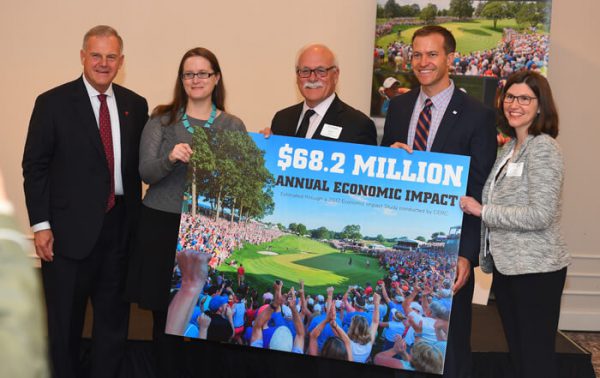
 CERC first conducted an impact analysis of the tournament in 2011, and completed another impact analysis for the Travelers Championship in 2017. The results were compared, to look at the changes over time and factors that may have influenced changes in the tournament’s economic effects.
 With record attendance, sales and fan engagement, the 2017 Travelers Championship raised the bar across the board through a strategic approach that focused on providing a first-class experience for fans, players, sponsors, volunteers and charity, officials pointed out. This marks the first time that the Travelers Championship has been recognized as “Tournament of the Year.”




 In Connecticut, individuals earning more than $200,000 gave 66.4 percent of all Connecticut giving, down 1.7 percent from 2012, according to the Chronicle analysis. The portion of all givers in this income bracket in Connecticut down 0.2 percent while the giving per itemizer is down 20.6 percent. In looking at the state’s major metropolitan areas, greater Bridgeport, Hartford, and New Haven, the analysis round that giving rates for taxpayers at four income levels fell below the average for the size group in each of the metropolitan areas.
 onicle used 2015 Internal Revenue Service data on individuals who earn $50,000 or more annually and who itemize charitable deductions on their income-tax returns to create a snapshot of giving in every county and metropolitan area in the country. Only donations of taxpayers who took a deduction are included, the publication noted. The key measure, according to the Chronicle, is the giving ratio: the total of a locality’s charitable contributions as a share of its total adjusted gross income.