CT’s Manufacturing Report Card Features Every Grade, From A to F
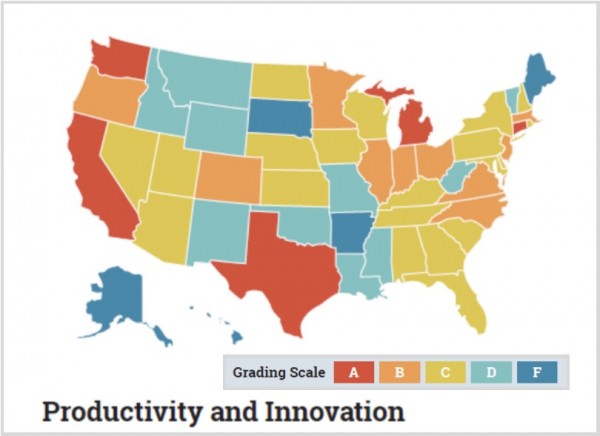
/Connecticut’s report card on Manufacturing and Logistics is a mixed bag, according to data compiled by Indiana’s Ball State University Center for Business and Economic Data. The state’s grades in nine categories range from an A in the Productivity and Innovation category to an F in Worker Benefit Costs.
The other categories were Manufacturing Industry Health, Logistics Industry Health, Human Capital, Tax Climate, Expected Liability Gap, Global Reach and Sector Diversification. Overall the state received one A, one B+, one B, one C+, two C-, two D, and one F. 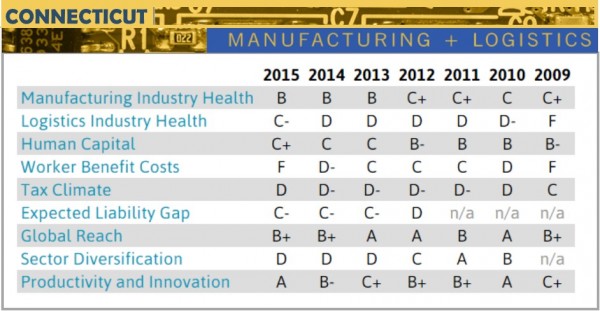
Connecticut’s manufacturing industry is 8.1 percent of the state economy, according to the report. The total personal income in Connecticut is $203,703,411,000 and earnings from manufacturing total $16,591,678,000, the report stated.
The state’s top grade was in Productivity and Innovation. The researchers described that category as “the value of manufactured goods per worker – productivity – as well as firm access to inventions and innovations,” which “is critical to the long-term performance of a firm and the industry as a whole.” To measure productivity and innovation, they used manufacturing productivity growth, industry research and development expenditures on a per capita basis, and the per capita number of patents issued annually. Connecticut was one of five states to earn an A; the others were California, Michigan, Texas, and Washington State.
Compared with 2009, Connecticut’s grades improved in the categories of Productivity and Innovation, Manufacturing industry Health, and Logistics Industry Health, and declined in Tax Climate and Human Capital. In Tax Climate, the state dropped from a D last year to a D- on 2015’s report card. Sector Diversification, which received an A in 2011, dropped to a C the following year, and has been mired at a D in each succeeding year.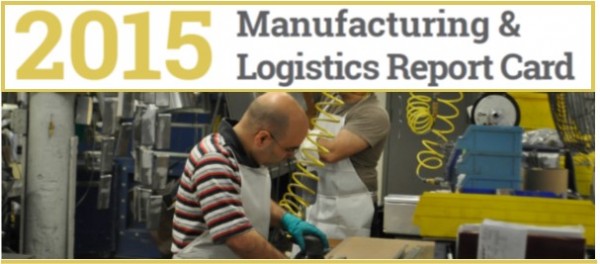
The report authors note that “states that concentrate their manufacturing activity in a single sector typically suffer higher volatility in employment and incomes over a business cycle and are also more likely to experience greater effects of structural changes to the economy involving a single sector.
Connecticut’s Tax Climate grade has been a steady D or D- since 2010, after earning a C in 2009.
In the Global Reach category, in which Connecticut received a B+, only South Carolina, Ohio, Indiana, and Delaware received a higher grade. Connecticut’s grade matched New Hampshire, placing Connecticut in the top six in that category. The Ball State researchers indicated that “the level of international trade (in both imports and exports) is a robust measure of competitiveness in the production, movement and distribution of consumer durable and non-durable goods.”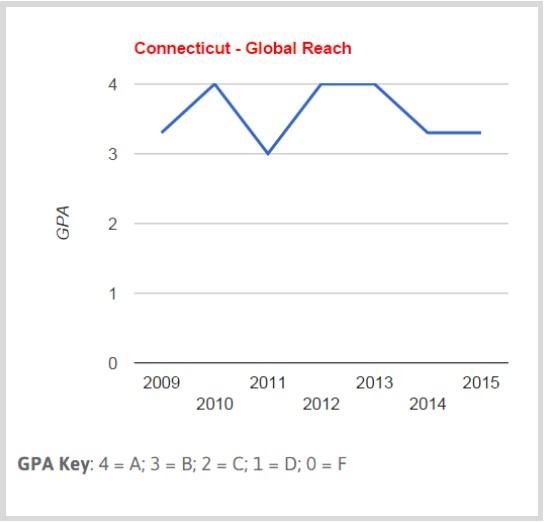
The university’s national report provided report cards to all fifty states in each of the categories.
The Center for Business and Economic Research is an economic policy and forecasting research center at Ball State University. CBER research includes public finance, regional economics, manufacturing, transportation, and energy sector studies.


 It all began in the summer of 1953, when David N. Mullany, grandfather of the current company owners (brothers David and Stephen) was watching his 12 year old son and a friend play a game in their backyard in Fairfield, using a perforated plastic golf ball and a broomstick handle. They had given up on baseball and softball - not enough players for two teams, not enough space for a field, and too many broken windows.
 Established in 1998, the
  Medical technology creates more than two million jobs directly and indirectly across the United States. The industry is one of the few U.S. manufacturing sectors that is a net exporter, and its innovations help reduce the human and economic burden of chronic disease. Industry officials point out that while U.S. leads the world in the development of new medical technology, the device tax “threatens that leadership.”


 The Marcum Tech Top 40, now in its 8th year, recognizes technology companies with at least $3 million in annual revenue and a four-year record of growth, in six industry sectors. Both privately held and publicly traded companies are eligible. This year, 14 were publicly traded; 26 were privately held.
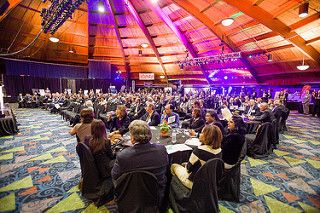
 The Lawrence W. O’Toole Award is given out each year to an individual, organization, school or district exhibiting great leadership through innovation or courage in moving student-centered approaches to learning forward in New England. The winner will receive a $100,000 grant from the Nellie Mae Education Foundation.


 When the license renewal application does reach the agency’s Media Bureau, they will consider “how the allegation of violation was resolved,” as well as a range of other factors in deciding whether or not to renew the station’s license. The other, more routine, factors include whether any other objections have been raised about the station, whether the station has been adequately serving the public in their area of license, their history of compliance with FCC regulations, and their overall performance. License renewals for radio stations are issued by the FCC for a period of eight years.
 lorado with 79 and Missouri with 75.