Rate of Success Obtaining Venture Capital is High in Hartford, Study Finds
/A look at the nation’s 50 largest metropolitan areas to see how entrepreneurs have fared in their quests to secure money from venture capitalists, angel investors, and online crowds brought a somewhat surprising result – among the cities mentioned as ranking high in venture funding success rates was Hartford. Connecticut’s Capitol was listed among a handful of cities with success rates for businesses seeking venture capital that “are about twice as high as the national average.”
According to a new report issued this month by the Kauffman Foundation, roughly $68 billion was invested in venture capital (VC) deals in the United States in 2014 and 7,878 employer businesses reported receiving venture capital funds. Thirty percent of those recipients were located in just four metro areas: New York, Los Angeles, San Francisco, and Boston. The national average was 0.2%.
Among the metro areas that rank highly in terms of those venture funding success rates, according to the report “Trends in Venture Capital, Angel Investing and Crowdfunding,” include: San Francisco, CA (0.8%), San Jose, CA (0.8%), Boston, MA (0.5%), Hartford, CT (0.5%), Memphis, TN (0.4%), Minneapolis, MN (0.4%), Philadelphia, PA, (0.4%), Richmond, VA (0.4%), Washington, D.C. (0.4%). Among the lowest ranked of the 50 largest metropolitan regions in the nation, at 0.1 percent, were Baltimore, Denver, Jacksonville, Las Vegas, Orlando, Riverside, and Tampa.
The report noted that “Some perhaps unlikely metro areas rank highly in terms of those venture funding success rates: Hartford, Memphis, Richmond, and Buffalo. This doesn’t necessarily mean that there are higher quality firms there, and, of course, the volume of firms seeking VC is smaller…And, these data don’t mean that all the funding came from local sources: venture capital firms in New York could be investing in Hartford businesses. But these numbers lend credence to arguments…that high-quality deals can be found everywhere, and that firms in these regions can succeed in raising equity capital.”
While 10.3 percent of entrepreneurs report using personal credit cards when starting their business, nationally, only 0.6 percent initially received venture capital, the analysis found.
The metros with the highest percentage of firms receiving venture capital funding when starting include: San Jose (2.4%), San Francisco (1.5%), Salt Lake City (1.3%), Aust in (1.2%), Baltimore (1.1%), Birmingham (1.1%), and Nashville (1.1%).
According to the report, based on the 2014 Annual Survey of Entrepreneurs (ASE), “the primary sources of initial financing for new businesses in the United States are: personal and family savings, bank business loans, and personal credit cards.” The report notes, however, that “entrepreneurs also tap other sources of funding, including venture capital, which “can be disproportionately important for business growth.”
The ASE, conducted by the U.S. Census Bureau, is the largest annual survey of American entrepreneurs ever done, and is done in a public-private partnership between the Census Bureau, the Kauffman Foundation, and the Minority Business Development Agency. The ASE samples approximately 290,000 employer businesses across all U.S. geographies and demographics, the report explained.
The top metropolitan statistical area for crowdfunding success in 2014 was Charlotte; for angel investing, San Jose led the way. The report concludes that the concentration of venture capital firms in California, Massachusetts, and New York, “is well-correlated with the relative concentration of firms that receive VC investments.” Crowdfunding campaigns in Minneapolis and Oklahoma City, the report indicates, “may not be entirely due to local funders.”
“The ASE data add quantitative confirmation to what we know from other sources: high-quality entrepreneurs can be found—and can get funding—in nearly every corner of the United States.”
Including Hartford.
 “The cyclocross national championships are the pinnacle of cyclocross racing in the United States each year,” said Micah Rice, Vice-President of National Events, USA Cycling. Cyclocross is a very specific type of bike racing, as described by Cyclocross Magazine. For the most part, the course is off-road but there are sometimes portions of pavement included in the course. Riders can expect to encounter grass, dirt, mud, gravel, sand, and a whole slew of other assortments and combinations. The races are based on a set time (measured by numbers of laps), not distance. Depending on your category, a race can be as quick as 30 minutes (for beginners), or as long as 60 minutes (for pros).




 Harman's products, which provide infotainment, telematics, connected safety and security services, are used in more than 30 million vehicles made by automakers such as BMW, Toyota Motor Corp and Volkswagen, according to its website. Harman’s portfolio of audio brands includes AKG®, Harman Kardon®, Infinity®, JBL®, Lexicon®, Mark Levinson®and Revel®
 ACM comprises one of the largest, most experienced concentrations of world-class aerospace companies, the world's AEROSPACE ALLEY! ® The organization points out that member firms grew up where aerospace was born. Today, precision components manufacturer in the state take to the skies every day, in every corner of the globe, as they have since the inception of powered flight.

 The STSI's 107 individual indicators are sorted into five composites: Research and Development Inputs, Risk Capital and Entrepreneurial Infrastructure, Human Capital Investment, Technology and Science Workforce, and Technology Concentration and Dynamism. The report indicated that "Connecticut showed major improvement in the Technology Concentration and Dynamism index, going from 21st to 10th. This dramatic rise marks one of the larger overall changes on this index. While modest increases were seen in the Research and Development Inputs index and Human Capital Investment index, these two indices have a much heavier focus on stock measures, and Connecticut’s aerospace and defense sectors help anchor the state’s performance in these areas."
 In the Human Capital Investment composite index, Connecticut ranked third, as it did in 2014 and 2012, after ranking fifth in 2010. In Research & Development, Connecticut placed eighth, its second highest finish, after ranking tenth, seventh and seventh in previous indexes. Connecticut ranked 11th in Risk Capital and Entrepreneurial Infrastructure, up from 14th two years ago, but not as high as sixth place in 2012 and third in 2010.

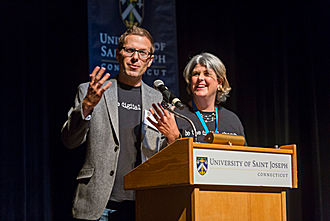 nship bloggers to follow in 2014 by Common Sense Media. Polgar, an attorney and college professor, is a frequent speaker (three-time TEDx) and tech commentator on television and in print, focusing on digital citizenship, creativity, cyber ethics, tech balance and humanizing the online experience.
 Joining internationally renowned

 FBI Special Agent Judy Eide, a 25-year veteran currently assigned to the Bureau’s New Haven Division Computer Crime squad and a coordinator of the Connecticut Chapter of InfraGard, will be one of the speakers. Also on the program is Mark Ramsey the Chief Information Security Officer for ASSA ABLOY – Americas and President of the Connecticut Chapter of InfraGard. Ramsey also teaches at Fairfield University, and previously held information security positions at Stanley Black & Decker and General Electric.
 “We want this to be a must-attend event for anyone responsible for strategic technical decisions within their organization,” says Steven Bulmer, Walker’s vice president of professional services. “Tech Impact is really a self-defining event based upon the intense interest and demand from our clients, especially for information security services.”
 The top 10 undergraduate schools to study game design were University of Utah (Salt Lake City, UT), University of Southern California (Los Angeles, CA), Rochester Institute of Technology (Rochester, NY), DigiPen Institute of Technology (Redmond, WA), Becker College (Worcester, MA), The Art Institute of Vancouver (Vancouver, British Columbia), Hampshire College (Amherst, MA), Michigan State University (East Lansing, MI), Drexel University (Philadelphia, PA) and New York University (Brooklyn, NY).
 raduate schools to study game design were University of Utah (Salt Lake City, UT), University of Southern California (Los Angeles, CA), Rochester Institute of Technology (Rochester, NY), DigiPen Institute of Technology (Redmond, WA), Becker College (Worcester, MA), The Art Institute of Vancouver (Vancouver, British Columbia), Hampshire College (Amherst, MA), Michigan State University (East Lansing, MI), Drexel University (Philadelphia, PA) and New York University (Brooklyn, NY).