Neighboring States Bring in Millions in Toll Revenue; CT Remains Toll Free

The Connecticut House of Representatives debated for nearly six hours the issue of reinstating tolls on Connecticut highways, but did not vote.  Connecticut remains a toll-free state, for residents and those driving through the state. How much money might the state receive in toll revenue if tolls were imposed?  The Office of Legislative Research, responding to a legislative inquiry, has surveyed neighboring states and issued a report this past week.

Toll revenue ranged from $20.4 million in FY 16 (Rhode Island) to $1.57 billion in calendar year 2016 (New Jersey), according to the legislature’s research office. In Massachusetts in FY2016, toll revenue was $395 million; in Maine $133.8 million in calendar year 2016; in New Hampshire a total of $130.7 million. 

The New York Thruway Authority and New Jersey Turnpike Authority each collect tolls on their respective highways, the Office of Legislative Research (OLR) report noted. In addition, the Port Authority of New York and New Jersey collects tolls on its bridges and tunnels connecting those two states (the George Washington, Goethals, and Bayonne bridges, the Outerbridge Crossing, and the Lincoln and Holland tunnels). In calendar year 2016, the Port Authority collected $1.86 billion in toll revenue.

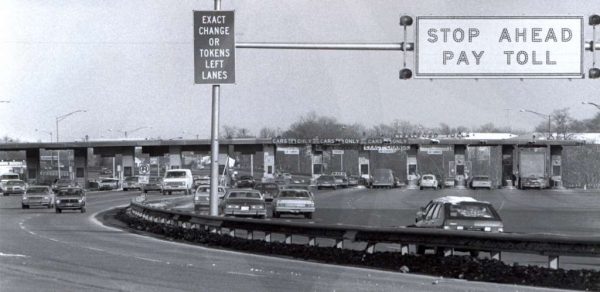
Tolls were eliminated by lawmakers more than three decades ago in 1983, following a horrific accident at the then-Stratford toll booths, in which six people were killed. The last Connecticut highway toll was paid at the Charter Oak Bridge in Hartford on April 28, 1989.

In their final year of operation in the mid-‘80’s, Connecticut Turnpike tolls brought the state $56.4 million, the Merritt and Wilbur Cross Parkways 11.3 million, and the three bridges in the Hartford area, $4.7 million, according to a previous OLR report issued in 2009.

Technology, however, has made traditional toll booths obsolete, and Massachusetts recently removed its toll booths, switching to an overhead electronic system – thus maintaining the revenue without extending the dangers and the highway back-ups inherent with the toll plazas.  Connecticut residents driving through Massachusetts on the MassPike have noticed the striking difference.

Despite projections of budget deficits in coming years, the legislature did not vote on imposing tolls as a means of raising revenue this year.    It was estimated that 30 percent of the tolls would be paid by out-of-state drivers and 70 percent by Connecticut residents.  Federal rules require that toll revenue from interstate highways must be used for maintenance or improvements on those highways.  The legislature’s Transportation Committee had voted 19-16 in favor of the tolls bill, which led to the House debate on the proposal.  It was pulled before a vote could be held.

The 2009 OLR Report also noted that according to annual data compiled by the Federal Highway Administration, in 2007 almost 32.5 percent of all the vehicle miles traveled (VMT) in Connecticut occurred on its Interstate highways. Nationally, only 24.4% percent of all VMT occurs on Interstate System. Connecticut's Interstate VMT percentage is higher than many other states, including, at the time, Massachusetts, New York, New Jersey, and Pennsylvania.

The most recent OLR Report did not estimate what Connecticut might earn in toll revenue; it merely reported on the most recent earnings of neighboring states that impose tolls on their major roadways.

CT Ranked 36th in Construction Jobs Added During Past Year

Connecticut ranked 36th in the nation in the number of construction jobs added between July 2016 and July 2017, one of 36 states (and the District of Columbia) that added construction jobs during the 12-month period. The analysis by the Associated General Contractors of America of Labor Department data found that firms in parts of the country that build infrastructure projects are seeing less demand for their services amid overall declines in public-sector spending. Only 100 construction jobs were added in Connecticut during the past year, moving the states employment level in construction industries from 58,800 to 58,900, reflecting growth of two-tenths of one percent.

“Despite growing private-sector demand, it appears that construction employment in some parts of the country is being brought down by declining public-sector investments,” said Ken Simonson, chief economist for the association.  “Some of these declines will be offset thanks to recently enacted state infrastructure funding increases, but stagnant federal investments are not helping.”

Among the New England states, Rhode Island ranked third in the nation, with a 12-month gain of 12.7 percent, New Hampshire ranked fourth with 11.8 percent growth in construction jobs, and Maine ranked sixth, with a 9.3 percent increase.

California added the most construction jobs (51,000 jobs, 6.6 percent) during the past year. Other states adding a high number of new construction jobs for the past 12 months include Florida (35,800 jobs, 7.5 percent); Louisiana (13,900 jobs, 9.8 percent); Oregon (11,900 jobs, 13.2 percent) and Texas (10,400 jobs, 1.5 percent). Oregon added the highest percentage of new construction jobs during the past year, followed by Nevada (12.8 percent, 9,700 jobs).

Thirteen states and the District of Columbia shed construction jobs between July 2016 and July 2017 while construction employment was unchanged in North Dakota. Iowa lost the highest number of construction jobs  (-4,400 jobs, -5.4 percent), followed by Illinois (-4,300 jobs, -2.0 percent) and North Carolina (-2,500 jobs, -1.2 percent).  South Dakota lost the highest percentage for the year (-5.6 percent, -1,400 jobs) followed by Iowa and Mississippi (-3.9 percent, -1,700 jobs).

Association officials have continued to urge Congress and the administration to make needed new investments in the country’s aging infrastructure to offset declining public-sector investments in construction. In particular, they urged officials to consider including new infrastructure investments as part of a tax reform measures expected this fall, the association indicated in a news release.

New Haven's “SeeClickFix” Selected by National Mag, Set to Host User Summit as Hurricane Residents Use Service

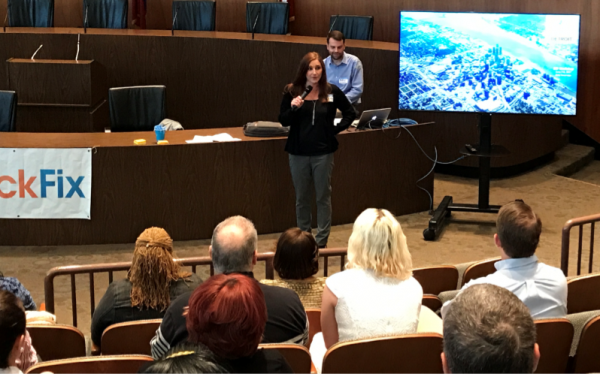
When Fast Company magazine developed a feature article entitled “United States of Innovation” for its most recent issue, they selected one business in each state to highlight.  Connecticut’s representative was SeeClickFix, a New Haven-based business that began a decade ago with a basic premise and has expanded steadily since. As Fast Company described it:  “A Help Desk for Citizens – New Haven resident Ben Berkowitz created the SeeClickFix app to allow locals to quickly report non-emergency issues (broken meters and streetlights, potholes, and even excessive noise from ice-cream trucks).  Officials can track, manage and reply within the app.  It has since expanded to some 300 municipalities across the country.”

There have been a total of more than 3 million “issues fixed” according to the SeeClickFix website, in communities including Chicago, Minneapolis, St. Petersburg, Detroit, Oakland, Albany, Albuquerque, Washington, D.C. Of particular interest this during the past two weeks - SeeClickFix in numerous Florida communities, and in Houston.

In the aftermath of Hurricane Harvey, the efforts with Houston instantly intensified.  Berkowitz said SeeClickFix has worked with the city of Houston and several of its neighboring suburbs since 2009, handling an estimated 30,000 residents.  Those numbers will likely jump when the totals for 2017 are tallied.  Berkowitz told CTNewsJunkie that will be especially true in the coming weeks as operations shift from emergency calls handled by police and other emergency personnel to calls that are SeeClickFix specialties, such as power outages, downed trees and other types of “more routine” assistance.

In Florida, St. Petersburg is among the 10 communities with SeeClickFix in operation, and the site is filled with reports of downed trees, storm debris, broken water mains, non-working street lights, and other hazards, with many accompanied by photos illustrating the danger or dilemma.  Other communities include Pinellas County (which includes Clearwater), Seminole, Gainsville, and Venice, which signed on a year ago.

The company’s website continues to proudly boast “Made in New Haven” and Berkowitz’ company profile explains “The inspiration for SeeClickFix came from a desire to improve his own community with his neighbors and his government.”

Even before the hurricane in Houston this year, the company's growth has continued, with the first city in Kentucky signing on recently, and communities in Georgia and Michigan also added.  A workshop, with municipal attendees from more than 80 communities, was held in Detroit.  Next, a SeeClickFix User Summit is scheduled for September 13 & 14 in New Haven.

Fast Company summed up “50 projects that are really making America great again” noting that “Change doesn’t have to happen from the top down” as the publication highlights “some of the most promising projects, initiatives, and companies that are springing up in every state of the union. Together, they present a portrait of the country today—its concerns and responses, and its enduring capacity for progress.”


State’s Money Woes Earn National Spotlight

The cover of the national magazine depicts a waterfront home in Mystic Seaport, under the headline that reads “The fiscal mess in America’s richest state.”  Connecticut, without an approved state budget for all of July and August and nearly half of September, is earning some notice.  And it is not particularly friendly. The article, in the September issue of Governing, begins with the question, “How could the nation’s wealthiest state become a fiscal basket case?”  The answer is complex, and the magazine devotes a full six pages to walking through how the state got into this mess, and how it might navigate its way out.

Along the way, the magazine suggest that the state “may be too rich for its own good,” pointing out that “long blessed with a disproportionate number of high-income residents, the state has entertained lavish spending habits for decades.” It also cites statistics that underscore the problems and challenges:

  • Over the past 20 years, job creation numbers have ranked in the bottom five among the 50 states
  • Connecticut has the nation’s second-highest rate of income inequality, after New York
  • The state has lost population for three years running
  • Last year, Greater Hartford ranked fourth and New Haven fifth in population loss among the nation’s 100 largest metro areas

The ineffective state spending cap, approved by voters more than 20 years ago but routinely circumvented since, is cited as a contributor to the fiscal cliff the state sits on, along with an overreliance on the income tax, political infighting, increased taxes, the lack of regionalism and a host of other decisions made by Governors and legislatures for decades.

One glaring example cited:  “Connecticut, which is home to 3.6 million people, has 111 police dispatch centers.  By comparison, Houston, which as 2.3 million residents, has just one emergency dispatch center, which handles fire as well as police.”

With a circulation of 85,000 in print and a widely viewed website, Governing is described as "the nation's leading media platform covering politics, policy and management for state and local government leaders." It is among the most widely read and most influential among government leaders - with an audience that also includes "journalists, academics, advocates and activists."

The article did point to some silver linings, past and present.  “Connecticut clearly has the means to change course. Not only is its median income still high, but the state boasts assets such as proximity to Boston and New York, amiable coastlines and river valleys, and notable institutions of higher education.  In addition to the continuing presence of a thriving financial sector, Connecticut is home to aerospace and defense contractors and other advanced manufacturers who can’t hire help fast enough, as well as a growing medical and life sciences sector.”

On the other hand, the publication points out, “Connecticut is 80 percent white, but its population of white children under the age of 10 is falling faster than in any other state.  Racial and ethnic minorities already make up more than 50 percent of infants and toddlers and are about to become a majority of 3- and 4-year olds.”  There is, the publication adds, “a pronounced achievement gap among racial groups and by geography.”

The conclusion reached by the Governing article?  “Connecticut is not in a death spiral but it has failed to position itself to react to changing demographics and location preferences… it’s clear that what’s worked so well for Connecticut in the past isn’t working now.”

Summed up House Speaker Joe Aresimowicz, one of many political leaders, including the Governor and legislators from both political parties, as well as city officials and economic analysts, who were interviewed for the article: “We are the land of steady habits and the world has changed around us.”

Women in Manufacturing Bring Summit to Hartford Next Week

The 800-member Women in Manufacturing (WiM) professional organization will hold their annual Summit at the Connecticut Convention Center in Hartford, September 13 - 15, 2017. This annual Summit is geared toward women who have chosen careers in manufacturing and want to share perspectives and network with others in the industry. It is expected to attract more than 300 professional women in manufacturing, with titles ranging from production to CEO. Attracting hundreds of women in manufacturing from across the country, WiM's annual Summit is the only national conference of its kind. This networking and educational event features manufacturing plant tours, professional development tracks, industry roundtables, keynote presentations and social events to expand participants' networks.

Plant tours that have been organized as part of the conference agenda include visits to Kaman Corporation, CNC Software, Hartford Flavor Company, TRUMPF Inc., and Pratt & Whitney, all on the opening day of the conference on September 13.

Break-out sessions will focus on Technology, Leadership & Professional Development, Operational Excellence, and Diversity & Inclusion.  Speakers at conference-wide sessions will discuss topics including “Engineering Young Women,” “Developing Your Personal Brand,” “Recruiting A Pipeline for Skilled Labor Positions,” “Empowering Women Through Sales,” and “The growing Digital Intensity of Manufacturing.”

Speakers will include Jonna Gerken, Manager, PCME Group, Pratt & Whitney and the president of the Society of Women Engineers, and George Saiz, President & CEO of The Association for Manufacturing Excellence.

The Board Chair of Women in Manufacturing is Sheila LaMothe, Vice President of Strategic Initiatives for Goyer Management International, a Florida-based company.  Previously, she spent 15 years responsible for the marketing and public relations activities for TRUMPF Inc. in Farmington, CT, initially serving as Marketing Manager before becoming Associate Director of Marketing & Public Relations. She founded the WiM Connecticut Chapter and served as chapter chair until her relocation to Florida.

Among the host committee members is the Connecticut Business and Industry Association.  The New Haven Manufacturers Association and the Waterbury Regional Chamber’s Manufacturer’s Council are among the Supporting Partners for the Summit.

This is the organization’s first summit to be held in the Northeast.  The Summit location moves around the country giving attendees the opportunity to experience manufacturing and develop their networks throughout the United States.  The  6th annual summit was held last year in Nashville, TN.  Previous events were held in Minneapolis, MN; Schaumburg, IL; Dearborn, MI; Milwaukee, WI; and Cleveland, OH.

How Connected is Connecticut? State Ranks 6th in the USA

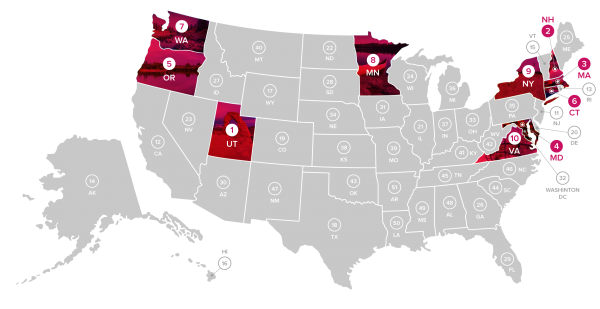
Internet access is as good in Connecticut as just about anywhere else in the country.  A new report on the Top Connected States in America ranks Connecticut as the 6th most connected state in the nation. The analysis, by USDish.com, found that the top 10 states showing excellent connectivity to broadband all value connecting rural citizens to the resources they need to succeed economically, both in school and at work. “Overall we found that the most important factor in these states’ ability to connect rural citizens to the internet were the use of government funded broadband task forces, infrastructure maintenance, and local support. The states that listened to the community were more likely to connect them to proper resources and economic growth flourished.”

While Connecticut ranked 6th overall, the state’s ranking varied in each of the categories of the analysis:  Connecticut ranked 10th in Access, 1st in Rural Access, 12th in Speed, and 21st in Support (by government).

Analysts compiled and ranked the report using data from the American Community Survey, conducted by the U.S. Census Bureau, the EducationSuperHighway non-profit, Fastmetrics, the National Conference of State Legislatures (NCSL) and the Institute for Local Self-Reliance.

Connecticut ranked 10th in Access, 1st in Rural Access, 12th in Speed, and 21st in Support.  The top five states for Rural Access were all in the Northeast – Connecticut, Massachusetts, New Hampshire, New Jersey, and Rhode Island. “Perhaps the emphasis on education and communication makes it easier to access the internet as a student, even in a rural area like Connecticut,” the analysis stated.

The analysis points out that a main reason why people don’t have access to broadband internet is due to a lack of income. Cited is a Pew Research poll that found 23 percent of people making under $30,000 per year don’t use the internet, possibly because of the high price for something they don’t consider a basic need. Most rural schools across the country still lack access to fiber and pay more than twice as much for bandwidth.

In contrast, Minnesota, New Hampshire, Oregon, and Maryland all have state government broadband task forces which promote the expansion of internet access throughout their rural areas, the analysis points out.

For internet access per state, the USDish team analyzed the percentage of school districts meeting a minimum of 100 Kbps per student.  They also examined the percentage of those with an internet subscription, and the total percentage of users with any access to the internet at all, be it in the form of a community library, town hall, or school.

Speed was analyzed by the average Mbps per state, and they evaluated states on whether they had a stimulus project, broadband task force, or whether the state had barriers preventing them from expanding the connectivity of those living in the area (i.e. laws, infrastructure support, prohibitions, etc.). As for rural area access, data on the number of households that had broadband internet in both urban and rural areas was used.  USDish.com is an authorized retailer of DISH Network.

Former CT Sportscaster Handling Weather Reporting Duties During Hurricane in Houston

Khambrel Marshall, who once delivered the evening sports news on Hartford’s Channel 3, has accomplished the rare broadcast trifecta – he has been a sports anchor, news anchor, and weather reporter during his career – all in some of the nation’s largest media markets.  It is a career with heightened visibility in recent days, as a Hurricane Harvey barrelled in on Houston, where Marshall is an on-air member of the NBC affiliate’s “Severe Weather” team, as well as the host of a weekly public affairs program on KPRC-TV. Joining the WFSB sports team in 1980 at age 27, Marshall spend five years at channel 3, moving from the nation’s number 23 TV market to number 13 when he relocated to Miami in 1985.  At the time, he became the first black sports anchor in South Florida, according to published reports.  He had received his broadcasting degree from Arizona State University while working in his first job in television as weekend sports anchor in Phoenix, prior to arriving in Hartford. He remained in sports until news captured his attention while he was sports director in Miami and was called upon to anchor during Hurricane Andrew.

In a 1980 interview published in Hartford Sports Extra, Marshall said “I’m an honest person.  And I have a great rapport with people.”  That has been evident at each stop in his career, because, Marshall explained three decades ago, “I like to rub elbows. I really like to meet the folks.”  He was one of 12 recipients to receive the National Community Service Award from the Westinghouse Corporation and was named "Outstanding Young Floridian" by the Fort Lauderdale Jaycees for his humanitarian efforts in the wake of Hurricane Andrew.

Marshall later joined KPRC in Houston in 1999 as a news anchor after 13 years in Miami.  He left the air in 2006 to accept a producer's position.  He then returned as a member of the station’s "Severe Weather Team."  He also airs a weekly public affairs program, Houston Newsmakers, that airs on Sunday mornings, just after Meet the Press.   He is approaching his 2oth anniversary at the Texas station, just a couple of years away.

A self-proclaimed "weather geek" since high school, he earned his Broadcast Meteorology Certification from Mississippi State University – after his broadcasting career was already underway.  Living through and reporting on Hurricane Andrew solidified his thirst for meteorological knowledge, specifically tropical weather phenomena.   It is an interest, and experience, that has been on display over the weekend in Houston.

Among his numerous honors is one of broadcasting's top awards, the Emmy, for a feature series titled "Guardians at Sea," chronicling the efforts of the U.S. Coast Guard to rescue Cuban and Haitian refugees crossing the Florida Straits.

He almost came to Hartford two years earlier, after the president of Post Newsweek, then the owner of WFSB, saw him on the air in Phoenix.  The station’s news director got in touch.

“He said the president of Post Newsweek stations saw in Phoenix for a convention or something, saw me on the air, and would like me for the Hartford station.”  Marshall recalled that although he liked Hartford, he decided to stay in Phoenix.  Two years later, after a brief stint in Detroit, Marshall and Hartford connected as he became the sportscaster on the 11 PM newscast, joining a team led by veteran sportscaster Dave Smith.

Marshall has made his mark supporting local nonprofit organizations in addition to his on-air work.  He supports Big Brothers Big Sisters, and was March of Dimes Texas Communications volunteer of the year twice.  He is a past Chairman of the Executive Committee of Big Brothers Big Sisters of Southeast Texas, and recent board member of Collaborative for Children.  In addition, he is a Senior Fellow in the "American Leadership Forum: Houston/Gulf Coast Chapter." The intense ALF one-year program is designed to join and strengthen diverse leaders in the community to better serve the public good.  Marshall was married in 1979 – just months before landing at WFSB in Hartford - to his wife Debbie, and they have two daughters.


National Leader, Connecticut Green Bank Reaches Milestone in Project Financing

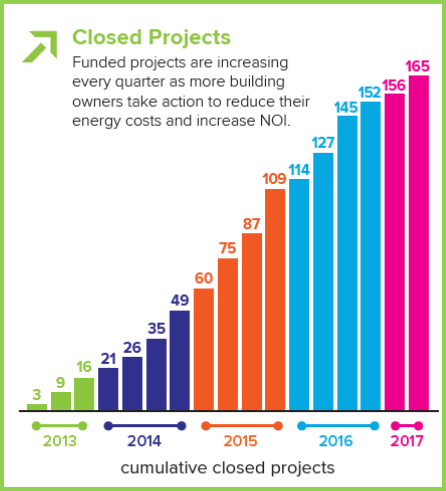
The Connecticut Green Bank’s C-PACE program recently surpassed $100 million in closed project financing. Out of the 19 states with C-PACE (Commercial Property Assessed Clean Energy) programs, this project financing level is second only to California, according to officials. The Connecticut Green Bank’s C-PACE program reached the milestone of $100 million in total closed project financing. The solar photovoltaic (PV) and energy efficiency projects, which vary in size and scope, are saving more than $9.29 million annually in energy costs for nearly 170 building owners across multiple sectors. 

The Green Bank, which administers the C-PACE program, seeks to make green energy more accessible and affordable to commercial and industrial property owners by providing no money down long-term financing for meaningful energy upgrades to their buildings.

C-PACE enables building owners to finance qualifying energy efficiency and renewable energy improvements through a voluntary assessment on their property tax bill. As the program grows, more Connecticut businesses can achieve lower energy costs. Reaching $100 million in closed project financing reaffirms Connecticut’s program as a national leader, officials indicated.

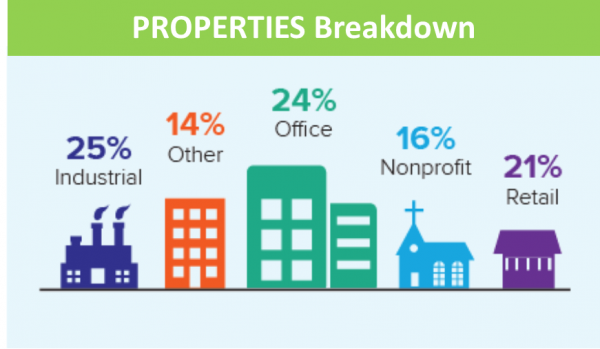
Since its inception in 2011, 166 C-PACE projects have been closed in 69 of the 128 municipalities that have opted into the program. C-PACE funds have been used in manufacturing facilities, non-profits, houses of worship, retail establishments, office buildings, and other business entities.  The projects consist of solar installations, new boilers, energy efficiency lighting measures, HVAC systems, and other energy improvements that help building owners to take control of their energy costs.

“Connecticut’s Green Bank has really been the national leader for C-PACE,” said David Gabrielson, the Executive Director of PACENation, the national non-profit that supports development of PACE programs nationwide. “The way they administer their program has really served as a great example for other program administrators throughout the U.S., and we congratulate the entire Green Bank team on this impressive milestone.”

The project that propelled the Green Bank over this milestone will be installed at Farmington Sports Arena (FSA). FSA is a 130,000-square foot modern indoor sports facility that is home to four indoor and three outdoor artificial turf fields as well as four natural grass outdoor fields. The project, which will be installed by 64 Solar, consists of two solar PV systems (170 kW total).

Connecticut’s C-PACE program maintains an open market approach, allowing private capital providers to finance projects for building owners, and, in 2015, the Green Bank reached an agreement that provided it access to up to $100 million in private funding for C-PACE projects. Today, nearly 70% of the funding in the program consists of private capital.

“The Connecticut Green Bank is a leader in the green energy movement, but the rapid growth of C-PACE wouldn’t be possible without the support of our contractors, capital providers, municipal officials, and other stakeholders who have contributed to the C-PACE movement,” said Mackey Dykes, Vice President of Commercial, Industrial and Institutional programs at the Connecticut Green Bank. “There is still significant potential for energy improvements for Connecticut businesses and non-profits, and we look forward to bringing cleaner and cheaper energy to more building owners across the state.”

The website Energy Collective noted recently that “states have and will continue to play a key role in leading the clean energy transition,” highlighting the work in Connecticut as among the national models.

“Connecticut has found a way to make the financing of clean energy deployment more accessible and affordable for consumers and businesses. In 2011 the state legislature created the Connecticut Green Bank, the nation’s first green bank. It uses public funds to attract private capital investment in green energy projects. By leveraging private investment, the Green Bank significantly increases the total amount of financing available for clean energy projects.

The site highlighted that “Among the Green Bank’s most successful initiatives is the Commercial Property Assessed Clean Energy (C-PACE) program, which allows commercial property owners to pay for clean energy or efficiency upgrades over time through their property taxes.

The Connecticut Green Bank is the nation’s first green bank. Established by the Connecticut General Assembly on July 1, 2011 as a part of Public Act 11-80, the Connecticut Green Bank evolved from the Connecticut Clean Energy Fund (CCEF) and the Clean Energy Finance and Investment Authority (CEFIA), which was given a broader mandate in 2011 to become the Connecticut Green Bank.

https://youtu.be/kPqO4QlTkDU

Jepsen Stresses CyberSecurity at Home and Business, with Settlements and Warnings

National Cyber Security Awareness Month isn’t until October, but Connecticut Attorney General George Jepsen and just over a dozen of his colleagues across the country are getting a head start in warning the public about the dangers of so-called pirate websites. In televised public service announcements now airing in Connecticut, along with social media and radio psa’s, Jepsen shares hackers can infect visitors’ computers with malware and viruses that can leave consumers’ personal and financial information vulnerable.

Cyber security is a topic Jepsen has been involved with for some time.  This past March, the Attorney General announced the creation of a new department within the Connecticut Office of the Attorney General – the Privacy and Data Security Department – that works exclusively on investigations and litigation related to privacy and data security.

The new department has been responsible for all investigations involving consumer privacy and data security. It also helps to educate the public and business community about their responsibilities, which include protecting personally identifiable and sensitive data and promptly notifying affected individuals and the Office of the Attorney General when breaches do occur.

Jepsen is immediate past president of the National Association of Attorneys General (his one-year term ended in June) and has been a member of the organization’s Internet Safety/Cyber Privacy and Security Committee.

National Cyber Security Awareness Month, a month-long collaborative effort between the United States Department of Homeland Security and the National Cyber Security Alliance, began in 2004 and is held every October. During the campaign, individuals are encouraged to take advantage of resources that can help them be safer and more secure while online.

This week, Jepsen’s office announced that Connecticut has joined with 31 other states and the District of Columbia in a $5.5 million settlement with Nationwide Mutual Insurance Company and its subsidiary, Allied Property & Casualty Insurance Company, which resolves the states' investigation into a 2012 data breach that exposed sensitive personal information of 1.2 million consumers across the country. Approximately 774 Connecticut residents were impacted by the breach, the Office said. Connecticut's share of the settlement funds totals $256,559.28, which will be deposited in the state's general fund. The Connecticut Attorney General's office was a co-leader of the investigation and negotiations, along with the Offices of the Attorney General of the District of Columbia, Florida and Maryland.
In May, Jepsen announced that Connecticut joined with 46 other states and the District of Columbia in an $18.5 million settlement with the Target Corporation to resolve the states' investigation into the retail company's 2013 data breach. The settlement represented the largest multistate data breach settlement achieved to date.  That breach affected more than 41 million customer payment card accounts and contact information for more than 60 million customers. Connecticut will receive $1,012,936 from the settlement, which will be deposited in the state's General Fund.

In the new public service announcement, Jepsen stresses that “Nowadays, all of you have to worry about cybersecurity,” Jepsen tells viewers in his ad. “Hackers are always looking for new ways to break into our computers. Something as simple as visiting pirate websites can put your computer at risk.”

"State AGs often serve as the consumer protection agency for their citizens, so we appreciate the leadership they are taking in alerting consumers to the new danger that consumers face from malware and content theft websites," said Tom Galvin, Executive Director of the Digital Citizens Alliance, a consumer-focused group that looks at how to make the Internet safer. "Criminals are exploiting stolen content by baiting consumers to view videos and songs and then stealing their IDs and financial information. It should be a wake-up call for consumers."

Among the states whose Attorneys General are participating in the initiative are Arizona, Hawaii, Idaho, Indiana, Kansas, Kentucky, Louisiana, Montana, North Carolina, North Dakota, Oregon, South Dakota and Wisconsin.


https://www.youtube.com/watch?v=-r1wMnXP9Bk&feature=youtu.be

The Connecticut Attorney General's office has previously issued a series of tips for consumers:

TIP #1: When it doubt, throw it out:

Be very cautious about clicking on a link or opening an email, social media post or tweet (or its attachment) from someone you do not know and trust, and always keep virus protection software up to date. Consumers that use Facebook or Twitter should regulate their privacy settings to ensure personal information is protected and not accessible. Also, only allow those that you know into your social network rather than those that you may not recognize.

TIP #2: Watch out for phishing emails or scams:

You may do business online with financial institutions that you know and trust, however, always keep in mind that legitimate businesses will never ask you to reply in an email with any personal information such as your Social Security number, PIN number. If you question the validity of an email you received, call the number on your credit card, bank statement, or on the financial institution's actual website (which you should find online without clicking on any links in a suspicious email).  If available, always use a safe payment option when making online purchases, such as a credit card.

TIP #3: Keep your machine clean and up to date:

Online users can reduce the risk of their computers being infected with malware by keeping antivirus software up to date and having the latest versions of apps, Web browsers and operating systems. Many but not all software programs will automatically update in order to avoid risks.  Consumers should consider turning on automatic updates when available to be sure that critical updates are not missed while waiting for manual download.

TIP #4: Help to educate your children about online safety and security:

Remind your family to limit how and with whom they share any information on line.  When made available, set privacy and security settings on accounts and web browsers used by children to your comfort level for surfing the Web and information sharing.  If your browser does not support such settings, consider using one that does.  From social media to simple internet searches, it is important to talk to children about online security before they potentially confront risks on line.   

TIP #5: Regularly change and update passwords and web keys:

If you use the Internet for banking, bill-paying or other monetary transactions, be sure to select secure, difficult-to-guess passwords and PINs, and get in the habit of changing them on a regular basis whenever possible. Consumers can also protect their personal and communications data by encrypting their own wireless Internet networks and regularly changing their wifi passwords. Try not to login into any social media accounts on a public computer and if you must, be sure to never save passwords or login information.

Rebuffed Again in CT, Tesla Explores Growth in Westchester

Tesla’s goal of selling vehicles direct to consumers in Connecticut remains elusive, dismissed out of hand by Connecticut’s legislature this year, as last year and the year before.  Even the sole “gallery” the electric car manufacturer and retailer has been operating in the state, in Greenwich, has been ordered by the Connecticut Department of Motor Vehicles to “cease all functions.” Within a stone’s throw of the state line, in Westchester County, NY, the company is actively exploring potential locations for a new car dealership and customer education center, according to published reports. Under Connecticut’s dealer franchise law, automobiles may only be purchased through independent car dealerships.  Tesla’s business model relies on direct-to-consumer sales.

Both a retail center and warehouse in the town of Greenburgh are currently under consideration, Westfair Publications reported this week.  “We’ve been working with Tesla for quite some time now in searching for a proper facility in the area where they can house both sales and service,” said James MacDonald of Simone Development Cos., a Bronx-based company that owns both potential Tesla properties, Westfair reported.

In June, as the Connecticut legislature’s regular session concluded, a proposal that would have permitted Tesla to sell cars directly to consumers was never raised for debate. It made it through the Transportation and Finance, Revenue, and Bonding Committees, but was never called for a vote in either chamber.

House Speaker Joe Aresimowicz said at the time that he was reluctant to say that it was the objections of the state’s car dealers, who are subject to the regulations under the state’s motor vehicle franchise system, that killed the Tesla bill, CTNewsJunkie reported.  The Connecticut Automobile Retailers Association strongly advocated for defeat of the proposed legislation this year, as in previous years.

In New York, Tesla is currently limited to five sales locations, in accordance with a law passed in that state in 2014.  Efforts are underway in New York to increase that number.

A spokesman for Tesla said in June that the company wasn’t quite ready to give up on Connecticut.  Diarmuid O'Connell, Tesla's vice president of business development, said in an interview with the Hartford Business Journal in May that the company hoped to open 10 stores if the legislation was approved, which would "conservatively" employ 25 full-time workers.

"We're talking 250 jobs in the near term," O'Connell said, adding that some locations could employ as many as 50 people, the newspaper reported. The company also released a Greenberg Quinlan Rosner poll showing that 74 percent of Connecticut residents "strongly" or "somewhat" support allowing direct sales in Connecticut.

Tesla is prohibited from selling directly in Connecticut, Michigan, Texas, and West Virginia, according to the company. There are about 1,300 Teslas registered in Connecticut, nearly two-thirds of the electric vehicles in the state, according to the state Department of Motor Vehicles.

In a recent op-ed published in New York, Nick Sibilla of the Institute for Justice, a libertarian public interest law firm, indicated that in a review of employment figures for car dealerships in Massachusetts, New Jersey and New York, the Acadia Center, a nonprofit focused on creating a clean energy economy, concluded that “there has been no negative impact on auto dealer job levels or trends” in nearby states that allow direct sales of electric vehicles.  The Union of Concerned Scientists recently pointed out that “between January and June of 2016, dealers in the Bridgeport to New York City metro area had 90 percent fewer electric vehicles listed for sale than Oakland, when adjusted for relative car ownership.”

Tesla is currently in the midst of raising $1.5 billion as it ramps up production of the Model 3 sedan, its first mass market electric car, with an anticipated pricetag hovering around $35,000, about half the cost of Tesla's previous models, and thought to be more attractive to consumers.  The loss in sales tax revenue to Connecticut could be substantial if sales of the Tesla are not permitted in the state, according to some estimates.

Will the company’s plans impact legislatures in Connecticut or New York?  Back in June, CTNewsJunkie reported Connecticut House Majority Leader Matt Ritter said he thought the issue might be resolved “when you see more Teslas” on the road.  That day may be coming, emanating from Greenburgh if not Greenwich.