Hartford’s Innovation, Manufacturing History Highlighted in Exhibits at Smithsonian and State Capitol
/On Wednesday, July 13, the Smithsonian Institution’s National Museum of American History will make public a special portion of their collection with “Objects Out of Storage: Hartford, CT.” The special exhibit, led by curator Susan Tolbert and historian Eric Hinz, will take place at noontime in the Lemelson Center for the Study of Invention and Innovation in the nation’s Capitol. Describing Hartford’s prominent manufacturing history, Hinz said “Hartford, CT, is a classic story in the history of American technology. If you have ever wondered why people refer to “Yankee ingenuity,” this is what they are talking about.” He adds, “In the mid and late 1800s, the United States overtakes Great Britain as the world’s foremost economic superpower, largely on the strength of its prowess in inventing and manufacturing new technologies. Hartford is at the center of that revolution.”
Hartford, described as “one of the birthplaces of American mass production,” is well represented in the ongoing exhibit, Places of Invention, which “takes visitors on a journey through time and place to meet people who lived, worked, played, collaborated, adapted, took risks, solved problems, and sometimes failed—all in the pursuit of something new.”
 The exhibit notes that by the 1850’s “Hartford became the center of production for a wide array of products—including firearms by Colt, Richard Gatling and John Browning; Weed sewing machines; Royal and Underwood typewriters; Columbia bicycles; and even Pope automobiles.”
The Lemelson Center is located at the Smithsonian's National Museum of American History, Constitution Avenue between 12th and 14th Street NW, in Washington, DC. The Lemelson Hall of Invention and Innovation is located on the Museum's first floor in its Innovation Wing. In the exhibit, which debuted last summer, Hartford is featured with Silicon Valley and just four other locations: Hollywood, home of Technicolor; the Medical Alley of Minnesota, where cardiac innovations of the 1950s flourished; the Bronx, N.Y., birthplace of hip-hop in the 1970s; and the current, clean-energy innovations of Ft. Collins, Colo.
Among the featured innovations on display is the bicycle, manufactured for the first time in the United States in Hartford. As the Smithsonian historian explains, “sensing a commercial opportunity, Albert Pope began importing bicycles from England and hatched a plan to produce them domestically in 1877. Within a year, Pope rode the train from Boston to Hartford, then, ‘to the amazement of the city’s onlookers, 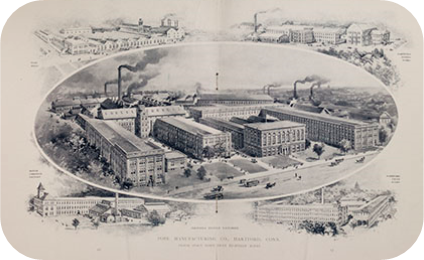 rode his high-wheeler from the station down Capitol Avenue to the Weed Sewing Machine Company.’”
The history continues: “Pope approached factory superintendent George Fairfield with a proposal: would Weed agree to build a test run of 50 bicycles under contract? When Fairfield agreed, Pope (via the Weed Sewing Machine Company) became the first domestic manufacturer of bicycles in the United States. By 1895, Pope’s expanded Hartford operations included five factories set on 17 acres, employing 4,000 workers, making him Hartford’s largest employer.” Pope manufactured bicycles, motorcycles, and automobiles.
That chapter in Hartford history has recently captured the imagination of a well-known Hartford artist, whose cut-paper recreations of that chapter of the city’s transportation and recreation breakthrough is now available for display, having just completed an exhibition at the Connecticut State Capitol.
 Jeanne Manzelli, a resident of Windsor, has a
  BFA in Sculpture from the Massachusetts College of Art and her MED in Art Education from the University of Massachusetts, Amherst. Her experience includes a 20 year career in design, manufacture, appraisal and sale of jewelry, two decades as mural artist working closely with interior designers as an industry professional, and 14 years teaching basic and advanced drawing, sculpture and 3D design as well as color theory at Tunxis Community College.
Her latest endeavor is a departure, and a salute to an innovation from a century and a half ago. The intricate designs, accompanied by information panels highlighting the history, are now available to be displayed at public facilities, such as schools, libraries, and community centers. Manzelli looks forward to sharing her work (and is seeking a sponsor to underwrite the exhibit), as well as stimulating a conversation about innovation in Hartford, then and now.



 suranceQuotes, found that the average increase in premiums across the country when a teen driver is added to an existing policy is 79 percent. That is a slight improvement from a few years ago, when the increase nationwide averaged 84 percent.
 Perhaps the most significant underlying factor is that each state regulates insurance differently, and those regulatory differences account for some of the variations in the study’s findings, according to insuranceQuotes. For instance, Hawaii is the only state that doesn't allow insurance providers to consider age, gender or length of driving experience when determining premiums. That means that the cost for teens doesn't differ much from the cost for adults buying auto insurance. This may also account for lower increases in states such as New York, Michigan and North Carolina, where insurance is regulated more strictly and rating factors are more stringent, insuranceQuotes points out. The increases in those states when adding a teen to an existing policy were all below 60 percent, among the lowest increases in the nation.

 The quarterly survey is released by





 for a proposed mixed use development project at 161-177 State Street, which is phase one of a multi-phase project that includes demolition of the Mills public housing project and implementation of the Harbor Brook Flood Control project north of the Hub site. The new building will be within walking distance of Meriden`s new Transit center.
 In February, the Connecticut Small Business Development Center (CTSBDC), the City of Meriden and The Midstate Chamber of Commerce announced the opening of the newest CTSBDC office, to be located at Meriden City Hall.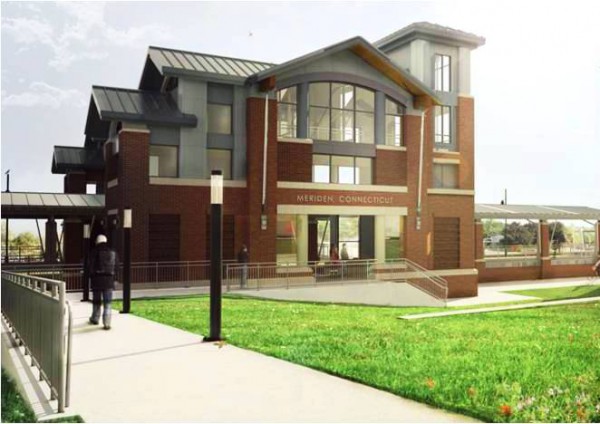
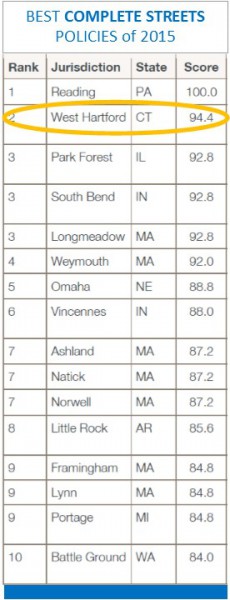 The U.S. Surgeon General and Secretary of Transportation both spoke out for more Complete Streets last year and Congress passed a transportation bill that included Complete Streets language for the first time ever.
 arlier this year, the University of Connecticut released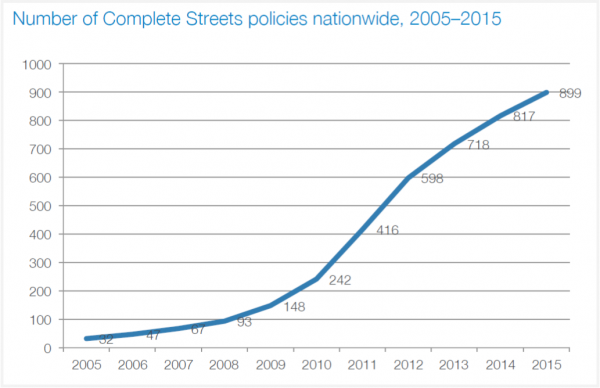


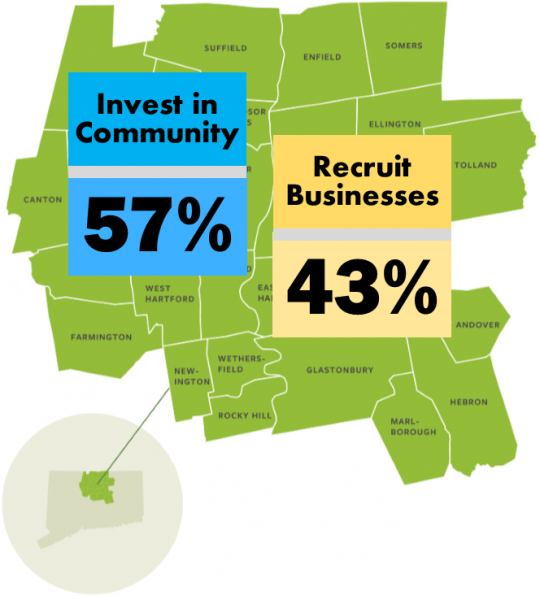 The data from the survey reflect a difference of opinion among older residents of the region. Individuals over age 46 took the opposite view from younger residents, with a majority expressing a preference for spending skewed toward recruiting companies. The reversal was dramatic, with two-thirds of those age 36-45 preferring investing in communities, by a margin of 67%-33%, and individuals age 46-55 expressing a preference for resources to be aimed at recruiting companies, with two-thirds holding the opposite view, 63%-38%.