PERSPECTIVE: Insurance Company Mergers - Why Patients and Consumers Will Not be Better Off

by Frances Padilla Many Connecticut residents still don’t know that by the end of this year, Anthem Insurance Co. and CIGNA may merge—forcing us all into a dire situation.

Anthem currently provides health insurance to about 1.1 million state residents and CIGNA covers just short of half a million.  If the proposed Anthem-CIGNA merger is approved, the resulting mega-insurer will cover 64 percent of covered lives in Connecticut.  Anthem and CIGNA have policyholders in 27 states.

CT perspectiveAdditionally, Aetna, with a Connecticut enrollment of about 500,000, is proposing to merge with Kentucky-based Humana, and recent news accounts speculate that it is contemplating moving its headquarters out of Connecticut.

We at Universal Health Care Foundation have been tracking these mergers since last June.  The plans were made public shortly after the King vs. Burwell Supreme Court decision.  That decision, upholding the subsidies in the Affordable Care act, was a big win for consumers.

However, it was also a big win for insurers; as Wendell Potter pointed out in his blog post.  Since then, the merger proposals were submitted for approval to the Federal Trade Commission and individual states’ departments of insurance. The United States Department of Justice also has to rule on monopoly implications of the mergers.quote

In a letter to the Antitrust Division of the DOJ, the American Antitrust Institute states, “The acquisitions are troubling for two important reasons.  They are likely to substantially lessen competition in numerous health insurance markets in the U.S., to the detriment of consumers. And, crafting relief that would adequately protect consumers is inherently difficult.”

Mergers are justified on the basis of increased efficiency and opportunity for innovation, but past experience doesn’t uphold those claims. The Anthem-CIGNA proposal should be carefully questioned, because it can be expected to increase health insurance premiums, and cause deductibles, co-pays, and co-insurance out-of-pocket costs to spike.

Cost is already a major reason why consumers put off care. A Consumers Union poll found that costs are a “top of mind” worry for consumers, whether they are insured or not.  Thirty-five percent of respondents reported relying on home remedies or over-the-counter drugs instead of going to see the doctor when sick. Another 27 percent did not fill a prescription for needed medicine.

The Kaiser Family Foundation reports that for Connecticut, the average combined employee contributions to health insurance and deductibles doubled from 4.2 percent of income to 8.8 percent between 2003 and 2013, as a percent of median household income.  Workers are faced with increasing cost-sharing shifted to them by employers, many of whom are self-insured, and contract insurers to provide administrative services.  The use of high deductible plans, widely viewed as “under-insurance,” has taken off.

The Foundation has been using the image of two sumo wrestlers with the consumer and patient caught between the insurers and the hospitals. Hospitals merge, develop new revenue centers, acquire physician practices and create mega-systems with bargaining power over insurers.  And insurers merge to gain bargaining leverage, creating monopolies to protect the value of their stocks and meet shareholder expectations. Meanwhile, patients and consumers are left bereft of necessary care and shouldering the burden of medical debt.

https://youtu.be/eTRXFzb_U6c

Final resolution of the insurer mergers is in a holding pattern.  No one knows when the DOJ will rule on the antitrust issues, though. It may be in the next few months. Most state insurance commissioners are waiting for that decision to render theirs.  Some state statutes require public hearings, but most don’t.

percentageSome observers think “all eyes are on Connecticut” with how the Anthem-CIGNA merger is handled here, given the market concentration that can be expected.  Connecticut statutes require our insurance commissioner, Katherine Wade, to evaluate the financial solvency of the merging companies and the benefit to policyholders.  She is a national leader among insurance commissioners and faces some criticism here for her refusal to recuse herself, given her ties to CIGNA.

The Department of Insurance is not required by statute to consider the impact of a proposed merger (or of rate hike increases) on affordability to policyholders.  Public hearings held in the past have been held at times and locations inaccessible to most consumers. They do accept testimony online, but few people provide it.

It is not yet clear when there will be a public hearing called in Connecticut. We do know that there has to be 30 days public notice.  And we have been told that there is interest in hearing from consumers, health care providers and employers.

Contact us if you want to have your voice heard by state officials, and join us to make sure people’s interests are put first.

_________________________________________________

Frances Padilla is President of Universal Health Care Foundation of Connecticut

anthem-merger

PERSPECTIVE commentaries by contributing writers appear each Sunday on Connecticut by the Numbers.  

Last week: 2016 to be a Year of Power Shifts and Workforce Facelifts.  


PERSPECTIVE: 2016 to be a Year of Power Shifts and Workforce Facelifts

by Thomas Phillips and Sandra Rodriguez With New England as clearly the oldest region in the country with an average age of 40.3 years,[1] there significant retirements are expected for the next 15 years that will have a profound impact on the size and quality of our labor force.

Yet, with workforce demand at high levels, the supply side isn’t sufficient to meet employer needs.  There are many reasons for this supply/demand mismatch.

CT perspectiveNOT ENOUGH PEOPLE.  The growth rate of the US population aged 18 to 64 is rapidly decelerating and will remain very low through 2030.[2]  That should translate into a continued difficult time in finding qualified workers, while the knowledge base within businesses and organizations is eroding.

NOT ENOUGH HARD and SOFT SKILLS. There is a perceived shortage of people with the hard and soft “essential” skills both required and desired by hiring professionals.  This may be why nearly half of those jobless in Connecticut and neighboring states are considered long-term unemployed.[3]  The technical skills these individuals possess are no longer applicable and essential skills get “rusty” when not used over a period of time.  For the younger population, these skills are often untested.

NOT ENOUGH INTEREST FOR THE JOBS IN DEMAND.  Demand is high for healthcare and manufacturing workers.  Construction employment has also been increasing in Connecticut[4] and is expected to continue to rebound over the next few years.[5]  However, according to The Hartford’s 2015 Millennial Leadership Survey (published by The Hartford), less than 7% of the younger generation interviewed responded favorably to wanting careers in Manufacturing or Construction.  Fortunately, 31% of the 18-34 year olds interviewed said their interests lie in healthcare, but percentage-wise, they are more interested Arts and Entertainment, Education and Technology.

NOT ENOUGH COLLABORATION. As Connecticut and the New England region is facing economic quotechallenges, an aging workforce, and lack of coordination and overlap in services, now is the time to create more public / private partnerships to drive success.

PROMISING APPROACHES.  The Supply/Demand Workforce mismatch can’t be solved by any one organization, with any one grant or source of funding, or with any one strategy.  In North Central Connecticut, Capital Workforce Partners and other collaborative organizations are stoking the pipeline with skilled talent, in areas of current or expected business demand through a web of integrated partnerships.  Here are just two examples:

MOVEUP! COLLABORATIVE. This is a collaborative effort among 26 adult education providers, workforce training programs and community colleges to improve adult literacy services in the Capital Region of Connecticut.  Move UP!’s partners envision a regional adult literacy system that offers a coordinated continuum of literacy services, childcare, counseling and other social service support, career pathways that lead to well-paying jobs and coordination within the community to get the work done.

HARTFORD OPPORTUNITY YOUTH COLLABORATIVE.  This Collaborative includes leaders in education, youth development, and workforce development committed to addressing the education and employment needs of 16 to 24 year old disconnected youth (not in school and not working or no high school diploma) otherwise known as ‘Opportunity Youth.’  With financial support from the Aspen Forum for Community Solutions, Hartford Foundation for Public Giving, and the Social Innovation Fund (as a subgrantee of Jobs for the Future), a full scale, multi-year comprehensive plan has been developed and several youth-centered programs are underway.

These initiatives share one common thread – partnership between business, workforce development, education, economic development and government.  In this new year of power shifts and workforce facelifts, it will take all community stakeholders together to ensure there are enough people, trained and ready to work in the jobs that are in demand today and will be in demand tomorrow.  It will take public/private partnerships to guarantee that the education system is preparing youngsters with the mastery they will need to be successful in their career pathways.  And it will take groups with differing ideologies and competing missions to continue to convene and collaborate until as much common ground can be identified as possible for progress.

_________________________________________

Thomas Phillips is President and CEO, and Sandra Rodriguez is Communications Director, at Capital Workforce Partners, which provides a range of services and training to job seekers and businesses.  Learn more at www.capitalworkforce.org

PERSPECTIVE commentaries by contributing writers appear each Sunday on Connecticut by the Numbers.


[1] 2010-14 American Community Survey 5-Year Estimates

[2] Conference Board: “From Not Enough Jobs to Not Enough Workers What Retiring Baby Boomers and the Coming Labor Shortage Mean for Your Company” Publication Date: September 2014 Report Number: TCB-R-1558-14-RR. Data Source:  The Census Bureau

[3] Nick Difiesta and Derek Thomas, MPA, Connecticut Voices for Children, “The State of Working Connecticut 2015,” November 2015

[4] Connecticut Department of Labor

[5] Economic Modeling Specialists International (EMSI)

PERSPECTIVE: Is Mama Drama Impacting a Woman’s Ability to Give Her Daughter the Chance to Be Her Best?

by Heather Freeman Mothers are powerful role models. They leave an indelible imprint on a girl’s self-identity starting from before birth. When her imprint is that which supports a healthy dose of self-love and confidence, her daughter can develop her own sense of self, separate from her mother’s. She will grow up to be confident about her strengths and talents, and capable of taking the lead in her health and wellbeing.

perspective squareHowever, this is a rare occurrence. More often than not mothers unconsciously carry an imprint which keeps them from giving their daughters the chance to be their best. This imprint then gets passed on, leaving the next generation of girls carrying on a legacy of self-doubt and low self-esteem. Our point of power as women is to know that we do not need to repeat our mother’s unconscious legacies – that our past does not script our future. And the moment we decide to break the cycle we can then truly awaken to our potential.


According to board-certified ob-gyn and New York Times best-selling author Dr. Christiane Northrup, a mother’s belief system about health and life in general becomes the daughter’s way of being. “If your mother was happy, healthy, vibrant, and loved her menstrual cycle, her breasts, and her body in general, then your health legacy will in general be optimal. If your mother was a smoker, anorexic, depressed, self-absorbed, or anxious, this may adversely affect your confidence and overall wellbeing.”

Jaqueline Lapa Sussman, MS, LPC, a practitioner of Eidetic Imagery Psychology (a fast moving methodology which allows one to go beyond their rational surface mind and uncover stored images of their potential and wholeness) says “Image Psychology research in the last half century has shown that our mother’s influence is wired into our brains and color our automatic knee jerk reactions to life.” Throughout a girls childhood a mother’s emotional wellbeing is communicated through her tone, body language, and actions, which programs her daughter with attitudes that affect her for the rest of her life. A girl grows up and takes that image from her mother (good or bad) with her to her adult life, and if she decides to become a mother, she then imprints that image with her own children.

The journey into motherhood provides women with a unique opportunity to break the cycle, to lead their lives and their daughters from a conscious, empowered space. When they boldly step into this power they are able to create a safe relationship with their daughter. The type of relationship that girls have voiced they need in order to communicate about and navigate their lives.

The Girls Scout Research Institute Report (2003) revealed emotional safety is as important as physical safety for girls. The relational model, developed by Jean Baker Miller, M.D., author of the groundbreaking book Towards a New Psychology of Women, offers a paradigm shift in our understanding of human development and of society as a whole.  Dr. Miller's relational model proposes that growth-fostering relationships are a central human necessity and that disconnections are the source of psychological problems.quote

The path to providing this safe space is better communications and a deeper understanding of the role interpersonal communication plays in creating a safe space. Interpersonal communication is a mutual relational, co-constructed process which John Stewart, Ph.D. Professor of Speech Communication at the University of Washington, identifies as a process, as opposed to something that one person does "to" someone else. The relational aspect of the process -- the fact that communication takes place between people and influences every aspect of their relationship -- is central to understanding why certain communications succeed while others falter.

Every time people communicate, they offer definitions of themselves and respond to their perceived definitions of the other(s). However, since these perceptions are always subjective, and therefore inherently judgmental, communication often leads to misunderstandings and bad feelings -- causing people to shut down.

A mother’s job is complex. There is no doubt she tackles it with the best intentions - and not everything a woman has learned from her mother is considered bad or damaging. There are certainly parts of the imprint that a women will want to take with her into her adult life and there are always gifts in the shortcomings one has received.

However, our point of power as women is to know that we do not need to repeat our mother’s unconscious legacies – that our past does not script our future. And the moment we decide to see the legacy that has been passed on to us and to reflect, honor, and pay tribute to that legacy, is the transformational moment when we can move forward with a new life enriching story.  We can then set our mind, body, and souls free and empower the next generations to come.

__________________________________________

Heather Freeman, founder of the Gutsy Girl Club, is a resident of Colorado via Connecticut. As a transformational empowerment coach, she works with a spirited community of women who deeply support one another, build each other up, and provide a safe, supportive space to promote mothering from a place of authentic self-identity and a strong connection to one another.  The free report Survival Tips for Raising a Gutsy Girl  is available online. Learn more at www.gutsygirlclub.com

PERSPECTIVE commentaries by contributing writers appear each Sunday on Connecticut by the Numbers.

PERSPECTIVE: Is Philanthropy Women’s Work?

by Mary Cahalane The numbers

In Connecticut, the nonprofit sector employs almost 14% of our workforce. Connecticut nonprofits generate $33.4 billion in revenues annually. Individuals in Connecticut contribute $2.7 billion a year. The sector is important to our state.

Recently, I wrote about the struggles of balancing work and life – especially for those of us in the nonprofit world.

Stress is a real problem in the sector. And it’s getting in the way of our organizations’ missions.

PageLines- CTperspective.jpgThe New York Times article that inspired my original post looked at the problem of stress in our lives.

The author suggested as a society, we’ve separated caregiving and work. Work we prioritize; caregiving is sidelined. And the need for both in our lives puts a great deal of pressure on the people who are caregivers – mainly women.

The impact on women in the nonprofit sector

Our approach to caregiving versus work is also holding women back. The need to juggle so many responsibilities at work and at home becomes impossible.

Women in Connecticut make up almost 70% of private nonprofit salaried workers. Yet median wages for women are $46,004 compared to $60,168 for men.

Nationally, it’s the same: nonprofit workers are also overwhelmingly women. Yet men fill most of the leadership roles – particularly in larger organizations.

The impact on nonprofit organizations

Dan Pallotta wrote a piece for The Daily Beast 6 years ago, Gender Trouble at Nonprofits. One paragraph really whacked me in the face.quote

Charity is not allowed to use the same tools as business because society subconsciously regards it as female, and discriminates against it the same way it has historically discriminated against women. Charity is subservient. The for-profit sector heads to the office every day to do the real business of the world, while charity stays at home and dabbles in idealism and sentiment. Even the governing structure of charity is patriarchal; business people direct nonprofit staff—seven in 10 of whom are women—from the perches of their board seats.

Wow.

We have a leadership problem

Here’s the irony of it all, though. When you survey people about the most important leadership qualities, they’re the ones most associated with women.

Diversity is needed to build a strong organization. We applaud it in theory, but struggle with it in practice. That’s not lip service, that’s fact. Surveys point to a need for the qualities women score more highly on. These traits include “expressive”, “plans for the future”, “reasonable”, “loyal”, “flexible” and “patient”.

Why the disconnect? An article in the Harvard Business Review talks about second generation bias – unconscious, unintentional, but still present.

It’s a trap for women: men who score high on likeability are also seen as more competent leaders. For men, the two leadership traits are complementary. Women are seen as less competent if they’re more likable.

This infographic from TCC Group makes the problem of gender diversity in our sector quite clear.

Double whammy?

Nonprofit organizations must work twice as hard to care for the needs of the world. And as Pallotta says, they’re denied many of the tools used in the for-profit world. Somehow, we’re supposed to innovate without investment. We’re supposed to care for people while not caring for our employees.

Nonprofit work is seen as less important – even though it’s desperately needed. (And not likely to be done by the private sector.)

That’s bad enough. But then within our sector, women are still fighting for a place at the grown-ups’ table.

So what can we do?

We can mentor. We can push for flexibility. We can be conscious of bias when we hire or promote. We can model kinder, gentler organizations.

But what’s needed to create real change is leadership.

We need leaders with those qualities usually identified with women.

We need the loudest voices to be those who value empathy, vulnerability, loyalty, flexibility and patience.

This isn’t only about what’s just.

It’s about what’s best for the sector and for the world. It’s about effectiveness.

We’re killing ourselves to save the world.

Doesn’t that mean we’re doing it wrong?

___________________________________________

Mary Cahalane is a nonprofit fundraising consultant, and author of the blog Hands-On Fundraising.  She has more than 30 years of experience with community-based organizations, major regional theaters and a variety of nonprofit organizations in Connecticut and beyond. 

PERSPECTIVE commentaries by contributing writers appear each Sunday on Connecticut by the Numbers.

PERSPECTIVE: Gun Reforms vs. Gun Servants

by Dick Polman Why do Republicans nauseatingly refuse to address America's gun murder epidemic? Why are they so determined to sustain our well-earned reputation as the most violent nation in the civilized western world? Why are they jerking their knees in reflexive opposition to President Obama's modest attempts to defend our right to remain alive?

Of course we know why. It's Obama hatred and gun lobby love.

You would think, judging by their tiresomely predictable reactions, that Obama is poised to dispatch an army of flying monkeys to swoop into American homes and spirit away the 270,000,000 guns that we apparently hold dear.PageLines- CTperspective.jpg

But this fever swamp rhetoric is flatly contradicted by reality. Obama is basically tweaking existing gun laws to make them work better. Which is exactly what Republicans have been urging all along.

For instance, the federal background check system is notoriously understaffed and under-financed. Under federal law, if the FBI can't complete a check within three days, the buyer gets his gun without the check having been completed. That's what happened last year in Charleston, South Carolina. Remember the white racist terrorist who killed nine people at the historic black church? He got his gun because the understaffed feds didn't obtain his criminal record within the mandated three days.

So Obama is beefing up the background-check system - directing more money and manpower to weed out the criminals and mentally ill. Plus, he's earmarking an extra $500 million to mental-health services, to better help those who have woes between their ears.

Yet the Republicans don't like any of that.

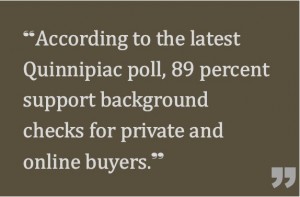
Obama also took action to close loopholes in existing laws - most notably, the one that allows people to buy guns, without any background screening, from private sellers and online sellers. Isn't it logical to tweak existing laws so that everybody gets screened prior to buying bang-bangs? The American public certainly thinks so; according to the latest quoteQuinnipiac poll, 89 percent support background checks for private and online buyers.
The Republicans don't want any of that, either.

Requiring shippers to report stolen guns - that makes sense, too. Investing in advanced technology so that kids can't accidentally pull gun triggers - that makes sense, too. And yet, not a single Republican has spoken up to say, hey, that's a good idea.

Instead, all we got was the usual pap, plus a lot of whining about Obama's alleged kingly behavior. They're basically complaining that Obama is doing end-runs around the Republican Congress, somehow forgetting that the Republican Congress is invested in doing the gun lobby's business by doing nothing. Just last month, in fact, it squashed a bill designed to beef up background checks.

Kathleen Parker - the center-right political columnist, no friend of Obama's - says it well on Wednesday: "In fairness to the gun lobby, which may not deserve such charity, one can understand reservations about limiting access to guns. What is less easily understood is the refusal of Republicans to take the reins of any given issue and do something constructive rather than invariably waiting to be forced into the ignoble position of 'no.' It is one thing to be in the pocket of the National Rifle Association. It is another to do nothing and then assume a superior posture of purposeful neglect, as though do-nothingness were a policy and smug intransigence a philosophy."

Can Obama's executive actions substantially curb our annual gun murder epidemic? No way. We have too many guns in circulation for that to happen. He freely acknowledged that on Tuesday, saying, "We know we can't stop every act of violence, every act of evil in the world.  But maybe we could try to stop one act of evil, one act of violence."

There it is - the desire to save at least a few of the lives that would otherwise be lost. Doing something to dent the death toll sure beats thoughts 'n' prayers.

Or to paraphrase the Talmud, "He who saves a single life, saves the world entire."

__________________________________________

Dick Polman is a former columnist at The Hartford Courant and was founding editor of The Hartford Advocate.  He is the national political columnist at NewsWorks/WHYY in Philadelphia and a "Writer in Residence" at the University of Pennsylvania. Email him at dickpolman7@gmail.com. Copyright 2016 Dick Polman, distributed exclusively by Cagle Cartoons newspaper syndicate.

PERSPECTIVE commentaries by contributing writers appear each Sunday on Connecticut by the Numbers.

PERSPECTIVE: Consider the Meaning of Language Before You Use It – Or Prepare to Lose

by Paul Steinmetz A university is a wonderful place to work if you like the energy of young people, smart coworkers who are trained to challenge the status quo, and the clanging excitement that the combination creates. You will also notice that the inhabitants of universities and colleges sometimes get themselves knotted up in problems that others don’t face, and they often involve the use of language.

One reason for these issues is that there are a lot of constituencies of higher education, and trying to please them all might be impossible.

Complicating the situation, colleges and universities are often at the forefront of trends in lifestyle and other thinking, which means the words we use to describe these new things are not well defined or accepted. It’s very easy to be well-meaning and yet upset someone.

Finally, you have professors who are very definite in their opinions and students who are enthusiastic in their challenge of such opinions.

The occasional result: chaos, misunderstanding and anger.

perspective squareHere are a few examples:

At the University of Tennessee at Knoxville, an administrative office published a guide of pronouns that transgender people might prefer. The list included ze and hir or zir instead of he/she and her or him. Xe and xem would take the place of they and them.

The education trade journal Inside Higher Ed reported that the guide “created a political uproar in the state.” The university president ordered the guide removed from the UT website, saying, “The social issues and practices raised by the Office for Diversity and Inclusion are appropriate ones for discussion on a university campus. However, it was not appropriate to do so in a manner that suggests it is the expectation that all on campus embrace these practices.”

At Washington State University, a professor wrote a syllabus that banned the use of certain words in class and promised punishment to any students who used the words.

From the syllabus:

“Use of racist, sexist, homophobic, transphobic, xenophobic, classist or generally offensive language in class or submission of such material will not be tolerated. (This includes ‘The Man,’ ‘Colored People,’ ‘Illegals/Illegal Aliens,’ ‘Tranny’ and so on — or referring to women/men as females or males.)”language quote

The university administration acknowledged that the professor was attempting to provide a safe and supportive learning environment for everyone. But it pointed out that the syllabus probably violates the First Amendment and ordered all professors “to ensure that students’ right to freedom of expression is protected along with a safe and productive learning environment.”

Finally, you might think that the definition of genocide is clear-cut, but it’s not. Sacramento State University in California is the most recent institution to teach us this.

A sophomore there says her professor threatened to kick her out of class after she allegedly challenged his statement that the term “genocide” wasn’t appropriate for U.S. settler and government actions against American Indians.

Again according to a report in Inside Higher Ed, the professor allegedly said that genocide implies intention and, in his opinion, most native people were killed by European diseases.

The student said she was “enraged” by that statement and a couple of days later she debated the professor in class and began reading out loud the United Nations’ 1948 definition of genocide. The professor asked her to stop, inviting her to talk to him after class rather than “hijack” his lesson. Social media and bloggers reported on the confrontation and the university is investigating exactly what happened in the classroom. (The Inside Higher Ed article offers examples of the many variables considered in deciding what is and what isn’t considered genocide.)

Although none of these situations occurred at the university where I work, I pay attention to them because it would be my task, along with many others, to advise on a response to such an uproar should it happen here.

As a professional writer and public relations practitioner, I often say that anticipating problems and addressing possible issues is usually better for an organization, and individuals, than moving ahead without thinking about the consequences of words. Language is sometimes volatile and has the potential to convey things not intended if mishandled. My other advice is that, when about to engage in potentially controversial activity, you should always let the boss know what you are doing. He/she/ze might later backtrack, but at least you have communicated thoughtfully and clearly. And that is what is important.

________________________________________________

Paul Steinmetz is director of Public Affairs & Community Relations at Western Connecticut State University. As the founder of Writing Associates, he consults on writing issues for businesses and individuals. If you want to discuss a writing issue, contact him at paul@paulsteinmetz.com.

PERSPECTIVE commentaries by contributing writers from across the state appear each Sunday on Connecticut by the Numbers.