PERSPECTIVE: The Midnight Art of Pavement Markings

by Jennifer Paquin The long and short of line painting is – the world needs it! It keeps chaos at bay. Imagine going to a mall that does not have pavement markings, especially during the holiday season. Pavement markings help prevent accidents and, at the scene of an accident, are often used to determine fault. The markings are for your safety: they protect you and, most importantly, they guide you to where you want to go.

If you’ve ever traveled on a newly paved road or parking area before the markings have been painted, you quickly realize how dangerous life would be without them.

While you are sleeping somewhere soft and warm – workers in this profession are painting lines on parking lot pavement that will tell you where to park, turn, and stop when you pull into school, or a store, or the dentist’s office, tomorrow morning. CT perspective

This is the world of highway and pavement “marking,” also known as line painting or line striping. It is one of the few services performed in the dead of the night, so that parking stalls, arrows, fire lanes and those cross-hatches will seem to have magically appeared when you arrive at work or hit the road the next day.

A typical night has many challenges, and on occasion, unexpected surprises. First we position our trailer in a safe, central location, which allows for quick and easy access to paint cans and necessary tools. Then, we wait. And wait. For the parking lot, or at least a section of it, to empty out. This could take minutes or hours, depending on how cooperative people are, intentionally or unknowingly.

And yes, there is always that one car. No one knows who it belongs to or how long it has been there – or how long it might remain unmoved. Patience is a requisite. This is especially true when you realize that you have finished painting an entire lot, loaded everything back into the trailer to head home, and then along comes the person who owns that one car.   q1

If the job is to repaint over old lines, the work begins with cleaning each line with a broom and a leaf blower. Next, we measure lines that are completely faded out, mark them with yellow crayon, and snap each line with blue chalk from a snap-line. This process, which can take hours, has a rinse, repeat cycle to it. If the weather is windy, the chalk dust will fly everywhere except on the line.

If the job calls for a brand new layout (as with new pavement for a new business) then additional time must be factored in. The measuring is more precise and close attention must be paid to the contractor’s blueprint. Strong math skills, along with precision and patience, are necessary in this profession if the job is to be done right.

The machine needs to be loaded with paint and the paint gun positioned based on what type of work will be done first. The process of filling the paint machine usually goes smoothly; however the paint must be strained through a colander to ensure that no lumps will block the machine pump. Lumps can shut down the whole operation from minutes to hours while the pump is taken apart to locate, and then relieve, the blockage.

Paint color is determined by the business owner or the town. Yellow is preferred for visibility, especially during the winter months. The paint gun position is a trial and error process with an array of different sized gun tips available. For example, when painting stencils such as the Handicapped symbol, a larger tip is used. A large fabric tarp is placed on the ground to pre-test the width of the spray. The objective is for the paint gun to spray a four inch wide line.

Then come the “stalls.” There are three types: Standard, Hollywood, and Handicapped. (Yes, it is really called “Hollywood” in the industry.) A Standard stall consists of two lines, nine feet wide by eighteen feet long; a Hollywood stall consists of two rectangular boxes, one on each side of the stall, to allow more room when opening vehicle doors; and the Handicapped stall size and layout is determined by the Americans with Disabilities Act, and the town.

q2Constant alertness is needed on a job site. Cars and pedestrians can appear quickly, seemingly out of nowhere, so both painter and assistant need to watch and listen attentively, especially when the paint machine is running. Reflective vests and pants are a safety must, and a flashlight should be hooked onto your clothing as well, to be ready at all times.

Interruptions will occur throughout the night. People ask questions about what we are doing; onlookers are fascinated by the process; and cars can slip in and park without notice on larger jobs.

There is a lot of running around; it is in the nature of the job. Often, people come by to ask for directions, and as the night goes on, the questions can get strange. My favorite question has been, “Where is the nearest grocery store?” – as we were painting the grocery store’s parking lot! Another common question, “How long does it take for the paint to dry?” Answer:  It depends on temperature and weather conditions. On dry, hot days, it takes about fifteen minutes or less; but, when the temperature drops, drying time can take up to two hours.

When the sun starts to rise and the job is completed, we usually get a few early birds entering the lot before the paint has fully dried. Some people are annoyed about being re-directed to a different parking area, especially if they are late to their destination. Sometimes we have no choice but to reluctantly let them go, as they drive through the orange cones, because they have already driven over the paint that needed just a little more time to completely dry.

And now, as the clock reads 6:00 a.m., and the dawn awakens a new day, we are heading home. Another hundred-plus stall parking lot awaits us tomorrow.

________________________________

Jennifer Paquin is a seasoned legal marketing and business development professional, residing in Tolland County. She is currently writing her first novel and can be found frequently assisting her husband with his line painting business, A&A Line Painting.

PERSPECTIVE commentaries by contributing writers appear each Sunday on Connecticut by the Numbers.


PERSPECTIVE: CT Independent Colleges Among National Leaders in Student Completion; Working to Reduce Disparities

by Jennifer Widness Recent news coverage labeling Connecticut’s private, non-profit institutions of higher education as “drop-out factories” is a flawed conclusion based on incomplete data and requires additional scrutiny.  While more always can and should be done to improve the outcomes for low-income students in our higher education system, Connecticut’s private, non-profit colleges have made this issue a priority and in fact are among the nation’s leaders in completion rates for all students.CT perspective

First, let’s address the limitations of the data used in the report.  To conduct their analysis, the authors from the Washington, D.C. think tank, the Third Way, used data compiled for the U.S. Department of Education’s College Scorecard.  As the authors noted in their study, but the reporter failed to mention, this data set only includes full time, first time students that have received a federal loan.  This accounts for less than 40% of the undergraduate students enrolled at these institutions.  There is no accounting for students that transfer, in or out, or a student that has taken a semester off and returned.  Given the evolution of how people access higher education, thquote1is is a significant omission.

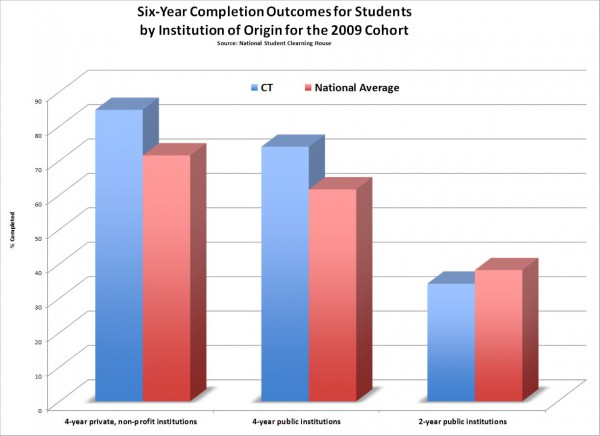
Graduation rates are complicated and hard to calculate given limited access to good data but the National Student Clearinghouse is the most complete data set available as it does have the capacity to track transfer students.  As illustrated in Figure 1 below, it recently calculated the 6-year completion rate for students that began at a four-year private, non-profit institution in Connecticut at 84.72%.   This is the second highest completion rate in the country and ten points above the national average for the sector (20 points above the national average for the 4-year publics).  Connecticut’s private, non-profit institutions are some of the most productive in the nation.

Further, the authors misappropriated the term “dropout factories” by applying it to institutions with graduation rate of 75% or less.   This is a threshold used for K-12 schools by the U.S. Department of Education.   If all higher education institutions with a graduation rate of less than 75% using data compiled by the College Scorecard were considered “dropout factories” nearly all institutions in Connecticut, public and private, would fall into that category.  See for yourself here.quote2

Nuances with the data and terminology used in this particular report aside, average completion rates in all sectors of higher education across do need to be improved.   While Connecticut’s higher education institutions have some of the highest completion rates in the country, our state faces one of the largest post-secondary degree attainment gaps between whites and minorities.  The authors of the Third Way are right to point out that high-risk populations need greater access to higher education.   We agree.

This has been a priority, and always will be, for Connecticut’s independent colleges.

CCIC’s member institutions have redoubled efforts to focus on this challenge by providing more resources to student support services, increasing financial aid to unsustainable levels and creating innovative programs that support a diverse student body to enroll, persist and complete college.

The state, on the other hand, also needs to chartplay a greater role in this area. Why?  Connecticut’s Strategic Plan for Higher Education lays it out perfectly.  In essence, our economy will increasingly require a talented, well-educated workforce to thrive and the only way to guarantee this talent pool exists is to ensure our state residents have access to and complete a post-secondary education.  While severe budgetary constraints exists given shrinking revenues, we cannot afford not to do a better job in coordinating this work across all sectors of higher education and the workforce.

Connecticut is fortunate to have some of the best, most productive and diverse public and private higher education institutions in the country.  Labeling them inappropriately is untrue – and even worse unproductive.  These institutions are some of our state’s greatest assets.  If we want to see Connecticut grow and thrive again we have to capitalize on our strengths and put these institutions to work.

____________________________________

Jennifer Widness is President of the Connecticut Conference of Independent Colleges


PERSPECTIVE commentaries by contributing writers appear each Sunday on Connecticut by the Numbers.

Also of interest… Do Community College Students Go Begging?

PERSPECTIVE: Can Trust be Restored?

by Peter F. Eder The public’s trust in just about everything continues to be at historically low levels and there is every indication this trending will continue its downward slope.  Not just trust in federal government action but all levels and branches of government, as documented by any number of ongoing Pew Research Center and Quinnipiac Polling Institute studies.

Just one example would be the Pew Research Center’s November 23, 2015 report, entitled: “Beyond Trust: How Americans view their government.”  The top line finding was that fewer than three-in-ten Americans have expressed trust in the federal government in every major national poll conducted since July 2007 – the longest period of low trust in government in more than fifty years.  The survey reported that increased distrust in government exists for every party, across the demographic spectrum and generation clusters, and extends to diminished belief in government fairness.CT perspective

And while distrust is perhaps most manifest these days in politics, the same billowing distrust exists when respondents are measured about credibility in media outlets, financial institutions, religious organizations and seemingly any private or public institution.

Living in a digital age also makes it harder to figure out what is trustworthy.  When it is easy to find confirmation for almost anything ordinary, grave or absurd, with contradictory information and rival sources, determining trustworthiness is truly challenging.

All this seems based on the continual distortion of truth, no sense of compromise, and the polarization and self-serving nature of almost all collective and individual behavior.quote

If we accept this as current reality, the critical question is “How can Trust ever be restored?”  Let me suggest what might have to occur.  First of all, we have to find leaders who will put others first.  It will be individuals who recognize that their neighbors aren’t just the persons who live next to them or who share the same views, values, and interests, but those that inhabit every space around themselves.  We need individuals whose personal experience have guided them through tragedy and triumph, without fostering a mindset that they are championing their own advancement.

q2To those of us who look to – or up to – them, we need an open, inquiring, compassionate mind.  We need to set aside the rush to judgement, to listen to all sides of an issue, to take the time to search out the truth, to separate the hype from the reality.
In time past, these attributes ensured the common good.  Who will take the first leadership steps and who, as followers, will listen, encourage and emulate them?  Or is it sadly already too late?

________________________________

Peter F. Eder is a retired marketing executive, AARP Connecticut community volunteer and a founding board member of At Home In Darien, his community aging-in-place organization.  Throughout his career, he has been involved with local and national organizations within the communications arena and in responding to acute needs of people in our communities.

PERSPECTIVE commentaries by contributing writers appear each Sunday on Connecticut by the Numbers.

Also of interest:  Freedom's Just Another Word For 

PERSPECTIVE: Why Now is the Time to Invest in CT’s Downtowns

by John Simone Over the last few years, there has been a tremendous acknowledgement of the importance and appeal of downtown.  Numerous studies have quantified this issue in myriad ways:

  • showing the common demand among millennials and baby boomers for walkable town centers – whether they be in urban, suburban or rural communities;CT perspective
  • noting that money spent downtown stays downtown (in stark contrast to big-box retailers);
  • showing that each new unit of downtown housing translates into thousands of dollars’ worth of business for the downtown; and
  • finding that by even modest estimates vacant storefronts cost communities hundreds of thousands of dollars in lost tax revenue and rents each year.

At this point, it’s also widely agreed that development in these typically compact areas is amongst the most sustainable, environmentally friendly and economically robust thanks to ready infrastructure and a diverse mix of uses, businesses, and housing.

Connecticut especially is becoming hyper-sensitive to the importance of energetic and robust town centers as it finds itself in the midst of many opportunities and challenges.

First and foremost, our downtowns can provide the authentic, walkable communities needed to attract and retain the talented workforce Connecticut needs to compete locally, nationally and internationally. This is of particular importance because Connecticut is currently facing the dual burdens of a ballooning aging population coupled with a declining population of 18-34 year olds – both of whom increasingly want to be in walkabq1le, more active and transit-accessible downtowns.  At the same time, an increasing demand for downtown living is paralleled with a general lack of diverse and affordable housing choices. Upper story space in existing older buildings is vacant and available, but expensive to renovate.
Connecticut’s downtowns also represent the greatest chance to restore social and economic balance to a state known to have both the richest and poorest neighborhoods, a divide that needs to be healed if true prosperity is to be gained.  Creating robust downtowns will also ensure success of the State’s $1.5 billion investment in transit (notably CTfastrak and railway upgrades) which is already creating demand for development around these transit stations.

Given these tremendous opportunities and obstacles, it’s little wonder the Connecticut Main Street Center (CMSC) is being increasingly called on to further demonstrate the economic return of attractive, engaging and well-managed downtowns.

To meet this growing need, CMSC recently adopted a new strategic plan to guide us as we take on more of a lead role in calling for greater investment in our town and city centers. Not only will we proactively advocate for increased financing for mixed-use and transit oriented development, but alsoq2 for policies and regulations that support and enhance our main streets, as well as identifying  more and better models of downtown management, including training, education, and communication for downtown professionals.  Championing sustainable financing for these downtown organizations will also be a priority.

Connecticut’s downtowns deserve to be recognized as the drivers of the state’s economy and epicenters of social equity and entrepreneurial ingenuity.  By investing in the components of a healthy downtown, from walkable streets to inviting housing and interesting amenities, we’ll reach the goals set in our plan, making Connecticut’s rich mix of quaint village centers and bustling urban centers an irresistible draw for innovators of all ages to live, work and prosper.

___________________________________________

John Simone is President and CEO of Connecticut Main Street Center. 


PERSPECTIVE commentaries by contributing writers appear each Sunday on Connecticut by the Numbers.

 Also of interest: Progress Made on Regional Cooperation

PERSPECTIVE: Cycling and Pedestrian Safety - A Progressive Movement

by Sean Alexander The majority of population within the United States utilizes automobiles for transportation.  Connecticut has the smallest percentage of people walking to work among states in the Northeast, and is one of two states with the smallest percentage of people who bicycle to work.  Although bicyclists account for less than 1% of all commuters, biking to work has increased by 60% in the last decade.CT perspective

In 2014, the Vulnerable User Bill took effect in CT and new legislation in 2016 seeks to increase fines for failure to yield.  These are stepping stones that are bringing the cyclists and pedestrians of Connecticut our deserved safety on the streets.

Although laws and bills like these are passed everyday, it is up to the authorities to enforce them.  Most importantly, it is the motorists and cyclist’s responsibility to see these rules are not just safety guidelines to follow when we see fit, but to proactively live by these rules.  When someone makes a mistake by causing a collision by speeding, forgetting to yield the right of way or disregarding a stop sign, this is no accident.  I’ve learned not to characterize such mistakes as accidents.

In 2011, my wife neaq1rly lost her life due to the carelessness and irresponsibility of a negligent driver who failed to obey the stop sign and also failed to avoid colliding with a cyclist.  My wife’s journey to this date has been exceedingly long and tortuously painful.  She has endured nearly 30 arduous surgeries and has been left with a body and mind crippled with pain and post traumatic stress.

Gaylord Rehabilitation Center is where Colleen began to rebuild her new life with her new scar stricken body.  Everyone has ups and downs during life’s journey, whether it bestows its appearance as emotionally or physically painful.  Colleen has said and will continue to say, “Everything is relative”, when someone complains of having a bad day and then realizing everything Colleen has endured.

Let me tell you, my wife has suffered an unfathomable amount of pain during this recovery process.

Jody Williams is a Nobel peace laureate and Vermont native whom Colleen and I have become friends with.  During an extreme low point in Colleen’s recovery at Gaylord’s, she recalled a quote of Jody’s, “Emotion without action is irrelevant”.  Colleen then used those enabling words and became a tool to build change starting at Gaylord’s Rehabilitation Center to q2organize a bike tour to raise money for their program.  Nearly 10 months later, the bike tour raised $12,000, which went toward purchasing four recumbent bicycles.
During the last several years, we have become cycling and safety advocates within our community.  Most recently, we joined the Board of Directors of Bike Walk CT and have become State Coordinators for the Ride of Silence.  Being tapped into these gateways of advocating for safety, our hearts and souls can feel some relief knowing we are providing ourselves as catalysts for change.

____________________________________________

Sean Alexander is a devoted husband, avid triathlete, shares the importance of laughter and works to make a positive impact in the world.   A graduate of Stetson University where he studied Marketing, he has seen first-hand what happens when drivers are careless on roadways, and has made it his passion to educate cyclists and motorists alike about mutual respect and safety.  Sean speaks about the role of care giving which encompasses nutrition, health and exercise and the importance to take care of oneself in order to care for others.

PERSPECTIVE commentaries by contributing writers appear each Sunday on Connecticut by the Numbers.

LAST WEEK: Highway Winter Maintenance Pay off?  Safety!


PERSPECTIVE: Highway Winter Maintenance Pay off? Safety!

by Eric Jackson, PhD and Donald Larsen, PE In Connecticut, as in many other snow belt states, the state Department of Transportation (CTDOT) as well as local Public Works Departments (DPWs) can suddenly be thrust into the spotlight (or the hot seat) when winter storms hit, particularly when driving conditions deteriorate.  Our daily exposure to lightning fast activities and information, which allow us to assess situations aCT perspectivend form opinions rapidly have altered our expectations.

Interestingly, as little as ten years ago, when a winter storm would make travel hazardous and place our busy lives on hold, we seemed able to adapt, maybe wait a day, adjust and move on.  Today’s society has little patience for travel delays and the “privilege” to travel is now seen as more of a right.

Fortunately, the CTDOT does not view this challenge as insurmountable and has used foresight and innovation to keep winter travel as safe as possible.  Since the winter seaq1son of 2006/2007 CTDOT has changed the way winter maintenance is performed.  They have discontinued the use of abrasives (such as sand) and phased in methods known as ‘anti-icing’ strategies [1].  These strategies have been honed and polished continually over the past ten years.
The Connecticut Academy of Science and Engineering (CASE) prepared a report for the Connecticut General Assembly in 2015 that evaluated winter maintenance strategies employed at CTDOT.  This study reviewed CTDOT’s anti-icing effects on safety, the environment, and corrosion of vehicles and highway infrastructure.  The entire report can be found at http://www.ctcase.org/reports/  [2].  The safety implications of these changes were analyzed using the Connecticut Crash Data Repository (CTCDR), a motor vehicle crash database housed at the University of Connecticut.

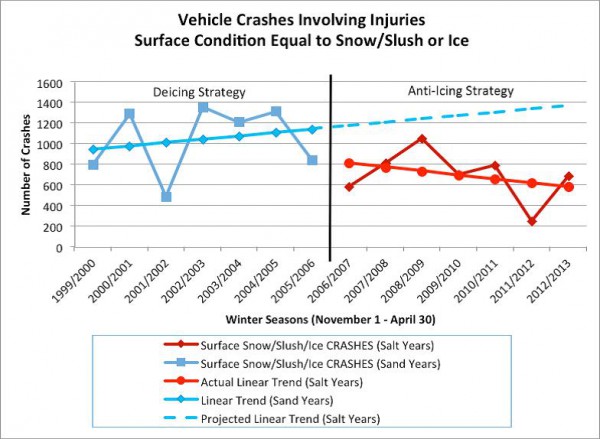
An analysis of vehicle crashes over thirteen winter seasons, 1999 to 2013, was conducted to try and evaluate the impact of anti-icing on safety (see chart).  A comparison of crashes, specifically for state-maintained roads during winter seasons, indicates that injuries declined by 19.2%, on average, since anti-icing strategies were implemented.  When crashes on snow/slush or ice surface conditions were examined the average reduction in crashes with nonfatal injuries was an even more dramatic, 33.5%. graph

CHART: Motor vehicle crashes involving nonfatal injuries with pavement surface condition equal to snow/slush or ice on Connecticut state-maintained roadways.

The reduction in the number of motor vehicle crashes with nonfatal injuries is a significant finding because according to a study by Qiu et al at the University of Iowa the rate of crashes on snow can be 84% higher than on dry pavement [3].  With an estimated cost in 2010 (from the National Highway Traffic Safety Administration) of $276,000 per non-incapacitating injury, [4] society- including everyone that travels - benefits from this significant reduction in injurious crashes.

Between 2006 and 2013, there was a reduction of 2,449 crashes with nonfatal injuries on Connecticut state-maintained roadways during snow/slush or ice conditions.  This calculates out to a cost savings of approximately $676 million.*q2

Other ongoing research throughout the world shows that plowing is still the most cost effective way to clear the roadways of snow and ice.  Abrasives such as sand, grit or stone dust do not remove the snow or ice, and only delay the inevitable need for removal or melting.

However, the anti-icing techniques – the scientific application of deicing chemicals such as salt and other materials - provide a very important aid to snow/ice removal operations, preventing ice and snow from bonding to paved surfaces.  With anti-icing, the time period with snow covered roads – which are those critical times when crashes are most likely to occur - is also reduced.

From the estimated savings shown, it is important that CTDOT and the local municipal DPWs continue to improve winter maintenance by employing state-of-the-art equipment for chemical applications, timely snow and ice removal, and using weather monitoring stations as well as advanced weather prediction services and models. It appears that from the safety benefits alone, the continued expenditures made on winter maintenance have paid off.  Reducing the negative economic impact that results when people and goods don’t move is another benefit.

The CTCDR is available to anyone wishing to view motor vehicle crash statistics in Connecticut, for any type of crash, under any road conditions.  Connecticut is one of the few states that maintains a publicly accessible crash database.  It is highly recommended that if you have an interest in crash data, visit http://ctcrash.uconn.edu/ [5].

____________________________________

Dr. Eric Jackson is an Associate Research Professor in the School of Engineering at the University of Connecticut and is Director of the Connecticut Transportation Safety Research Center.  Donald Larsen PE, is a Temporary University Specialist at the Connecticut Transportation Institute at UConn and former Supervising Engineer with the Connecticut Department of Transportation

PERSPECTIVE commentaries by contributing writers appear each Sunday on Connecticut by the Numbers.

LAST WEEK: Do Community College Students Go Begging?

______________

[1]   CTDOT Staff, An Overview of Snow and Ice Control Operations on State Highways in Con­necticut, Office of Maintenance, Bureau of Highway Operations, Connecticut Department of Transportation, Newington, CT, June 2015.

[2]   Mahoney, J., D. Larsen, E. Jackson, K. Wille, T. Vadas, and S. Zinke, Winter Highway Maintenance Operations: Connecticut, Publication CT-2289-F-15-1, CTDOT, Connecticut Academy of Science and Engineering, July 2015. http://www.ctcase.org/reports/WinterHighway2015/winter-highway-2015.pdf

[3]   Qiu, L., and W. Nixon, Effects of Adverse Weather on Traffic Crashes, Transportation Research Record: Journal of the Transportation Research Board, No. 2055, Transportation Research Board of the National Academies, Washington, D.C., 2008, pp. 139-146.

[4]  Blincoe, L. J., Miller, T. R., Zaloshnja, E., & Lawrence, B. A., The Economic and Societal Impact of Motor Vehicle Crashes, 2010, National Highway Traffic Safety Administration, USDOT, Washington, DC, Report No. DOT HS 812 013, May 2014, (rev. 2015, May).

[5]   Connecticut Crash Data Repository, Connecticut Transportation Institute, University of Connecticut, Storrs, CT. Website. http://ctcrash.uconn.edu/ (Accessed May 5, 2016).

*   For purposes of this calculation, each crash was arbitrarily assigned one non-incapacitating injury.

This article is based on a study conducted by the Connecticut Academy of Science and Engineering on behalf of the Connecticut Department of Transportation.  Eric Jackson and Donald Larsen served as members of the Research Team from the Connecticut Transportation Institute at the University of Connecticut.  Access the full study report, an executive summary, and briefing at http://www.ctcase.org/reports/index.html

PERSPECTIVE: Do Community College Students Go Begging?

by Endia DeCordova A professor at Manchester Community College noticed that a student – typically a regular class attendee – had stopped coming. Efforts to contact the student ultimately revealed that she had given up on many of her goals, including her education, because of depression. Having her electricity turned off because she couldn’t afford the bill was the last straw.CT perspective

A staff member at the college was approached by a student who asked to borrow a dollar for the vending machine. He had to remain on campus all day -- through an evening course -- and couldn’t afford to buy anything from the cafeteria.

One more anecdote involves a student who dropped out because of an inability to scrape up bus fare. That student relied on public transportation to get everywhere, including to class.

q1These are true stories. The names are omitted and details smoothed over for obvious reasons. But they really happened this spring at MCC.  The image of the college student – not a care in the world – partying and protesting, cramming just in time to pass an exam, and simply marking time until graduation has never really been accurate. It is certainly far from the truth today. College students face major financial and emotional stress just to get to the point where they can even settle into their studies, much less complete their degrees.

In fact, the story of the borrowed candy-bar dollar is especially heartbreaking as it makes clear how much of a hurdle food-insecurity is for an increasing number of college students. A February 2016 article in The Chronicle of Higher Education, “Students Shouldn’t Have to Choose Between Books and Food,” highlights the disturbing data on hunger among college students. According to a 2015 study by the Wisconsin HOPE Lab, 20 percent of community-college students were going hungry. Another, by City University of New York, found that 39 percent of its students were similarly at risk.

This underscores a major issue for college students nationally. How is it that higher ed creates poverty among people who are clearly working to improve their lives?

Rising costs of tuition, fees and books are easy to point to. At MCC, people are struggling to pay for higher education and after they enroll, often can’t follow through. For the spring 2016 term, nearly 900 students who applied to MCC paid their application fee but did not enroll. Another nearly 500 students enrolled but couldn’t complete their payments and were forced to drop out for lack of financial resources. Of those, many struggled to buy books or other class materials.

But the real issue is running just below the surface. Common sense tells us all that if you can’t afford to pay for something that is essentially a luxury – or a privilege, as many still view a college degree – you don’t buy it.

For many MCC students, not going to college is not an option. Their education is key to transformation – in many cases, moving them from zero hope to a promising future and a life of contributing to their families and their communities.

Yet as they forge ahead, they go begging for the basics. As the students above tragically did, they too often give up short of their goals. At the same time, public funds in Connecticut for higher ed are dropping.q2

This is why MCC is working through its foundation to develop a retention and completion grant program. Like many community colleges nationwide, we are determined to support students who have delayed starting college or “stopped out” of college because of short-term financial distress.

We ask students to assume some of the risk connected with the funding so they remain vested in their futures, but these grants (not loans) are designed to help them pay for the books -- or the bus pass, the electricity, the food they need -- to keep going and to graduate or transfer.

A college education today is a necessity. No one should have to beg.

__________________

Endia DeCordova is Dean of Institutional Advancement and Community Engagement for Manchester Community College.


PERSPECTIVE commentaries by contributing writers appear each Sunday on Connecticut by the Numbers.

LAST WEEK: Face Your Fears - and the Editorial Board