Municipal Equality Index Finds CT Above Average for LGBT Residents

Connecticut cities continue to rank above-average when compared with municipalities across the country in the level of equality provided to lesbian, gay, bisexual, and transgender (LGBT) residents.  Bridgeport, Hartford, New Haven, Stamford and Storrs (Mansfield) were the five Connecticut municipalities included by the Human Rights Campaign (HRC), the nation’s largest LGBT civil rights organization, in an assessment of LGBT equality in 353 cities across the nation. index report

The 2014 Municipal Equality Index (MEI), the only nationwide rating system of LGBT inclusion in municipal law and policy, shows that cities across the country, including in Connecticut, continue to take the lead in supporting LGBT people and workers, even when states and the federal government have not.

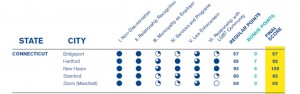
The average score for the five municipalities in Connecticut was 74 out of 100 points, comfortably above the national average of 59.  The individual scores in Connecticut, largely unchanged from a year ago, were New Haven: 100, Hartford: 92, Stamford: 62, Storrs (Mansfield): 59, and Bridgeport: 57.  The scores earned by Hartford and Bridgeport dropped slightly from a year ago, and New Haven scored at 100 for the second consecutive year.  Because of changes in the legal landscape from year to year, the MEI report has revised the scoring assessment criteria, which has impacted scores in some municipalities.

Cities are rated on a scale of 0-100, based on the city’s laws, policies, benefits, and services. Key findings contained in the 70-page MEI report, issued in partnershiphrc-logo with the Equality Federation, provide “a revealing snapshot of LGBT equality in municipalities of varying sizes, and from every state in the nation,” the report noted.

The MEI rates cities based on 47 criteria falling under six broad categories:

  • Non-discrimination laws
  • Relationship recognition
  • Municipality’s employment policies, including transgender-inclusive insurance coverage, contracting non-discrimination requirements, and other policies relating to equal treatment of LGBT city employees
  • Inclusiveness of city services
  • Law enforcement
  • Municipal leadership on matters of equality

The cities researched for the 2014 MEI include the 50 state capitals, the 200 most populous cities in the country, the four largest cities in every state, the city home to each state’s largest public university, and an equal mix of 75 of the nation’s large, mid-size and small municipalities with the highest proportion of same-sex couples.

The report found that “momentum for municipal equality is not a coastal trend or mega-urban phenomenon – it is something cities of all sizes in all parts of the country are doing because the people in those cities demand equality of treatment for all.”  Cities had an opportunity to review the draft scorecard and offer feedback prior to publication.

Equality and Economic Development

The report also indicates that “a growing body of research has shown that cities that have vibrant gay and lesbian communities have higher levels of income, life satisfaction, housing values, and emotional attachment to their community as well as higher concentrations of high-tech business. The Fortune 500 has long recognized that top talent is attracted to inclusiveness. In fact, the private sector has been using fair workplaces as a tool to recruit and retain top talent.”

The report adds that “Businesses will increasingly have to evaluate the legal landscape offered by a potential new location in its calculation of where to expand operations.”  Connecticut’s state laws – such as marriage equity and non-discrimination protections – provide a hospitable environment for its cities to employ equitable practices, officials said, but municipalities also have the capacity to take the lead, in Connecticut and elsewhere.  In ten states, cities fare well despite restricbusinesstive state laws.
“From Mississippi to Idaho, mid-size cities and small towns have become the single greatest engine of progress for LGBT equality--changing countless lives for the better,” said HRC President Chad Griffin. “In just three years, the number of municipalities earning top marks for their treatment of LGBT citizens has more than tripled. Simply put, in this country there is an ongoing race to the top to treat all people, including LGBT people, fairly under the law, and it’s time our state and federal laws caught up.”

According to the report, the New England, Mid-Atlantic, and Western regions of the United States – where marriage equality states have predominated – tend to do better than the national average when it comes to municipal equality. The reported pointed out, however, that every region has at least one 100-point city, such as New Haven. For example, in the Southeast, Florida boasts three 100-point scores, and Atlanta repeats its perfect score again in 2014; in the Southwest, Austin repeats its perfect score; and in the Plains, Iowa City joins two perfect scores in Missouri with St. Louis and Kansas City.

Thirty-eight cities earned perfect 100-point scores, up from 25 in 2013 and 11 in 2012, the first year of the MEI. New Haven earned a 100-point score, helping to set a standard of LGBT inclusiveness with exemplary policies ranging from non-discrimination laws and equal employee benefits, to cutting edge city services.

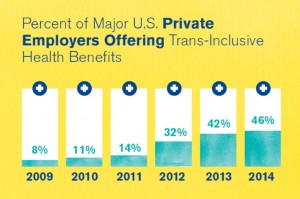
Among the report’s striking findings:  A dramatic increase in the number of cities offering transgender-inclusive healthcare benefits, and the fact that 32 million people have better protections from discrimination on the basis of gender identity at the local level then they do from state law. The full report is available online at www.hrc.org/mei.
CT stat

Best Value School Districts? East Granby, Litchfield, Stafford

There are any number of ways to measure the effectiveness of local school districts, and the latest effort has placed East Granby, Litchfield and Stafford at the top of the list. Using school quality and cost-of-living measures, the national website NerdWallet has ranked the Connecticut school districts that best represent “the most bang for your buck” - affordable communities with good schools.top 10

The most affordable school districts in Connecticut were determined based on three factors:

  • Standardized test scores. NerdWallet combined 10th grade CAPT scores and SAT scores in 2012.
  • College readiness. The website factored in equally weighted scores for the graduation rate and the percent of high school graduates seeking higher education in 2012.
  • Class size. They also considered the student-to-teacher ratio in select school districts.

The top ten in Connecticut are: 1) East Granby, 2) Litchfield, 3) Stafford, 4) Canton, 5) Farmington, 6) Bolton, 7) Regional District 19, 8) East Lyme, 9) Regional District 8, 10) Regional District 4.

The next ten in the rankings are Simsbury, Glastonbury, Avon, South Windsor, Westbrook, Granby, Somers, Waterford, Regional School District 18 and Regional School District 15.  NerdWallet evaluated 121 unified and secondary school districts in Connecticut, utilizing data from the U.S. Census Bureau or the Connecticut State Department of Education.

According to the website, the East Granby School District has a high graduation rate of 94% and students scored an average of 1641 on their SATs, well above the state average, and CAPT scores are in the top third for the state.  Litchfield’s four-year graduation rate of 97% is one of the highest in the state.  The Stafford School District is described as “an ideal setting for parents who want more individualized attention for their kids, with one of the lowest student-teacher ratios in the state at 14.2:1.”students

Last month, East Granby school officials announced the start of a manufacturing training program at East Granby High School in collaboration with Asnuntuck Community College in Enfield.  Students who participate in the five-year program can earn a high school diploma and an associate's degree in advanced manufacturing technology from Asnuntuck.  It is the first of its kind in Connecticut, according to officials, and includes internships at local manufacturing companies while attending Asnuntuck. Students who earn their Associates Degree are automatically accepted into the Connecticut State University System and the University of Hartford.

Regional District 19 includes E.O. Smith High School in Storrs.  Regional District 8 serves Hebron, Andover and Marlborough.  Regional District 4 includes Chester, Deep River, and Essex.

Network TV, National Advertising, Breakfast Food Boost UConn

UConn is making a splash these days in some unfamiliar places. Think iconic stadium, all the news that’s fit to print, and cereal– all of which have headlined the state’s flagship university in recent days.CBS This past Saturday, the Huskies football team played Army at Yankee Stadium – the University’s first appearance at the ballpark in the Bronx.  While UConn came up short on the scoreboard, the game was competitive and offered the school visibility in the New York metropolitan area and on CBS Sports Network, which televised the game. NYT ad

Fans who happened to be reading the print edition of The New York Times on Friday may be been surprised to see a full-page ad promoting the university.  The ad touted the university’s “unprecedented moves to unleash the solutions of tomorrow,” specifically highlighting a $3.6 billion investment in additive manufacturing, gnomic medicine and cybersecurity, the hiring of 300 faculty in fields including cognitive science human rights and intellectual inquiry, and recruiting 6,500 additional students to “lead their generation in addressing the most important challenges of our time.”

The ad was a one-time placement strategically timed to several significant events happening in New York City, including the Army-UConn game, an alumni gathering, and a meeting of the UConn Foundation board.  UConn has a very active and robust alumni network in New York City and the region, officials noted.

The ad was purchased at a negotiated rate and ran not only in New York City, but nationwide in The Times. It was paid for with funds from the university’s marketing budget (approximately $43,000) and private dollars (approximately $10,000), specifically designated by donors to elevate the University through advertising.  The UConn tagline, “Innovation unleashed,” was included in the ad, which featured text reading “Dear UConn, Thank you.  Sincerely, The Future.” Total average print circulation for The New York Times for Monday-Friday was 680,905, as of March 2014.

For those who read their morning paper with a bowl of cereal – there’s more UConn to come.

Just arriving on the market is a new, limited edition Husky Heroes cereal.  “The one and only cereal to honor both the UConn Women’s and Men’s National Championship basketball teams,” according to a newly launched website, is a honey nut toasted oat cereal and comes in a 14 oz. box.  Basketball coaches Geno Auriemma and Kevin Ollie are each featured on the commemorative cereal box, which is sold in a two-pack. husky_herOes

Marketed by Pittsburgh-based PLB Marketing, described as the “premier source for athlete-endorsed, quality food products,” there is a limited edition of 25,000 boxes being produced.  The company also is currently promoting Miggy’s Salsa, with a likeness of Detroit Tigers star Miguel Cabrera, Fastball Bars, a chewy chocolate chip granola bar featuring his teammate Justin Verlander, and Gronk Flakes, featuring New England Patriots’ tight end Rob Gronkowski.

The Husky Heroes cereal is available on-line at www.huskyhereoscereal.com, with delivery anticipated later this month.  The price is $14.97 for a two-box set, plus UPS shipping charge of $9.95, for a total of $24.92. The cereal is officially licensed by UConn through the university’s licensing agency, the Collegiate Licensing Company.  The university receives a standard 12 percent royalty on sales of all licensed products bearing UConn trademarks.

In addition to web purchases, the cereal will be distributed locally in the coming weeks to some Connecticut retail locations by Bozzuto’s (retailers to be announced).  It will also be sold at the UConn Coop.  For those inclined to stock up early, bulk orders of 500 boxes are eligible for special pricing directly from PLB.  Advance sales are just underway, and as of Monday afternoon there were 24,848 boxes remaining.


uconn web

Northwest Connecticut Economy on Cusp of Recovery; Workforce Factors Are Key

Nearly 60 percent of businesses in northwest Connecticut project an increase in total sales revenue in 2015, according to a new survey, although fewer than half of the businesses surveyed (46 percent) anticipate higher pre-tax profits next year. The 2014 Survey of Northwest Connecticut Businesses, conducted by the Connecticut Business & Industry Association (CBIA) and the Chamber of Commerce of Northwest Connecticut, “paints a picture of a regional economy that is recovering but also constrained by rising costs and workforce challenges,” according to the organizations.NW Chamber study

Two-thirds of northwest Connecticut businesses (67%) surveyed are somewhat or very concerned about the area’s aging population, in terms of maintaining an adequate workforce. That’s up 11 percentage points from 2012, when the survey was last conducted. Business leaders predicted the skills most in demand will be industry-specific in medical, utilities, manufacturing, and construction fields (37%) and computer/IT skills (28%).

Businesses are fairly evenly divided on the greatest advantage to doing business in northwest Connecticut, identifying the region’s proximity to New York, Boston, and Springfield markets and amenities (22%); local environment (17%); supportive chamber of commerce (14%); active local banks (11%); and arts, culture, and entertainment opportunities (10%).

While 36% say they will have more employees next year, nine percent anticipate having fewer employees, and the majority (55%) expect no change in the size of their workforce.  Top economic priorities are, in order, growing the local manufacturing base, regional collaboration to attract business investment, and retaining a skilled workforce. The cost of living (cited by 43% of executives surveyed) is considered to be the single greatest disadvantage. Three leading issues two years ago, fell from the issues of most concern now: credit availability, healthcare costs, and tight marketing budgets.priorities chart

By a ratio of 2:1, employers in northwestern Connecticut believe that schools in their area—and throughout the state—adequately prepare workers for entry-level jobs, according to the survey. Although confidence in Connecticut’s education system prepagingaring workers for higher-level jobs is not quite as strong, the majority of respondents nonetheless believe Connecticut schools and colleges provide an adequate education for mid-level employees (59% of employers surveyed); management workers (61% of employers); and executive-level employees (58%).

Nearly 200 companies, with an average of 55 employees and representing a variety of sectors participated in the survey, and their responses reflected dramatic changes in recent years in the way in which businesses are marketed to potential customers. While quality broadband is viewed as an issue for one-third of businesses surveyed, 56 percent use social media to market their products and services (and 60 percent do other web marketing)—edging out print advertisements (54 percent of businesses). Radio, billboards, sales representatives, and word of mouth are other key components of the marketing mix, the survey found.

The report concludes that “with GDP data and other indicators showing we are on the cusp of a stronger economic upswing, pressure on hiring has increased to meet demand.”   Noting the “increasing numbers of retirees, Northwestern Connecticut’s workforce challenges, which have always been serious, are now critical,” the report emphasizes.

Spur-Econ-Growth_103014-572x368

25th Anniversary of Fall of Berlin Wall Is Focus of Forum at Southern

Today’s college students have known only one Germany in their lifetime, but those from previous generations recall the post-World War II nations of East Germany and West Germany – until the wall separating those countries dramatically came down. That event – 25 years ago this weekend – will be the focus of a special program at Southern Connecticut State University that will feature Nicholas Burns, a career U.S. diplomat who played a key role in how the Bush Administration dealt with the fall of the Berlin Wall.Mauerfall_Logo_1_FalloftheWall_FINAL_020714

Burns, who was involved in the discussions on Berlin and Germany before and during that pivotal time in history, will be the keynote speaker at a Monday, Nov. 10 forum on campus.  The program, “Remembering the Fall of the Berlin Wall: 25 Years Later,” is free and open to the public, and will run from Noon to 2 p.m. in the Michael J. Adanti Student Center.

Burns served in the United States government for twenty-seven years. Today, he is a professor of the practice of diplomacy and international politics at Harvard University’s Kennedy School of Government. He is a member of Secretary of State John Kerry’s Foreign Affairs Policy Board at the U.S. DBurnsN_Headshot_Web-330x360epartment of State. He also writes foreign policy columns for the Boston Globe and Global Post and is a noted lecturer on U.S. foreign policy.

On November 9, 1989, jubilant crowds gathered on both sides of the Berlin Wall to celebrate the opening of border crossings between eastern and western parts of the city – an act that seemed impossible for decades, but would within a year lead to the reunification of Germany for the first time since World War II.

A panel discussion will follow the keynote and is scheduled to include:

  • Troy Paddock, chairman of the SCSU History Department and an expert on German history;
  • Kevin Buterbaugh, SCSU professor of political science and an international relations specialist;
  • Steven Breese, dean of the SCSU School of Arts & Sciences who lived in West Germany in 1989;
  • Eileen Kane, assistant professor of history at Connecticut College, where she specializes in modern Soviet/Russian history.

Video clips of major historical milestones pertaining to the fall will be shown, and a question-and-answer period will follow the panel discussion.  The video will include a look at the construction of the wall, as well as clips from speeches at the wall by President John F. Kennedy ("Ich bin ein Berliner") and President Ronald W. Reagan (Tear down this wall!).

As a career Foreign Service Officer, Burns was Under Secretary of State for Political Affairs from 2005 to 2008; the State Department’s third-ranking official when he led negotiations on the U.S.–India Civil Nuclear Agreement; a long-term military assistance agreement with Israel; and was the lead U.S. negotiator on Iran’s nuclear program. In 1990, he was appointed by PresideBerlin-Wallnt George H.W. Bush to the National Security Council, a post he held until 1995, bridging the administrations of Bush and President Bill Clinton.

Burns was U.S. Ambassador to NATO (2001–2005), Ambassador to Greece (1997–2001) and State Department Spokesman (1995–1997).  He worked for five years (1990–1995) on the National Security Council at the White House where he was Senior Director for Russia, Ukraine and Eurasia Affairs and Special Assistant to President Clinton and Director for Soviet Affairs in the Administration of President George H.W. Bush.

Transfer Credit Policy, Job Placement Key to Online Students, Distance From Institution Matters Less

A national study of students pursuing on-line degrees found that cost and financial aid are important, but not critical in the decision-making process for those considering an on-line program of study.  In addition, the data indicates that job placement messaging resonates, and transfer credit policy makes a difference in attracting online students. The “Online College Students 2014: Comprehensive Data on Demands and Preferences” report, is a joint project of Learning House and Aslanian Market Research, a division of EducationDynamics.  The standard benefits of an online program, such as convenience and flexibility, are no longer enough for colleges and universities to differentiate themselves, according to the study. Instead, students are looking for value, both in earning their degree and in how the degree will help their career. Among the key findings:pie

  • Although students reported that cost was a primary selection factor when choosing an online degree program, approximately two-thirds of respondents said they did not choose the most inexpensive program. Only 20% said they would not attend an institution if financial aid was not offered, although approximately half said they would need financial aid.
  • When given a choice of 18 marketing messages, the overwhelming favorite was “90% job placement.” The top-ranked marketing message categories were:  Career Opportunities (28%), Personalization (19%), Speed to degree (17%), Scholarships/Promotions (17%), Quality/Reputation (11%), and Student Support (8%).
  • Approximately 80% of students have earned credit elsewhere, and those students want to bring that credit with them. Having a clearly defined, generous, and easy-to-navigate transfer credit policy can help institutions stand apart.OCS2014-LPimage-TLH3

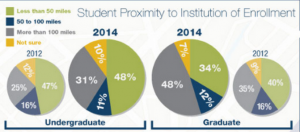
Overall, the study found that 54 percent of students attend an institution within 100 miles of where they live, showing a three-year trend of students increasingly willing to attend an institution farther from home. (In 2012, 80% reported attending an institution within 100 miles of where they lived. This declined to 69% in 2013.)

The number of individuals working full time declined from 60% in 2012 to 46% in 2014, while the number of those who are unemployed rose from 16% to 30% over the three past consecutive studies.

“For institutions looking to expand their online footprint, it’s critical to communicate the right message to students,” said Dr. David Clinefelter, Chief Academic Officer at Learning House and coauthor of the report. “Colleges and universities need to not only think about what sets their institutions apart, but also track student outcomes to provide quantifiable data about the value of their degrees.”

In Connecticut, Charter Oak State College's degree completion programs enable adults, who already possess college credits or work experience, to complete the Associate or Bachelor's (Baccalaureate) degree that meets their needs. Connecticut's public online college has been ranked number one in affordability among online degree programs in-state by AffordableCollegesOnline.org (AC Online). The  College offers a number of workforce relevant programs for adults who want to advance their careers, change careers, return to work, or validate their training and educational experiences.  Majors that can be completed using Charter Oak courses exclusively include Cyber Security, Health Care Administration and Health Information Management.

According to the National Center for Education Statistics, in 2012 approximately 2.6 million students were enrolled in fully-online degree programs, while 5.5 million were taking at least one online course.

Assets and Income Taxes, Back to the Future

A generation ago in Connecticut the Republican gubernatorial candidate, a resident of Fairfield County, was criticized by her Democratic incumbent opponent for the disparity between family assets and income taxes paid.  To observers of this year’s Connecticut campaign for Governor, the exchange may have a familiar ring. As reported by The New York Times after the first gubernatorial debate of the 1986 campaign between Gov. William O'Neill and Republican challenger Julie Belaga, a veteran legislator from Westport:

1000px-seal_of_the_governor_of_connecticut.svg“There was another exchange about the recent release of Mrs. Belaga's joint tax return, which showed that she and her husband, Myron, paid $110 in Federal income taxes last year because of losses incurred by an investment business being started by her husband. The couple reported total assets of $1.4 million.

Mrs. Belaga said she and her husband, a retired oil company executive, paid more than $500,000 in Federal income taxes in 1982 and that Mr. O'Neill seemed to be confusing the couple's assets with their income…  Mr. O'Neill said, ''When you have $1.4 million in assets and pay $110, and $257 the previous year, something tells me you're not quite the average taxpayer.'''

Belaga, the Deputy House Majority Leader, had won a three-way Republican primary to gain the Republican nomination to challenge O’Neill, then running for his second full term.  One of the two unsuccessful candidates in that Republican primary 28 years ago was former state Sen. Gerald Labriola, whose son is the current chairman of the Connecticut Republican Party.

O’Neill was re-elected and ultimately served as Governor for a decade; Belega subsequently served as New England Regional Administrator of the Environmental Protection Agency (EPA) and a member of the Export-Import Bank of the United States.   (WFSB archive photos)

1986


Nationwide Bicycle Fatalities Increase; CT Takes Steps to Improve Safety

The number of bicyclists killed on U.S. roadways is increasing, according to a report by the Governors Highway Safety Association (GHSA). GHSA’s Spotlight on Highway Safety: Bicyclist Safety indicates that yearly bicyclist deaths increased 16 percent between 2010 and 2012, while overall motor vehicle fatalities increased just one percent during the same time period. While bicyclists killed in motor vehicle crashes increased in 22 states between 2010 and 2012, six states – California, Florida, Illinois, New York, Michigan and Texas – represented 54 percent of all fatalities.  In 2012, Florida had the highest proportion of motor vehicle related deaths that were bicyclists (5 percent), followed by California (4.3 percent) and Massachusetts (4.3 percent).2014_bike_increase

Connecticut, according to the report, had 7 bicyclist deaths in 2010, 8 in 2011 and 4 in 2012.  The state was one of 25 states to have the number of fatalities drop from 2011 to 2012.

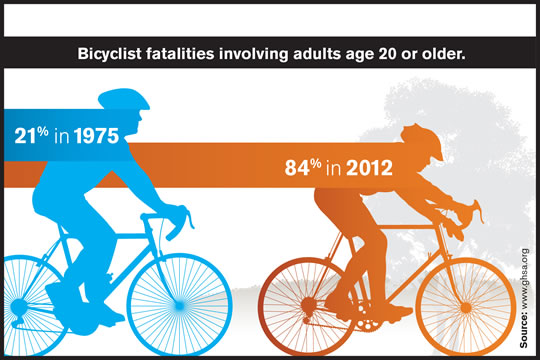
Bicycling is being used more for commuting, which is affecting the age of accident victims according to the study. In 2012, adults 20 and over comprised 84 percent of bicycle fatalities. That compares to adults making up only 21 percent in 1975.  Bicycle fatalities are increasingly an urban phenomenon, accounting for 69 percent of all bicycle fatalities in 2012, compared with 50 percent in 1975.

Until 2010, the number of cyclist fatalities annually had been dropping steadily since 1975 nationwide. The recent increase correlates with a 62 percent surge in bicycle commuting since 2000, according to 2013 Census Bureau data, as governments have promoted cycling as a way to reduce traffic, curb vehicle emissions and improve public health.2014_bike_adults

"The increase in cyclist fatalities on the road is tragic, but unsurprising, given the growth of the driving population and the number of cars on the road,” said Kelly Kennedy, Executive Director of Bike Walk Connecticut.   “Add to that the very real problems of distracted driving, aggressive driving, and street designs that put cyclists and pedestrians at risk. This is why we need complete streets, much better enforcement of speeding, distracted driving, and share the road laws, and the vulnerable user law that Connecticut just enacted."

Earlier this month, the state Department of Transportation (DOT)  issued a Complete Streets policy statement, which was praised by Bike Walk Connecticut.  The policy expressly promotes safe access for all users by providing a comprehensive, integrated, connected multi-modal network of transportation options.  DOT's policy is intended to improve safety and mobility and enhance Connecticut’s economic competitiveness by enabling communities to become livable, walkable, bikeable, drivable, efficient, safe and desirable.

report bThe new GHSA report indicated that in many states and urban areas, engineering measures are being adopted to accommodate bicycles on the road, “with the dual aim of protecting cyclists from collisions with motor vehicles, while encouraging cycling for its health and environmental benefits.”


In announcing the new Connecticut policy, DOT Commissioner James Redeker noted that Route 44 in East Hartford will undergo a “road diet” in 2015 to provide bike lanes, enhance vehicular safety and efficiency and improve pedestrian and transit accommodation throughout the corridor. The Department is also outfitting 50 train cars with bike racks on the New Haven Line operating between New Haven to New York City.

In its fifth year before the Connecticut legislature, the Vulnerable User bill passed earlier this year, and took effect on this month (on Oct. 1).  The new law requires a fine to be imposed on reckless motor vehicle drivers who cause the death or serious injury of a pedestrian, cyclist, wheelchair user, or other “vulnerable users” who were using reasonable care.

The GHSA report’s author, former Insurance Institute for Highway Safety Chief Scientist Dr. Allan Williams, analyzed current and historical fatality data to develop the bicyclist crash patterns.


Construction of New Rail Stations Set to Begin in 3 Connecticut Communities

The start of construction is imminent this fall for new rail stations in Wallingford, Meriden and Berlin as part of the New Haven-Hartford-Springfield (NHHS) Rail Program.  The new, expanded commuter service, to debut in 2016, will be branded the “Hartford Line,” as a key component of an increasingly robust multi-modal regional transportation system being developed in the state and region. Improvements at the three stations include high-level platforms on both sides of the track, overhead pedestrian bridge with new elevators and stair towers, platform snow melt systems, electric vehicle charging stations, ticket vending machines and passenger information display systems,  high-resolution video surveillance systems, increased parking capacity and roadway access improvements, improved accessibility and bicycle racks.2014.10.22_Hartford_Line_s

Funded through the Passenger Rail Investment and Improvement Act (PRIIA) created under President Barack Obama in 2008, and State of Connecticut bonds proceeds, the NHHS Rail Program is aimed at providing significant new regional passenger rail service options.  Existing stations on the Hartford line are in New Haven, Wallingford, Meriden, Berlin, Hartford, Windsor Locks and Springfield.  Plans call for future stations in North Haven, Newington, West Hartford and Enfield. base_map

Officials point out that one of the primary objectives of the NHHS program is to serve as a catalyst for transit-oriented development (TOD) around the stations. The state Department of Transportation is working with towns to help leverage the investment in railroad infrastructure to capture local development benefits. TOD, in the form of compact, mixed-use districts, is pedestrian-friendly and contributes to vibrant and active communities. By promoting the use of transit, TOD also reduces reliance on automobiles, resulting in energy cost savings and improved air quality.

In June, officials from the U. S. Department of Transportation’s Federal Railroad Administration (FRA) toured parts of the NHHS Rail corridor, and state officials recently visited a proposed rail station site in Enfield.

The new NHHS rail service is expected to operate at speeds up to 110 mph, cutting travel time between Springfield and New Haven to as short as 79 minutes. Travelers  will be able to board trains every 45 minutes during the morning and evening peak hours and every 90 minutes during off-peak periods when the new system is operational.

A year ago, a West Haven rail station was added to the New Haven line.  Located midway between Milford and New Haven stations, West Haven was the first new station to open on the New Haven Line since Fairfield Metro Station was added in 2011. West Haven Station was designed by Vanasse Hangen Brustlin and built by a Connecticut company, Manafort Brothers of Plainville.

A New York City-based construction firm, Judlau Construction, has been awarded the $58.8 million contract to build the new railroad stations in Berlin, Meriden and Wallingford, the New Haven Register reported last month.  The firm specializes in large public works projects and design-build services, and currently ranks #132 on Engineering News Record’s list of the Top 400 Contractors, as well as #32 among Top Domestic Heavy Contractors. (In 2011, the company ranked #113 on the Top 400 list and #33 on the Top Domestic Heavy Contractors list.)

In June, the Chicago Tribune reported that the company was being awarded a $64 million construction contract by Illinois Tollway as low bidder for construction of new highway entrance ramps.  The Tribune also reported that Judlau “admitted improper hiring practices and paid a $7.5 million penalty in connection with an alleged minority hiring scheme” in New York, which the company said it had “self-reported” to the U.S. Attorney’s office.  The Tribune reported that “according to a 2012 civil lawsuit settlement with the U.S. attorney's office, Judlau and its partner in a Metropolitan Transportation Authority tunnel project admitted engaging in improper hiring practices involving minority- and women-owned businesses, otherwise known as disadvantaged business enterprises, or DBEs.”

13 CT High Schools in Nation’s Top 500, Up from 8 Last Year; Four CT Schools "Beat the Odds"

Thirteen Connecticut high schools rank among the nation’s top 500 according to a report compiled by Newsweek Magazine – an increase from eight schools a year ago. Connecticut did not have a school ranked in the top 100.  The highest ranked Connecticut school on the list is Amity High School in Woodbridge, which placed at #112, up from #667 last year.  Connecticut’s top-ranked high school in last year’s analysis, the Connecticut IB Academy in East Hartford, also ranked #112 that year.  This year the IB Academy was at #140, the second highest ranked school in Connecticut.bestschools-share

New to the top 500 from Connecticut this year were Litchfield High School, Greenwich High School, Daniel Hand High School in Madison, South Windsor High School, Fairfield Warde High School, East Lyme High School, Wolcott High School, East Lyme High School, Wolcott High School, Lyme-Old Lyme High School, Haddam-Killingworth High School, Pomperaug High School in Southbury and Cheshire High School. 

Every year Newsweek announces the nation’s best high schools that do an outstanding job of preparing students for college.  The magazine teamed up with a research group to compile the list.  They said their methodology was more stringent than ever with new measures of quality and a high standard of data, utilized a College Readiness Score that was based on the following six indicators:

  • Enrollment Rate—25 percenthigh school
  • Graduation Rate—20 percent
  • Weighted AP/IB composite—17.5 percent
  • Weighted SAT/ACT composite—17.5 percent
  • Holding Power (change in student enrollment between ninth and 12th grades; this measure is intended to control for student attrition)—10 percent
  • Counselor-to-Student Ratio —10 percent

The number one spot in the nation went to Thomas Jefferson High School in Alexandria, VA.  Connecticut’s 13 high schools ranked in Newsweek’s Top 500 include:

  • Amity High School in Woodbridge (#112)
  • Connecticut IB Academy in East Hartford (#140)
  • Litchfield High School (#164)
  • Greenwich High School (#168)
  • Daniel Hand High School in Madison (#179)
  • South Windsor High School (#226)
  • Fairfield Warde High School (#227)
  • East Lyme High School (#228)
  • Wolcott High School (#337)
  • Lyme-Old Lyme High School (#352)
  • Haddam-Killingworth High School  (#336)
  • Pomperaug High School in Southbury (#386)
  • Cheshire High School (#401)

A year ago, there were eight Connecticut high schools in the top 500.  The top-ranked school in the state was the Connecticut IB Academy in East Hartford, at #112.  Also ranking in the top 500 in 2013 were Weston High School at #190, Staples High School in Westport at #196, New Canaan High School at #227, Ridgefield High School at #270, Farmington High School at #405, and Valley Regional High School in Deep River at #441.  All but the Connecticut IB Academy fell out of the top 500 this year.

Among this year’s top 500, Greenwich High School was #573 a year ago, Daniel Hand High School in Madison ranked #589, Amity Regional High School in Woodbridge was #667, and East Lyme High School was #723.

"Beat the Odds" Schools

In a separate ranking of the nation’s top schools for low-income students, which Newsweek describes as "Beat the Odds Schools," the highest-ranked Connecticut high school was the Greater Hartford Academy of the Arts, which ranked #266.  It is one of four Connecticut high schools to reach the nation's top 500, according to the Newsweek analysis.  The Connecticut IB Academy was the second-ranked Connecticut high school on this list as well, coming in at #275.  Bunnell High School in Stratford was #290, and Common Ground High School in New Haven was #316.

With the list, Newsweek sought to “recognize schools that beat the odds, performing better than statistically expected for their level of poverty.” Schools were ranked on how well they prepare their students for college, taking students’ socio-economic background into account.