
PERSPECTIVE l Major Accounting Changes Proposed by FASB for Nonprofits
/by Katrina Olson The Financial Accounting Standards Board (FASB) announced in April 2015 proposed changes to reporting for nonprofit organizations nationwide and will impact the approximately 13,340 nonprofits currently registered with the State of Connecticut, Department of Consumer Protection. The proposal represents the first major overhaul of nonprofit reporting requirements in more than two decades.
FASB, formed in 1973, serves as the standard-setting body that establishes accounting rules governing the preparation of financial reports by nongovernmental entities, including nonprofit organizations.
Changes are expected to be widespread, affecting all areas of the financial statements. Here are a few of the significant changes:
Net assets
With multiple proposed changes on the table, the greatest impact calls for elimination of the three classes of net assets, the reserves of a nonprofit organization—unrestricted, temporarily restricted, and permanently restricted. If passed, nonprofits would have to report two classes of net assets, “net assets with donor restrictions” and “net assets without donor restrictions”.
The current distinction between permanent restrictions and temporary restrictions has become blurred in recent years due to changes in state laws. Many states allow nonprofits to spend from permanently restricted endowment funds under certain circumstances.
FASB hopes simplifying the number of classes of net assets will improve understandability and reduce complexity.
Income statement
Another significant change would impact the statement of activities, which presents a nonprofit’s income and expenses. The proposed rule would require all nonprofits to report net income or loss from operating activities separate from non-operating activities. This would more clearly show the income and costs directly related to accomplishing the mission of the organization.
Non-operating activities, such as investment earnings or losses, can distort the operating bottom line. This makes it difficult for an interested party to distinguish the financial performance directly related to the nonprofit’s mission.
Cash flows
A change likely to stir the most controversy amongst nonprofit accountants is the proposed overhaul of the statement of cash flows, which identifies the organization’s sources and uses of cash. The cash flow statement is often cited as the most misunderstood statement.
Key stakeholders frequently gloss over the statement of cash flows, considering it unreadable. The FASB proposed change would present the statement using the direct method, requiring the reporting of cash receipts from key revenue sources as well as disbursements to suppliers versus to employees for wages. It’s anticipated that this change would provide a clearer presentation of cash in and out related to operations.
Proponents argue the change to the cash flow statement would provide more useful information to key stakeholders, although some nonprofit advocates take issue with any change that would cause even greater disparity between reporting requirements of nonprofit organizations versus for-profit businesses.
What’s the bottom line? Truth be told, these reporting changes will require an investment of time for nonprofits and their accountants to implement. Whenever there is any change to accounting rules, there are both benefits and costs.
FASB’s proposal comes at a time when stakeholders have increasingly complained that improvements are needed to the financial statement presentation for nonprofits to provide better information for decision-makers regarding a nonprofit’s financial performance, service efforts, need for external financing, and stewardship of donor funds.
The proposal has been years in the making, dating back to late 2009 with the formation of the Not-for-Profit Advisory Committee (NAC) – a group formed to work with FASB to focus on financial reporting issues affecting the nonprofit sector.
A handful of nonprofit accounting rule changes have passed in the years since the formation of the NAC – the current proposal represents the most sweeping modification to nonprofit reporting requirements, thus far.
Nonprofits and accountants may view these changes as extra work in the short-term, however we can only hope nonprofits will reap the anticipated benefits of providing better information to decision-makers.
The FASB proposed changes are expected to be effective for 2017. In the meantime, FASB invites individuals and organizations to weigh in on the proposed changes before August 20, 2015. To comment, visit the FASB website at www.fasb.org and click on Exposure Documents Open for Comment, or email director@fasb.org.
You might notice a comment from me as well!
Katrina Olson is an audit manager with Whittlesey & Hadley, P.C. She specializes in audits of nonprofit organizations. This article first appeared in Hartford Business Journal.
_________________________________________________________
CT by the Numbers publishes opinion articles of 600 words or less. Submissions should be emailed to info@ctbythenumbers.info. Perspectives are published at the discretion of CT by the Numbers.




 The survey noted that more than two-thirds of consumers (68 percent) looking to purchase their first home are interested in move-in ready homes while one-third would like to buy a fixer-upper. And when it comes to amenities, respondents are most interested in their first home having a backyard or pool and an attractive design, followed by energy efficient / smart homes technologies.

 U.S. Commerce Secretary Penny Pritzker honored a total of 45 American companies and organizations, many of which are small- and medium-sized enterprises (SMEs), at the 2015 President’s “E” Awards ceremony, held earlier this year. The six Connecticut businesses were among the 45 honored.

 Proton Onsite makes hydrogen and nitrogen generators. Mutualink manufactures equipment used to facilitate collaborative communication between public safety and first response teams at the scene of emergencies. Jonal Laboratories makes sealant used in the aerospace industry. Dymotek manufactures custom injection molded plastic and silicone parts for electronics, plumbing valves and juice dispensers.

 t assist and facilitate export activities were honored with the “E” Award for Export Service. Four firms received the “E” Star Award for Exports, which recognizes previous “E” Award winners who have reported four years of additional export growth. And, three companies were awarded the “E” Star Award for Export Service, which recognizes previous “E” Award winners that have shown four years of continued support of exporters since first winning the “E” Award.

 This year marks the 53rd anniversary of the



 using, residents between 35 and 44, and the percentage of residents under age 9. The final two categories used in the calculation, access to day care and access to grocery stores, were weighted at 5 percent.
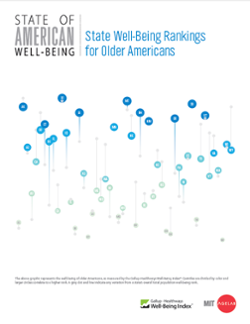
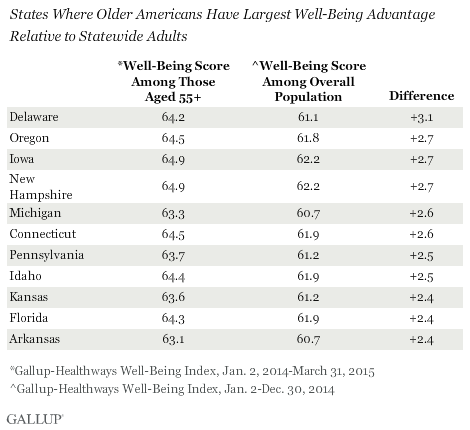 The Well-Being Index is calculated on a scale of zero to 100, where zero represents the lowest possible well-being and 100 represents the highest possible well-being. Connecticut’s well-being score was 64.5 for those age 55+, compared with 61.9 for the overall adult population. The difference of 2.6 was the sixth highest among the states.



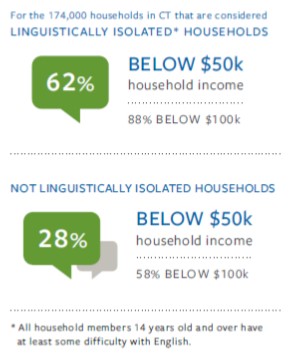
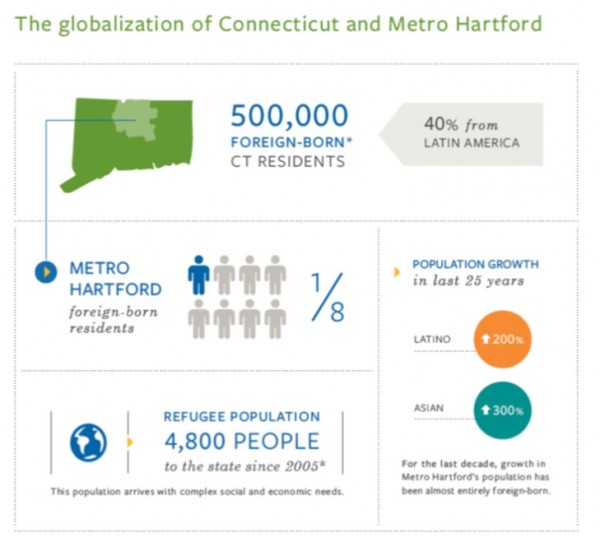 “The Latino Endowment Fund has offered this report as a means to expand the important discussion on efforts to support English Language Learners in our communities,” said Luis Cabán, chair emeritus of the Latino Endowment Fund Steering Committee. “This document provides us with an opportunity to reframe how we think about our increasingly global community and recognize the advantages of people speaking more than one language to enhance the richness of our community and create stronger links to the global marketplace.”