238 Organ Transplants in 2014 in CT; 1,467 on Current Waiting Lists in State
/At the beginning of this month, there were 1,467 individuals registered for organ transplants in Connecticut, according to the U.S. Department of Health and Human Services Organ Procurement and Transplant Network. The longest list was for a kidney transplant, with 1,259 names. In addition the transplant waiting lists included 159 people seeking a liver transplant, 52 awaiting a heart transplant, 18 on the waiting list for a kidney/pancreas, and 10 for a pancreas.
Among those on the heart transplant list, five individuals are between the ages of 18 and 34, eleven are between 35 and 49, 25 individuals are between age 50 - 64 and eleven are age 65 or older. Forty-one are men, eleven are women. The waiting time for a heart transplant, according to the data, is usually between one to six months, although in more than one-third of the cases, it is longer.
In Connecticut in 2014, there were 238 transplants according to the data, a portion of the 29,376 kidney, pancreas, liver, heart, lung and intestine transplants nationwide. Only 15 states had fewer transplant surgeries, including four states that did not have any (Idaho, Montana, Wyoming, Alaska). The largest number of transplants occurred in California (3,454), Texas (2,626), New York (1,826), Pennsylvania (1,803), and Florida (1,803). There were 796 transplants at hospitals in Massachusetts in 2014.
According to the state Department of Motor Vehicles,. Connecticut residents can join the Donor Registry at the DMV/AAA or online at Donate Life New England (www.donatelifenewengland.org). Donate Life New England is a joint endeavor of the organ procurement organizations that serve New England: LifeChoice Donor Services and the New England Organ Bank.
In Connecticut, only 43 percent of state residents over the age of 18 are included in the Donor Registry, which is below the national average of 48 percent.
Each year, more than 8,143 people donate organs after death, including organs for kidney transplant, liver transplant, heart transplant, or other organ transplant operations. Anyone above 16 years old can register to be an organ and tissue donor in Connecticut. At the age of 18, the decision to donate is authorization for donation. The DMV website points out that there are no age limits for organ donation, noting that “medical history is a far more important factor.”
The Association for Multicultural Affairs in Transplantation and Donate Life America joined forces this month to create a new nationwide observance called Donate Life ECHO, which stands for Every Community Has Opportunity. Designed to reach multicultural communities, the new observance from July 12th – 25th had two objectives: to focus on the power of sharing one’s personal decision to register as an organ, eye and tissue donor with members of one’s community; and to encourage registered donors to ask members of their personal networks and extended communities to talk about donation and register as donors.
“When people share the life-affirming message of donation within their community, more lives will be saved and healed,” said Caitlyn Bernabucci, Public Education Specialist for LifeChoice.
Multicultural communities play a critical role in America’s transplant system. They save and heal lives as donors of organs, eyes and tissue, need life saving kidney transplants in disproportionately high numbers, and serve patients and families as healthcare professionals. Organs are not matched according to race or ethnicity, officials explain, as people of different races often match one another. However, there is a higher probability of a match when received from someone of the same ethnicity because compatible blood types and tissue markers—critical qualities for donor and recipient matching—are more likely. Ultimately, a greater diversity of donors will increase access to organ and tissue transplantation for everyone, officials noted.





 The survey noted that more than two-thirds of consumers (68 percent) looking to purchase their first home are interested in move-in ready homes while one-third would like to buy a fixer-upper. And when it comes to amenities, respondents are most interested in their first home having a backyard or pool and an attractive design, followed by energy efficient / smart homes technologies.
 U.S. Commerce Secretary Penny Pritzker honored a total of 45 American companies and organizations, many of which are small- and medium-sized enterprises (SMEs), at the 2015 President’s “E” Awards ceremony, held earlier this year. The six Connecticut businesses were among the 45 honored.
 Proton Onsite makes hydrogen and nitrogen generators. Mutualink manufactures equipment used to facilitate collaborative communication between public safety and first response teams at the scene of emergencies. Jonal Laboratories makes sealant used in the aerospace industry. Dymotek manufactures custom injection molded plastic and silicone parts for electronics, plumbing valves and juice dispensers.
 t assist and facilitate export activities were honored with the “E” Award for Export Service. Four firms received the “E” Star Award for Exports, which recognizes previous “E” Award winners who have reported four years of additional export growth. And, three companies were awarded the “E” Star Award for Export Service, which recognizes previous “E” Award winners that have shown four years of continued support of exporters since first winning the “E” Award.
 This year marks the 53rd anniversary of the

 using, residents between 35 and 44, and the percentage of residents under age 9. The final two categories used in the calculation, access to day care and access to grocery stores, were weighted at 5 percent.
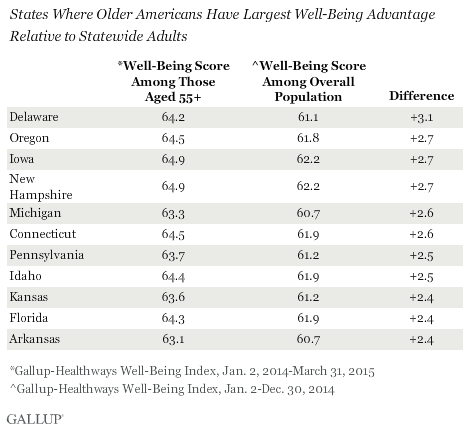 The Well-Being Index is calculated on a scale of zero to 100, where zero represents the lowest possible well-being and 100 represents the highest possible well-being. Connecticut’s well-being score was 64.5 for those age 55+, compared with 61.9 for the overall adult population. The difference of 2.6 was the sixth highest among the states.