CT High Schools Have Among Nation’s Smallest Gender Equity Gaps in Sports

High schools across the country are not providing girls with their fair share of spots on sports teams, according to data compiled by the National Women’s Law Center (NWLC), likely in violation of Title IX, which prohibits sex discrimination in schools that receive federal funds and has led, over the past 42 years, to significant increases in opportunities for girls in an array of academic and athletic programs in schools nationwide.  Despite the successes, there remain gaps in compliance, which led to the NWLC review. gender equity map While there is no set gap that constitutes a violation of Title IX, the federal law prohibiting sex discrimination in education, gaps of 10 percentage points or more indicate that schools are likely not complying with the law, according to NWLC.  The Center ranked states based on the percentage of their high schools that have large gender equity gaps in sports, and in some states more than 50 percent of high schools have such disparities.

Connecticut has the 11st smallest percentage of high schools with a large gender equity gap, 13 percent of high schools, which is well below the national average.  In the top-ranked state, Vermont, only 1.9 percent of high schools have a large gender equity gap, followed by Hawaii at 4.7 percent.  On the other side of the spectrum, in Georgia just over 66 percent of high schools – two-thirds of the state’s high schools – have a large gender equity gap.

Nationally, of the more than 16,000 high schools examined, nearly 4,500 schools — 28 percent — have large gender equity gaps.  In addition to George, states found to have more than 50% of co-ed public high schools with gender equity gaps of 10 percentage points or more include South Carolina, Louisiana, Tennessee, Mississippi, Alabama and the District of Columbia.text block

According to the NWLC, one way that a school can demonstrate compliance with Title IX is to show that the percentage of spots on teams allocated to girls is roughly equal to the percentage of students who are girls. The term “large gender equity gap” refers to a gap between the percentage of spots on teams allocated to girls and the percentage of students who are girls that is 10 percentage points or higher.


https://youtu.be/fQL4Ml49YR4


WTIC-AM License Renewal, Filed in November 2013, Remains on Enforcement Hold

The license renewal application of WTIC-AM, filed in November 2013, remains on “enforcement hold” at the Federal Communications Commission, as the agency’s Enforcement Bureau  considers “an alleged violation of FCC rules,” according to an FCC official. Until the enforcement hold is lifted, the agency’s Media Bureau cannot proceed with a decision on whether or not to renew the station’s broadcast license.  The Enforcement Bureau must first determine whether or not a violation of FCC rules has occurred.  If the allegation is substantiated, the agency has a range of options, such as warning that the violation not be repeated or imposing a monetary fine on the station, according to FCC officials.fcc-logo_dark-blue

An FCC spokesman said in late August that the FCC’s Enforcement Bureau began expediting its review of complaints that hold up license renewals last year.  That expedited review of a backlog of pending complaints enabled the Media Bureau to grant over 950 license renewals in the last few months of 2014.  WTIC-AM was not among them.  The accelerated pace has continued, but officials would not predict when the complaint filed related to the pending WTIC-AM renewal would be considered.

WTIC-AM, which is licensed to Hartford but operates from studios in Farmington, can continue broadcasting under the broadcast license that expired 17 months ago, on April 1, 2014, until the FCC acts on its renewal application.  The renewal application was filed by the station nearly two years ago, on November 27, 2013. Stations must file an application for license renewal four months prior to the expiration date of the station’s license.

Precisely what the allegation under review involves is not made known to the public.  That information is only made available to the licensee or their attorney, according to an FCC official. The agency can, and often does, communicate with the station as part of their review process.  WTIC has previously declined to comment on the ongoing review process at the FCC.

Officials say it is not unusual for a license renewal to be on enforcement hold for an extended period of time.  Stations in such a status routinely continue to operate without any interruption until a decision on license renewal is made.

WTIC-AM-2When the license renewal application does reach the agency’s Media Bureau, they will consider “how the allegation of violation was resolved,” as well as a range of other factors in deciding whether or not to renew the station’s license.  The other, more routine, factors include whether any other objections have been raised about the station, whether the station has been adequately serving the public in their area of license, their history of compliance with FCC regulations, and their overall performance.  License renewals for radio stations are issued by the FCC for a period of eight years.

Connecticut by the Numbers first reported the FCC’s enforcement hold nearly a year ago, in September 2014.  Subsequently, Hartford Attorney Ken Krayeske filed an informal objection on October 1, 2014 to WTIC’s broadcast license renewal, alleging that the station “demonstrated serious malfeasance” and “helped conceal violations of federal law,” related to former Governor John Rowland’s use of the WTIC radio program he hosted to promote the Congressional campaign of Lisa Wilson-Foley. Krayeske had filed a previous complaint in 2012 that did not result in FCC action against the station.

Middle Schools Use Lunchtime to Break Social Isolation, Prevent Bullying

No One Eats Alone is a lunchtime school event that seeks to reverse the trends of social isolation by asking students – for one lunchtime period - to engage in a simple act of kindness at lunch.  Students make sure that no one is eating alone and they make an effort to eat with new classmates and peers. Developed by a national organization – Beyond Differences - No One Eats Alone Day 2015, held in February, saw more than 400,000 middle school students participate -- in over 700 schools in 38 states, including Connecticut.

nooneeatsaloneIn 2015, just over a dozen participating schools in Connecticut included North St School (Windsor Locks), Broadview Middle School (Danbury), Eastern Middle School (Greenwich), O.H. Platt High School (Meriden), Fairfield Woods Middle School (Fairfield), Washington Middle (Meriden), Northeast (Stamford), Schaghticoke Middle School (Warren), King Street Intermediate School (Danbury), Dag Hammarskjold Middle School (Wallingford), Orville H. Platt High School (Meriden ), Avon Middle (Avon), and Moran Middle School (Wallingford).

Among the partner organizations from across the country is Sandy Hook Promise, based in Newtown.sandy hook

As the 2015-16 school year got underway, one Connecticut middle school decided not to wait for the annual observance, scheduled for February 13, 2016.

Derby students were greeted on the first day of school by staff all sporting red t-shirts with the logo and words "No One Eat Alone.”  The shirts signify the kickoff of a new program that several education organizations hope to launch across every district in the state, the CT Post reported.  Derby Schools Superintendent Matthew Conway told the CT Post that he would like to see “no one eats alone” practiced every day.

Involved in the project in Connecticut are the Connecticut Education Association, Connecticut Association of Public School Superintendents, Connecticut Association of Schools/Connecticut Interscholastic Athletic Conference, Beyond Differences and Derby Public Schools.

date 2016

California-based Beyond Differences (beyonddifferences.org) is a non-profit organization dedicated to ending social isolation in middle schools across the country and creating a culture in which all kids feel included, valued and accepted by their peers. The organization is based on the tenet that students are in charge of their own campus culture of inclusion.

Social isolation is a problem in every school, officials say, emphasizing that the problem of social isolation to be universal. They also “acknowledge the relationship between social isolation and bullying and violence. By reducing social isolation, we believe we can help end much bullying and violence.”

Beyond Differences we are dedicated to helping teens and schools make social inclusion the new reality. The organization was founded by the parents of Lili Smith who was born witSchool_Front_Wide_Webh a cranial facial syndrome and was socially isolated during her middle school years, the organization’s website explains.  After Lili died at the age of 15 due to medical complications from her syndrome, a group of teens from the local community banded together to bring change to their local schools. They had not realized that they had been leaving Lili out from all the fun social get-togethers. Upon hearing about Lili's feelings of being left out, they were determined to never let anyone feel that way again.  The initiative was born.

Officials stress that “school communities with a culture of inclusion will have far fewer instances of bullying and cruelty. We believe that much of the bullying and violence in our schools can be addressed by treating the underlying causes, rather than just the symptoms.”


https://youtu.be/VPH4OSMBr_c

New Mission for Graustein Memorial Fund Is Equity in Education, End to Racism and Poverty

The heightened racial unrest and unrelenting racial disparities that have risen in the public consciousness in recent years have prompted a mission shift for the New Haven-based William Caspar Graustein Memorial Fund, one of the state’s venerable family foundations. In an open letter to the community, Executive Director David Addams, who came to the fund just over a year ago, explained that “The Graustein family, trustees and staff, during our planning process, were confronted by the depth and persistence of racial and economic inequality, struck by the seeming acceptance of the status quo, concerned for the destructive effects of inequity on our individual and collective futures, and united in our resolve that rigorous attention to equity underlies our future work.”

WCGMF - Header LogoAddams said that “to guide us as we work to help remove these barriers,” the trustees adopted a new mission:  The mission of the William Caspar Graustein Memorial Fund is to achieve equity in education by working with those affected and inspiring all to end racism and poverty.

In recent years, the mission focus of The William Caspar Graustein Memorial Fund has been to “work collaboratively to improve education for Connecticut's children by strengthening the involvement of parents and the community in education, informing the public debate on critical policies, and improving educational practice.”  Connecticut’s children have been the focus of the Graustein Memorial Fund’s grantmaking, working with rural, urban and suburban communities, and both public and private schools.mission statement

Addams noted that the many accomplishments in that area have included providing help to increase access to early childhood learning, build community capacity, and create a new state office to support and grow the field.”  The Fund, and its supporters, have “moved Connecticut closer to the goal of ensuring that every child has what they need,” Addams said.

Referencing that “50 years after the passage of major civil rights legislation, racial disparities persist more in Connecticut than anywhere else in America,” Addams said that “these inequities are barriers for families of color and families living in poverty to reaching their full potential.”

Addams said that one of the state’s strongest assets – the families and neighborhoods that have direct experience in raising children and dealing with the barriers of racism and poverty – are underutilized, noting that “within all of us, and especially those most affected by racism and poverty, there are the strengths, determination, creativity and wisdom we need to succeed.”

Indicating that “real change takes a long-term commitment from many partners,” Addams said that the fund intends to “start slowly and co-create the path forward with those who would like to join us on this journey.”


https://youtu.be/ya2vq4dEhOs


CT Ranks 25th in Telecommuting Jobs; Nationwide 37 Percent Say They’ve Telecommuted

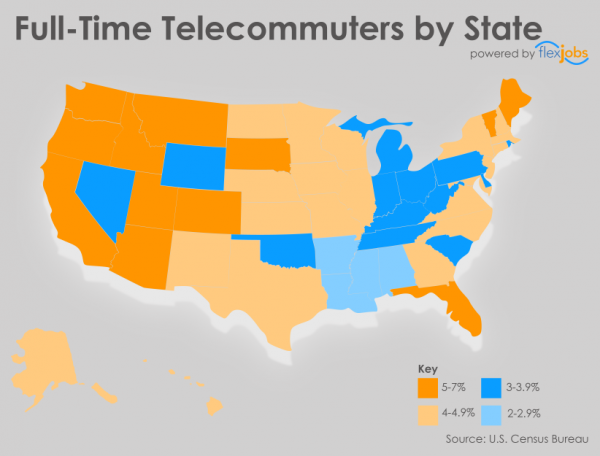
Thirty-seven percent of U.S. workers say they have telecommuted, up slightly from 30 percent last decade but four times greater than the 9 percent found in 1995, according to a newly released Gallup poll.  Connecticut ranks 25th in the nation in full-time telecommuters, data compiled by the website flexijobs.com indicates. The leading states for full-time telecommuters, based on percentage of workforce, are Colorado (6.9%), Vermont (6.8%), Oregon (6.3%), Montana (6%), Maine (5.7%), Arizona (5.5%), Idaho (5.5%) and New Hampshire (5.4%).  In Connecticut, 4.3 percent of the workforce are telecommuters.25th

Based on years of researching companies that hire for telecommuting, part-time, flextime, or freelance jobs, FlexJobs has compiled the best list of 100 of companies located in Connecticut that specifically have hired for jobs with at least one of these flexible working options.

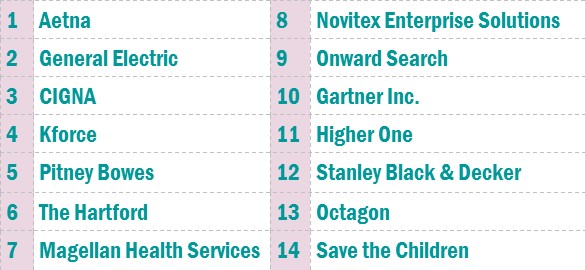
Connecticut’s top companies for flexible jobs are Aetna, General Electric, CIGNA, Kforce, Pitney Bowes, The Hartford, Magellan Health Services, Novitex Enterprise Solutions, Onward Search, Gartner Inc, Higher One, and Stanley Black & Decker.Full-Time-Telecommuters-by-State-by-FlexJobs-2015

The percentage of telecommuters nationwide is based on Gallup's annual Work and Education poll, conducted earlier this month, Aug. 5-9, 2015. Technology has made telecommuting easier for workers, and most companies seem willing to let workers do their work remotely, at least on an occasional basis if the position allows for it, the Gallup analysis points out. Even though telecommuting has become more common, the growth in the practice appears to have leveled off in recent years, according to Gallup.

The survey indicated that U.S. workers say they telecommute from home rather than go into the office about two days per month, on average. Nine percent of workers say they telecommutop companieste more than 10 workdays -- meaning at least half of all workdays -- in a typical month.  The majority of Americans, including both those employed and not employed, believe workers who work remotely are just as productive as those who work in a business office.


CT Tax on Cigarettes is Nation’s 4th Highest, Headed Toward 2nd Highest

Connecticut’s cigarette tax, $3.40 per pack, is the 4th highest in the nation.  State cigarette tax rates vary widely, ranging from 17 cents per pack in Missouri to $4.35 in New York, according to a report published in Governing magazine. When Connecticut’s tax increases to $3.65 per pack on October 1, the state will surpass the Massachusetts tax of $3.51 per pack, moving into 3rd place.  Rhode Island, at $3.75 per pack, ranks 2nd, behind New York State.  Should the scheduled increase of another 50 cents occur a year from now, Connecticut would have the nation’s second highest tax on cigarettes. cigarette

Rounding out the top 10 states with the highest cigarette taxes are Hawaii (5), Vermont (6), Washington (7), Minnesota (8), New Jersey (9), Wisconsin (10).

Policymakers often support tax increases on tobacco products as a means of raising revenue or improving public health by encouraging smokers to quit, the Governing analysis points out.  A handful of states passed cigarette tax hikes in the 2015 legislative session. Nevada lawmakers approved the single largest cigarette tax increase, raising the rate from 80 cents to $1.80 per pack, the publication indicates.

While noting that Connecticut's tax rate is set to increase to $3.65 per pack in October, the publication indicated that earlier proposals in the Pennsylvania and New Hampshire legislatures also included cigarette tax increases, but the two states have yet to pass budgets.

Kansas and Louisiana pushed cigarette taxes up by 50 cents and Ohio increased that state’s tax by 35 cents. Earlier this month, Alabama’s legislature voted down a proposal to increase that state’s tax by 25 cents per pack from the current 42.5 cents per pack, the third lowest tax in the nation.  Only Georgia, Virginia and Mississippi have lower taxes on cigarettes.smoking cigarette

The National Taxpayers Union Foundation reported that tobacco tax collections failed to meet initial revenue targets in 72 out of 101 recent tax increases, Governing reported, and as of 2011, only two states were funding tobacco control programs at levels recommended by the Centers for Disease Control and Prevention, which much of the tax revenue funneled into state general funds.

In Connecticut, the cigarette tax increased 61 cents in 2002 to $1.11 per pack, by another 40 cents in 2003, an additional 49 cents in 2007 and $1.00 in 2007 to reach $3.00 per pack.  In 2011, the tax increased by another 40 cents to the current $3.40 per pack.


New CT Consumer Confidence Survey Shows More Residents Likely to Stay, Although Outlook Relatively Unchanged

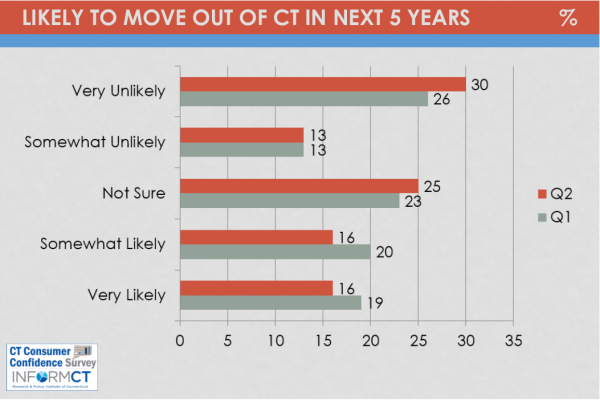
Fewer Connecticut residents now expect to move out of the state in the next five years, according to the results of the 2015 Connecticut Consumer Confidence Survey released today by InformCT, covering the second quarter of the calendar year. In the first quarter, the percentages were even, with 39 percent saying it was likely they’d move from the state during the next five years and the same percentage saying a move out of state was unlikely.  In the new survey, 32 percent said it is likely they will move out of state in the next five years, a slight drop, while the percentage who say it is unlikely has grown to 43 percent.CTConsumConfSurveyLOGO
Overall, Connecticut residents’ confidence in the state’s economy and their personal financial prospects are nudging along tentatively and unevenly, but relatively unchanged in the year’s second quarter compared with the first few months of the year.

Results of the Q2 Survey (April-June 2015) tend to reinforce what was found in Q1 (January-March).  Consumers see little change in what is perceived as a sluggish economy and do not envision any change in the next 6 months. This is also reflected in their attitudes toward the job market, with 6 in 10 feeling that there are insufficient jobs for the available workforce.move out
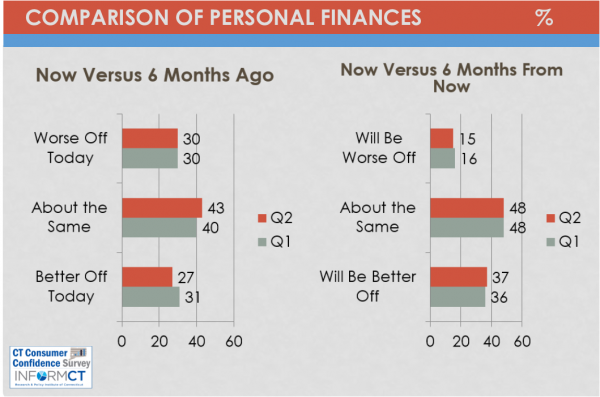
Regarding personal finances, slightly fewer state residents felt they were better off today than six months ago, but slightly more felt they would be better off six months from now.  A plurality, however, felt that their personal finances were about the same as six months ago, and were unlikely to change in the next six months.

Inform CT is a public-private partnership that provides independent, non-partisan research, analysis, and public outreach to help create fact-based dialogue and action in Connecticut.  The survey is designed to generate an ongoing measure of consumer confidence in the Connecticut economy.  The survey also found that:

  • Fairfield County residents are the most likely (32%) to think that business conditions are better.
  • Residents of Litchfield (36%) and Windham (34%) counties are the most likely to feel that jobs are very hard to get.
  • Residents of Tolland County (38%) are the most likely to feel that they are better off.

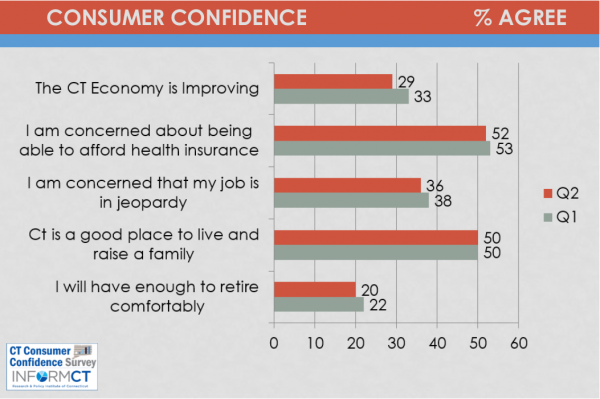
Concerns that survey respondents “job may be in jeopardy” dropped slightly from the first to second quarter, as did concerns “about being able to afford health insurance.”  However, slightly fewer people felt they had “enough to retire comfortably,” or that the state’s economy was improving.  On the question of whether Connecticut is a “good place to live and raise a family,” for the second consecutive quarter, the split was 50-50.  As income increases, respondents are more likely to agree that Connecticut is a good place to live and raise a family, the survey results showed.
personal financesThe survey is being administered for InformCT by the Connecticut Economic Resource Center, Inc.(CERC) and Shelton-based Smith & Company. The analysis, which is based on the responses of 400 randomly selected Connecticut residents (roughly 50 per county), addresses key economic issues such as overall confidence, reactions to housing prices, upscale consumer purchases, leisure spending and current investments. InformCT is a public-private partnership that currently includes staff from CERC and the Connecticut Data Collaborative.

The results also indicated that women (78%) are significantly more likely than men (52%) to indicate that they are likely to move out of Connecticut, and respondents with household incomes of $50,000 or less are significantly more likely to indicate that they will move out of Connecticut, according to survey officials.

More than 60 percent of state residents said they plan to take a vacation outside Connecticut (22% very likely, 39% somewhat likely) and 44 percent said they planned to vacation in Connecticut (26% very likely, 18 percent somewhat likely).  The most likely vacation location appears to be state parks, with 43 percent indicating that such a visit was likely in the next six months.  Forty-one percent planned to visit a casino, outdistancing visits planned to aquariums (27%), the Connecticut Science Center (13%) and other state attractions.

Regarding plans for major purchases in the next six months, often considered a harbinger of economic strength, 28 percent said they planned to make a “major consumer expenditure,” 22 percent anticipated purchasing a new car, and 15 percent said they were planning to refinance or purchase a new home. consumer confidence
CERC, based in Rocky Hill, is a nonprofit corporation and public-private partnership that provides economic development services consistent with state strategies, leveraging Connecticut’s unique advantages as a premier business location. Smith & Company LLC is a market research firm.  More information about the survey, and subscribing, can be found at www.informct.org.

“This research provides a measure of the strength of our economy as well as a gauge of select economic factors,” stated Alissa DeJonge, Vice President of Research at CERC.  “It is a valuable and cost-effective strategic planning tool for any company or organization that wishes to take the temperature of the Connecticut consumer.”

“Whether you are a financial services institution, health care provider, insurer, developer, utility, trade association, or advertiser, those who wish to subscribe to this regular information can add proprietary questions for their own purposes,” added Stephen A. Smith, President of Smith & Company.

 

Sexting Is Now Among Top 10 Concerns in Children's Health, Survey Shows

With more kids online and using cell phones at increasingly younger ages, two issues have quickly climbed higher on the public’s list of major health concerns for children across the U.S: sexting and Internet safety. Compared with 2014, Internet safety rose from the eighth to the fourth biggest problem, ahead of school violence and smoking, in the 2015 annual survey of top children’s health concerns conducted by the C.S. Mott Children’s Hospital National Poll on Children’s Health. Sexting saw the biggest jump, now the sixth top-ranked issue, up from thirteenth.

Childhood obesity, bullying, and drug abuse remained the top three child health concerns for a second year in a row, while child abuse and neglect ranked fifth.  Smoking and tobacco use, usually rated near the top of the list, dropped from the fourth top concern to the seventh – which may reflect the decline in smoking and tobacco use by youth in recent years.

MottPollWeb “The major health issues that people are most worried about for children across the country reflect the health initiatives providers, communities and policy makers should be focused on,” says Matthew M. Davis, M.D., M.A.P.P., director of the National Poll on Children’s Health and professor of pediatrics and internal medicine in the Child Health Evaluation and Research Unit at the U-M Medical School.
“The increasing level of concern about Internet safety and sexting that are now ranked even higher than smoking as major childhood health issues really dominates the story this year,” adds Davis, who is also with the U-M School of Public Health, Gerald R. Ford School of Public Policy, and deputy director for U-M’s Institute for Healthcare Policy and Innovation. “We found that while the public may find benefits to today’s shifting media environment, whether through cell phones or other technology, many also recognize risks that may make young people vulnerable.”

Studies have found that about 1 out of every 5 to 10 teens — guys and girls — have sent sexually suggestive pictures. And about 1 out of every 3 to 8 teens have received them, according to the Connecticut Children's Medical Center website.  The studies focused mainly on pictures, not sexually suggestive comments, messages, or tweets. The percentage of teens involved in sexting goes up if written sexual content is included, but it's not clear by how much. But one thing is clear, the site emphasizes: Sexting is relatively common among teens.

Expanding use of smart phones and other technology potentially exposes children and teens to the danger of predators and other harms like cyber-bullying, the report noted. Sexting (sending and receiving sexually suggestive text messages and photos) has also led to cases of teens around the country suffering from low self-esteem and even committing suicide following photos being widely shared among peers.

Sexting is relatively new, and many states have not created laws that specifically address it, especially when it comes to teenagers. In many states, teens who engage in sexting can be charged with significant crimes (concerning child pornography) because they are sharing images of minors.   Connecticut, however, is one of a number of states with laws that specifically address minor teens (those under the age of 18) who engage in sexting.  The Connecticut law was enacted in 2010.


https://youtu.be/kap7DHQyrww

Guns at the Airport? CT Ranks 43rd As Texas, Florida Confiscate Hundreds

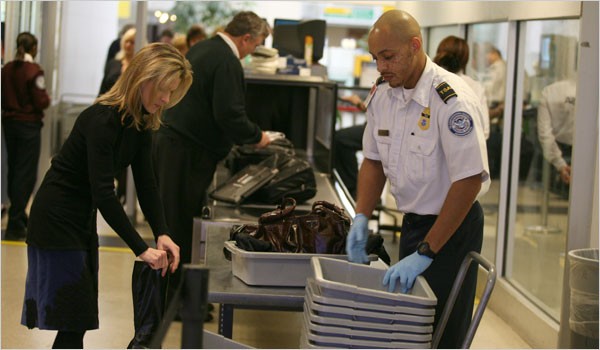
Airport travelers caught carrying firearms were most prevalent in Texas, Florida and Georgia, with Connecticut ranking 43rd among the states, according to federal data analyzed by Bloomberg News. Texas saw the most confiscations in 2014, with 424 guns found in screenings, according to Transportation Security Administration data. Dallas/Fort Worth International Airport, where 120 firearms were found in carry-on luggage, topped the list nationwide.

Ranked second was Florida, with 253 guns found during the year at the state’s airports, followed by Georgia with 119, California with 101, and North Carolina with 97.  Arizona and Tennessee tied for 6th with 94 guns discovered at each state’s airports, followed by Cotsa-airportlorado with 79 and Missouri with 75.

In Connecticut in 2014, there were four firearms found during 2014 according to the data.  Two of them were loaded.  There were also 4 firearms found at the state’s airports in 2013, Bloomberg reported.

With all 50 states now allowing people to carry concealed guns, with varying degrees of limitations, Bloomberg reported, more are being forgotten in clothing, holsters and handbags.  Firearm confiscations rose 22 percent from 2013.  Guns were discovered at airports in all 50 states in 2014, the data indicated.

The Transportation Security Administration screened more than 653 million passengers last year, about 14.8 million more than in 2013. The states and territories with the fewest were Rhode Island, South Dakota and the Virgin Islands.suitcase

Bloomberg ranked the 50 U.S. states and the U.S. Territories by the number of firearms discovered by the Transportation Security Administration (TSA) in carry-on luggage at that state's airports. The numbers for each state represent a total of all of the airports in that state covered by the TSA. Firearms are defined by the Bureau of Alcohol, Tobacco, Firearms and Explosives as a destructive device, machine gun, silencer, short-barreled rifle, short-barreled shotgun and any other weapon from which a shot can be discharged.

Supreme Court Justices Who Overturned CT Death Penalty Were Appointed by Three Different Governors, As Were Opponents

The four Justices of the Connecticut State Supreme Court who overturned Connecticut’s death penalty law this month were appointed to the high court by former Governor Lowell P. Weicker (Justices Richard Palmer and Flemming Norcott), former Governor M. Jodi Rell (Justice Dennis Eveleigh) and current Governor Dannel P. Malloy (Justice Andrew McDonald). The vote abolishing the death penalty in Connecticut was 4-3, with Justice Palmer joined in the majority by Justices Eveleigh, Norcott and McDonald. None are household names in the state – at least they were not before the decision – which was both widely criticized and highly praised by proponents and opponents of the death penalty, as well as legal observers and legislators.

Three dissenting opinions were written or signed by Chief Justice Chase T. Rogers, appointed to the Court by former Gov. Rell; Justice Peter Zarella, appointed by former Gov. John G. Rowland, and Justice Carmen Elisa Espinosa, appointed by Gov. Malloy.four justices

Thus former Gov. Rell and her successor, Gov. Malloy, each appointed a Justice on each side of the controversial opinion.  Two Justices on the majority opinion were appointed by former Gov. Weicker. Former Gov. Rowland's Supreme Court appointee was among the dissenters.

Justice Flemming L. Norcott Jr., who retired at age 70 in October 2013 after sitting on the case in April 2013, was the first African American appointed to the state Appellate Court, in 1987, and five years later was appointed to the state Supreme Court by Gov. Weicker. Justice Carmen Elisa Espinosa became a justice of the Supreme Court on March 6, 2013, having been appointed to the position by Gov. Malloy about six weeks before the case was heard. Justice Espinosa is the first Hispanic Supreme Court Justice in Connecticut.  Norcott and Espinosa were on opposite sides of the decision.

Chief Justice Chase T. Rogers, appointed to the Court by former Gov. Rell, was initially nominated to the Superior Court by Rowland in 2006.  Associate Justice Peter T. Zarella was nominated by Rowland in 2001.  Judge Dennis G.death Eveleigh was nominated for the state Supreme Court by Gov. Rell in 2010, after having initially been appointed to the Superior Court in October 1998 by Gov. Rowland.

The majority decision, written by Justice Palmer, found flaws in the 2012 death penalty law, which banned "prospective" death sentences, those imposed after the effective date of the law. But the majority wrote that it chose to analyze capital punishment and impose abolition from a broader perspective, according to published reports.

Justice Palmer graduated from Wethersfield High School, attended Trinity College in Hartford, and received his Juris Doctor from the University of Connecticut School of Law.  He served as an Assistant United States Attorney for Connecticut from 1980 to 1982 and from 1987 to 1990.  In 1991, Justice Palmer was appointed as United State’s Attorney for Connecticut and he was later the Chief State’s Attorney for Connecticut.

Justice Eveleigh received his J. D. from the University of Connecticut School of Law. Upon graduation from law school, Justice Eveleigh served on active duty in the U.S. Army as a First Lieutenant.

Justice McDonald began his public service career in 1993 as a member of the Stamford Board of Representatives, where he served until 1995, prior to his election to the state legislature. McDonald was later Legal Counsel to Gov. Malloy, and was nominated by Malloy to the Supreme Court in 2013, the same year as Espinosa, and a year after the legislature passed the non-retroactive death penalty ban, which was signed into law by Gov. Malloy.

In the case, State v. Santiago, Eduardo Santiago was tried for murder for hire, convicted, and sentenced to death. He appealed his sentence, and while the Court did not find that putting him to death was unconstitutional at the time, it did find that there were issues in his original trial that warranted a new sentencing hearing. While his appeal was pending, the 2012 legislation passed, abolishing the death penalty for crimes committed after April 24, 2012—which Santiago argued was grounds to remove death as a possible penalty. The Court then examined his claim that “the death penalty is no longer consistent with standards of decency in Connecticut and does not serve any valid penological objective.”

Four Justices on majority opinion, L to R, above:  Richard Palmer, Flemming Norcott, Dennis Eveleigh and Andrew McDonald.

CT Supreme Court: Seated, L to R, below: Justice Richard N. Palmer, Chief Justice Chase T. Rogers, Justice Peter T. Zarella. Standing, L to R: Justice Carmen E. Espinosa, Justice Andrew J. McDonald, Justice Dennis G. Eveleigh, Justice Richard A. Robinson, Senior Justice Christine S. Vertefeuille.  Justice Robinson was appointed to the Court after the Santiago case was heard.  

Supreme_Bench_w041614