Increased Municipal Burden, Disproportionate Impact on Low-Income Drivers Among Possible Effects of Highway Tolls, Report Finds

If Connecticut opts to introduce a system of tolls on the state’s roads to help fund a significant expansion of transportation infrastructure projects in the years ahead, the toll system instituted could run the risk of causing an increased use of local roadways that “could shift the burden of maintenance and congestion to municipalities,” and lower income residents in the state could be faced with “a higher burden relative to their incomes than wealthier Connecticut residents.” Those warnings to policy makers are included in an Issue Brief  by Inform CT that reviews the various tolling options and respective challenges posed.  Connecticut eliminated tolls more than 30 years ago in the aftermath of a horrific accident at the Stratford toll plaza, and state leaders have been in a “perpetual debate about whether to reinstate them ever since,” the paper points out.issue brief
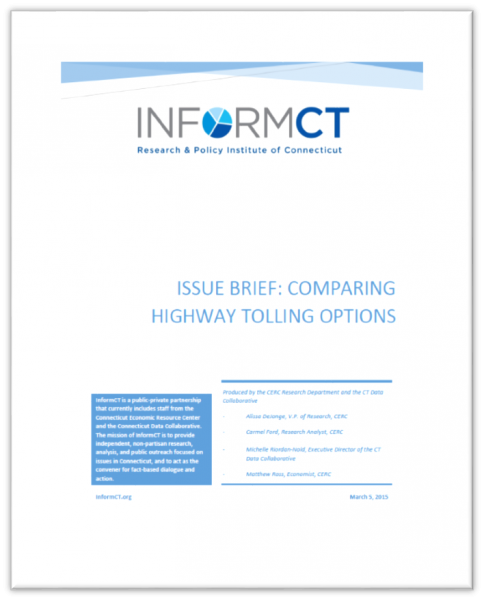
With overhauling the state’s transportation system is a leading element in Governor Malloy’s agenda to boost the state’s economy, renewed attention is being paid to methods of generating sufficient revenue to support those initiatives, and to issues raised in the 2015 policy brief.  Spurred by advances in technology, the possibility of imposing a system of electronic tolls, such as those in use in other states, are among the considerations, with border tolling, distance tolling and congestion pricing among the options.

920x920The issue brief indicated that a disadvantage of a distance toll system on all limited access highways in Connecticut would be that it “could create an incentive for people to use alternative roadways. The increased use of these roadways could shift the burden of maintenance and congestion to municipalities.” The advantage would be that distance tolls “could help to more efficiently allocate the cost of these roadways to drivers who use them the most.”

In analyzing the potential impact of tolls placed at Connecticut’s borders, the policy paper notes that while such an approach would “help to ensure that out-of-state residents driving through Connecticut pay for their use of Connecticut’s roadways,” border tolls “place a disproportionate burden on residents of Connecticut who commute out-of-state to work. This burden is further amplified if we believe that, on average, these out-of-state commuters use a smaller share of the roadways than their in-state commuting counterparts.”
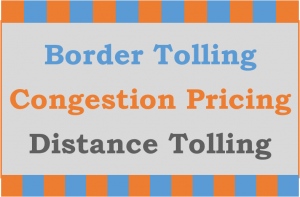
toll optionsCongestion pricing, which provides for higher toll charges at peak traffic times, “helps to limit traffic on major roadways and create an incentive for people to use more environmentally friendly forms of public transportation,” the policy paper indicates.  However, a congestion pricing system “could polarize roadway use by displacing low income commuters during peak driving hours. Congestion pricing could also create displacement effects whereby the increased use of local roadways could shift the burden of maintenance and congestion to municipalities.”Print

The report suggests that “congestion pricing and distance tolls could become more affordable for low income residents if electronic payment systems were implemented that allow for income-based rate reductions.”

Earlier this year, a study panel recommended installing tolls and raising taxes in order to pay for Malloy's 30-year, $100 billion transportation program.  Legislators have said that any decision on the imposition of tolls is at least a year away, as attention focuses during the current session on establishing a method to assure that money allocated to transportation is not redirected to other areas of government.

The issue brief also stress that “a key consideration when trying to outweigh the benefits and costs of implementing tolling in Connecticut is how the revenue from the tax will be redistributed to the residents of the state.” It goes on to highlight that “as the bill stands, the monies raised would go into the Special Transportation Fund but allocation of the monies from there is not specified. The allocation of these funds is an important discussion that needs to take place before the impact of the legislation can be considered in earnest.”

InformCT is a public-private partnership that currently includes staff from the Connecticut Economic Resource Center and the Connecticut Data Collaborative. The mission of InformCT is to provide independent, non-partisan research, analysis, and public outreach focused on issues in Connecticut, and to act as the convener for fact-based dialogue and action.

PERSPECTIVE: Freedom’s Just Another Word For…

by Rich Hollant

Music.

Around the time the State of Connecticut and the City of Hartford were releasing bleak news of their respective budgets, Joey Batts, a Hartford Public School teacher, released a video wherein for 3 minutes 22 seconds he sang his heart out about his affection for the Capital City. The ditty was entitled, “Hartbeat: A Love Letter for Hartford”. You should give a listen—you’ll be inspired. Set against a gritty-yet-hopeful portrayal of our streets, Joey Batt’s rhymes didn’t look at the Hartford neighborhoods with rose-colored glasses, but rather with objectivity brought to focus by real love. At this writing, the video has 1,083 shares on social media and has accrued 54,921 unique views—that’s nearly half our city. Imagine that.

CT perspectiveDance.

At about the same time, I was paying attention to Arien Wilkerson, the 20-something artistic director of the Hartford-based troop, Tnmot Aztro. His ensemble had been dazzling audiences with wildly collaborative and awe-inspiring feats of syncopated brilliance. As the budget news dominated the headlines, Wilkerson was provoking the established media and city leadership in support of two opportunities critical to his success: press coverage of dance and greater access to performance venues. The self-generated tension in his pleas missed the intended mark, but it didn’t matter. Tnmot Aztro would become not just the first local dance troop to perform at the contemporary art space, Real Art Ways, they would do so for 3 solid sold-out performances.

expressionArt.

Against the backdrop of the General Electric exodus, union negotiations, and looming austerity budgets, co:lab launched Parkville Studios, a residency program for recent Connecticut art school graduates. Eventually, we will install a 360° mentoring program where the resident cohorts will support high school students interested in an arts education while the residents, themselves, will receive guidance from private collectors, gallery owners, and curators from throughout the Northeast. We’ll do this soon, but not right now.

Right now, we are motivated by a sense of urgency to keep the brightest of our emerging creative talents painting, drawing, and searching for their voice right here in Hartford. Our priority is to offer them the space to generate their indelible contributions to our culture. This priority is as benevolent as it is self-serving because if you care about a community’s ability to heal, or about equity finding its level, or about the pursuit of the elusive “Better World”, then you can do no better service to your own ideals than to double up your investment in creative expression. The timing is irrelevant. Do it because it needs doing—because it changes everything.in front

Wonder.

That’s what creativity does—it moves us to action. Yet in a down economy, the knee-jerk reaction has been to cut spending on the things that are deemed to be superfluous, limiting expenditures to the “essentials”. Among the first things to go are outreach through marketing and the fostering of the creative part of our culture. That approach is unsustainable. Take another look at the anecdotes above. This is how our community is primed to be reached—through song, through movement, through the paint and textures that represent the essence of who we are right here and right now. When things are tough, we need to stimulate more imagination, not less. We need more lifting up, more hope-giving. We need the new creative people up in front because they conduct the movement. If I were in dire straits, I’d want a New Orleans style marching band like Hartford Hot Several co-opting George Michael songs on the bow. Seriously—we’d levitate.

Invest boldly.

_______________________________________

Rich Hollant is the principal, strategist and a design director at co:lab, a firm he started in 1988.  co:lab helps organizations committed to social value tackle the big questions that lead to greater awareness, purposeful motivation, and deeper loyalty.

PERSPECTIVE commentaries by contributing writers appear each Sunday on Connecticut by the Numbers.

LAST WEEK: The Economic Impact of Not Investing in Social Purpose Leadership

Legislature to Examine Why Zero Convictions for Human Trafficking, Even As Incidents Increase in CT

Human trafficking is a form of modern-day slavery. This crime occurs when a trafficker uses force, fraud or coercion to control another person for the purpose of engaging in commercial sex acts or soliciting labor or services against his/her will.  It is happening in Connecticut. Connecticut’s Permanent Commission on the Status of Women (PCSW) is convening a Joint Informational Forum with the state legislature’s Judiciary, Public Safety and Security, and Children’s Committees on Thursday, March 31 at the Legislative Office Building to examine the issue, the response of law enforcement and other agencies in Connecticut, and where changes in state law need to be made.

A decade ago, in 2006, Connecticut enacted Public Act 06-43, which created the felony charge of trafficking in persons.

“And yet, since then, only 10 arrests have been made and there have been no convictions,” according to PCSW, which noted that during that same time, the Department of Children and Families has received more than 400 referrals of individuals with high-risk indicators for human trafficking that demanded a collaborative response, including the participation of law enforcement.  Those numbers have climbed each year, with 133 referrals in 2015, according to the Governor’s office. human trafficking

“We decided to convene trafficking experts because, as we learn more about human trafficking, in particular sex trafficking of adults and minors, we need to ensure that victims are supported and that law enforcement and prosecutors have the tools to adequately punish traffickers, those buying sex, and those permitting and facilitating the sale of sex in Connecticut,” said Jillian Gilchrest, senior policy analyst for the PCSW, and chair of the state's Trafficking in Persons Council.

“Although the legislature has made great strides to increase awareness and enhance training programs against human trafficking, and especially the sex trafficking of minors – the truth is that this modern-day slavery is a national issue,” said State Rep. Noreen Kokoruda, the ranking member of the General Assembly’s Committee on Children. “Connecticut must take the critical steps necessary to combat human trafficking and to make sure that the legislation we passed is enforced. In order to proactively address this issue, we need a collaborative effort from all agencies; this issue is simply too important to ignore.”

Data from the National Human Trafficking Resource Center (NHTRC) indicates that in 2015 there were 120 calls made and 39 human trafficking cases reported in Connecticut – the highest numbers in the past three years. The statistics are based on phone calls, emails, and webforms received by the NHTRC that reference Connecticut. The NHTRC works with service providers, law enforcement, and other professionals in Connecticut to serve victims and survivors of trafficking, respond to human trafficking cases, and share information and resources.

Since 2007, the NHTRC has received more than 600 calls to their hotline that reference Connecticut.  As Connecticut’s felony crime of trafficking in persons, Connecticut Statute §53a-192a approaches its 10-year- anniversary, members of the Judiciary, Public Safety, and Children’s Committees are interested in understanding why no one has been convicted under §53a-192a and what policy or legislative changes can help remove current barriers to prosecution in these cases, officials said.

chartIn Connecticut, a person is guilty of trafficking in persons when such person compels or induces another person to engage in sexual contact or provide labor or services by means of force, threat of force, fraud or coercion. Anyone under the age of 18 engaged in commercial sexual exploitation is deemed a victim of domestic minor sex trafficking irrespective of the use of force, threat of force, fraud or coercion.

In a January report to the state legislature, the Trafficking in Persons Council pointed out that “Connecticut is not unique; there are many states that have yet to prosecute a trafficking case. In fact, according to the U.S. Department of State, as of 2011 only 18 states brought forward human trafficking cases under state human trafficking statutes.”

A series of proposals are now being considered by the state legislature.  In recent testimony, the PCSW pointed out that “the demand side of human trafficking and prostitution has all but been ignored in Connecticut. Arrests have been concentrated first on prostitutes, and secondarily on those buying sex. In fact, in the last 10 years in Connecticut, prostitutes were convicted at a rate of 7 times that of those charged with patronizing a prostitute It’s a basic premise of supply and demand: if you reduce the demand, you reduce the supply, which in this case, is the purchase of women and children for sex.”

In legislative testimony last month, the PCSW pointed out that “more and more trafficking and prostitution are being arranged online and taking place at hotels and motels throughout Connecticut. According to the National Human Trafficking Resource Center (NHTRC), Hotels and Motels are among the top venues for sex trafficking in Connecticut.”  PCSW stressed that “as we learn more about human trafficking, and what the crime looks like in Connecticut, we must ensure that our policies keep pace with that reality.”  Among the proposals is one designed to “give more tools to investigators,” Gov. Malloy and Lt. Gov. Wyman recently told a legislative committee.

The Trafficking in Persons (TIP) Council is chaired and convened by the Permanent Commission on the Status of Women and consists of representatives from State agencies, the Judicial Branch, law enforcement, motor transport and community-based organizations that work with victims of sexual and domestic violence, immigrants, and refugees, and address behavioral health needs, social justice, and human rights.

The report recommended that “Connecticut must ensure the creation of laws that address the continuum of exploitation, the implementation of laws, and the pursuit of criminal punishments for such cases. Sentences should take into account the severity of an individual’s involvement in trafficking, imposed sentences for related crimes, and the judiciary’s right to impose punishments consistent with its laws.”

Regarding victims of trafficking in Connecticut, the report recommended that “Key victim protection efforts include 3 "Rs" - rescue, rehabilitation, and reintegration. It is important that human trafficking victims are provided access to health care, counseling, legal and shelter services in ways that are not prejudicial to victims’ rights, dignity, or psychological well-being. Effective partnerships between law enforcement and service providers mean victims feel protected and such partnerships help to facilitate participation in criminal justice and civil proceedings.”

According to Rep. Rosa C. Rebimbas, ranking member of the Judiciary Committee, “Connecticut has made great strides to protect vulnerable women and children with strong laws against human trafficking, and resources to help them escape from the horrors of human trafficking, yet we are still behind when it comes to prosecution of the criminals who perpetrate such heinous offenses. We will continue to press for stronger laws to protect Connecticut residents, and to bring justice on their behalf.”

Coalition Calls for Public Input, Comprehensive Analysis, Greater Scrutiny of Cigna-Anthem Merger

A coalition of consumer and medical organizations is calling for greater public input into the Connecticut Insurance Department’s review of the proposed Anthem-Cigna health insurance mega-merger, and is expressing concerns about the potential “negative impact on both the cost and quality of care in Connecticut” of that merger and the proposed Aetna-Humana merger. The groups – Universal Health Care Foundation, Connecticut Citizen Action Group and the Connecticut State Medical Society – formed the “Connecticut Campaign for Consumer Choice” coalition and urged state Insurance Commissioner Katherine Wade to “ensure an open, transparent hearing process in Connecticut, where policy holders, physicians and other interested parties are given maximum opportunity to share their views.”

In a letter to Wade, the organizations urged a series of actions as part of the Anthem-Cigna review “to protect our health care options in Connecticut” – that a public hearing be held at a time and place that “allows for maximum public participation,” that interested parties be granted intervenor status (which would allow witnesses to be called and cross examined), and that a department commission a study that will “analyze the potential impact on cost, access, and the Connecticut economy, including jobs,” as part of the agency’s deliberations on the merger proposal. coalition

Bloomfield-based Cigna and Indianapolis-based Anthem are two of the nation’s five largest health insurance companies.  It is anticipated that a hearing would be held sometime this spring, but plans have not yet been announced. The coalition leaders indicated that “all eyes from around the country will be on Connecticut,” as home of two of the nation’s leading health insurance companies.

They also launched a new website, www.consumerchoicect.org, which will provide the public with information about the proposed mergers.  The site states that “what’s really happening is that fewer choices mean higher costs for consumers and employers. With fewer insurers for the remaining three national companies to compete against, there will be less of an incentive to keep costs low or develop innovative servchoiceices to bring in new customers.”

Connecticut Insurance Department spokeswoman Donna Tommelleo said the department "is reviewing the proposed acquisition in accordance with all applicable  Insurance Holding Company Statutes. The Form A application is posted on Home Page of the Department’s Web site for public view and the site is updated frequently as more documents are filed. After the application is fully reviewed and deemed complete by the Department there will be public hearing held within 30 days. The public will be given ample opportunity to provide both written and oral comment."  She indicated that "the Department respects the coalition’s interest in the matter.” The Anthem-CIGNA merger was filed with the state Insurance Department last September.

In advocating for the merger, Anthem has established a website that highlights the company’s views on the benefits of a merged company, at www.betterhealthcaretogether.com  The site indicates that “the combined companies will operate more efficiently to reduce operational costs and, at the same time, further our ability to manage what drives costs, helping to create more affordable health care for consumers.”

Matthew Katz, executive director of the Connecticut State Medical Society, said that the merger “could be the demise of already struggling private practices,” and will aanthemdversely impact patient costs and access to care.  "Goliaths will not  benefit consumer choice," he said.   The Society opposes the merger, as do the other organizations in the coalition.  They indicated that a fair, open, transparent review process would make it more difficult for the merger to be approved as being in the public interest.

Noting that Wade serves as chair of the National Association of Insurance Commissioners working group on the Anthem-Cigna mercer, and that the working group’s proceedings are not open to the public, the coalition leaders stressed the importance of an open and comprehensive process in Connecticut.

The letter to Commissioner Wade, dated March 22, was signed by Frances Padilla, president of the Universal Health Care Foundation of Connecticut, Tom Swan, executive director of the Connecticut Citizen Action Group, and Matthew Katz, Chief Executive Officer of the Connecticut State Medical Society.

The Connecticut State Medical Society is a federation of eight component county medical associations, with total membership exceeding some 7,000 physicians. Universal Health Care Foundation of Connecticut is an independent, non-profit philanthropy, supporting research-based policy, advocacy and public education that “advances the achievement of quality, affordable health care for everyone in the state.”  CCAG, founded four decades ago by consumer advocate Ralph Nader,  has "created change on the issues members care about including quality, affordable health care, protection of consumers, the environment, and democracy."

CT Ranks 10th in Percentage of Structurally Deficient, Functionally Obsolete Bridges

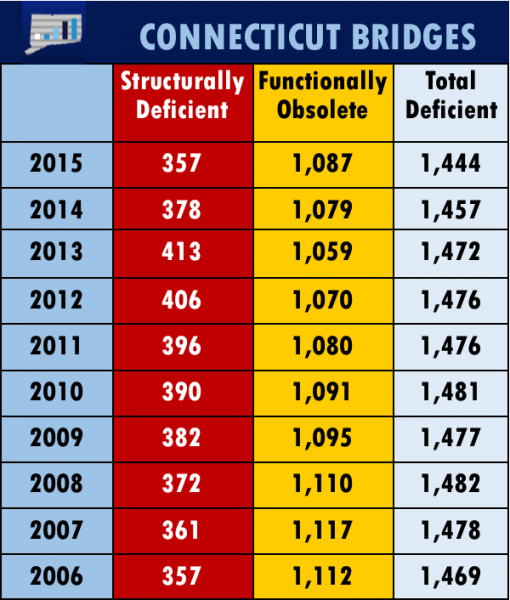
Of Connecticut’s 4,225 bridges, 357 are structurally deficient (8.4%) and another 1,087 are functionally obsolete.  That’s 34 percent of the state’s bridges deemed deficient by experts – and it ranks Connecticut as the 10th worst state in the nation, by percentage. Worse than Connecticut?  Only Rhode Island, Massachusetts, Hawaii, Pennsylvania, Alaska, New York, West Virginia, New Jersey and Maine.  The data, compiled by the Federal Highway Administration of the U.S. Department of Transportation, reflects information and analysis through December 31, 2015. Picture4

While the number of structurally deficient bridges in Connecticut is the lowest since 2006, the number of functionally obsolete structures has climbed in recent years, and is now the highest since 2010.  The total number of bridges in the two categories has dropped in each of the past three years, but remains at about one-third of the state’s bridges.  Connecticut ranks 26th in the percentage of structurally deficient bridges.

According to the Nation Bridge Inventory Database website, Structurally Deficient is a status used to describe a bridge that has one or more structural defects that require attention. This status does not indicate the severity of the defect but rather that a defect is present. Conditions driving the designation could include the bridge deck, the superstructure or the substructure of the bridge.

The sufficiency rating is calculated per a formula defined by the Federal Highway Administration, which places 55 percent value on the structural condition of the bridge, 30 percent on its serviceability and obsolescence, and 15 percent on its essentiality to public use. According to the Iowa Department of Transportation, “a structurally deficient bridge, when left open to traffic, typically requires significant maintenance and repair to remain in service and eventual rehabilitation or replacement to address deficiencies.”

The category Functionally Obsolete is a status used to describe a bridge that is no longer by design functionally adequate for its task. Reasons for this status include that the bridge doesn't have enough lanes to accommodate the traffic flow, it may be a drawbridge on a congested highway, or it may not have space for emergency shoulders, according to the National Bridge Invencautiontory Database. Functionally Obsolete does not communicate anything of a structural nature – it may be perfectly safe and structurally sound, but may be the source of traffic jams or may not have a high enough clearance to allow an oversized vehicle.
A year ago, Connecticut has 378 structurally deficient bridges and 1,079 considered functionally obsolete. Two years ago, 413 bridges were defined as structurally deficient and 1,059 were listed as functionally obsolete.

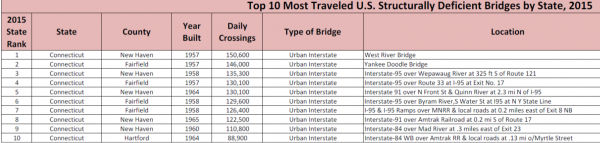
A January 2016 report by the American Road & Transportation Builders Association compiled the most traveled U.S. Structurally Deficient Bridges, and identified the West River Bridge in New Haven, built in 1957, ranked as the 98th most travelled structurally deficient in the nation.  At number 110 on the list was the Yankee Doodle Bridge in Fairfield, also constructed in 1957. At number 148 was the I-95 bridge over the Wepawaug River, south of Route 121 in New Haven, built in 1958.

Also ranking in the nation’s top 200 most travelled structurally deficient bridges were the I-95 bridge in Fairfield over Route 33 at Exit 17 (ranked number 159), the I-91 Bridge over North Front Street and Quinn River in New Haven just north of I-95 (number 160), and the I-95 bridge over Byram River in Fairfield (number 161).  Those bridges were built in 1957, 1964 and 1958, respectively.

bridges by state

Combatting Childhood Obesity Starts From Day One; Wide-Ranging Policies Proposed

Less “screen time,” more physical activity, more nutritional foods and fewer sugary beverages – that’s the formula to prevent obesity from taking root in infants and toddlers in the formative years of childhood, according to new recommendations by the Child Health Development Institute (CHDI) of Connecticut.  A series of “science-based policy opportunities” for Connecticut, outlined this week, also include support for breastfeeding in hospitals and child care centers.scale The need for stronger action is underscored by recent statistics.  In Connecticut, one of every three kindergartners is overweight or obese, as is one of every three low-income children. Children who are overweight or obese are more likely, according to the policy brief, to have:

  • risk factors for future heart disease, such as high cholesterol and high blood pressure
  • a warning sign for type 2 diabetes called “abnormal glucose tolerance,” although many children are being diagnosed with the full-blown disease in increasing numbers
  • breathing problems such as asthma
  • gallstones, fatty liver disease, and gastroesophageal reflux (acid reflux and heartburn)
  • problems with their joints

“Recent research shows that obesity may be very difficult to reverse if children are not at a healthy weight by 5 years of age,” the policy brief indicated. “Investing early in preventing childhood obesity yields benefits for all of us down the line by fostering healthier children, a healthier population overall and greatly reducing obesity-related health care costs over time.”

The policy brief recommends five ways Connecticut’s child care settings and hospitals can help our youngest children grow up at a healthy weight:

  1. Support breastfeeding in hospitals and in child care centers and group child care homes.
  2. Serve only healthy beverages in all child care settings.
  3. Help child care centers and group child care homes follow good nutrition guidelines.
  4. Increase physical activity time for infants and toddlers in all child care settings.
  5. Protect infants and toddlers in all child care settings from “screen time.”

The recommendations stress that “talking, playing, singing and interacting with people promotes brain development and encourages physical activity,” and urges that healthy infant and toddler development be encouraged by:

  • Never placing them in front of televisions, computers, or tablets to occupy them
  • Never allowing infants and toddlers to passively watch a television, computer, mobile phone or other screen that older children in the same room are watching

“Healthy lifelong weight begins at birth,” said Judith Meyers, President and CEO of CHDI and its parent organization the Children’s Fund of Connecticut. “Investing in obesity prevention policies makes sense for Connecticut.”  Meyers added that “the numbers are staggering,” and it has become clear that “to really address this problem we need to prevent it in the first place.”

If Connecticut were to implement the five recommendations highlighted in the policy brief, it would be the first state in the nation to do so, officials said. 1-5 A number of the proposals have been successfully implemented in other jurisdictions, including states and cities.  Marlene Schwartz, Director of UConn's Rudd Center for Food Policy and Obesity, noted that Connecticut has long been a leader in providing nutritional lunches in schools, and said that now the state’s attention needs to move to the earlier years of childhood.  “The field has realized that we need to start even earlier,” she said.  Rudd also indicated that determining "policy changes that might help reduce the disparities" in Connecticut, which are apparent in race, ethnicity and socioeconomic data, is also essential.

Legislation now pending at the State Capitol, which is not as comprehensive as the policy brief recommendations, is designed to "increase the physical health of children by prohibiting or limiting the serving of sweetened beverages in child care settings, prohibiting children's access to certain electronic devices in child care settings, and increasing children's participation in daily exercise."  The proposed legislation, HB 5303, was recently approved by a 10-3 vote in the Committee on Children, but has an uncertain future before the full legislature.

Dealing with childhood obesity has been a challenge because of the “many different systems and programs that impact childhood development – which can also provide “many different places for opportunities to influence what happens.”  Officials said that some of the policy proposals can be realized through legislative action, others by regulatory changes, and others through voluntary initiatives.  They indicated that since Connecticut established the Office of Early Childhood in recent years, coordination of oversight and services has improved, which is an encouraging development.  Child care settings provide an opportunity to impact a large proportion of the state’s pre-kindergarten children, but plans to disseminate the message more broadly, including through pediatrician’s offices, are being considered. obesity consequences

The recommendations call for “allowing toddlers 60-90 minutes during an 8-hour day for moderate to vigorous physical activity, including running, and “adherence to federal nutrition guidelines” including more whole grains and low-sugar cereals, no sugary drinks, and fewer fried foods and high-sodium foods.  Through 11 months, infants should be served “no beverages other than breast milk or infant formula, and those 12 months through 2 years old should be served no beverages other than breast milk, unflavored full-fat milk water, and no more than 4 ounces of 100% fruit juice.”

The CHDI policy brief indicates that “childhood obesity can contribute to poor social and emotional health because overweight and obese children are often bullied and rejected by their peers as a result of their weight. That stress can affect every part of their development, interfering with their learning (cognitive), health (physical and mental), and social well-being.”

k obeseThe recommendations, described as “affordable, achievable, common sense measures,” were prepared for CHDI as part of a grant to the UConn Rudd Center for Food Policy and Obesity, funded by the Children’s Fund of Connecticut.  The author was public health policy consultant Roberta R. Friedman, ScM.

CHDI began focusing on strategies to promote healthy weight in children from birth to age two after publishing thechdi_logo IMPACT “Preventing Childhood Obesity: Maternal-Child Life Course Approach” in 2014. The report reviewed scientific research on the causes of obesity and explored implications for prevention and early intervention. In 2015, the Children’s Fund of Connecticut funded four obesity prevention projects in Connecticut that addressed health messaging, data development, policy development and baby-friendly hospitals.

Unemployment Drops in Waterbury, Norwich/New London Lead CT; Unemployment Lowest in Danbury

The unemployment rate in greater Waterbury and the Norwich-New London saw a larger decrease during the past year than Connecticut’s other large metropolitan areas, and the state’s lowest unemployment rate can be found in Danbury, according to new data released by the U.S. Bureau of Labor Statistics. Danbury was the only one of the state’s six largest metro region to crack the top 200 for lowest unemployment rate, earning a spot at number 168. The year-over-year unemployment data shows that unemployment rates were lower in January 2016 than a year earlier in 333 of 387 metropolitan areas in the U.S., higher in 43 areas, and unchanged in 11 areas. In Connecticut, the six major metropolitan areas all saw a decline in the unemployment rate.chart

Nationwide, the unemployment rate dropped eight-tenths of a point, from 6.1 percent in January 2015 to 5.3 percent in January 2016.  Only one Connecticut region – Danbury – had a lower unemployment rate, at 5.1 percent.  Generally in Connecticcut, the larger the unemployment rate in January 2015, the larger the drop over the following year.

The one percent drop in unemployment in Waterbury and Norwich-New London-Westerly ranked each region tied for 124th for the largest drop in the nation.  Also reaching the top 200 for the largest reduction in unemployment was the Hartford-West Hartford-East Hartford area, ranking 197th with a drop of 0.7 percent, from 6.7 percent to 6.0 percent.

Even with the drop in unemployment, Waterbury’s jobless rate is the highest among the state’s major urban areas, at 7.4 percent. Bureau-of-Labor-Statistics

In this year’s rankings, Waterbury was number 342 with an unemployment rate of 7.4 percent. Norwich-New London-Westerly was at number 295 with an unemployment rate of 6.4 percent.  New Haven and Hartford-West Hartford-West Hartford were tied at number 263 with an unemployment rate of 6.0 percent, and Bridgeport-Stamford-Norwalk at number 235 with an unemployment rate of 5.8 percent, down from 6.3 percent a year ago.

Ames, Iowa, and Boulder, Colo., had the lowest unemployment rates in January, 2.5 percent each. El Centro, Calif., had the highest unemployment rate, 19.2 percent. A total of 187 areas had January jobless rates below the U.S. rate of 5.3 percent, 184 areas had rates above it, and 16 areas had rates equal to that of the nation.

PERSPECTIVE: The Economic Impact of Not Investing in Social Purpose Sector Leadership

by Maggie Gunther Osborn As a leader in transition leaving Connecticut, I wanted to reflect on what is happening with leadership in the social purpose sector in our state and sound a few alarm bells. For those of you unfamiliar with my terminology, I am talking about what we normally refer to as the non-profit sector.  I have chosen to stop saying non-profit, because it has trained us to believe that this is a sector with limited economic impact or does not require the same investments in infrastructure and human capital as other sectors. Non-profit is a tax status but does not describe the work of the social purpose sector.

CT perspectiveIn Connecticut, the social purpose sector employs between 14-17% of the workforce and generates $33.4 billion in revenues annually. Connecticut foundation giving supporting the sector totals more than $1 billion, but is primarily invested in the programs and outcomes of the sector giving very little attention to investment in leadership.  In fact, nationally less than 1% of all foundation grants support leadership capacity and development. The social purpose sector is a vital, critical part of our state and yet is not often regarded as such in discussions of economic benefit, sustainability, leadership, innovation and job creation.quote 1

I sit around the periphery of these discussions and see that much of the energy is focused on the leadership of organizations. We invest in leadership training for our corporate workforces because we understand it is key to the culture, sustainability and productivity of business. I often ask board members who run successful enterprises what they attribute their success to and often they reply “we invest in our people.” And yet very few of them, in their roles as board members, bring that same thought perspective to bear on social purpose decisions.

The result of a lack of investment in the leadership of the social purpose sector is leading to the statistics revealed in Third Sector New England’s Leadership New England Report 2015: Essential Shifts for a Thriving Nonprofit Sector.

  • 60% of CT leaders say they will be leaving their organizations within the next five years and 47% of those in the next two years.
  • 59% of CT leaders are over 55 compared to 53% in the New England region as a whole.
  • More than 54% of organizations have no succession or sustainability plan.
  • 61% of CT leader’s salaries are under $100k with 21% under $50k.
  • 59% of CT organizations have 3 or fewer month’s cash reserves in comparison to 49% of all New England organizations.
  • 29% of CT organizations have no cash reserves compared to just 7.2% of all New England organizations. This indicates that a much larger proportion of CT organizations is at risk of immediately running out of funds than the respective proportion in New England as a whole.

quote 2At this point, there are a couple of things to note. First, while we have been talking about leadership transitions for many years, the recession delayed the major transition of leaders out of the sector until now.  Second, there is no bench strength to call on from within these organizations when these leaders retire.  Very little investment has been made to build the skills and capacity of middle managers to step up into leadership roles. Third, most of the departing leaders are Baby Boomers whose leadership roles were dependent on their willingness to work long hours in a professionalized volunteer sector.  We will not fill these rolls with Millennials and Gen Xers for what we paid their predecessors.

Current professionals expect to work in places that are dynamic and culturally competent business environments where they feel comfortable and can advance.  They will not stay a professional lifetime anywhere, and will not stay more than a few years where these characteristics do not exist. In addition, the state budget crisis is going to be our norm for the next decade consequently offloading more responsibility to this sector. We need people with the skills to not only provide services, but also create new business models, attract talent and strategically work through these enormous challenges.

All of us, whether professional, volunteer, elected official, philanthropist, board member or donor, should strive to recruit the best and brightest to the social purpose sector by investing in leadership in the same ways we do in the private sectors. Strong leaders will make the next generation of the social purpose sector resilient enough to meet the challenges that face Connecticut.

______________________________________

Maggie Gunther Osborn is president of the Connecticut Council for Philanthropy.  She will be leaving the organization in June to assume the post of chief strategy officer for the Forum of Regional Associations of Grantmakers in Washington, DC. 


PERSPECTIVE commentaries by contributing writers appear each Sunday on Connecticut by the Numbers.

LAST WEEK: Reaching Untapped Potential of Urban Students