Raising Revenue Getting Tougher for Towns, Cities in Connecticut; Property Tax Drives Disparities

The Connecticut Data Collaborative has launched a series of reports that will examine the fiscal situation of Connecticut’s 169 municipalities making the data compiled in several recent statewide initiatives that examined fiscal challenges facing the state and its towns more readily accessible to the public. The goal is to “highlight the major findings from these initiatives and reports; expand on the research that was done; present it through a new medium; and inform a broader audience on the work being done in the state.”

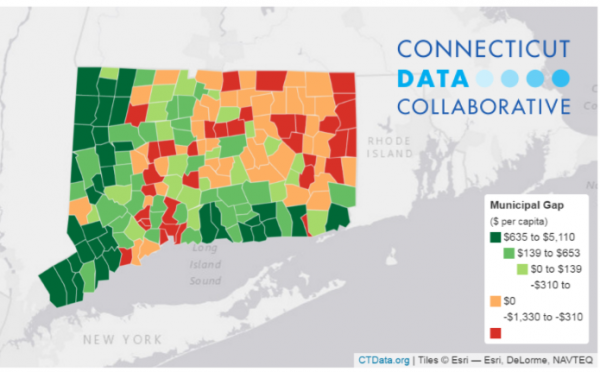
The first data story, published this month, highlights the findings from a report to the General Assembly’s Program Review and Investigations Committee prepared by the Federal Reserve Bank of Boston’s New England Public Policy Center (NEPPC), “Measuring Municipal Fiscal Disparities in Connecticut.”map

The conclusion: the capacity to raise revenue from property taxes is the main driver of fiscal disparities in Connecticut.

  • 78 of 169 towns have a deficit, with revenue capacity below the cost of providing services. These 78 towns represent almost 60 percent of state’s population.
  • 91 of 169 towns have sufficient capacity to raise revenue capacity to cover the cost of services.
  • Municipal cost differences exist but are not as dramatic as the differences in the ability to raise revenue
  • Current state non-school grants made to towns have a limited effect in reducing non-school fiscal disparities in Connecticut.
  • Five cost factors were identified as driving non-school municipal costs: unemployment, population density, private sector wages, town road maintenance, and jobs per capita.
  • Statistical analysis shows that the following factors do not impact costs: poverty, population, the share of foreign-born population, and the share of older rental housing units

The website points out that “a municipal gap exists when the costs are higher than the revenue raising capacity,” and provides an interactive town-by-town listing of the “gaps.”  The highlighted findings:

  • The largest gaps are in Hartford (-$1,330), Bridgeport (-$1,168), New Haven (-$1,101), New Britain (-$1,056) and New London (-$896). The largest surpluses are in Westport, New Canaan, Darien, and Greenwich.  The data is FY 2007-2011, averaged.
  • 78 towns in the state have a deficit - the capacity is below the cost of providing services. These towns cover almost 60 percent of state’s population.
  • 91 towns have sufficient capacity to raise revenue greater than the cost of services. These towns cover 40 percent of the state’s population, primarily in Fairfield County, Litchfield and the shoreline.

Since property taxes are the primary way that municipalities raise revenue, the website examined the trends in the Equalized Net Grand List (ENGL) since 2011.  Overall, property tax revenue has been on the decline, the data indicated. An interactive table on the site shows - by town- the average annual growth rate (or decline) in the grand list from 2011 to 2014, and also shows the Municipal Gap calculated by the report. In total, ENGL has declined for 145 of the 169 towns since 2011 – “thus the revenue raising capacity for towns has only become more difficult.”

Most Expensive State for Car Insurance? Michigan Ranks First, CT is 17th

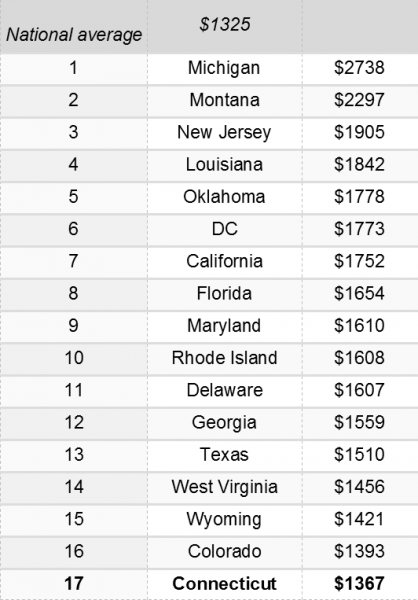
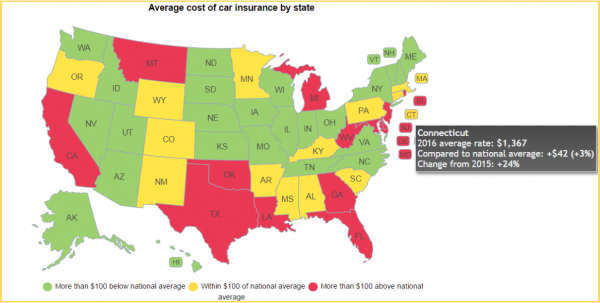
The most expensive car insurance rates in the nation are in Michigan.  Connecticut ranks 17th.   It is the third consecutive year that Michigan has topped the list. Connecticut’s average of $1,367 is 3 percent above the national average of $1,325.  The average rate in Connecticut jumped by 24 percent from 2015 to 2016, according to the survey.  The Connecticut data was compiled in February.  Among the New England states, Rhode Island was ranked tenth, averaging $1,608, Massachusetts ranked 21st at $1,325. Maine had the lowest rates, at $808 annually.

Insure.com’s 2016 state-by-state comparison of auto insurance premiums found that Montana captured the No. 2 spot for the second year in a row. New Jersey broke into the top five for the first time ever, Louisiana was No. 4, and Oklahoma rounded out the top five.list

On the flipside of the cost coin, Maine led the way for the cheapest car insurance in the country. Maine has been in the top three for the least expensive car insurance for all six years of the study, according to insure.com. This year, Ohio came in No. 2, Wisconsin was three, Idaho took fourth, and New Hampshire earned No. 5.

The annual study compiles rates from six large insurance carriers in 10 ZIP codes in every state. Rates were for the same full-coverage policy for the same driver -- a 40-year-old man with a clean driving record and good credit. The rates are an average for the 20 best-selling vehicles in the U.S. in order to present more accurate rates for the average driver – without high-end sports or luxury cars skewing the data. Each model was rated on its cheapest-to-insure trim level.

mapThe national average for a full-coverage policy as featured in the Insure.com report came in at $1,325 this year – a slight increase from last year’s average of $1,311. Rates varied from a low of $808 a year in Maine to a budget-busting $2,738 in Michigan. Insurance rates in Michigan are more than double (107 percent) the national average.

Insurance rates are influenced by a number of different factors. Everything from traffic, crime rates, state and local laws, the percentage of uninsured drivers, as well as the number of insurance companies competing in a market can all result in higher or lower insurance premiums in your state.

Insure.com commissioned Quadrant Information Services to calculate auto insurance rates from six large carriers (Allstate, Farmers, GEICO, Nationwide, Progressive and State Farm) in 10 ZIP codes per state. Insure.com averaged rates in each state for the cheapest-to-insure 2016 model-year versions of America’s 20 best-selling vehicles and ranked each state by that average. Rates are for comparative purposes only within the same model year.

CT Obesity Rate is 43rd in US; Steadily Increasing, But Among Lowest Rates

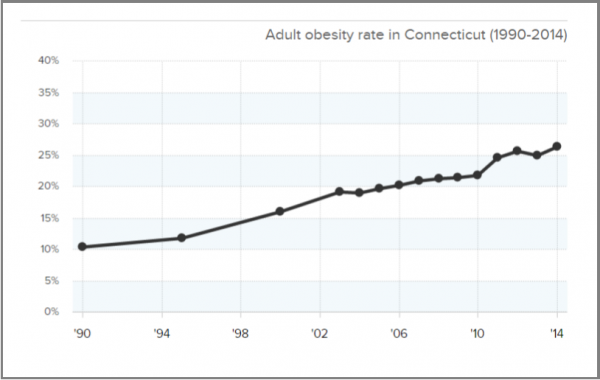
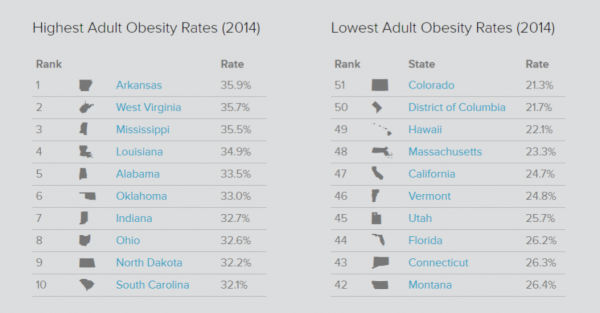
Connecticut’s obesity rate has increased dramatically during the past two decades, but the state has among the lowest adult obesity rates in the country, ranking 43rd among the states in an analysis of obesity rates. According to the most recent data, rates of obesity now exceed 35 percent in three states (Arkansas, West Virginia and Mississippi), 22 states have rates above 30 percent, 45 states are above 25 percent, and every state is above 20 percent. Arkansas has the highest adult obesity rate at 35.9 percent, while Colorado has the lowest at 21.3 percent.CT rates

Connecticut now has the ninth lowest adult obesity rate in the nation, according to The State of Obesity: Better Policies for a Healthier America. Connecticut's adult obesity rate is currently 26.3 percent, up from 16.0 percent in 2000 and from 10.4 percent in 1990.

U.S. adult obesity rates remained mostly steady — but high — in 2014, the most recent full year data available, increasing in Kansas, Minnesota, New Mexico, Ohio and Utah and remaining stable in the rest.

The analysis also found that 9.2 percent of adults in the state have diabetes, an obesity-related health issue, ranking 35th in the nation as of 2014. It is the highest rate in the state in the past 25 years. The number of diabetes case is projected to increase from 267,944 in 2010 to 412,641 by 2030, at the current pace of increase.obesity rates

The adult hypertension rate, 31.3 percent, ranks Connecticut 27th among the states.  The number of hypertension cases is projected to increase from 708,945 in 2010 to 941,046 by 2030.  Heart diseases is projected to increase from 214,986 people in 2010 to 1,014,057 in 2030, and obesity-related cancer is projected to more than double in 20 years, from 58,115 in 2010 to 147,883 in 2030.

The state-by-state analysis is a project of the Trust for America’s Health and the Robert Wood Johnson Foundation.

Charter Oak State College's First Online Graduate Degree Program Approved; to Begin This Fall

For the first time in it’s more than 40-year history, Charter Oak State College, Connecticut’s public online college, will be offering an online graduate degree program beginning this fall. A Master of Science in Organizational Effectiveness and Leadership, developed by the College, has been approved by the New England Association of Schools and Colleges (NEASC), the College’s regional accrediting authority. Charter-oak-state-college-logo

“Our alums want to pursue higher degrees, and many want to continue their studies at their alma mater, Charter Oak State College.  For working adults, our online format fits their lifestyle, and our workforce focused degree programs resonate with employers and employees alike,” said Ed Klonoski, President, Charter Oak State College.

The Master of Science in Organizational Effectiveness and Leadership is a 33 credit online degree program with student outcomes including expanding leadership skills, managing change, improving decision making skills, and conducting applied research, officials said.  The program includes the option to choose one of two tracks – business or non-profit.

Prospective students can request more information at www.CharterOak.edu/masters. Online applications to be available later this Spring.

Founded in 1973, Charter Oak State College is Connecticut’s only public online college, offering associate and bachelor’s degree completion programs in high-demand fields including Health Information Management, Health Care Administration, Cyber Security and Business Administration.  Charter Oak is accredited by the New England Association of Schools and Colleges and governed by Connecticut’s Board of Regents for Higher Education.


73 Local Health Departments Serve CT's 169 Municipalities

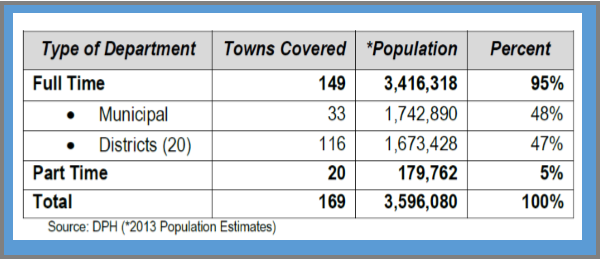
Connecticut has 73 local health departments serving the state’s entire population – individuals residing in the state’s 169 cities and towns. Data compiled by the state Office of Legislative Research breaks down the health departments by full-time and part time, as well as their geographic coverage. Of the 73 local health departments across the state, 53 are full-time departments, while the remaining 20 are part-time. The full-time departments include 33 individual municipal health departments and 20 health district departments (multi-town departments serving from two to 20 towns).numbers

By law in Connecticut, a town may have a part-time health department if: (1) it did not have a full-time department or was not part of a full-time district before January 1, 1998, (2) it has the equivalent of one full-time employee, and (3) the Department of Public Health commissioner annually approves its public health program and budget.

According to the Department of Public Health (DPH), based on the state’s 2013 estimated population, full-time health departments (both municipal and district) serve about 95 percent of the state’s population, while part-time departments serve the remaining 5% percent, OLR reports.

Connecticut’s local public health system is decentralized and a local health department falls under the jurisdiction of its respective municipality or district. Staff are hired and employed by the municipal or district health department.

The law requires towns, cities, and boroughs to nominate a municipal health director, who must be approved by their respective legislative bodies and DPH. The DPH commissioner may remove the director for cause. The town, city, or borough may also take such action with the commissioner’s approval.public health

Municipal and district health departments enforce the state’s public health laws, rules, and regulations, including the Public Health Code. Responsibilities include jurisdiction to:

  • examine and remediate public health hazards, nuisances, and sources of filth;
  • levy fines and penalties for Public Health Code violations;
  • grant and rescind license permits (e.g., for food service establishments or septic systems);
  • establish fees for health department services;
  • submit to DPH reports on reportable diseases from health care providers and clinical laboratories; and
  • provide for sanitation services (district directors may serve as sanitarians as practical).

Full-time municipal and district health departments receive state funding. The legislature eliminated funding for part-time health departments in 2009, according to OLR.


PERSPECTIVE: Reaching Untapped Potential of Urban Students

by Jahana Hayes My personal experiences are the greatest contributing factors to my becoming a teacher. These experiences shaped my views and continue to influence my teaching style. Being the first in my family to attend college helps me to fully appreciate the importance of education.

As a child everything I learned about school I learned at school. Teachers provided me with the support and encouragement to be a good student. My family provided for me; however education was not seen as a pathway to success. None of their experiences included higher education so they stressed the importance of hard work and industry. They told me to get a job with decent pay and benefits and work hard to support myself. This message was contradicted by the constant cycle of drugs, welfare and abuse that persisted in my family.

CT perspectiveTeachers exposed me to a different world by letting me borrow books to read at home and sharing stories about their college experiences. They challenged me to dream bigger and imagine myself in a different set of circumstances. I was oblivious to opportunities that existed outside of the projects where I grew up, but my teachers vicariously ignited a passion in me. I was surrounded by abject poverty, drugs and violence, yet my teachers made me believe that I was college material.

I can still remember the teachers who refused to accept the stereotypical views of inner city children and for them I am grateful. As a result, I entered this profession with a passion for the work that I do and an understanding that my work would extend beyond the classroom and into the world. I have a full understanding that many students come to school struggling to solve adult problems and teachers have to work through that before they can even begin to teach.

I became a teenage mother in high school and almost gave up on my dreams completely. However, my teachers showed me the many options that were still available if I continued my education. These positive experiences at school inspired me to become a teacher and that has always been my driving influence.qyote 1

As a teacher, my own life is a constant reminder that students come from different circumstances and experiences. I have learned that teaching is a lifestyle that extends well beyond the contracted hours. I strive to meet students where they are, and not dwell on where they should be. I remember myself at various points in my journey and wonder how hopeless I must have seemed to the teachers who continued to work with me. They saw potential in me and did not give up even when it seemed like I would not graduate.

Working in an urban public school district with a widely diverse population, I see so many things that fall outside of traditional teaching responsibilities. It is those times when I am transformed into an advisor, counselor, confidant and protector. I also recognize that not all of my students have the same desire as I did to go to college. I remind them that this too is ok.

Students have to learn to be their best selves and pursue their own dreams even if higher education is not their best option. Many students are amazed that I don’t constantly push them into a college setting. I let them know that it is wholly acceptable to be an entrepreneur or a carpenter, hairdresser, plumber or whatever they desire.

One of the most critical issues affecting both education and society is the lack of empathy and understanding of others. If we show students that they are important, begin to engage them in dialogue, help them develop an appreciation for diversity and recognize that all people matter while they are still in school; many of the challenges we face in society will be improved.

As a teacher, I strive to facilitate learning in a way that engages students by connecting on a personal level and stimulating academic growth while simultaneously producing contentious and productive members of society. By serving their community students are able to demonstrate personal growth and model adult behaviors. This has become extremely personal to me because I feel that graduating students who demonstrate respect, responsibility, honesty and integrity is as critically important as mastering content and demonstrating proficiency.
quote 2As a child growing up in an urban poverty stricken environment, I only came in contact with one minority teacher. This contact greatly influenced the person I became. Most of my teachers lived outside the district and had experiences that were very different from mine. Many of my teachers were second or third generation educators and had always known they would be teachers. I saw little of myself in any of them.

I do not say this to imply that only minority educators would have a clearer understanding of my life, or that a minority teacher would have similar experiences; but to say that as a child I would have loved to see a teacher who looked like me and shared my cultural background.

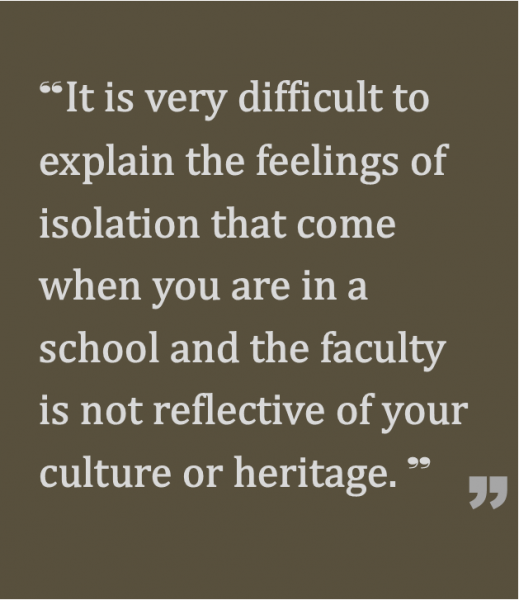
In a recently published study in Economics of Education Review, it was shown that Black, white and Asian students benefit from being assigned to a teacher that looks like them. Their test scores go up in years when their teacher shares their ethnicity, compared to years when their teacher has a different ethnicity. It is very difficult to explain the feelings of isolation that come when you are in a school and the faculty is not reflective of your culture or heritage. As population demographics continue to shift, school districts must be intentional in their efforts to create a more diverse workforce.

As a teacher, I try to always be enthusiastic and express a sincere interest in my students’ academic success. I aim to inspire students to be more interested in the process than the product. I am constantly trying to challenge students to take a constructivist approach, ask questions, and in turn, apply their learning in different ways. My goal is for students to become self-directed, intrinsically motivated learners who are less concerned with grades and more concerned with gaining deeper knowledge and understanding.

While I have a passion for educating students, I am most proud of the influence I have beyond the classroom and I see this as my greatest contribution. Students are constantly coming to me for advice and direction. In my job I have been able to engage students in a variety of multi-faceted service projects. I never expected community service to be such a pronounced part of my work but the satisfaction that comes from watching students take ownership of their community is unmatched.

I believe that it doesn’t matter how bright a student is or where they rank in a class or what colleges they have been accepted to if they do nothing with their gift to improve the human condition. I try to teach students that we are all obligated to help others and improve society. Oftentimes people in the community ask me how I get so many young people to volunteer for community service and my answer is always the same, “I ask.”

_________________________________________

Connecticut’s 2016 Teacher of the Year, Jahana Hayes, teaches social studies at John F. Kennedy High School in Waterbury.  In January, she was named one of four finalists by the Council of Chief State School Officers for National Teacher of the Year, which will be selected next month.  This perspective is an excerpt of her 18-page National Teacher of the Year application.  A native of Waterbury, she attended Naugatuck Valley Community College, Southern Connecticut State University, University of Saint Joseph and University of Bridgeport.

PERSPECTIVE commentaries by contributing writers appear each Sunday on Connecticut by the Numbers.

 LAST WEEK: Suicide Prevention - Creating a Message of Hope for Young Adults 

State Residents Express Confidence in Public Schools; CT Ranks 12th in Poll

North Dakota residents (89%) are more likely than those living in any other U.S. state to rate the K-12 education provided in their state as excellent or good, followed closely by those living in Minnesota and Nebraska (82%). Connecticut ranked at number 12 in the nation, for residents’ assessment of their state’s public schools, with 71 percent viewing the caliber of education provided as good or excellent. In stark contrast to the top states, about half as many Nevada and New Mexico residents, 42% in each state, rate their public edCHDIucation systems positively, the lowest percentages in the country, in a new poll released by Gallup.  Joining the two southwest states at the bottom of the list are Hawaii (47%), Louisiana (49%), Arizona (50%), California and Alabama (52%), Mississippi (53%) and  Oregon and Rhode Island (54%).

71State residents were asked “how would you rate the quality of public education provided in grades K-12” on a scale including excellent, good, fair and poor.  The top 10 states after North Dakota, Minnesota and Nebraska are Iowa, New Hampshire and Massachusetts (80%), Wyoming (79%), South Dakota (78%) and Vermont and Virginia (75%).

These results are based on a Gallup poll conducted from March through December 2015, and released this week, with approximately 500 interviews in every state.

Residents in states where a large share of residents rate the quality of education as excellent or good are also more likely to believe their public school system prepares students for success in the workplace, according to Gallup.230px-Gallup_Corporate_logo

When asked “Do you believe your state public school system prepares students for success in the workplace?” North Dakota and Nebraska again topped the list, at 89 percent and 81 percent, respectively.  Connecticut ranked 18th at 68 percent.


Connecticut Ranks 10th in U.S. in Percentage of Latinos Among Eligible Voters

Connecticut, with 10.8 percent of eligible voters of Latino heritage, ranks 10th among the states in the percentage of eligible Latino voters.  In 16 states, more than half of the Latino population is eligible to vote, including Connecticut which ranks 13th with 51.8 percent of the Latino population eligible to vote in the November elections. Those states include Vermont, Maine, Hawaii, New Mexico, Alaska, Montana, North Dakota, West Virginia, Florida, Pennsylvania, New Hampshire, and South Dakota, with percentages ranging from 61.9 percent to 51.9 percent. latino vote

A record 27.3 million Latinos will be eligible to vote in the 2016 elections, which will include legislative and Congressional elections, United States Senator and President/Vice President.  The Hispanic population in Connecticut is the 18th largest in the nation. About 540,000 Hispanics reside in Connecticut, 1 percent of all Hispanics in the United States, according to data compiled by the Pew Hispanic Center.  In other key data:

  • Connecticut’s population is 15 percent Hispanic, the 11th largest Hispanic statewide population share nationally.
  • There are 280,000 Hispanic eligible voters in Connecticut—the 15th largest Hispanic statewide eligible voter population nationally. California ranks first with 6.9 million.
  • Some 11 percent of Connecticut eligible voters are Hispanic, the 10th largest Hispanic statewide eligible voter share nationally. New Mexico ranks first with 40%.
  • Some 52 percent of Hispanics in Connecticut are eligible to vote, ranking Connecticut 13th nationwide in the share of the Hispanic population that is eligible to vote. By contrast, about eight-in-ten (79 percent) of the state’s white population is eligible to vote.

mapThe states with the largest Latino population are California, Texas, Florida, New York, Illinois, Arizona, New Jersey, Colorado, New Mexico, Georgia and North Carolina.  With the smallest Latino populations are two New England states – Maine and Vermont – along with North and South Dakota and West Virginia.  Another New England state, New Hampshire, is among the ten states with the smallest Latino population.
Among Connecticut’s Congressional Districts, the share of eligible voters who are Latino range from 6.4 percent in the 2nd C.D. in Eastern Connecticut, to 12.9 percent in Western Connecticut’s 5th Congressional District.  The percentages in the Connecticut’s other districts are 10.2% in the 3rd C.D. (Greater New Haven), 11.8% in the 4th C.D. (mostly Fairfield County) and 12.8% in the 1st C.D. (Greater Hartford).

All demographic data are based on Pew Research Center tabulations of the U.S. Census Bureau’s 2014 American Community Survey.

Personal Financial Literacy Education Lacking in CT Schools

Only five states require a stand-along course in Personal Finance for high school graduation.  Connecticut is not one of them. With a statewide requirement unlikely, students in at least one town are trying to take matters into their own hands by advocating for financial literacy to be a graduation requirement.

In West Hartford, a student-driven petition has amassed about 600 signatures, The Hartford Courant reported recently.  For the class to be required, the town’s Board of Education would need to approve it.   fin ed

Two national reports highlight the lack of a requirement for financial literacy in order to graduate high school.  Fundamental knowledge, such as how to manage a checkbook and the impact of interest on outstanding loans or credit card purchases are staples of personal finance courses when they are offered.  Some schools in Connecticut offer such classes, but only a small percentage of students tend to take them, because they are not required.

One national report said of Connecticut, “personal finance is not included in the graduation requirements either as a stand-alone course or embedded in another course. And personal finance is not required to be offered or taken.”

Another national analysis noted the following:

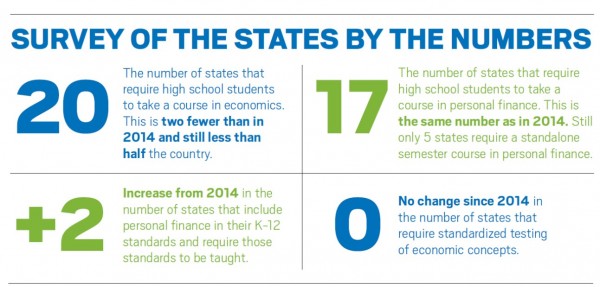
  • Since 2014, two additional states include personal finance in their K-12 standards and require those standards to be taught.
  • While more states are implementing standards in personal finance, the number of states that require high school students to take a course in personal finance remains unchanged since 2014 – just 17 states.
  • Only 20 states require high school students to take a course in economics – that’s less than half the country and two fewer states than in 2014.
  • There has been no change in the number of states that require standardized testing of economic concepts – the number remains at 16.
  • 75 percent of credit card carrying college students were unaware of late payment charges.

Connecticut’s Social Studies Framework, adopted a year ago, includes economics, economic decision-making, exchange and markets, the national economy and the global economy among “supporting disciplines” among the main concepts for world history instruction in grades 9-12.

Personal financial literacy, however, is not included.logo

The 2016 Survey of the States by the Council for Economic Education (CEE) shows that there has been slow growth in personal finance education in recent years and no improvement in economic education.

Every two years, CEE conductcenter for fin lits a comprehensive look into the state of K-12 economic and financial education in the United States, collecting data from all 50 states and the District of Columbia. The biennial Survey of the States serves as an important benchmark, revealing “both how far we’ve come and how far we still have to go.” This year the report concluded that nationally “the pace of change has slowed.”
Connecticut state Sen. L. Scott Frantz has tried unsuccessfully to improve financial education in Connecticut for seven of the past eight years with proposed legislation that would require it, the CT Post reported recently. This year, due to a strong focus on the state budget, he’s been told introducing the bill again would be moot, so will wait until next year to broach the topic again, the Post reported.

“You have generations of kids graduating without a clue about managing their personal finances,” Frantz said. “It doesn’t have to be anything more sophisticated than how to balance a checkbook, understanding a credit card and interest rates, being aware of the marketing tactics that credit card institutions use. It’s an area that we need to improve upon significantly going forward.”

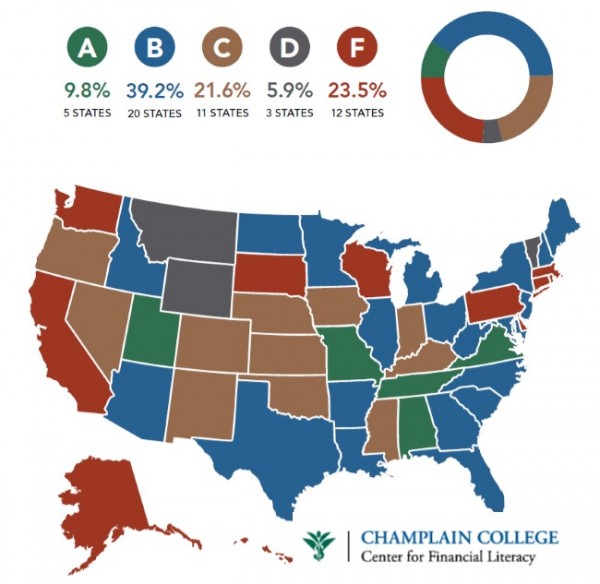
Champlain College's Center for Financial Literacy, using national data, graded all 50 states and the District of Columbia (D.C.) in 2015 on their efforts to produce financially literate high school graduates. In their review, 26 states received grades of C, D or F. Less than half were given grades A or B, and 29% had grades of D or F.  Connecticut was among those earning an F.

Of the states with failing grades, the analysis said: These states have few requirements or none at all for personal finance education in high school. High school students in these states are able to graduate without ever having the opportunity to take a course that includes financial literacy instruction.  The report noted that California, Connecticut, Massachusetts, Pennsylvania, Washington and Wisconsin have created programs that promote financial literacy education in high schools. However, this support does not eliminate the possibility of a student leaving high school without access to any financial literacy instruction prior to graduation.

“States that combine personal finance and economics, support teachers, and hold studestates datants accountable for learning objectives have the best chance of promoting the development of young people who are better financial managers and stewards of their credit—behaviors with which many, if not most, young people tend to struggle,” said J. Michael Collins of the University of Wisconsin-Madison’s Center for Financial Security. “Rigorous state standards can facilitate local schools to implement well-designed programs, which in turn expose students to concepts they otherwise would not learn.”