Connecticut to Join The Boston Fed's "Working Cities Challenge" to Help Communities Improve Economic Outcomes
/Connecticut will be the latest state participating in the Federal Reserve Bank of Boston’s Working Cities Challenge competition, an economic development effort that builds cross-sector collaboration and leadership to solve challenges affecting urban communities. Businesses and organizations from the private sector throughout the state, along with state government, have played a significant role as a catalyst in bringing the Working Cities Challenge to the Land of Steady Habits. As part of this initiative, cities in Connecticut will have the ability to apply for competitive funding to be used toward addressing local issues in a sector of their choosing, be it education, workforce development, small business development, or other areas that can improve economic outcomes for residents. This summer, the Boston Fed will begin conducting meetings across Connecticut to provide more information about the Working Cities Challenge. Cities will be able to apply for design grants in the fall of 2016.
The Boston Fed will lead the competition, providing technical support and staff resources. A steering committee composed of local and national partners will determine the cities in Connecticut that will be eligible to apply. An independent, expert jury that does not include the Boston Fed will select winning cities.
The Boston Fed launched the program in Massachusetts in 2013, building on research that identified cross-sector collaboration and leadership as the key ingredients in resurgent smaller cities across the county. The State of Rhode Island has also joined Massachusetts as a participating site of the Working Cities Challenge.
 Funding for the competition prize awards will be provided both by the State of Connecticut, which has committed $1 million, and an additional $2 million commitment from private partners. The Doris Duke Charitable Foundation, The Kresge Foundation, Living Cities, NeighborWorks America, The United Illuminating Company, Stanley Black & Decker, Boehringer Ingelheim, Travelers Companies, Inc., The Hartford Foundation for Public Giving, Webster Bank, Eversource Energy, Liberty Bank Foundation, Hartford HealthCare, Barnes Group, Hoffman BMW of Watertown/Hoffman Auto Group, United Technologies Corp., Charter Communications, and Fairfield County’s Community Foundation have all committed to participating in the challenge.
“This Working Cities Challenge is about delivering collaborative, transformative projects that will improve the economic outcomes in our cities, creating strong, resilient, and inclusive communities,” Governor Malloy said. “To build a stronger Connecticut, we must build upon the strengths of our urban areas, and I commend the Boston Fed for their leadership on this effort. We look forward to working with them in support of Connecticut and cannot thank our private partners enough for their participation.”
 “We are pleased to bring the Working Cities Challenge to Connecticut and are thankful to Governor Malloy for his support of the effort, as well as the Hartford Foundation, the Doris Duke Foundation, Living Cities, The Kresge Foundation, and many others,” Boston Fed President Eric Rosengren said. “The partners have come together to make it possible to bring the competition to Connecticut – precisely the model of cross-sector collaboration that forms the basis of the Working Cities Challenge. This competition focuses on the residents of the state’s postindustrial cities – places with unique assets that taken together can help to build civic leadership infrastructure, which our research shows is a key component of economic resurgence.”
“Collaboration among the nonprofit, private, public and philanthropic sectors and residents is fundamental to ensuring our communities thrive,” Linda J. Kelly, President of the Hartford Foundation for Public Giving, said. “We are proud to support the Working Cities Challenge as a proven approach for the coordination across multiple systems and stakeholders that is necessary to strengthen our urban centers and benefit the entire state.”
 “It’s gratifying to see the strong support from Connecticut companies, foundations, and the Malloy administration for the Working Cities Challenge under the thoughtful leadership of the Boston Fed,” James C. Smith, Chairman and CEO of Webster Bank, said. “By encouraging the development of civic infrastructure as a prerequisite to physical infrastructure, the Working Cities Challenge promises to revitalize Connecticut’s smaller cities economically and transform the lives of inner city residents.”
“Across the country many, many communities lack cohesive leadership to make use of their disconnected assets,” Rip Rapson, President and CEO of The Kresge Foundation, said. “The Working Cities Challenge offers a short-term incentive for smaller communities to come together for a prize. But its true value will be felt when those communities find the long-term benefits of collaborations that engage citizens to right economic wrongs and provide for widespread opportunity.”

 To those of us who look to – or up to – them, we need an open, inquiring, compassionate mind. We need to set aside the rush to judgement, to listen to all sides of an issue, to take the time to search out the truth, to separate the hype from the reality.
 A recent report in Business Insider indicated that one in three new businesses in the U.S. were started by an entrepreneur age 50 or older. Describing “running a business as the new retirement,” the news report cited an infographic in easylifecover that highlighted those aged 55-64 in the U.S. have actually had the highest rate of entrepreneurial activity in the last 10 years, noting that the founders of McDonald's, Coca Cola, and Kentucky Fried Chicken – among others - were all over 50 when they established their businesses.
 The interactive “Boot Camp” event at reSET – open to people of all ages with a special focus on the 50 and over –included short presentations from local resource organizations, networking opportunities and valuable information on the programs and tools available to potential business owners. Attendees were updated on the necessary steps and tools to launch a business, and had opportunities to talk one-on-one with local mentoring organizations, lenders, small business advisors and community leaders for advice and assistance.
 hand at the reSET event in mid-June were representatives of the Office of Secretary of State (where new businesses are registered),
  reSET serves all entrepreneurs, but specializes in social enterprise ― impact driven business with a double and sometimes triple bottom line. In addition to providing co-working space and accelerator and mentoring programs, reSET aims to inspire innovation and community collaboration, and to support entrepreneurs in creating market-based solutions to community challenges. The organization’s goal is to “meet entrepreneurs wherever they are in their trajectory and to help them take their businesses to the next level.”

 suranceQuotes, found that the average increase in premiums across the country when a teen driver is added to an existing policy is 79 percent. That is a slight improvement from a few years ago, when the increase nationwide averaged 84 percent.
 Perhaps the most significant underlying factor is that each state regulates insurance differently, and those regulatory differences account for some of the variations in the study’s findings, according to insuranceQuotes. For instance, Hawaii is the only state that doesn't allow insurance providers to consider age, gender or length of driving experience when determining premiums. That means that the cost for teens doesn't differ much from the cost for adults buying auto insurance. This may also account for lower increases in states such as New York, Michigan and North Carolina, where insurance is regulated more strictly and rating factors are more stringent, insuranceQuotes points out. The increases in those states when adding a teen to an existing policy were all below 60 percent, among the lowest increases in the nation.


 In recent years, the Connecticut program, coordinated by Connecticut’s Old State House with support from Connecticut Humanities, has grow in numbers and in the quality of the students’ work, organizers point out. This year, Connecticut History Day had 10,600 points of contact with Connecticut students, teachers, parents and history professionals, including workshops for 4,500 students—twice last year’s number.

 The analysis points out that the type of land in a given area has a significant impact on its worth. Agricultural and other largely undeveloped areas are generally worth significantly less than cities and suburbs land. Developed land, or land where housing, roads, and other structures are located, is valued at an estimated $106,000 per acre, while undeveloped land was estimated at $6,500 per acre, and farmland at only $2,000 per acre, according to the analysis.
 le, more active and transit-accessible downtowns. At the same time, an increasing demand for downtown living is paralleled with a general lack of diverse and affordable housing choices. Upper story space in existing older buildings is vacant and available, but expensive to renovate.
 for policies and regulations that support and enhance our main streets, as well as identifying more and better models of downtown management, including training, education, and communication for downtown professionals. Championing sustainable financing for these downtown organizations will also be a priority.

 In addition to its impact on drivers, the AMA notes that blue-rich LED streetlights operate at a wavelength that most adversely suppresses melatonin during night. It is estimated that white LED lamps have five times greater impact on circadian sleep rhythms than conventional street lamps, the AMA indicated. Recent large surveys, according to the AMA, found that brighter residential nighttime lighting is associated with reduced sleep times, dissatisfaction with sleep quality, excessive sleepiness, impaired daytime functioning and obesity.
 The Conversation website is a collaboration between editors and academics to provide "informed news analysis and commentary that’s free to read and republish." It
 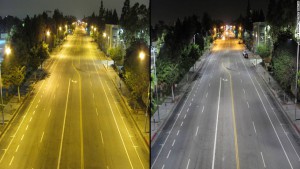 PHOTO: Traditional street lighting (left) vs. LED lighting (right).