PERSPECTIVE: CT Independent Colleges Among National Leaders in Student Completion; Working to Reduce Disparities
/by Jennifer Widness
Recent news coverage labeling Connecticut’s private, non-profit institutions of higher education as “drop-out factories” is a flawed conclusion based on incomplete data and requires additional scrutiny. While more always can and should be done to improve the outcomes for low-income students in our higher education system, Connecticut’s private, non-profit colleges have made this issue a priority and in fact are among the nation’s leaders in completion rates for all students.
First, let’s address the limitations of the data used in the report. To conduct their analysis, the authors from the Washington, D.C. think tank, the Third Way, used data compiled for the U.S. Department of Education’s College Scorecard. As the authors noted in their study, but the reporter failed to mention, this data set only includes full time, first time students that have received a federal loan. This accounts for less than 40% of the undergraduate students enrolled at these institutions. There is no accounting for students that transfer, in or out, or a student that has taken a semester off and returned. Given the evolution of how people access higher education, th is is a significant omission.
Graduation rates are complicated and hard to calculate given limited access to good data but the National Student Clearinghouse is the most complete data set available as it does have the capacity to track transfer students. As illustrated in Figure 1 below, it recently calculated the 6-year completion rate for students that began at a four-year private, non-profit institution in Connecticut at 84.72%. This is the second highest completion rate in the country and ten points above the national average for the sector (20 points above the national average for the 4-year publics). Connecticut’s private, non-profit institutions are some of the most productive in the nation.
Further, the authors misappropriated the term “dropout factories” by applying it to institutions with graduation rate of 75% or less. This is a threshold used for K-12 schools by the U.S. Department of Education. If all higher education institutions with a graduation rate of less than 75% using data compiled by the College Scorecard were considered “dropout factories” nearly all institutions in Connecticut, public and private, would fall into that category. See for yourself here.
Nuances with the data and terminology used in this particular report aside, average completion rates in all sectors of higher education across do need to be improved. While Connecticut’s higher education institutions have some of the highest completion rates in the country, our state faces one of the largest post-secondary degree attainment gaps between whites and minorities. The authors of the Third Way are right to point out that high-risk populations need greater access to higher education. We agree.
This has been a priority, and always will be, for Connecticut’s independent colleges.
CCIC’s member institutions have redoubled efforts to focus on this challenge by providing more resources to student support services, increasing financial aid to unsustainable levels and creating innovative programs that support a diverse student body to enroll, persist and complete college.
The state, on the other hand, also needs to 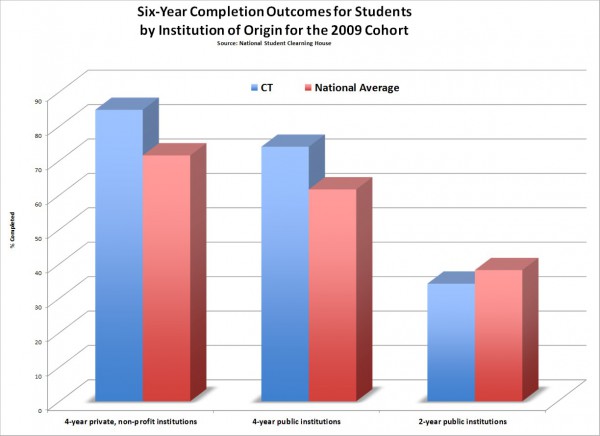 play a greater role in this area. Why? Connecticut’s Strategic Plan for Higher Education lays it out perfectly. In essence, our economy will increasingly require a talented, well-educated workforce to thrive and the only way to guarantee this talent pool exists is to ensure our state residents have access to and complete a post-secondary education. While severe budgetary constraints exists given shrinking revenues, we cannot afford not to do a better job in coordinating this work across all sectors of higher education and the workforce.
Connecticut is fortunate to have some of the best, most productive and diverse public and private higher education institutions in the country. Labeling them inappropriately is untrue – and even worse unproductive. These institutions are some of our state’s greatest assets. If we want to see Connecticut grow and thrive again we have to capitalize on our strengths and put these institutions to work.
____________________________________
Jennifer Widness is President of the Connecticut Conference of Independent Colleges.
PERSPECTIVE commentaries by contributing writers appear each Sunday on Connecticut by the Numbers.
Also of interest… Do Community College Students Go Begging?


 The site said of
 s, including:

 Des Moines Golf and Country Club was the site of the 1999 U.S. Senior Open Championship which drew a record 252,800 spectators.



 Funding for the competition prize awards will be provided both by the State of Connecticut, which has committed $1 million, and an additional $2 million commitment from private partners. The Doris Duke Charitable Foundation, The Kresge Foundation, Living Cities, NeighborWorks America, The United Illuminating Company, Stanley Black & Decker, Boehringer Ingelheim, Travelers Companies, Inc., The Hartford Foundation for Public Giving, Webster Bank, Eversource Energy, Liberty Bank Foundation, Hartford HealthCare, Barnes Group, Hoffman BMW of Watertown/Hoffman Auto Group, United Technologies Corp., Charter Communications, and Fairfield County’s Community Foundation have all committed to participating in the challenge.
 “We are pleased to bring the Working Cities Challenge to Connecticut and are thankful to Governor Malloy for his support of the effort, as well as the Hartford Foundation, the Doris Duke Foundation, Living Cities, The Kresge Foundation, and many others,” Boston Fed President Eric Rosengren said. “The partners have come together to make it possible to bring the competition to Connecticut – precisely the model of cross-sector collaboration that forms the basis of the Working Cities Challenge. This competition focuses on the residents of the state’s postindustrial cities – places with unique assets that taken together can help to build civic leadership infrastructure, which our research shows is a key component of economic resurgence.”
 “It’s gratifying to see the strong support from Connecticut companies, foundations, and the Malloy administration for the Working Cities Challenge under the thoughtful leadership of the Boston Fed,” James C. Smith, Chairman and CEO of Webster Bank, said. “By encouraging the development of civic infrastructure as a prerequisite to physical infrastructure, the Working Cities Challenge promises to revitalize Connecticut’s smaller cities economically and transform the lives of inner city residents.”
 To those of us who look to – or up to – them, we need an open, inquiring, compassionate mind. We need to set aside the rush to judgement, to listen to all sides of an issue, to take the time to search out the truth, to separate the hype from the reality.

 A recent report in Business Insider indicated that one in three new businesses in the U.S. were started by an entrepreneur age 50 or older. Describing “running a business as the new retirement,” the news report cited an infographic in easylifecover that highlighted those aged 55-64 in the U.S. have actually had the highest rate of entrepreneurial activity in the last 10 years, noting that the founders of McDonald's, Coca Cola, and Kentucky Fried Chicken – among others - were all over 50 when they established their businesses.
 The interactive “Boot Camp” event at reSET – open to people of all ages with a special focus on the 50 and over –included short presentations from local resource organizations, networking opportunities and valuable information on the programs and tools available to potential business owners. Attendees were updated on the necessary steps and tools to launch a business, and had opportunities to talk one-on-one with local mentoring organizations, lenders, small business advisors and community leaders for advice and assistance.
 hand at the reSET event in mid-June were representatives of the Office of Secretary of State (where new businesses are registered),
 reSET serves all entrepreneurs, but specializes in social enterprise ― impact driven business with a double and sometimes triple bottom line. In addition to providing co-working space and accelerator and mentoring programs, reSET aims to inspire innovation and community collaboration, and to support entrepreneurs in creating market-based solutions to community challenges. The organization’s goal is to “meet entrepreneurs wherever they are in their trajectory and to help them take their businesses to the next level.”


 suranceQuotes, found that the average increase in premiums across the country when a teen driver is added to an existing policy is 79 percent. That is a slight improvement from a few years ago, when the increase nationwide averaged 84 percent.

 Perhaps the most significant underlying factor is that each state regulates insurance differently, and those regulatory differences account for some of the variations in the study’s findings, according to insuranceQuotes. For instance, Hawaii is the only state that doesn't allow insurance providers to consider age, gender or length of driving experience when determining premiums. That means that the cost for teens doesn't differ much from the cost for adults buying auto insurance. This may also account for lower increases in states such as New York, Michigan and North Carolina, where insurance is regulated more strictly and rating factors are more stringent, insuranceQuotes points out. The increases in those states when adding a teen to an existing policy were all below 60 percent, among the lowest increases in the nation.



 In recent years, the Connecticut program, coordinated by Connecticut’s Old State House with support from Connecticut Humanities, has grow in numbers and in the quality of the students’ work, organizers point out. This year, Connecticut History Day had 10,600 points of contact with Connecticut students, teachers, parents and history professionals, including workshops for 4,500 students—twice last year’s number.