

Hartford’s Innovation, Manufacturing History Highlighted in Exhibits at Smithsonian and State Capitol
/On Wednesday, July 13, the Smithsonian Institution’s National Museum of American History will make public a special portion of their collection with “Objects Out of Storage: Hartford, CT.” The special exhibit, led by curator Susan Tolbert and historian Eric Hinz, will take place at noontime in the Lemelson Center for the Study of Invention and Innovation in the nation’s Capitol. Describing Hartford’s prominent manufacturing history, Hinz said “Hartford, CT, is a classic story in the history of American technology. If you have ever wondered why people refer to “Yankee ingenuity,” this is what they are talking about.” He adds, “In the mid and late 1800s, the United States overtakes Great Britain as the world’s foremost economic superpower, largely on the strength of its prowess in inventing and manufacturing new technologies. Hartford is at the center of that revolution.”
Hartford, described as “one of the birthplaces of American mass production,” is well represented in the ongoing exhibit, Places of Invention, which “takes visitors on a journey through time and place to meet people who lived, worked, played, collaborated, adapted, took risks, solved problems, and sometimes failed—all in the pursuit of something new.”
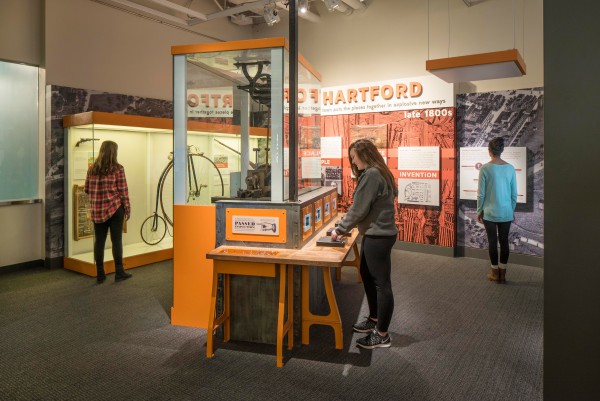 The exhibit notes that by the 1850’s “Hartford became the center of production for a wide array of products—including firearms by Colt, Richard Gatling and John Browning; Weed sewing machines; Royal and Underwood typewriters; Columbia bicycles; and even Pope automobiles.”

The Lemelson Center is located at the Smithsonian's National Museum of American History, Constitution Avenue between 12th and 14th Street NW, in Washington, DC. The Lemelson Hall of Invention and Innovation is located on the Museum's first floor in its Innovation Wing. In the exhibit, which debuted last summer, Hartford is featured with Silicon Valley and just four other locations: Hollywood, home of Technicolor; the Medical Alley of Minnesota, where cardiac innovations of the 1950s flourished; the Bronx, N.Y., birthplace of hip-hop in the 1970s; and the current, clean-energy innovations of Ft. Collins, Colo.
Among the featured innovations on display is the bicycle, manufactured for the first time in the United States in Hartford. As the Smithsonian historian explains, “sensing a commercial opportunity, Albert Pope began importing bicycles from England and hatched a plan to produce them domestically in 1877. Within a year, Pope rode the train from Boston to Hartford, then, ‘to the amazement of the city’s onlookers, 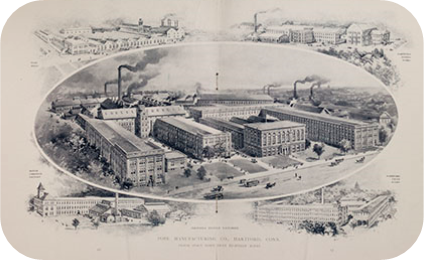 rode his high-wheeler from the station down Capitol Avenue to the Weed Sewing Machine Company.’”
The history continues: “Pope approached factory superintendent George Fairfield with a proposal: would Weed agree to build a test run of 50 bicycles under contract? When Fairfield agreed, Pope (via the Weed Sewing Machine Company) became the first domestic manufacturer of bicycles in the United States. By 1895, Pope’s expanded Hartford operations included five factories set on 17 acres, employing 4,000 workers, making him Hartford’s largest employer.” Pope manufactured bicycles, motorcycles, and automobiles.
That chapter in Hartford history has recently captured the imagination of a well-known Hartford artist, whose cut-paper recreations of that chapter of the city’s transportation and recreation breakthrough is now available for display, having just completed an exhibition at the Connecticut State Capitol.
 Jeanne Manzelli, a resident of Windsor, has a
 BFA in Sculpture from the Massachusetts College of Art and her MED in Art Education from the University of Massachusetts, Amherst. Her experience includes a 20 year career in design, manufacture, appraisal and sale of jewelry, two decades as mural artist working closely with interior designers as an industry professional, and 14 years teaching basic and advanced drawing, sculpture and 3D design as well as color theory at Tunxis Community College.
Her latest endeavor is a departure, and a salute to an innovation from a century and a half ago. The intricate designs, accompanied by information panels highlighting the history, are now available to be displayed at public facilities, such as schools, libraries, and community centers. Manzelli looks forward to sharing her work (and is seeking a sponsor to underwrite the exhibit), as well as stimulating a conversation about innovation in Hartford, then and now.


 is is a significant omission.



 The site said of
 s, including:


 Des Moines Golf and Country Club was the site of the 1999 U.S. Senior Open Championship which drew a record 252,800 spectators.

 Funding for the competition prize awards will be provided both by the State of Connecticut, which has committed $1 million, and an additional $2 million commitment from private partners. The Doris Duke Charitable Foundation, The Kresge Foundation, Living Cities, NeighborWorks America, The United Illuminating Company, Stanley Black & Decker, Boehringer Ingelheim, Travelers Companies, Inc., The Hartford Foundation for Public Giving, Webster Bank, Eversource Energy, Liberty Bank Foundation, Hartford HealthCare, Barnes Group, Hoffman BMW of Watertown/Hoffman Auto Group, United Technologies Corp., Charter Communications, and Fairfield County’s Community Foundation have all committed to participating in the challenge.
 “We are pleased to bring the Working Cities Challenge to Connecticut and are thankful to Governor Malloy for his support of the effort, as well as the Hartford Foundation, the Doris Duke Foundation, Living Cities, The Kresge Foundation, and many others,” Boston Fed President Eric Rosengren said. “The partners have come together to make it possible to bring the competition to Connecticut – precisely the model of cross-sector collaboration that forms the basis of the Working Cities Challenge. This competition focuses on the residents of the state’s postindustrial cities – places with unique assets that taken together can help to build civic leadership infrastructure, which our research shows is a key component of economic resurgence.”
 “It’s gratifying to see the strong support from Connecticut companies, foundations, and the Malloy administration for the Working Cities Challenge under the thoughtful leadership of the Boston Fed,” James C. Smith, Chairman and CEO of Webster Bank, said. “By encouraging the development of civic infrastructure as a prerequisite to physical infrastructure, the Working Cities Challenge promises to revitalize Connecticut’s smaller cities economically and transform the lives of inner city residents.”
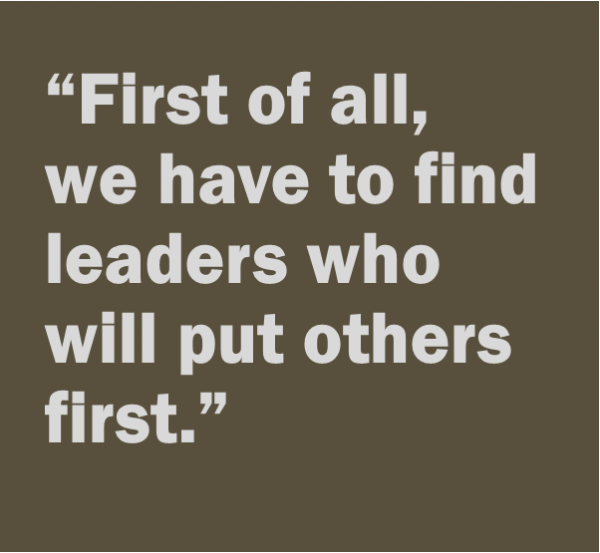
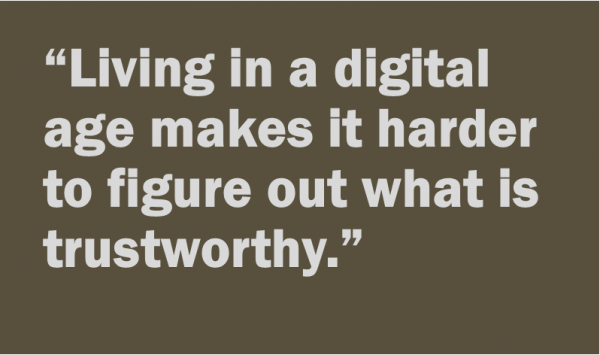 To those of us who look to – or up to – them, we need an open, inquiring, compassionate mind. We need to set aside the rush to judgement, to listen to all sides of an issue, to take the time to search out the truth, to separate the hype from the reality.

 A recent report in Business Insider indicated that one in three new businesses in the U.S. were started by an entrepreneur age 50 or older. Describing “running a business as the new retirement,” the news report cited an infographic in easylifecover that highlighted those aged 55-64 in the U.S. have actually had the highest rate of entrepreneurial activity in the last 10 years, noting that the founders of McDonald's, Coca Cola, and Kentucky Fried Chicken – among others - were all over 50 when they established their businesses.
 The interactive “Boot Camp” event at reSET – open to people of all ages with a special focus on the 50 and over –included short presentations from local resource organizations, networking opportunities and valuable information on the programs and tools available to potential business owners. Attendees were updated on the necessary steps and tools to launch a business, and had opportunities to talk one-on-one with local mentoring organizations, lenders, small business advisors and community leaders for advice and assistance.
 hand at the reSET event in mid-June were representatives of the Office of Secretary of State (where new businesses are registered),
 reSET serves all entrepreneurs, but specializes in social enterprise ― impact driven business with a double and sometimes triple bottom line. In addition to providing co-working space and accelerator and mentoring programs, reSET aims to inspire innovation and community collaboration, and to support entrepreneurs in creating market-based solutions to community challenges. The organization’s goal is to “meet entrepreneurs wherever they are in their trajectory and to help them take their businesses to the next level.”


 suranceQuotes, found that the average increase in premiums across the country when a teen driver is added to an existing policy is 79 percent. That is a slight improvement from a few years ago, when the increase nationwide averaged 84 percent.

 Perhaps the most significant underlying factor is that each state regulates insurance differently, and those regulatory differences account for some of the variations in the study’s findings, according to insuranceQuotes. For instance, Hawaii is the only state that doesn't allow insurance providers to consider age, gender or length of driving experience when determining premiums. That means that the cost for teens doesn't differ much from the cost for adults buying auto insurance. This may also account for lower increases in states such as New York, Michigan and North Carolina, where insurance is regulated more strictly and rating factors are more stringent, insuranceQuotes points out. The increases in those states when adding a teen to an existing policy were all below 60 percent, among the lowest increases in the nation.





















