

Connecticut Students Know Much About History; Stand Out in National Contest
/Hamilton. Say the name these days, and people almost reflexively think of the hit Broadway show. But for Connecticut students Juliana Rodrigues, Max Bueno, Samantha Gilbert, Emily Strickland, and Joseph Zarif from Memorial Middle School in Middlebury, Hamilton brings to mind more recent history.
The students won two Special Awards for their project, Alexander Hamilton Explores a Financial System for the New Nation of America, at the National History Day Competition for middle school and high school students, held this month in Maryland. They middle-schoolers won the U.S. Constitution Award and the Special Award in History in the Federal Government.
Connecticut History Day is a program for students in grades 6-12 that encourages exploration of local, state, national, and world history. After selecting a historical topic that relates to an annual theme, students conduct extensive research using libraries, archives, museums, and oral history interviews. Students analyze and interpret their findings, draw conclusions about their topic's significance in history, and create final projects that demonstrate their work.
Connecticut History Day is one of 57 affiliate programs of the highly regarded National History Day program. Student projects developed by students in Connecticut are entered into a series of competitions, from the local to the national level, where professional historians and educators evaluate them.
The students from Middlebury were not the only Connecticut students to shine on the national stage this year.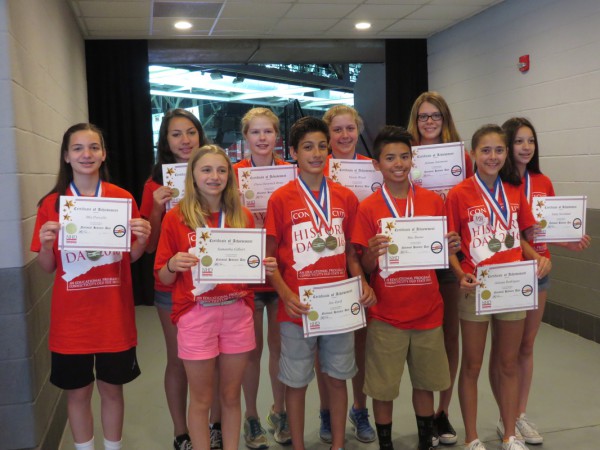
- Mia Porcello, a middle school student from St. Timothy School in West Hartford, captured a national title by winning First Place in the Junior Individual Exhibit Category for her entry Florence Wald: Exploring Medical Boundaries, Exchanging Hospitals to Hospice.
- Shay Pezzulo, a high school student from Classical Magnet School in Hartford, captured CHD’s second national title of the year by winning First Place in the Senior Individual Website Category for her entry Duel and Duality: New Journalism, New York. Pezzulo also attended "Breakfast on the Hill" with members of Congress during her trip to the NHD Contest - an event sponsored by the National Endowment for the Humanities.
- The Outstanding Connecticut Entry Award from the Senior Division was awarded to Nicole Wood, Juliana Salamone, Katherine Hurst and Flora Dievenich for their group project, Women Airforce Service Pilots and the Flight for Equality. They are students at Greenwich High School and were also finalists in the Senior Group Performance Category.
- The Outstanding Connecticut Entry Award from the Junior Division was awarded to Hunter Dale and Noah Vasington for their group project, Branch Rickey: Branching Off to New Ideas. They are students at Mansfield Middle School in Storrs and were also finalists in the Junior Group Exhibit Category.
- Rosie the Riveter, an exhibit created by Claire Graham, Hana Previte, Isabel Saltzman, and Lauren White was one of only 57 projects featured at the National Museum of American History’s "National History Night" on Wednesday, June 15. They are students at Wilton High School.
The students, who helped Connecticut stand-out at the national competition, range from first-time program participants to history day veterans and from AP students to students who are struggling in school, according to officials. The national competition was held June 12-16 at the University of Maryland.
 In recent years, the Connecticut program, coordinated by Connecticut’s Old State House with support from Connecticut Humanities, has grow in numbers and in the quality of the students’ work, organizers point out. This year, Connecticut History Day had 10,600 points of contact with Connecticut students, teachers, parents and history professionals, including workshops for 4,500 students—twice last year’s number.
"Good strategic thinking by our History Day team has increased the number of students who learn and grow through this program," said Sally Whipple, Executive Director of Connecticut's Old State House. "Old State House workshops, resources and coaching have helped students develop high quality projects based on sound research. We serve thousands of students through this program, but more important than the number served, is the quality of that service. Students develop critical thinking, writing and research skills, along with increased confidence, curiosity and the ability to ask and find answers to compelling questions. The Old State House staff strives to do this every day through all of its programs. It's great to see student work that we've helped nurture receive the highest National History Day honors possible."
This is the fifth consecutive year that Connecticut students have placed at the national contest and appears to be the first time that Connecticut students have won two first place awards. The initiative in Connecticut is in line with the state’s relatively new Social Studies Framework and helps students build confidence, as well – as does the recognition, both in state and at the national level. 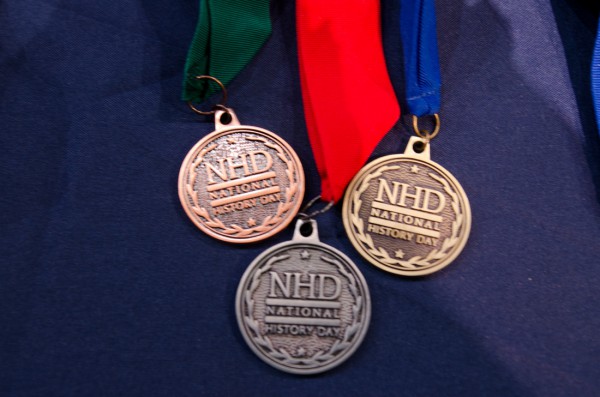
Earlier this year, state contest winners were determined at a day-long event hosted at Central Connecticut State University. That followed regional contests held in Torrington, New Haven, Fairfield, Mansfield, Manchester and Hartford. Among the statewide category winners, at the high school level, were students from Hartford, Farmington, Manchester, Norwich, Weston, Wilton, Westport, Southbury, Woodbury, Greenwich, Ellington, New Haven and Wallingford. Topics ranged from the Panama Canal to Pequot Ware, Immigration Policy to Women Airforce Pilots, 20th Century Psychiatry to War of the Worlds, Cheney Brothers to Langston Hughes.
The road to National History Day (NHD) begins in Connecticut’s classrooms and home schools where well over 2,000 students choose topics reflecting an annual NHD theme, conduct research and analysis and create an exhibit, performance, website, paper or documentary that shares their findings. Of these, more than 1,250 students competed in this year’s regional contests, with over 400 of the winners going on to the State Contest, which sends first and second-place winners on to Nationals.
https://youtu.be/6pt2R_5cXQs

 The analysis points out that the type of land in a given area has a significant impact on its worth. Agricultural and other largely undeveloped areas are generally worth significantly less than cities and suburbs land. Developed land, or land where housing, roads, and other structures are located, is valued at an estimated $106,000 per acre, while undeveloped land was estimated at $6,500 per acre, and farmland at only $2,000 per acre, according to the analysis.


 le, more active and transit-accessible downtowns. At the same time, an increasing demand for downtown living is paralleled with a general lack of diverse and affordable housing choices. Upper story space in existing older buildings is vacant and available, but expensive to renovate.
 for policies and regulations that support and enhance our main streets, as well as identifying more and better models of downtown management, including training, education, and communication for downtown professionals. Championing sustainable financing for these downtown organizations will also be a priority.


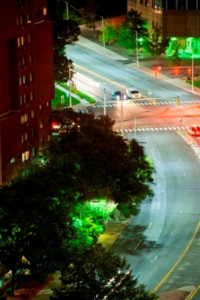 In addition to its impact on drivers, the AMA notes that blue-rich LED streetlights operate at a wavelength that most adversely suppresses melatonin during night. It is estimated that white LED lamps have five times greater impact on circadian sleep rhythms than conventional street lamps, the AMA indicated. Recent large surveys, according to the AMA, found that brighter residential nighttime lighting is associated with reduced sleep times, dissatisfaction with sleep quality, excessive sleepiness, impaired daytime functioning and obesity.
 The Conversation website is a collaboration between editors and academics to provide "informed news analysis and commentary that’s free to read and republish." It
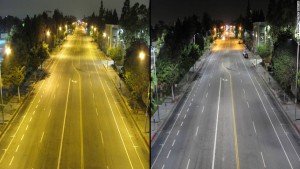 PHOTO: Traditional street lighting (left) vs. LED lighting (right).


 Lewis’ commitment and dedication impressed the judging panel.




 “Wholesome Wave is thrilled by the innovations that USDA is supporting through the new FINI grants, which are taking the work of increasing affordable access to healthy food to even greater levels of impact,” said Michel Nischan, CEO & Founder of Wholesome Wave. “So many SNAP shoppers are working parents with limited time to source healthier food choices. Through the new Farm-to-Grocery model, our partners in Connecticut and Vermont will be able to expand affordable access to SNAP consumers in a way that allows them to find and purchase more healthy food from a variety of retailers.”




 rly lost her life due to the carelessness and irresponsibility of a negligent driver who failed to obey the stop sign and also failed to avoid colliding with a cyclist. My wife’s journey to this date has been exceedingly long and tortuously painful. She has endured nearly 30 arduous surgeries and has been left with a body and mind crippled with pain and post traumatic stress.
 organize a bike tour to raise money for their program. Nearly 10 months later, the bike tour raised $12,000, which went toward purchasing four recumbent bicycles.




















