New Milford’s McCusker Earns Spot on Gymnastics Junior National Team

Every four years, America’s attention turns to gymnastics, as the Olympics push the U.S. team to the forefront of competitive sports.  The road to Rio, and the 2016 Summer Games, is underway, but for Connecticut residents following the sport, the run-up competitions are providing an opportunity to look not only at this summer’s climactic event, but down the road a few summers. McCusker - beamConnecticut’s top junior gymnast, Riley McCusker of New Milford, put herself squarely on the radar screen for the future with a solid second place finish in the P&G Gymnastics Championships junior women’s event, held in St. Louis.  That earned McCusker, who turns 15 this month, a slot on the eight-member U.S. National Junior Women’s Team, with international competition on the horizon.

In addition to finishing in second place overall, McCusker finished in second place on the uneven bars, floor exercise and balance beam, reflecting solid performances on both days of the competition.

McCusker  is joined on the eight-member U.S. National Junior Women’s Team by Shania Adams of Plain City, OH; Jordan Chiles of Vancouver, WA; Morgan Hurd  of Middletown, DE; Emma Malabuyo of Flower Mound, TX; Maile O'Keefe of Las Vegas, NV; Gabby Perea of Geneva, IL and Trinity Thomas of York, PA.

“I had no expectations coming in,” McCusker said. “This was my first season as an elite and first P&G Championships. I just came in, did my gymnastics and then waited to see what would happen.”McCusker 2nd

What happened was about as good as it gets, and reinforced her trajectory in the sport.  She told CT by the Numbers: "Qualifying to the national team was the best day of my life because I realized then that all of my hard work and sacrifices have started paying off!”

Last month, competing at the Secret Classic at the XL Center in Hartford – with the vocal support of friends and family from New Milford, McCusker had stand-out moments and finished 9th overall in a crowded field.  That experience under her belt, the arena in St. Louis was yet another step forward in a progress-filled year.

The USA Gymnastics Elite Program is designed to provide competitive experiences for athletes aspiring to the National Team. The National Teams (Senior and Junior) are selected from the USA Championships each year. These athletes represent the United States in international competitions.

McCusker is coached by Maggie Haney and Victoria Levine at MG Elite in Morganville, New Jersey.  Her teammate, Lauren Hernandez, earned a spot on the U.S. National Senior Women’s Team in recent weeks, followed this week by being named to the U.S. Olympic Tealaurie, rileym for this summer’s Games in Rio de Janeiro, Brazil.  The U.S. Olympic Trials were July 8 and 10 in San Jose. The 16-year-old Hernandez was the 2015 junior national champion, and is a competitor that McCusker trains with and is inspired by.

McCusker, who began gymnastics at age 6, was enthused to have childhood friends – many of whom hasn’t seen her compete at the elite level – in the stands in Hartford.  Their handmade signs of support were quite visible, as were the vocal cheers.

Proud of her Connecticut roots, McCusker’s Instagram page includes a memorial honoring the victims at Sandy Hook elementary School in December 2012. And she was thrilled to participate in the Hartford competition earlier this summer, recalling when she was in the stands with family watching the competitors just as her dedication to gymnastics was taking root.

If her accomplishments during the past month are any indication, there will be more opportunities for fans to gather in support of Connecticut’s home town girl in the future.

As one of the many commenters opining on social media after her P&G performance noted, “2020 here she comes.”

PHOTOS:  Riley McCusker in St. Louis (John Cheng photos); with Lauren Hernandez.

https://youtu.be/ZfXeDEdO6Dc

Hartford’s Innovation, Manufacturing History Highlighted in Exhibits at Smithsonian and State Capitol

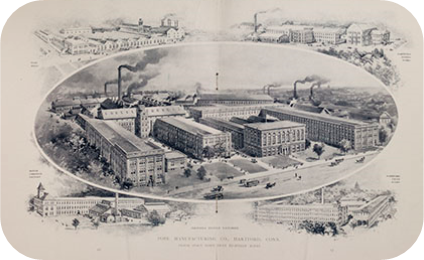
On Wednesday, July 13, the Smithsonian Institution’s National Museum of American History will make public a special portion of their collection with “Objects Out of Storage: Hartford, CT.”  The special exhibit, led by curator Susan Tolbert and historian Eric Hinz, will take place at noontime in the Lemelson Center for the Study of Invention and Innovation in the nation’s Capitol.banner-POI-sign-ET2015-4379_1 Describing Hartford’s prominent manufacturing history, Hinz said “Hartford, CT, is a classic story in the history of American technology. If you have ever wondered why people refer to “Yankee ingenuity,” this is what they are talking about.”  He adds, “In the mid and late 1800s, the United States overtakes Great Britain as the world’s foremost economic superpower, largely on the strength of its prowess in inventing and manufacturing new technologies. Hartford is at the center of that revolution.”
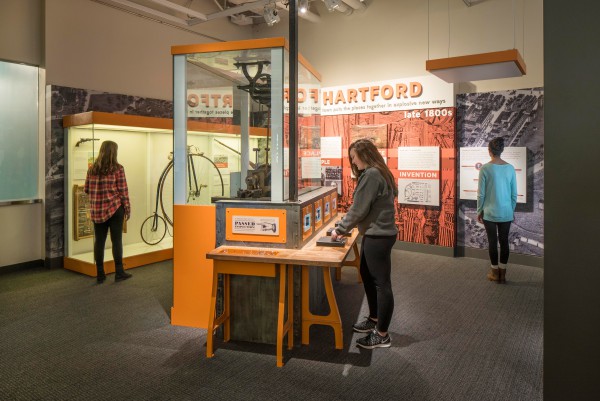
Hartford, described as “one of the birthplaces of American mass production,” is well represented in the ongoing exhibit, Places of Invention, which “takes visitors on a journey through time and place to meet people who lived, worked, played, collaborated, adapted, took risks, solved problems, and sometimes failed—all in the pursuit of something new.”

HartfordThe exhibit notes that by the 1850’s “Hartford became the center of production for a wide array of products—including firearms by Colt, Richard Gatling and John Browning; Weed sewing machines; Royal and Underwood typewriters; Columbia bicycles; and even Pope automobiles.”lemelson

The Lemelson Center is located at the Smithsonian's National Museum of American History, Constitution Avenue between 12th and 14th Street NW, in Washington, DC. The Lemelson Hall of Invention and Innovation is located on the Museum's first floor in its Innovation Wing. In the exhibit, which debuted  last summer, Hartford is featured with Silicon Valley and just four other locations: Hollywood, home of Technicolor; the Medical Alley of Minnesota, where cardiac innovations of the 1950s flourished; the Bronx, N.Y., birthplace of hip-hop in the 1970s; and the current, clean-energy innovations of Ft. Collins, Colo.

Among the featured innovations on display is the bicycle, manufactured for the first time in the United States in Hartford.  As the Smithsonian historian explains, “sensing a commercial opportunity, Albert Pope began importing bicycles from England and hatched a plan to produce them domestically in 1877. Within a year, Pope rode the train from Boston to Hartford, then, ‘to the amazement of the city’s onlookers, plantrode his high-wheeler from the station down Capitol Avenue to the Weed Sewing Machine Company.’”

The history continues: “Pope approached factory superintendent George Fairfield with a proposal: would Weed agree to build a test run of 50 bicycles under contract? When Fairfield agreed, Pope (via the Weed Sewing Machine Company) became the first domestic manufacturer of bicycles in the United States. By 1895, Pope’s expanded Hartford operations included five factories set on 17 acres, employing 4,000 workers, making him Hartford’s largest employer.” Pope manufactured bicycles, motorcycles, and automobiles.

That chapter in Hartford history has recently captured the imagination of a well-known Hartford artist, whose cut-paper recreations of that chapter of the city’s transportation and recreation breakthrough is now available for display, having just completed an exhibition at the Connecticut State Capitol.

IMG_0185Jeanne Manzelli, a resident of Windsor, has a IMG_0176BFA in Sculpture from the Massachusetts College of Art and her MED in Art Education from the University of Massachusetts, Amherst. Her experience includes a 20 year career in design, manufacture, appraisal and sale of jewelry, two decades as mural artist working closely with interior designers as an industry professional, and 14 years teaching basic and advanced drawing, sculpture and 3D design as well as color theory at Tunxis Community College.


Her latest endeavor is a departure, and a salute to an innovation from a century and a half ago. The intricate designs, accompanied by information panels highlighting the history, are now available to be displayed at public facilities, such as schools, libraries, and community centers.  Manzelli looks forward to sharing her work (and is seeking a sponsor to underwrite the exhibit), as well as stimulating a conversation about innovation in Hartford, then and now.

IMG_0196

PERSPECTIVE: CT Independent Colleges Among National Leaders in Student Completion; Working to Reduce Disparities

by Jennifer Widness Recent news coverage labeling Connecticut’s private, non-profit institutions of higher education as “drop-out factories” is a flawed conclusion based on incomplete data and requires additional scrutiny.  While more always can and should be done to improve the outcomes for low-income students in our higher education system, Connecticut’s private, non-profit colleges have made this issue a priority and in fact are among the nation’s leaders in completion rates for all students.CT perspective

First, let’s address the limitations of the data used in the report.  To conduct their analysis, the authors from the Washington, D.C. think tank, the Third Way, used data compiled for the U.S. Department of Education’s College Scorecard.  As the authors noted in their study, but the reporter failed to mention, this data set only includes full time, first time students that have received a federal loan.  This accounts for less than 40% of the undergraduate students enrolled at these institutions.  There is no accounting for students that transfer, in or out, or a student that has taken a semester off and returned.  Given the evolution of how people access higher education, thquote1is is a significant omission.

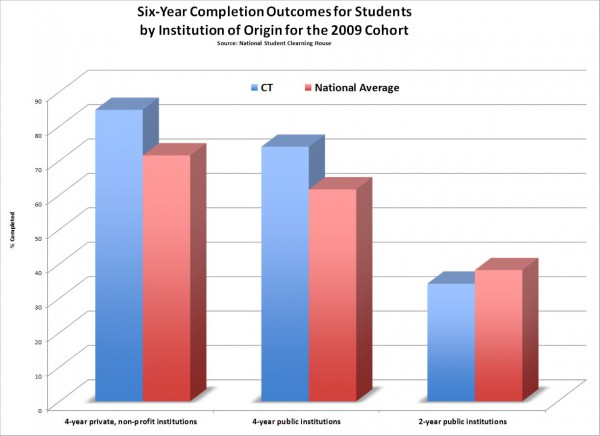
Graduation rates are complicated and hard to calculate given limited access to good data but the National Student Clearinghouse is the most complete data set available as it does have the capacity to track transfer students.  As illustrated in Figure 1 below, it recently calculated the 6-year completion rate for students that began at a four-year private, non-profit institution in Connecticut at 84.72%.   This is the second highest completion rate in the country and ten points above the national average for the sector (20 points above the national average for the 4-year publics).  Connecticut’s private, non-profit institutions are some of the most productive in the nation.

Further, the authors misappropriated the term “dropout factories” by applying it to institutions with graduation rate of 75% or less.   This is a threshold used for K-12 schools by the U.S. Department of Education.   If all higher education institutions with a graduation rate of less than 75% using data compiled by the College Scorecard were considered “dropout factories” nearly all institutions in Connecticut, public and private, would fall into that category.  See for yourself here.quote2

Nuances with the data and terminology used in this particular report aside, average completion rates in all sectors of higher education across do need to be improved.   While Connecticut’s higher education institutions have some of the highest completion rates in the country, our state faces one of the largest post-secondary degree attainment gaps between whites and minorities.  The authors of the Third Way are right to point out that high-risk populations need greater access to higher education.   We agree.

This has been a priority, and always will be, for Connecticut’s independent colleges.

CCIC’s member institutions have redoubled efforts to focus on this challenge by providing more resources to student support services, increasing financial aid to unsustainable levels and creating innovative programs that support a diverse student body to enroll, persist and complete college.

The state, on the other hand, also needs to chartplay a greater role in this area. Why?  Connecticut’s Strategic Plan for Higher Education lays it out perfectly.  In essence, our economy will increasingly require a talented, well-educated workforce to thrive and the only way to guarantee this talent pool exists is to ensure our state residents have access to and complete a post-secondary education.  While severe budgetary constraints exists given shrinking revenues, we cannot afford not to do a better job in coordinating this work across all sectors of higher education and the workforce.

Connecticut is fortunate to have some of the best, most productive and diverse public and private higher education institutions in the country.  Labeling them inappropriately is untrue – and even worse unproductive.  These institutions are some of our state’s greatest assets.  If we want to see Connecticut grow and thrive again we have to capitalize on our strengths and put these institutions to work.

____________________________________

Jennifer Widness is President of the Connecticut Conference of Independent Colleges


PERSPECTIVE commentaries by contributing writers appear each Sunday on Connecticut by the Numbers.

Also of interest… Do Community College Students Go Begging?

Former UConn QB Cochran Says Football Puts Players in Harm’s Way, Urges End to "Cycle of Silence"

Former UConn quarterback Casey Cochran, who retired from the sport at age 20 after suffering his 13th concussion, said this week that “There are problems with the game that need to be addressed. As it is played right now, tackle football — with its pads and helmets — puts players in harm’s way, all of the time, regardless of age and ability.” Cochran, writing a first-person story about his experiences with football and concussions in The Players’ Tribune, an online site founded by Derek Jeter, issued an alert to others who’ve journeyed through the sport, or continue to compete:

“I want to say to all former, current and future athletes who have or will suffer a concussion: Do not hide it. Tell your coaches, medical staff, parents, friends and teammates. Get treatment. The cycle of silence hurts more and more people each year.”

Cochran, from Monroe, explained that in the 18 months since his decision, after suffering a concussion on the last play of the first game of UConn’s 2014 season, against Brigham Young University, “I still feel the lingering effects from my many concussions. Life is a balancing act now. Some days it’s hard to wake up before noon. Sometimes I don’t want to leave my bed at all. In high school, I had a 3.9 GPA. Now I have trouble focusing and performing well in my graduate-school classes.”Cochran

He warned that “Those who play football, particularly those who begin in their youth, are given a glamorized version of the sport – one where camaraderie, discipline, toughness and leadership are highlighted and the wretchedness is ignored and swept under the rug. As a result, we fall in love with and value the good and push aside the bad.”

Cochran recalled that “I probably should have stopped playing football in eighth grade after my third concussion, but I was afraid to speak up. Afraid of disappointing people who had invested in my career. Afraid of who was I was without football. I wish I hadn’t hid the three concussions I had in one week during my junior year of high school, but I was afraid that college recruiters would find out.”

Even with increasing awareness of the risks of concussions, Cochran said the near and long-term effects haven’t led to enough changes.  “The only word I know to describe the first few moments after a concussion is limbo — there are a few moments between the world that you were just a part of and your new brain-injured reality,” Cochran explained.  “My head was seized with tremendous pressure, and that same awful, familiar depression from previous head injuries came over me — like a dark, heavy blanket, swallowing me up.”

With it all, he retains optimism: “There is life outside of the white lines. A lot of life. Stepping away from football was one of the scariest things I’ve ever had to do. I felt lost for a long time. For a little over a year, I felt like I was somewhere, deep in the ocean, being pulled by the currents. But what pulled me back from the depths was hope. Hope that things would get better.”logo

He now finds purpose in being an advocate for player safety, speaking to audiences, doing interviews and writing a book about his experiences.  To those going through what he did, during his 14 years of playing football, he says “If you feel alone, you aren’t. Chances are, there are a lot of people out there who have some idea of what you’re going through. Just keep looking. Reach out.”

Added Cochran: “Sometimes it’s nice to admit that things aren’t O.K.: ‘Hello, my name is Casey, and I have anxiety and depression.’ It may be permanent. It may be just the beginning. I don’t know what the future has in store for me and it will be some time before the medical field can paint a clearer picture for me. I may have CTE right now. I might have dementia at 50. My entire future is uncertain.”

Best Bargain for Retirees? Waterbury Ranks 10th in the USA

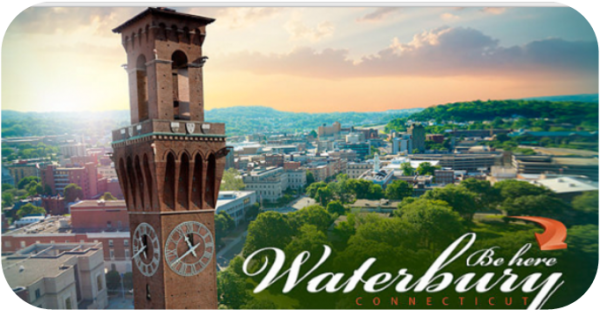
Headed towards retirement?  Keep Waterbury in mind.  A new ranking of the best bargains for retirees has the Brass City holding down the final slot on the top ten list.  The list, developed by the website GO Banking Rates and running on the CBS Moneywatch website, ranks Waterbury as the 10th best town in the country for retirees. waterbury imageThe site said of Waterbury: “Waterbury is in New Haven County on the Naugatuck River, close to Hartford and New York City. Waterbury has a colonial history with historic houses, and the downtown is clean and has many trees. You will find art and cultural events, and great health care facilities.”

A 2015 report by the Government Accountability Office found that about half of households led by people ages 55 and older have no retirement savings at all. Among households with retirement savings, the median amount of those savings is just $104,000 for households ages 55-64, and $148,000 for households ages 65-74. Such modest savings make it difficult to keep up with expenses during retirement. Americans 65 years of age or older average nearly $44,686 in annual expenses, according to the Bureau of Labor Statistics.

And Waterbury, apparently, can make those dollars go further.  The GOBankingRates website ranking considered several local factorretireess, including:

  • Housing — rental prices for a one-bedroom apartment, rounded to nearest dollar.
  • Percentage of retirees — in the local population as of April 1, 2010.
  • Walkability — scores ranging from 25 for Montgomery, Ala., to 65 for Allentown, Pa.
  • Safety factors — scores ranging from 6 for Rochester, N.Y., and Louisville, Ky., to 30 for Boise, Idaho.

Each city was given a weighting for each of the criterion and was ranked based on the overall score.  The top 20:

  1. Boise, Idaho
  2. El Paso, Texas
  3. Allentown, PA
  4. Grand Rapids, MI
  5. Champaign, IL
  6. Charlottesville, VA
  7. Lincoln, NE
  8. Bloomington, IN
  9. Cedar Rapids, IA
  10. Waterbury, CT
  11. Colorado Springs, CO
  12. Missoula, MT
  13. Rochester, NY
  14. Greensboro, NC
  15. Fort Worth, TX
  16. Billings, MT
  17. Phoenix, AZ
  18. Lexington, KY
  19. Omaha, NB
  20. Columbus, OH

The City of Waterbury’s website highlights “the sense of neighborhood identity and pride is so important that Waterbury has some of the most active neighborhood associations in the state.”  The site explains that “their efforts focus on protecting the small-town character and livability of their communities as they plan neighborhood block parties, concerts and beautification projects.  And with over twenty distinct and diverse neighborhoods-- many with their own commercial center, park, school, and sports associations-- there is truly a place for everyone in Waterbury.  These well-preserved and diverse neighborhoods are often recognized as one of the city's greatest assets.”

The original settlement of Waterbury – the 9th largest city in New England - dates back to 1674 and the city's name is reference to its proximity to the Naugatuck River and its many tributaries which flow through the heart of the city.


https://youtu.be/4MZDO2vFPjA

Connecticut is Finalist to Host 2021 Solheim Cup, Prestigious Women’s U.S. vs. Europe Golf Event

Connecticut is in the running to host the 2021 Solheim Cup, often described as the most exciting event in women's professional golf, in what would be a significant coup for the state’s sports fans. The female equivalent of the men’s Ryder Cup, the tournament is held every odd-numbered year and matches the best players from the United States against the best from Europe.sondheim cup

Brooklawn Country Club in Fairfield is one of six finalists to host the 2021 Cup, along with Inverness in Toledo, Scioto Country Club outside Columbus, Oak Tree National in Edmond, Okla., Lancaster (Pa.) Country Club, and a to-be-determined course in San Antonio, Texas.

The 2017 edition is slated for play at the Des Moines Golf & Country Club on August 14 – 20, 2017.  Scotland recently won the right to host The Solheim Cup in 2019.   The 16th edition of the team event will be played at the world famous PGA Centenary Course at The Gleneagles Hotel in Perthshire.

Officials at the Connecticut Convention & Sports Bureau recently confirmed that conversations are underway that may result in the event being played in Fairfield County in 2021 – if Connecticut is selected from the field of finalists. Presentations by competing cities are being made on July 19 in Chicago.  The state should learn of the selection decision by the end of the year. Connecticut’s elected officials, at the state and federal level, have provided support for the Brooklawn bid.  brooklawn-logo-600x400

Brooklawn Country Club was formed in 1895 and from its earliest days, was conceived as a family club. Rich in history, Brooklawn was one of the first dozen or so clubs to join the United States Golf Association in 1896. Brooklawn has been the site of numerous amateur and professional championships including the 1974 USGA Junior Championship, the 1979 U. S. Women’s Open, the 1987 U. S. Senior Open and the 2003 USGA Girls Championship.

Although more than a year away, Des Moines is already spreading enthusiasm and selling tickets to the week-long event.  The August event traditionally draws some 200,000 fans for the three days of competition and preceding practice rounds.

“The support that the Des Moines community has shown for golf events in the area has been tremendous. Based on the incredible welcome that we’ve already seen from the city, state, and local organizers, I have no doubt that the 2017 Solheim Cup is already on track to be one of the best event we’ve ever staged,” said LPGA Commissioner Mike Whan. “From the very first time we met the Des Moines Golf and Country Club leaders, we realized that we were able to think big, rally the support of the community, and facilitate corporate and fan experiences that will take The Solheim Cup to a new level.”

golf1Des Moines Golf and Country Club was the site of the 1999 U.S. Senior Open Championship which drew a record 252,800 spectators.


After an extensive and very competitive bidding process for the 2019 event, the final decision saw Scotland edge out a strong bid from Sweden, according to published reports.  There were 10 countries - Denmark, England, Netherlands, Norway, Portugal, Scotland, Spain, Sweden, Turkey and Wales – that submitted expressions of interest in hosting the 2019 event, the next time it is to be held in Europe.

Ivan Khodabakhsh, chief executive of Ladies European Tour said: “The competitive nature of the bidding process for the 2019 event is testimony to the growth in interest in women’s professional golf and women’s sport in general. The Solheim Cup has grown to be the biggest event in the women’s game delivering outstanding value to its partners at a local, national and international level.” win

There is no early word on what impact the recent “Brexit” vote that is expected to lead to the United Kingdom’s departure from the European Union might have on the event.

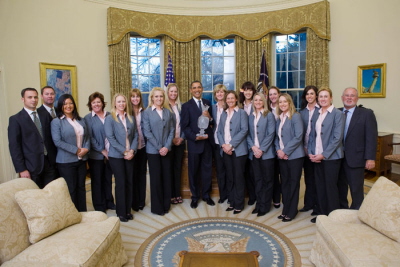
Last month, the victorious 2015 U.S. Solheim Cup team visited Washington D.C. to be recognized for their accomplishments last September in defeating the European Team and winning back the Cup after back-to-back losses. The team sported matching red, white and blue sneakers for their Oval Office meeting with President Obama.gulbiswhitehouseteam

Scotland’s bid, which was led by the EventScotland team within VisitScotland’s Events Directorate and backed by The Scottish Government, was submitted in August and received huge support from stars across the golfing, sporting and media spectrum.  John A. Solheim, PING Chairman and CEO, commented: “I am excited that the Solheim Cup will be returning to Scotland, home of Europe’s first win.  Gleneagles is certainly one of the great venues in golf and I’m sure that the members of the 2019 Solheim Cup teams will be up to meeting the challenges of this exceptional golf course.”

In the 1930’s, A. W. Tillinghast, one of history’s premier golf architects who also designed, among others, the courses at Winged Foot Golf Club, Baltusrol Golf Club, Bethpage State Park and Quaker Ridge Golf Club, redesigned the Brooklawn course in Fairfield into its present form.  Des Moines Golf and Country Club is the second Pete Dye-designed venue to host The Solheim Cup following the 2005 tournament at Crooked Stick Golf Club in Indiana.

2015


Connecticut to Join The Boston Fed's "Working Cities Challenge" to Help Communities Improve Economic Outcomes

Connecticut will be the latest state participating in the Federal Reserve Bank of Boston’s Working Cities Challenge competition, an economic development effort that builds cross-sector collaboration and leadership to solve challenges affecting urban communities. Businesses and organizations from the private sector throughout the state, along with state government, have played a significant role as a catalyst in bringing the Working Cities Challenge to the Land of Steady Habits. As part of this initiative, cities in Connecticut will have the ability to apply for competitive funding to be used toward addressing local issues in a sector of their choosing, be it education, workforce development, small business development, or other areas that can improve economic outcomes for residents. This summer, the Boston Fed will begin conducting meetings across Connecticut to provide more information about the Working Cities Challenge. Cities will be able to apply for design grants in the fall of 2016.

The Boston Fed will lead the competition, providing technical support and staff resources.  A steering committee composed of local and national partners will determine the cities in Connecticut that will be eligible to apply.  An independent, expert jury that does not include the Boston Fed will select winning cities.

The Boston Fed launched the program in Massachusetts in 2013, building on research that identified cross-sector collaboration and leadership as the key ingredients in resurgent smaller cities across the county. The State of Rhode Island has also joined Massachusetts as a participating site of the Working Cities Challenge.

working citiesFunding for the competition prize awards will be provided both by the State of Connecticut, which has committed $1 million, and an additional $2 million commitment from private partners.  The Doris Duke Charitable Foundation, The Kresge Foundation, Living Cities, NeighborWorks America, The United Illuminating Company, Stanley Black & Decker, Boehringer Ingelheim, Travelers Companies, Inc., The Hartford Foundation for Public Giving, Webster Bank, Eversource Energy, Liberty Bank Foundation, Hartford HealthCare, Barnes Group, Hoffman BMW of Watertown/Hoffman Auto Group, United Technologies Corp., Charter Communications, and Fairfield County’s Community Foundation have all committed to participating in the challenge.

“This Working Cities Challenge is about delivering collaborative, transformative projects that will improve the economic outcomes in our cities, creating strong, resilient, and inclusive communities,” Governor Malloy said.  “To build a stronger Connecticut, we must build upon the strengths of our urban areas, and I commend the Boston Fed for their leadership on this effort.  We look forward to working with them in support of Connecticut and cannot thank our private partners enough for their participation.”

hartford“We are pleased to bring the Working Cities Challenge to Connecticut and are thankful to Governor Malloy for his support of the effort, as well as the Hartford Foundation, the Doris Duke Foundation, Living Cities, The Kresge Foundation, and many others,” Boston Fed President Eric Rosengren said.  “The partners have come together to make it possible to bring the competition to Connecticut – precisely the model of cross-sector collaboration that forms the basis of the Working Cities Challenge.  This competition focuses on the residents of the state’s postindustrial cities – places with unique assets that taken together can help to build civic leadership infrastructure, which our research shows is a key component of economic resurgence.”

“Collaboration among the nonprofit, private, public and philanthropic sectors and residents is fundamental to ensuring our communities thrive,” Linda J. Kelly, President of the Hartford Foundation for Public Giving, said.  “We are proud to support the Working Cities Challenge as a proven approach for the coordination across multiple systems and stakeholders that is necessary to strengthen our urban centers and benefit the entire state.”

new haven “It’s gratifying to see the strong support from Connecticut companies, foundations, and the Malloy administration for the Working Cities Challenge under the thoughtful  leadership of the Boston Fed,”  James C. Smith, Chairman and CEO of Webster Bank, said.  “By encouraging the development of civic infrastructure as a prerequisite to physical infrastructure, the Working Cities Challenge promises to revitalize Connecticut’s smaller cities economically and transform the lives of inner city residents.”
“Across the country many, many communities lack cohesive leadership to make use of their disconnected assets,” Rip Rapson, President and CEO of The Kresge Foundation, said.  “The Working Cities Challenge offers a short-term incentive for smaller communities to come together for a prize.  But its true value will be felt when those communities find the long-term benefits of collaborations that engage citizens to right economic wrongs and provide for widespread opportunity.”

 Working Cities video

PERSPECTIVE: Can Trust be Restored?

by Peter F. Eder The public’s trust in just about everything continues to be at historically low levels and there is every indication this trending will continue its downward slope.  Not just trust in federal government action but all levels and branches of government, as documented by any number of ongoing Pew Research Center and Quinnipiac Polling Institute studies.

Just one example would be the Pew Research Center’s November 23, 2015 report, entitled: “Beyond Trust: How Americans view their government.”  The top line finding was that fewer than three-in-ten Americans have expressed trust in the federal government in every major national poll conducted since July 2007 – the longest period of low trust in government in more than fifty years.  The survey reported that increased distrust in government exists for every party, across the demographic spectrum and generation clusters, and extends to diminished belief in government fairness.CT perspective

And while distrust is perhaps most manifest these days in politics, the same billowing distrust exists when respondents are measured about credibility in media outlets, financial institutions, religious organizations and seemingly any private or public institution.

Living in a digital age also makes it harder to figure out what is trustworthy.  When it is easy to find confirmation for almost anything ordinary, grave or absurd, with contradictory information and rival sources, determining trustworthiness is truly challenging.

All this seems based on the continual distortion of truth, no sense of compromise, and the polarization and self-serving nature of almost all collective and individual behavior.quote

If we accept this as current reality, the critical question is “How can Trust ever be restored?”  Let me suggest what might have to occur.  First of all, we have to find leaders who will put others first.  It will be individuals who recognize that their neighbors aren’t just the persons who live next to them or who share the same views, values, and interests, but those that inhabit every space around themselves.  We need individuals whose personal experience have guided them through tragedy and triumph, without fostering a mindset that they are championing their own advancement.

q2To those of us who look to – or up to – them, we need an open, inquiring, compassionate mind.  We need to set aside the rush to judgement, to listen to all sides of an issue, to take the time to search out the truth, to separate the hype from the reality.

In time past, these attributes ensured the common good.  Who will take the first leadership steps and who, as followers, will listen, encourage and emulate them?  Or is it sadly already too late?

________________________________

Peter F. Eder is a retired marketing executive, AARP Connecticut community volunteer and a founding board member of At Home In Darien, his community aging-in-place organization.  Throughout his career, he has been involved with local and national organizations within the communications arena and in responding to acute needs of people in our communities.

PERSPECTIVE commentaries by contributing writers appear each Sunday on Connecticut by the Numbers.

Also of interest:  Freedom's Just Another Word For 

Encore Entrepreneurs Look to Start New Businesses in CT

To paraphrase a commercial phrase from years ago, it isn’t your grandfather’s entrepreneurship.  In fact, the new version isn’t only for twenty- and thirty-somethings.  The fifty- and sixty-somethings are, in increasing numbers, looking to launch what AARP describes as “encore entrepreneurship.”  And the infrastructure to give those new entrepreneurial notions a boost is growing too, including in Connecticut. The most recent gathering, at the reSET business factory in Hartford, brought solid attendance and an array of experts to work with individuals with a full career under their belt, but nonetheless looking to start their next career. reSET photo

AARP and the U.S. Small Business Administration (SBA) hosted the free educational and networking “Boot Camp” seminar for Connecticut entrepreneurs and small business owners.  reSET, usually populated by a predominantly younger set of entrepreneurs, indicated that age and entrepreneurship are not mutually exclusive, and Community Developer Brandon Serafino went on to explain the availability of working space, expert mentors and consultants is areas ranging from law to accounting to marketing on hand to provide guidance.

Nora Duncan, state director of AARP, led the program presentations and described a strong portfolio of services available – and some surprising numbers that reflect the strength of encore entrepreneurship nationwide.

It turns out, she said, that there is research to show that not only do more older people start businesses but also that businesses started by older people are actually more successful on average.

A study by the Kauffman Foundation found, for example, that the average and median age of U.S.-born tech founders was thirty-nine when they started their companies. Twice as many were older than fifty as were younger than twenty-five.

aarpA recent report in Business Insider indicated that one in three new businesses in the U.S. were started by an entrepreneur age 50 or older.  Describing “running a business as the new retirement,” the news report cited an infographic in easylifecover that highlighted those aged 55-64 in the U.S. have actually had the highest rate of entrepreneurial activity in the last 10 years, noting that the founders of McDonald's, Coca Cola, and Kentucky Fried Chicken – among others - were all over 50 when they established their businesses.

logoThe interactive “Boot Camp” event at reSET – open to people of all ages with a special focus on the 50 and over –included short presentations from local resource organizations, networking opportunities and valuable information on the programs and tools available to potential business owners.  Attendees were updated on the necessary steps and tools to launch a business, and had opportunities to talk one-on-one with local mentoring organizations, lenders, small business advisors and community leaders for advice and assistance.

AARP state offices and U.S. Small Business Administration District Offices are in the midst of hosting events for Encore Entrepreneurs specifically designed for those age 50 and older who want to start or grow a small business.  Summer of Encore Mentoring events are being conducted during June, July and August, in Connecticut and around the country.  (Next event is June 29 at CCSU)

Among those on ctsbdc-logohand at the reSET event in mid-June were representatives of the Office of Secretary of State (where new businesses are registered), Hartford Economic Development Corporation, and the Connecticut Small Business Development Center.  SBA Connecticut District Director Anne Hunt outlined the businesses expertise available at offices throughout the state to support business start-ups and help navigate the hurdles that new businesses face.

The SBA-AARP strategic partnership is designed to jointly counsel, train, and mentor encore entrepreneurs on small business creation. For many 50+ individuals, officials say, entrepreneurship training is the toolkit that empowers them to use their experience, knowledge, and skills to become business owners and job creators. Since the partnership began in 2012, the SBA and AARP have educated more than 300,000 existing and budding potential encore entrepreneurs nationwide.

reSET-600x239-1-300x120reSET serves all entrepreneurs, but specializes in social enterprise ― impact driven business with a double and sometimes triple bottom line. In addition to providing co-working space and accelerator and mentoring programs, reSET aims to inspire innovation and community collaboration, and to support entrepreneurs in creating market-based solutions to community challenges. The organization’s goal is to “meet entrepreneurs wherever they are in their trajectory and to help them take their businesses to the next level.”

New Haven to Host Regional Economic Development Conference for Northeast

Each year, the Northeastern Economic Developers Association convenes a conference of practitioners and thinkers from throughout the region who learn and do business together. For the organization’s 60th annual conference this fall, the selected theme of “Transportation at the Crossroads” is designed “to help us bring a big idea to life - increasing economic self-sufficiency and vibrancy for citizens, businesses and communities.” The city selected to host the landmark event is New Haven. “We are broadly defining transportation to include moving people, cargo and data,” explain conference organizers of the event, expected to bring more than 250 professionals in a range of economic development areas to the September 11-13 conference.   new haven conf

NEDA will offer sessions in New Haven in the priority topic areas related to the transportation theme - a broad array of program topics, professional tools and networking opportunities that will provide high value to conference attendees.

Who is expected to attend?  Organizers anticipate community planners; representatives of banks, specialty lenders and investors; Chambers of Commerce leaders; developers; economic development organizations and consultants; engineering service firms; entrepreneurs; municipal planners, place-makers; policy makers; transportation planners and implementers; and federal, state, regional and local government representatives.

Keynote speakers include state and federal officials, including Governor Malloy; state Economic and Community Development Commissioner Catherine Smith; Transportation Commissioner James Redeker; Alissa DeJonge, Vice President of Research for the Connecticut Economic Resource Center; and New Haven Mayor Toni Harp.   In addition, former Gov. Parris N. Glendening of Maryland, President of Smart Growth America’s Leadership Institute and the Governors’ Institute on Community Design, a technical assistance program run in partnership with the EPA-DOT Partnership for Sustainable Communities and Smart Growth America, will address the conference, as will Congressman Bill Shuster, Chairman of the U.S. House Transportation and Infrastructure Committee.map

The conference will also recognize outstanding initiatives throughout the region, including the Project of the Year, Program of the Year, Educator of the Year, Member of the Year, and a series of marketing awards in categories including branding, marketing and promotion, and economic development content.  Nominations must be submitted (by NEDA members) by June 24.

Through NEDA membership, economic development practitioners, officials, and volunteer leaders develop and perfect their development tools, network with others in the field, and partner regionally to do the work of economic development, according to organization officials.

The NEDA “core philosophy” will be reflected in the conference sessions.  It reads “We believe economic development is inseparably intertwined with both community development and the leveraging of community assets to drive change. By forming collaborative partnerships with organizations pursuing goals similar to ours, local resources are maximized and the foundation for community sustainability is established from local stakeholders and small businesses committed to their common future.”

NEDA members “build stronger economies throughout the Northeastern United States,” including Connecticut, Delaware, Maine, Massachusetts, Maryland, New Hampshire, New Jersey, New York, Pennsylvania, Rhode Island, and Vermont, as well as the District of Columbia.

https://youtu.be/iphybn4GS8U