CT Families Continue to Struggle Financially, United Way Report Reveals

More Connecticut households are struggling to pay for their most basic needs, according to a new report from United Way.  More than one out of four households - in one of the wealthiest states in the U.S. - are employed, yet still fall below what is needed to thrive financially.  That is an increase in both the number and percentage of such households in 2014 as compared with 2012, according to the updated ALICE report. Two years ago, United Ways introduced ALICE, which stands for - Asset Limited Income Constrained Employed - to place a spotlight on a large population of residents who are working, but have difficulty affording the basic necessities of housing, food, child care, health care and transportation.pie
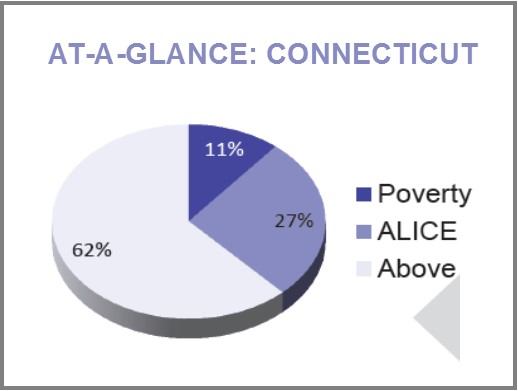
In those two years, the problem has grown worse, even has the recession has given way to a slow economic recovery, in Connecticut and nationwide.  ALICE and poverty households combined account for 38 percent of households in the state that struggle to make ends meet.

A total of 361,521 Connecticut households fall into what the study describes as the ALICE population. These are households earning more than the official U.S. poverty level, but less than the basic cost of living. This is more than 2.5 times the number of households that fall below the federal poverty level. ALICE households make up 20% or more of all households in 114 (67%) of Connecticut’s 169 cities and towns.

The highest levels (ALICE and poverty households) were in Hartford (74%), New Haven (65%), Waterbury (63%), Bridgeport (63%) and New Britain (63%).  Also above 50 percent are Meriden, West Haven, East Hartford and New London.  From 2007 to 2014, two cities, Danbury and Waterbury, saw their total household population decrease, by 7 and 9 percent respectively, while the rest experienced an increase in households, with the largest increase of 8 percent in Stamford, according to the report. The number of household below the ALICE Threshold increased in every one of the nine largest cities and towns with Norwalk seeing the largest percent increase (38 percent).
2016-alice-report-update-coverWhile the prevalence of low-wage jobs still defines Connecticut’s economy for ALICE, for the first time in the past decade, the percent of jobs paying less than $20 per hour fell below 50 percent of all jobs.  The report also highlights a number of trends in Connecticut, including:

  • The population is aging, and many seniors do not have the resources they need to support themselves.
  • Differences by race and ethnicity persist and ethnicity persist, creating challenges for many ALICE families, as well as for immigrants in Connecticut.
  • Low-wage jobs are projected to grow faster than higher-wage jobs over the next decade.
  • Technology is changing the workplace, adding some jobs, replacing many others, while also changing where people work, the hours they work, and skills required. The report notes that technology creates opportunities as well as challenges for ALICE workers.

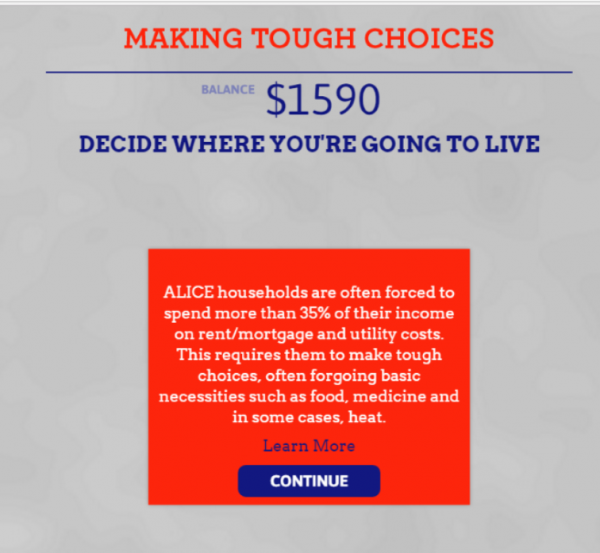
For the first time, an online simulator is also available to experience the financial challenges that ALICE households in Connecticut face at www.MakingToughChoices.org.  The updated Report uses data from a variety of sources, including the U.S. Census and the American Community Survey to provide tools that quantify the number of households in Connecticut's workforce that are struggling financially. The updated United Way ALICE Report reveals:

  • The composition of the ALICE population is men and women, young and old, of all races.
  • The breakdown of jobs in Connecticut by hourly wage (51% of jobs pay more than $20/hour) compared to what it costs to survive for a family of four (2 adults, 1 infant, 1 preschooler) - $70,788.
  • Every city and town in Connecticut has ALICE households. More than two-thirds of Connecticut's cities and towns have at least 1 in 5 households that fit the ALICE definition for financial hardship.cropped-alicemicrositelogo2

Poverty and ALICE households exist in every racial and ethnic group in Connecticut, but the largest numbers are among White non-Hispanic households. There were about one million White households in 2014, compared to 328,000 households of color (Figure 4 shows the populations of color for whom there is income data: Hispanic, Black and Asian). However, these groups made up a proportionally larger share of households both in poverty and ALICE: 64 percent of Hispanic households, 58 percent of Black households, and 30 percent of Asian households had income below the ALICE Threshold in 2014, compared to 31 percent of White households.

The largest population of color in Connecticut, Hispanics, has been growing since 2007, totaling 156,837 households in 2014, a 25 percent increase. As the number of Hispanic households increased, so did the number and proportion of Hispanics living below the ALICE threshold. The percentage of Hispanic ALICE households rose from 34 percent in 2007 to 39 percent in 2010 and then to 43 percent in 2014. Together Hispanic households in poverty and ALICE made up more than two-thirds of Hispanic households in 2014.
making-tough-choicesThere are some signs of improvement in the education gap among racial and ethnic groups, suggesting that some structural changes are occurring in Connecticut. In K-12 education, the Education Equality Index (EEI) shows that the achievement gap – the disparity in educational measures between socioeconomic and racial or ethnic groups – narrowed slightly between 2011 and 2014 in Connecticut.

Achievement gaps impact graduation rates and college performance. Among the Class of 2013, 64 percent of Black students and 59 percent of Hispanic students in the state went on to college within a year after graduating from high school, compared to 78 percent of White students. They also had lower 6-year college graduation rates: While 54 percent of White students got a college degree within 6 years, only 24 percent of Black students and 21 percent of Hispanic students did the same (Connecticut State Department of Education, 2015).

The updated ALICE Report recommends both short-term and long-term strategies to help ALICE families and strengthen our communities. United Ways work with many community partners to provide support to ALICE families to help them get through a crisis and avoid a downward spiral into even worse circumstances such as homelessness as well as assisting with financial literacy, education and workforce readiness.

Further, United Ways in Connecticut have invested more than $8.5 million in child care and early learning; $1.3 million in housing and homeless prevention work; $5 million in basic needs programs; and, have assisted working families in obtaining nearly $40 million in EITC and tax refunds and credits in 2016.

The updated Connecticut ALICE Report was funded by the 16 Connecticut United Ways. For more information or to find data about ALICE in local communities, visit http://alice.ctunitedway.org.  Connecticut United Ways are joining with United Ways in fifteen other states to provide statewide ALICE Reports. The updated Connecticut ALICE Report provides analysis of how many households are struggling in every town, and what it costs to pay for basic necessities in different parts of the state (Household Survival Budget).

https://youtu.be/u7gPJGu2psw

 [2014 ALICE introductory video]

PERSPECTIVE: New Economic Perspectives on the I-91 Knowledge Corridor

by Don Klepper-Smith Today, as I look out over our economic landscape in mid-2016, and given recent developments, I believe there is enough evidence to suggest that the odds of a U.S. recession over the next 12-18 months have risen to roughly 30-40 percent.

During our last recession, the National Bureau of Economic Research (NBER) did not make the official call until December 2008, a full year after the recession began, and after the November 2008 presidential election. So given the 2016 presidential election and the current political environment, it is highly unlikely that the so called "R- word" will be formally uttered by NBER before the end of 2016.CT perspective

If there's one thing I've learned in my 35 years of being a professional economist, it's that once the dominos start falling in a given direction, either to the upside or the downside, expect them to do more of the same. In other words, the economic status quo always perpetuates itself.

Good news begets good news, and bad news begets more bad news. The trick is in discerning the "turning point", which has so many intangibles attached to it. Bottom line: We are clearly starting to see cracks in our economic recovery, but recession is not a foregone conclusion.

q1Essentially, structural change relates to those factors within the domestic economy which are NOT related to, and operate independent of, the U.S. business cycle. Structural changes have to be understood in their scope and magnitude in impacting today’s economy because many of these same factors will also be affecting future levels of growth.

Often unappreciated by federal and state policymakers, these structural changes have had profound and significant effects on levels of economic growth and have vastly reshaped our economic landscape over time. As a result, policy options are far more complicated and challenging.

The good news is that the current U.S. expansion is seven years old this summer, a bit longer than the average post-war recovery of five years. Despite all the rhetoric and cheerleading, the domestic economy grew just 1.7%, 2.4% and 2.6% respectively over the last three years, about a half a percent below our long-term average. In fact, the last time we saw “average growth of 3%” was in 2005. Today, the economic fundamentals clearly argue for another year of “modest growth” in the range of 2%, but red flags are starting to appear.

Importantly, the traditional tools for stimulating the domestic economy - monetary and fiscal policy - have either been exhausted, or are politically unpalatable as of mid-2016.  Here’s the bottom line:  With little means to stimulate the U.S. economy, the overall economy is poised for just modest, below-average, real GDP growth in the 2%-2.5% range for both 2016 and 2017.

In Connecticut, there's clearly been an escalating "crisis of confidence" in the state's business community that's been long ignored, and it's not going to turn around quickly. Research shows that both business confidence and consumer confidence don't turn on a dime, and that it takes many years to rebuild confidence once it's lost.

The present lack of fiscal discipline in state and local finances is clearly one contributing factor. With State and local budgets climbing three, four and five percent annually, and those on fixed incomes earning one to two percent, it doesn't take a degree in math to understand that "mounting fiscal stress" is already baked into Connecticut's fiscal picture over the next ten to fifteen years.

Inform CT is a public-private partnership that provides independent, nonpartisan research, analysis and public outreach.  Highlights of the August 2016 Inform CT survey results include:

  • 40% of the state’s residents say they are likely to move out of state within the next five years.
  • More significantly, more than half of those between 18-25 also said they will leave in the coming years, adversely impacting the local labor supply in the years aheadq2

The issues cited include lack of economic growth, lack of jobs, health insurance costs, declining business conditions, high S&L taxes, and a transportation system that cannot support the needs of its workforce.

Look at the key economic metrics, Connecticut vs. Massachusetts:

  • Unemployment: CT at 5.6% in August 2016; MA at 3.9%; US at 4.9%
  • Unemployed: CT up 5,500 over last year; MA down 30,300
  • State Tax Revenue: CT up 0.8%; MA up 1.9%
  • Single Family Housing Sales: CT up 9.9% year-to-date; MA up 14.2%

The Connecticut economy is expected to see growth of about 1%-1.5% in both 2016 and 2017, well below our long-term average annual growth rate of 2.5%.

Four recommendations for Connecticut:

  1. To promote fiscal discipline, adopt a state spending cap tied to the CPI-U with accountability, adhere to the present spending cap laws on the books, which has been circumvented, and seek full accountability and visibility, making it known to the public when spending caps are exceeded.
  2. Privatize where it makes sense.
  3. Reconfigure wage and benefit packages for state and local workers to reflect what the private sector is paying.
  4. Promote regionalism and the sharing of resources with the idea of increasing productivity.

If the region wishes to be competitive in a global marketplace that is increasingly competitive and subject to profound structural changes, then emphasis on the STEM skills- science, technology, engineering and math provides a gateway for growth.

STEM skills set the table for expansion in our manufacturing sector, which carries significant economic multipliers. It’s manufacturing which begets non-manufacturing, not the other way around. For every manufacturing job created, there are another 1.5 jobs created elsewhere in the local economy.

_______________________________________

Don Klepper Smith is Chief Economist & Director of Research at DataCore Partners LLC and Economic Advisor to Farmington Bank.  This is adapted from his presentation to the New England Knowledge Corridor Mayors’ Economic Forum on October 5, 2016. 

PERSPECTIVE commentaries by contributing writers appear each Sunday on Connecticut by the Numbers.

First Niagara Transitions to KeyBank This Weekend

For customers of the soon-to-be-history First Niagara Bank, this will be a holiday weekend of banking transition, as KeyBank becomes the new name on the door on Tuesday morning after a host of changes inside. First Niagara branches, converting to KeyBank, will close at 3 p.m. Oct. 7 and reopen for business the morning of Oct. 11, the day after Columbus Day. The company promises a smooth transition, and has been providing customers of the bank’s more than 60 branches in Connecticut with step by-step previews of what to expect. The changes represent the completion of the $4.1 billion KeyCorp purchase of First Niagara.logo-lockup

“As KeyBank and First Niagara come together you can continue to bank as you currently do, using your same account number, checks, debit card, ATM card, credit card, telephone banking, online access and branches,” the company website points out.

First Niagara has 65 branches in Connecticut that will be transitioned to KeyBank branches. There were no existing KeyBank branches in the state prior to the merger, so there was no overlap that required branch closings, as is often the case with bank mergers.

Headquartered in Cleveland, KeyBank’s footprint includes 15 states via a network of more than 1,200 branches and more than 1,500 KeyBank ATMs. The company’s roots trace back 190 years to Albany, New York. Since then, KeyCorp has grown into one of the nation's largest bank-based financial services companies, among the top 15, with assets of approximately $135 billion, according to the company.

keybank-mapIn recent months, First Niagara did consolidate five Connecticut branches (Woodstock, Dayville, Hamden, East Haven and Madison), and all of the employees who worked at those branches were offered positions within the bank, officials indicated, and no layoffs were associated with that consolidation.

"By asset size, this is the largest bank merger since the financial crisis,” Beth E. Mooney, Key’s chairwoman and CEO, told the Buffalo News last month, during a visit to Key’s Northeast regional headquarters in Buffalo, which had been First Niagara’s corporate headquarters.

“So there is a significance and an importance for us to do it well that’s critical for our communities, our clients, our employees and our shareholders. But from an industry perspective, this is actually one that there’s a fair amount of eyes on us, as well.”

The conversion of First Niagara accounts and services to KeyBank will begin at with a 3 p.m. close of business on Friday, October 7.  Due to Online Banking updates, customer balances that appears online on Thursday, October 6 at 11:59 p.m. will not change until Saturday, October 8, at 6 a.m., so any purchases or deposits made during that time will not be reflected on online balances until Saturday. Customers can continue to use current First Niagara ATM/debit card, account numbers and PINs will not change.

The acquisition of First Niagara by Keycorp was announced on Oct. 30, 2015, and includes the addition of approximately 300 First Niagara branches in New York, Pennsylvania, Connecticut and Massachusetts.  First Niagara had entered the Connecticut market in 2011 with the purchase of New Alliance Bank.

Global Health and Innovation Conference, World's Largest, in New Haven in April

The Innovation Prize is a $10,000 and a $5,000 cash prize that is awarded to the two best social impact pitches that are presented at the 2017 Global Health & Innovation Conference, to be held in New Haven at Yale University on April 22-23, 2017. The Global Health & Innovation Conference (#GHIC) is the world's leading and largest global health conference as well as the largest social entrepreneurship conference, with 2,200 professionals and students from all 50 states and more than 55 countries, according to conference organizers.

The conference was developed by Unite for Site, a 501(c)(3) nonprofit global health delivery organization that is free of commercial interests and committed to promoting high-quality health care for all. GHIC 2017 will be Unite For Sight's 14th annual conference, having grown from a conference of about 100 participants in its first year.unite-for-sight-logo

Unite For Sight, headquartered on Church Street in New Haven, supports eye clinics worldwide by investing human and financial resources in their social ventures to eliminate patient barriers to eye care. Unite For Sight applies best practices in eye care, public health, volunteerism, and social entrepreneurship to achieve our goal of high-quality eye care for all. The programs are locally led and managed by ophthalmologists at Unite For Sight's partner eye clinics.

unite-2Unite For Sight's international eye care services with partner local eye clinics are provided year-round and are comprehensive, including examinations by local eye doctors, diagnosis and care for treatable conditions, education, and preventative care. The organization’s website indicates that Unite For Sight has provided eye care services to more than 2.1 million people worldwide, including more than 93,166 sight-restoring surgeries.

The conference is expected to include 300 speakers, including keynote addresses from:

  • Vanessa Kerry, Founder and CEO, Seed Global Health
  • Jeffrey Sachs, PhD, Director of Earth Institute, Columbia University; Quetelet Professor of Sustainable Development, Professor of Health Policy and Management, Columbia University; Special Advisor to Secretary-General of the United Nations Ban Ki-moon
  • Sonia Sachs, Director, Health Sector, Earth Institute, Columbia University; Health Coordinator, Millennium Village Project
  • Leana Wen, Baltimore City Health Commissioner

Unite for Sight was founded in 2000 by Jennifer Staple-Clark, then a sophomore at Yale University, in her dorm room. Unite For Sight is now a leader both in global health education and in providing cost-effective care to the world's poorest people. Staple-Clark, the organization’s Chief Executive Officer, is being honored in November by the Greater New Haven Chamber of Commerce as a Millennial Move Maker.unite

She is the recipient of the 2011 John F. Kennedy New Frontier Award, presented by the John F. Kennedy Library Foundation and the Institute of Politics at Harvard's Kennedy School of Government to "an individual whose contributions in the realm of community service, advocacy or grassroots activism have elevated the debate or changed the landscape with respect to a public issue or issues." In 2015, Middlebury College's Center for Social Entrepreneurship presented Jennifer with the Vision Award "to recognize leadership and vision in the world of social entrepreneurship."

Topics at the April conference will also include design thinking; education and school-based programs; environment health, energy, food and agriculture; healthcare delivery, university education initiatives; health policy, mental and neurological health; patient-centered initiatives; marketing communications; social entrepreneurship; surgery & global health; technology in global health; and non-communicable diseases.

unite-3The conference also includes Social Impact Labs, which provide an opportunity for selected speakers to present their new idea in the format of a 5-minute pitch. All of the presentations are ideas that are being developed, meaning that the ideas are in the brainstorming, early development, or early implementation stage.  Following each presenter’s 5-minute pitch, there is a 15-minute period for discussion and coaching with two expert speakers, questions, answers, and feedback from the audience.
For Innovation Prize at the 2017 GHIC, there are two categories: Early Stage (idea, program, or organization is less than 3 years old, and ideas in the brainstorming stage are also eligible) and Established Stage (program or organization is 3-6 years old). A newer program (0-6 years old) that is within an established (7+ year old) organization qualifies for the Social Impact Lab category as well.

https://youtu.be/Lt818tE5AUc

https://youtu.be/NtTtFAv-uTQ

Ridgefield, Wilton, Weston Are Connecticut's Safest Communities, Analysis Says

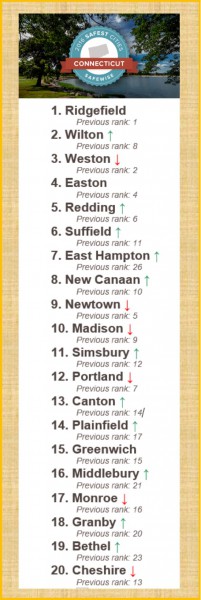
Ridgefield, Wilton, Weston, Easton and Redding top the list of Connecticut’s safest communities, according to an analysis from Safewise.  Rounding out the top 10 are Suffield, East Hampton, New Canaan, Newtown and Madison. The analysis explains that “one of Connecticut’s positive attributes is a relatively low crime rate.” Based on the most recent FBI Crime Report, the violent crime rate in Connecticut is nearly 40 percent lower than the national average and the property crime rate is over 25 percent lower, according to the Safewise report.

listIn 2014, roughly 30 out of every 1,000 people across the U.S. were victims of crime, while Connecticut’s crimes affected only 21 out of 1,000 people. Among the state’s 20 safest cities, however, only about three crimes were reported for every 1,000 citizens.

Ridgefield topped the list for the second consecutive year.  Among the biggest jumps on the list was East Hampton, which moved from #26 to #7.

According to the data, 70% of the 20 safest cities in Connecticut reported less than five violent crimes and 55% reported less than 100 property crimes. These figures are especially impressive considering the average population of the cities on our list is almost 19,000.

To identify the 10 safest cities in Connecticut, Safewise reviewed the most recent FBI Crime Report statistics from 2014, along with population data. Eliminated from the analysis were communities with fewer than 5,000 residents as well as any cities that failed to submit a complete crime report to the FBI.

Connecticut’s cities ranked at the bottom of the list.  Between #85 and #91 were New Britain, New London, Bridgeport, Waterbury, New Haven and Hartford.  Also among the towns ranked towards the bottom of the list were Derby, Plainville, Manchester, West Haven, and East Windsor.

SafeWise is a home security and safety brand committed to increasing safety education, awareness, and preparedness in American communities.

State Resident Published by National Magazine Concludes "Connecticut's Bad for Business"

The headline in the story posted over the weekend at the National Review website says simply, “Connecticut’s Bad for Business.” The article explains that “the state’s perpetual budget crisis has continued unhindered, with no resolution on the horizon,” and points to “a long list of causes” for the adverse business climate: “burdensome regulations, the second-highest tax burden in the country, restrictive zoning rules, high costs of labor, a lack of meaningful regional cooperation, clogged highways, crowded trains, and overall inadequate public transportation.”

The National Review focus on Connecticut launches into a discussion of “the educational disparities that characterize the school systems” including this spending review:national-review

“New Haven, featuring a perpetually beleaguered and fairly depleted school system, spends $17,200 per student. Fairfield, the wealthy town right next door to Bridgeport, actually spends less — just under $16,000. Waterbury, one of the poorest cities in the state, spends $15,000 per student; West Hartford, regarded by all as some sort of suburban Zion, spends $500 less. Hartford spends $19,400 per student, more than the New York exclaves of New Canaan and Darien and more than the shoreline oases of Madison and Guilford.”

The article suggests that among the factors adversely impacting the quality of education in urban districts is “stunningly dysfunctional boards of education” that feature “bitterly personal partisan acrimony” and “an inability to rise above petty, factionalist squabbling.”  Some examples are outlined.

Education funding, likely to be front and center in the 2017 state legislative session following a sweeping court decision now being appealed by the state, drew this observation:  “Wealthy towns may, on average, spend more per student than poorer towns and cities do, but it’s not a hard-and-fast rule; sometimes poor towns spend more, and sometimes they spend less. In any case, spending can’t explain it all.”

bearingsRecent articles by The New York Times and Atlantic are referred to, noting that they also reflected poorly on the state’s current condition.  National Review adds to the journalistic observations of a state filled with seemingly intractable dilemmas, noting that “Connecticut’s tax system is currently so dependent on the incomes of Fairfield County high-earners — as Governor Malloy has often made clear — that even the slightest variations can trigger a budget crisis.”  The article adds, however, that “finance lies somewhere near the bottom of a long list of factors in explaining the current state of Connecticut.”

The article suggests that GE’s departure and Sikorsky’s recent decision to stay in the state both reflect Connecticut’s weakness.

“That Sikorsky probably would have followed GE’s path out of the state without (state subsidies) suggests to me that Connecticut just isn’t a good place for business anymore — unless the state opens the coffers. The lack of middle-class jobs in Connecticut cannot be explained by an overreliance on finance in one of the state’s eight counties; rather, it has far more to do with Connecticut’s long-decaying business climate.”

The article was authored by National Review intern Noah Daponte-Smith, who is also a Yale University student and staff reporter and writer for the Yale Daily News, described as a “student of modern history and politics.”  Smith has also written - last summer - for Forbes, focusing on “British politics in the domestic and European spheres.” He is a graduate of the Hopkins School in New Haven.

Daponte-Smith indicates that Connecticut’s “problem can be solved,” but concludes that “blaming inequalities in education funding or the prominence of finance in Fairfield County’s economy are poor places to start.”

PERSPECTIVE: Hostility Instigated by Pride, Ambition, and Other Sinister and Pernicious Motives

by George Washington The period for a new election of a citizen to administer the executive government of the United States being not far distant, and the time actually arrived when your thoughts must be employed in designating the person who is to be clothed with that important trust, it appears to me proper, especially as it may conduce to a more distinct expression of the public voice, that I should now apprise you of the resolution I have formed, to decline being considered among the number of those out of whom a choice is to be made…

CT perspectiveObserve good faith and justice towards all nations; cultivate peace and harmony with all. Religion and morality enjoin this conduct; and can it be, that good policy does not equally enjoin it - It will be worthy of a free, enlightened, and at no distant period, a great nation, to give to mankind the magnanimous and too novel example of a people always guided by an exalted justice and benevolence.

Who can doubt that, in the course of time and things, the fruits of such a plan would richly repay any temporary advantages which might be lost by a steady adherence to it? Can it be that Providence has not connected the permanent felicity of a nation with its virtue? The experiment, at least, is recommended by every sentiment which ennobles human nature. Alas! is it rendered impossible by its vices?

In the execution of such a plan, nothing is more essential than that permanent, inveterate antipathies against particular nations, and passionate attachments for others, should be excluded; and that, in place of them, just and amicable feelings towards all should be cultivated…

The nation which indulges towards another a habitual hatred or a habitual fondness is in some degree a slave. It is a slave to its animosity or to its affection, either of which is sufficient to lead it astray from its duty and its interest.q1

Antipathy in one nation against another disposes each more readily to offer insult and injury, to lay hold of slight causes of umbrage, and to be haughty and intractable, when accidental or trifling occasions of dispute occur. Hence, frequent collisions, obstinate, envenomed, and bloody contests. The nation, prompted by ill-will and resentment, sometimes impels to war the government, contrary to the best calculations of policy. The government sometimes participates in the national propensity, and adopts through passion what reason would reject; at other times it makes the animosity of the nation subservient to projects of hostility instigated by pride, ambition, and other sinister and pernicious motives. The peace often, sometimes perhaps the liberty, of nations, has been the victim.

So likewise, a passionate attachment of one nation for another produces a variety of evils. Sympathy for the favorite nation, facilitating the illusion of an imaginary common interest in cases where no real common interest exists, and infusing into one the enmities of the other, betrays the former into a participation in the quarrels and wars of the latter without adequate inducement or justification. It leads also to concessions to the favorite nation of privileges denied to others which is apt doubly to injure the nation making the concessions; by unnecessarily parting with what ought to have been retained, and by exciting jealousy, ill-will, and a disposition to retaliate, in the parties from whom equal privileges are withheld.

q2And it gives to ambitious, corrupted, or deluded citizens (who devote themselves to the favorite nation), facility to betray or sacrifice the interests of their own country, without odium, sometimes even with popularity; gilding, with the appearances of a virtuous sense of obligation, a commendable deference for public opinion, or a laudable zeal for public good, the base or foolish compliances of ambition, corruption, or infatuation.


As avenues to foreign influence in innumerable ways, such attachments are particularly alarming to the truly enlightened and independent patriot. How many opportunities do they afford to tamper with domestic factions, to practice the arts of seduction, to mislead public opinion, to influence or awe the public councils. Such an attachment of a small or weak towards a great and powerful nation dooms the former to be the satellite of the latter…

Excessive partiality for one foreign nation and excessive dislike of another cause those whom they actuate to see danger only on one side, and serve to veil and even second the arts of influence on the other. Real patriots who may resist the intrigues of the favorite are liable to become suspected and odious, while its tools and dupes usurp the applause and confidence of the people, to surrender their interests.

__________________________________

George Washington was the first President of the United States, serving from 1789 to 1797.  This is an excerpt from his 6,000 word 1796 Farewell Address to the nation.  The full address appears on the website of the Lillian Goldman Law Library of Yale Law School, http://avalon.law.yale.edu/18th_century/washing.asp


Regional Volleyball Tournament Expands in Hartford in 2017

Hartford’s reputation as the place to be for aspiring collegiate volleyball players will continue to grow in 2017, as the New England Region Volleyball Association (NERVA) will be expanding its Mizuno New England Winterfest Tournament at the Connecticut Convention Center (CTCC) in January. NERVA will be adding an additional weekend - Friday, January 6, 2017 through Sunday, January 8, 2017 - to the tournament, which is expected to add 7,000 attendees to the 17,000 visitors Winterfest currently brings to the city of Hartford.volleylogo

Winterfest, the largest volleyball tournament in New England, is designed to showcase female volleyball players – ages 12 to 18 – to college coaches and recruiters from throughout the Northeast. Each year, NERVA holds its annual Mizuno New England Winterfest at the CTCC in January, over the long Martin Luther King Jr. weekend.  College representatives from New England and beyond traditionally attend, as well as family, friends, fans and teams from across New England.

In addition to the event’s expansion over an additional weekend, NERVA has committed to holding Winterfest at the Center through at least 2019. The added weekend is expected to bring an additional 900 overnight rooms to the region for a total of 5,400 rooms in 2017 and an additional 1,800 rooms starting in 2018 totaling 6,800 rooms, according to tournament officials. The original weekend brings over 4,500 rooms to the Hartford region.2013-ctcc-nerva-winterfest-300x200

“We have watched NERVA grow at the Center since 2010 and we are excited to team up with them to offer an additional weekend to Winterfest,” says Michael Costelli, General Manager of the Connecticut Convention Center. “The event brings thousands of visitors and an incredible energy to the Center and the city of Hartford. We look forward hosting the athletes, coaches and spectators for the foreseeable future.”

logo“The New England Region is looking forward to the expansion of two weekends for our Winterfest tournament,” says Roxann Link, New England Region Junior Commissioner. “All of our clubs, players and coaches have enjoyed playing at the Connecticut Convention Center and are excited that we will be able to add more teams.”

NERVA is one of 40 regions of USA Volleyball, the National Governing Body of volleyball. NERVA represents the states of Connecticut, Maine, Massachusetts, New Hampshire, Rhode Island and Vermont.

Taking place in the Convention Center’s exhibit halls, the Winterfest always fills up quickly and is maxed out with 200 teams playing on 25 courts, officials point out. The addition of a second weekend is designed to allow an additional 90 teams to participate in the tournament in 2017 and an additional 200 teams starting in 2018.

A year ago, NERVA added an additional tournament at the CT Convention Center over Memorial Day weekend.

Some Businesses Anticipate More Hiring in CT, But Employers Expectations Lower than Last Quarter, Last Year

Employers in Connecticut expect to hire at an “upbeat pace” during the fourth quarter of 2016, according to the Manpower Employment Outlook Survey, but hiring intentions are weaker than in the previous quarter, and a year ago. Nearly one in five Connecticut employers, 18 percent of the companies interviewed, plan to hire more employees between October and December, while 6 percent expect to reduce their payrolls. Another 73 percent expect to maintain their current workforce levels and 3 percent are not certain of their hiring plans. This yields a Net Employment Outlook of 12 percent, according to Manpower, which produces the quarterly surveys of business hiring plans.

q4Those numbers are not as strong as in previous surveys, taken  in advance of the third quarter of this year, and prior to the fourth quarter a year ago. Nationwide, the trend is in the opposite direction.  Employers indicate a slight increase in hiring plans for the final three months of 2016.

“Hiring intentions are weaker compared to Q3 2016 when the Net Employment Outlook was 15 percent,” Manpower spokesperson Betty Gooding said about the Connecticut numbers. “The hiring pace is expected to slow down compared to one year ago when the Net Employment Outlook was 16 percent.”

Among metropolitan areas in Connecticut among the top 100 surveyed nationwide, 16 percent of Bridgeport area employers anticipate more hiring in the fourth quarter, compared with 8 percent of Hartford region employers, according to the survey data.

For the coming quarter, job prospects appear best in Transportation & Utilities, Wholesale & Retail Trade, Information, Financial Activities, Professional & Business Services, Education & Health Services, Leisure & Hospitality and Government.ct-usa  Employers in Durable Goods Manufacturing, Nondurable Goods Manufacturing and Other Services plan to reduce staffing levels, while hiring in Construction is expected to remain unchanged, according to the survey.

Connecticut’s employers’ hiring projections are also slightly lower than the nationwide numbers.  Of the more than 11,000 employers surveyed in the United States, 22 percent expect to add to their workforces, compared with 18 percent in Connecticut, and 6 percent expect a decline in their payrolls during Quarter 4 2016. Sixty-nine percent of employers anticipate making no change to staff levels, and the remaining 3 percent of employers are undecided about their hiring plans.

net-ctIn the Northeast, 20 percent of employers surveyed anticipate stronger hiring activity in Quarter 4 2016.  Connecticut employers expectations are somewhat lower.

Heading into the fourth quarter, the states with the most optimistic hiring outlook are Hawaii, Tennessee, Utah, Montana, Florida and Arizona.  The most pessimistic are Alaska, New Jersey, Wyoming, Puerto Rico and Indiana.

The Manpower Employment Outlook Survey is conducted quarterly to measure employers’ intentions to increase or decrease the number of employees in their workforces during the next quarter. The Manpower Employment Outlook Survey’s United States results are based on interviews with 11,000 employers located in the 50 states, the District of Columbia and Puerto Rico, which includes the largest 100 Metropolitan Statistical Areas based on number of business establishments.

3rd Party Presidential Campaign Names Celebrity Chair for Connecticut

On the heels of the first presidential debate, the campaign of Libertarian presidential candidate Gary Johnson and running mate William Weld, has named Westport resident and well-known celebrity Melissa Joan Hart as Connecticut Chairperson for the campaign. The actress, best remembered for starring roles in her youth in Sabrina, the Teenage Witch and Clarissa Explains it All, tells People magazine’s online program People Now that she “loves politics,” but is “fatigued” by it now.

melissa-joan-hart"I want to break away from this two-party system and I think it's important for people to know that there's another candidate out there who really toes the line between Democrat and Republican," says Hart. "I mean he's Libertarian. But socially he's liberal, but fiscally conservative."

Johnson, 63, is the former governor of New Mexico – a position he held from 1995 to 2003. He ran a third party presidential campaign in 2012.  Weld is also a former Governor, having led the Bay State of Massachusetts, first elected in 1990.

Hart says she disagrees with the notion that a third-party candidate can't win the election, dispelling arguments that a vote for Johnson is a wasted vote.  In her home state, polls indicate his level of popular support is tiny, but she suggests it could have an impact.

"I think that everyone that I keep hearing say that, if they all voted for him we could have a third party win," she told People Now. "Even if he doesn't get that far, I just hope that they let him debate."  Referring to one of the campaigns most frequently mentioned issues, she indicated that "He was on a border state, so if you want to talk about immigration, he's the guy."

Johnson and Weld have yet to campaign in Connecticut.  Johnson was not invited to participate by the Commission on Presidential Debates because he did not have 15 percent of voter support according to recent national polling.  The Johnson campaign website indicates that a recent NBC/Survey Monkey poll shows Johnson leading both Donald Trump and Hillary Clinton among “pure independents” 31% to 24%. The survey, according to the site, is consistent with others showing Johnson with significant strength among not only independents, but particularly younger voters.

Melissa Joan Hart turned 40  earlier this year, is married to Mark Wilkerson. TV Guide reports she “made a pact with her husband to move out of Los Angeles before their second child went to kindergarten; they moved to Westport in 2009, and their family now includes three sons.