Career Services Grows in Importance to College Students, Survey Finds

While 52 percent of U.S. college graduates report visiting the career services office at least once during their undergraduate experience, they are equally likely to say their experience was "not at all helpful" (16%) as they are to say it was "very helpful" (16%), according to a new national survey of college graduates.  Overall, just under eight in 10 graduates who visited a career services offices describe the experience as “very helpful,” "helpful" or "somewhat helpful." The findings are outlined in the Gallup-Purdue Index Report 2016, released last month, based on more than 11,000 interviews with U.S. adults aged 18 and older with at least a bachelor's degree, conducted Aug. 22-Oct. 11, 2016. The study was conducted as part of the third year of the Gallup-Purdue Index -- a nationally representative survey that has interviewed 70,000 different college graduates over three years.

The survey found that graduates who recall having a high-quality experience with their career services office are markedly more likely to rate their college experience positively. For example, graduates who rated their experiences with career services as very helpful are 5.8 times more likely to strongly agree that their university prepared them for post-collegiate life, nearly three times more likely to "strongly agree" that their education was worth, and 3.4 times more likely to recommend their alma mater.

The campus Career Services office has grown increasingly important to students.  The survey found that recent college graduates are more likely than those who graduated earlier to report visiting their school's career services office. Sixty-one percent of graduates who received their degree since 2009 say they visited the career services office at least once during their undergraduate experience, while 32 percent report they did not (7 percent were unsure).

The results could stem from substantial changes in college students' interactions with career services over time and the fact that colleges' career services' offerings have evolved dramatically in past decades. It is also possible that a larger percentage of earlier graduates may be unable to recall their experience with the career services office, Gallup points out.

Gallup notes that Americans with a bachelor's degree can expect to earn about $1 million more than those with a high school diploma over the course of their careers. However, the unemployment rate for college graduates in the U.S. aged 25 and older is now nearly double what it was in 2000, compared with an overall employment rate that is only one percentage point higher in 2016 than it was in 2000.

As a result, the Gallup organization observes, “schools must adopt new programs and policies to better prepare their graduates for a changing and competitive job market.”  Career services are apparently an increasingly important part of that changing landscape.

Career services offices often provide this support, which can include stimulating student interest in disciplines they had previously not considered, helping students select a major field of study, helping students secure employment while enrolled in college, and preparing students for finding a job upon graduation through mock interviews and resume workshops.

PERSPECTIVE: Effective State Spending Cap Is Number One Priority for Business

by James C. Smith Formulating definitions for key spending cap terms and holding the line on exemptions from the cap in the name of fiscal responsibility will have a significantly positive impact on businesses’ willingness to invest here and on our state’s socio-economic future. Our success depends on the state’s ability to create a stable, competitive economic environment where people can start and expand businesses and families, with confidence in the future operating environment.

I am a Middlebury resident who was born and raised and works in the great city of Waterbury in our great state of Connecticut. I'm chairman and chief executive of Webster Bank. Webster was founded by my father, Harold Webster Smith, in Waterbury in 1935, the depth of the Great Depression, to help his neighbors build and buy their own homes. Over the years we've grown to become one of the largest commercial banks headquartered in New England.

For all of our recent growth into markets beyond Connecticut’s borders, Connecticut remains our most important market, accounting for nearly 70% of our 185 banking offices and over 70% of our 3,300 bankers. Webster serves one of every nine Connecticut households and about 30,000 Connecticut businesses. Yet as Connecticut’s growth has lagged the nation and the region in recent years, most of our growth is coming from faster growing regions in the Northeast…

We feel we have a duty to our customers and communities to speak out on important policy issues, like the spending cap, as we strive to be a catalyst for positive economic change. We are driven by policy, not partisanship. We listen closely to our customers, and we share with you the thoughts and concerns of many of them today.

I am deeply concerned for the state's fiscal condition, which I think we can agree is deteriorating. I strongly believe that fiscal pressures and related uncertainty regarding taxes and regulatory rules are largely responsible for the low and waning confidence expressed by businesses and consumers and is contributing to our alarmingly low standing in surveys measuring the business environment and economic prospects in states across the country…

It’s well known that Connecticut has yet to recoup all of the jobs lost in the Great Recession and that we lag well behind the nation in economic growth. In fact, private sector employment is about what it was in 1990. At the same time, many of the jobs that are being created are in lower-paying sectors of the economy, so personal income is growing slowly. At the core of our stubbornly slow recovery lies a profound lack of confidence among businesses, large and small, in the sustainability of state fiscal policies. Despite the two largest tax increases in state history in recent years, our state nonetheless remains mired in an endless cycle of budget crises with no end in sight…
This crisis atmosphere has had a predictable impact on business confidence… We are seeing a diminished appetite for capital investment among our state’s businesses compared to what we customarily have seen in the past. Many of our clients are being acquired rather than becoming active acquirers. As a barometer for the future, these signs do not portend a robust economy that provides good jobs for our children and grandchildren.

More and more people are losing confidence in our ability to achieve fiscal sustainability given the ‘new economic reality’, asserting that the challenges are insurmountable and apparently accepting our fate as a second tier state sinking deeper into that "economic cul-de-sac" that Michael Gallis, the expert on state competitiveness, warned us about in 1999.

I’m confident that we can turn it around if we adopt a ‘control our destiny’ approach to solving our fiscal problems, and that begins with you. You have it within your power to change the course of events by defining the spending cap, and especially the exemptions, in a way that sustainably controls total state spending, lowers the state’s cost of doing business and improves public sector productivity, and enables investment of the savings in programs and infrastructure improvements that will facilitate and encourage economic investment, thereby increasing business confidence and job creation. If we do not instill businesses with confidence in our state's leadership and finances, the attrition of businesses to other states will accelerate.

Businesses in this state are vitally interested in what this commission recommends. I would rate achievement of a functioning, effective spending cap as their number one priority. The commission’s recommendations will be closely watched to determine the level of discipline it seeks to impose on future spending, and taxes. You can be sure that businesses will make investment and location choices accordingly.

The plain truth is that our state has promised more than it can afford, or has been willing to fund, over many years. Governors and Legislatures made and underfunded forward commitments for decades and only recently have begun to defease them. Not funding those commitments is the primary reason we’re in the difficult situation we’re faced with now, since it led directly to more spending under the cap, which would not have been possible had that funding occurred more responsibly. Now two powerful forces are colliding, threatening to push spending even higher…the need to fund our promises previously made, and the willingness of the legislature to continually raise taxes to meet seemingly insatiable overall spending desires.

As the required funding trajectory for unfunded liabilities now rises, some favor exempting these expenses from the cap. This is 100% contrary to the intent of the constitutional amendment, and I believe it’s the biggest issue facing the commission.

The spending cap was intended to enforce fiscal discipline by limiting spending, and ‘limit’ is the key word in the constitutional amendment. This would require government to decide what to fund…and, importantly, what not to fund…and to make decisions that enable efficient management of government within our appropriately constrained ability to increase revenue consistent with growth in personal income or inflation.

Pushing fast-growing expenses out from under the cap in order to nominally comply with the cap while still satisfying our spending habit defeats the cap’s purpose and the voters’ intent. It’s like trying to eat our cake and have it, too. Most recently a simple majority of legislators moved $1.9 billion in payments toward unfunded pension liabilities outside the cap, freeing up approximately $100 million in additional spending under the cap this year. Such maneuvers violate the will of voters and only serve to make our finances more precarious. Unchecked, these maneuvers will surely produce a catastrophic result and would be the ruin of Connecticut. Exemptions from the cap now comprise approximately 30% of state expenditures. Remember that in the end, it’s total spending that matters most, since that is the basis for determining appropriations and taxes.

The constitutional amendment envisioned that only debt service was to be exempted, since placing debt service under the cap could unsettle the credit markets, raise the state’s cost of borrowing and possibly lead the state to postpone needed infrastructure improvements. I believe that only debt service should be exempted in the future since the fewer the exemptions, the more likely we can achieve true fiscal discipline. A case in point is that over the last forty-five years, total appropriations have grown at well over twice the rate of personal income.

We need to resurrect our Inner Yankee and become the "Land of Steady Habits" once again on spending. Despite its currently flawed status, the spending cap has acted as a brake on spending, encouraged bipartisanship, and spurred innovation in program delivery and organization of state government. And if the cap had been faithfully observed since 1992, cumulative state spending would have been reduced by as much as $5.5 billion.

The spending cap was adopted by more than 80% of voters as part of the grand bargain that led to the state income tax. I urge you to adopt definitions that allow the cap to work as voters intended. With proper definitions, an effective spending cap will encourage working across the aisle in the General Assembly, force our leaders to prioritize spending, and lead to new ways to deliver state services more efficiently.

To those who say that the spending cap is blind to needs, I point to the cap's safety valve. By a gubernatorial declaration and a three-fifths legislative vote, the cap can be exceeded, providing sufficient flexibility to respond to unforeseen needs.

Another area that needs attention is the Budget Reserve Fund (‘rainy day fund’) which is designed to protect surpluses to plug revenue shortfalls in recessions. Much of the surpluses were appropriated by the Legislature for other purposes such that in the early 2000's, when our state ran more than $5 billion in surpluses, only about $1.5 billion of that went to fill emergency revenue gaps or to retire outstanding obligations.

Had the Legislature faithfully adhered to the spending cap, Connecticut‘s rainy day fund in 2008 would have been over $2 billion greater. A larger balance in the rainy day fund could have significantly reduced the need for subsequent tax increases. And as any economist will tell you, a recession is not the time to raise taxes. I hope your recommendations will include some reference to the need for tighter oversight of the BRF.

As you craft definitions, I urge you to consider to these thoughts,

  1. In my view the most important issue the commission faces is deciding what expenditures should be included under the cap. The spending cap should be comprehensive and include all state spending other than debt service as envisioned in the constitutional amendment. The selective removal from the cap of fast-growing budget items guts the value of the cap and defeats the will of voters by allowing otherwise unallowable spending increases which in turn raise taxes.
  2. Specifically, contributions to meet unfunded pension liabilities (and other post-employment benefits) should be under the cap, since this is one of the state's largest and fastest-growing expenditures. Yes, this will lead to hard choices, as envisioned in the constitutional amendment… and hard choices are required for Connecticut to regain competitiveness.
  3. The definitions for income growth and the inflation rate should look back over at least five years to smooth out volatility and ameliorate the impact of one-time events.
  4. Capital gains should continue to be excluded from the calculation of personal income due to their inherent volatility. Capital gains are subject to numerous influences beyond the control of the state, including market movements up and down and federal tax increases, such as the 2013 increase that most likely inhibited investors from taking gains and in turn affected state tax collections.
  5. In years of revenue windfalls, a meaningful portion of revenue in excess of the cap should go automatically to the BRF with the remainder going to pay down the state's unfunded pension and healthcare obligations, the highest in the nation on a per capita basis.
  6. The spending cap must be enforceable and include a mechanism for judicial review in anticipation of potential legislative attempts to exploit any ambiguity in the definitions.
  7. Consider these three principles of fiscal responsibility -- stability, predictability, and competitiveness -- in crafting your recommendations:

Stability. Volatility and changeability are anathema to business investment. Businesses seek assurance that state finances, together with the BRF, are on solid footing when deciding where to invest or expand their workforce. The cap should act to protect both taxpayers and recipients of needed services from the unforeseen.

Predictability. Businesses need to have to have confidence in the state’s policy direction. In recent years, the state has made repeated changes to the tax code that penalize businesses or create uncertainty as to tax structure and rates. Recent actions to limit the research and development tax credit, adopt the unitary tax, and restrict the use of net operating loss carry-forwards are prime examples of the whipsawing policy that unnerves businesses and discourages investment. Likewise, state retirees need the confidence to know that the state can meet its pension obligations while fiscal responsibility requires that we adopt a credible plan for funding them, which we don’t have today.

Competitiveness. Competition breeds advantage, while a lack of competitiveness breeds decline, whether for states or nations. Competition lowers costs and enhances affordability by continually improving efficiency and creating the capacity to invest, which otherwise would be lacking. Every service that government delivers should be subject to rigorous competitive review to ensure delivery through the most efficient means, including knowledge of other states’ best practices. Our tax structure and rates must be competitive if we are to grow.

When Connecticut voters spoke in 1991, their message was loud and clear. They demanded a mandatory brake on state spending, which would be especially important in times when incomes are growing slowly. We live in such a time.

I urge the commission to recommend adoption of spending cap definitions that will impose constructive discipline on state spending, force our elected leaders to make choices, encourage public sector productivity gains, and regain the public’s confidence. If this commission adopts and the Legislature enacts definitions that meet the principles I’ve shared, Connecticut’s businesses will regain the confidence to grow and invest and create jobs.

____________________________

James C. Smith is Chairman and C.E.O., Webster Bank.  This is excerpted from testimony provided on Sept. 7, 2016 to the State Spending Cap Commission, where Smith was invited to testify.  Subsequently, at the Commission's Dec. 15 meeting, the members did not reach a consensus on recommendations.  The state legislature convened this month for the 2017 session.  

 

CT Playing Catch-up to Other States in Reducing Childhood Obesity

Although Connecticut has fared comparatively well to other states in adult obesity rates, the state does “not do as well for children, especially low-income children,” according to two new national reports, the Child Health and Development Institute (CHDI) of Connecticut indicates in the organization’s latest issue brief. “Preventing children from being overweight or obese requires action in the earliest years since experts agree that reversing these trends later in life can be very difficult,” CHDI points out. “It is currently estimated that one in four children are overweight or obese by the time they enter kindergarten.

The reports highlight how Connecticut is doing relative to other states on early childhood obesity prevention. Data for low-income children was drawn from families participating in the federal Special Supplemental Nutrition Program for Women, Infants, and Children (WIC).

The Trust for America’s Health and Robert Wood Johnson Foundation’s State of Obesity in America report shows that Connecticut ranks:

  • 12th out of 50 states for highest WIC obesity rates (low-income children ages 2-4 years old)
  • 27th out of 37 states for highest adolescent obesity rates (students grades 9-12) Mississippi high schoolers have the highest obesity rate in US: 18.9%. Montana the lowest: 10.3% Connecticut is 12.3%
  • 42nd out of 50 states for highest adult obesity rates (18 and older)

A new report from the Centers for Disease Control (CDC), Early Care and Education State Indicator Report, tracks state policies aimed at preventing obesity in child care settings and shows that Connecticut is missing opportunities to address healthy nutrition in early childhood and education settings (ECE).

The 2016 report examines 15 data indicators including, assessing each state’s licensing regulations for high impact obesity prevention standards. Connecticut only had 2 out of 47 obesity prevention standards in State licensing regulations for early care and education programs and lacked ECE professional development training on obesity prevention that 42 other states offer.

CHDI explains that since 2014, Connecticut state agencies have started to address early childhood nutrition through licensing and training. The State is currently in the process of reviewing Early Childhood Education (ECE) licensing regulations, and has developed general training for some early childhood providers on nutrition and fitness.

Additionally, the Department of Public Health offers training to ECE providers via funding through the Centers for Disease Control and is working with the Connecticut State Department of Education (SDE), Office of Early Childhood (OEC), and the UConn Rudd Center for Food Policy and Obesity to enhance professional development training focused on obesity prevention.

“Despite this progress,” the CHDI stresses, “more needs to be done to catch up with other states and reduce obesity rates among young children.” CHDI adds that “Connecticut must look at best practice standards related to early childhood obesity prevention and do better for our children to ensure that they grow at a healthy weight.”

Connecticut now has the 10th lowest adult obesity rate in the nation, according to The State of Obesity: Better Policies for a Healthier America released September 2016. Connecticut's adult obesity rate is currently 25.3 percent, up from 16.0 percent in 2000 and from 10.4 percent in 1990.

Sandy Hook Shooting Among Top 10 Impactful Historic Events for Millennials

Among American millennials, the 2012 shooting of students and teachers at Sandy Hook Elementary School in Newtown is one of the 10 events during their lifetime with the greatest impact on the country. That’s according to a new survey conducted by Pew Research Center in association with A+E Networks’ HISTORY. For Millennials, the 9/11 terror attacks and the Obama election leads the list – and by a greater margin than for other generations.

The top 10 list for these young Americans also varies from the rankings of other generations. For example, the Columbine school shooting makes the top 10 list of Millennials and Gen Xers but not Boomers or the Silent Generation.

Millennials also are unique in that five of their top 10 events – the Sandy Hook and Orlando/Pulse nightclub shootings, the death of Osama bin Laden, the Boston Marathon bombing and the Great Recession – appear in no other generation’s top 10 list.

The perceived historic importance of the attacks on New York and the Pentagon, span virtually every traditional demographic divide, the survey found.

The top 12 among millennials were: Sept.11; Obama election; Iraq/Afghanistan wars; Gay marriage; the tech revolution; Orlando shooting; Hurricane Katrina; Columbine shooting; Bin Laden; Sandy Hook; Boston Marathon bombing; Great Recession.
When participants of all ages were asked to identify a time or event during their lifetime when “you felt most disappointed in America,” among the events mentioned most often were the school shootings at Sandy Hook and Columbine.

To measure how Americans view the importance of recent historic events, Pew Research Center conducted a national, probability-based survey with a representative sample of adults who are members of the GfK KnowledgePanel, a national, probability-based online panel. Pew Research Center received supplemental funding from HISTORY to conduct this survey.

Survey participants were asked to list the 10 historic events that occurred during their lifetimes that they thought “have had the greatest impact on the country.” Respondents were further told that they could name a specific event, a series of related events or any other historic development that had a major influence on American life.

Leading the list among Generation X were Sept. 11; Obama election; Fall of Berlin Wall/End of Cold War; The tech revolution; Iraq/Afghanistan wars; Gulf War; Challenger disaster; Gay marriage; Hurricane Katrina; Columbine shooting; Orlando shooting; Oklahoma City bombing.

For baby boomers, the top historic events were Sept. 11; JFK assassination; Vietnam War; Obama election; Moon landing; the tech revolution; Civil rights movement; Fall of Berlin Wall/end of Cold War; MLK assassination; Iraq/Afghanistan wars.

Millennials are those young adults born between 1981 and 1998.  Generation X were born 1965 to 1980; the Baby Boom generation were born between 1946 and 1964.

CT Employers Less Optimistic About Hiring in First Quarter

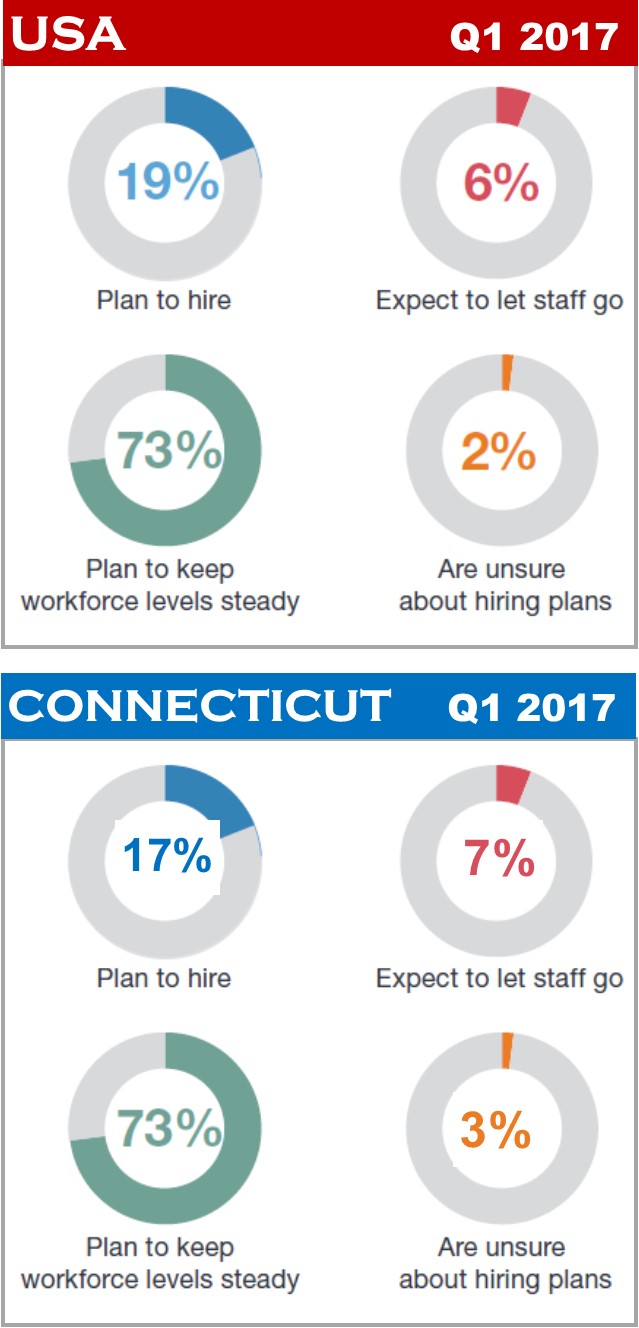
Employers nationwide are slightly more optimistic about hiring in the first quarter of 2017 than employers in Connecticut, according to the ManpowerGroup Employment Outlook Survey, although both expect to hire at a favorable pace during the first quarter of 2017. From January to March, 17 percent of Connecticut companies interviewed plan to hire more employees, while 7 percent expect to reduce their payrolls. Another 73 percent expect to maintain their current workforce levels and 3 percent are not certain of their hiring plans. This yields a Net Employment Outlook* of 10 percent.
For the coming quarter, job prospects appear best in Durable Goods Manufacturing, Nondurable Goods Manufacturing, Transportation & Utilities, Wholesale & Retail Trade, Financial Activities, Professional & Business Services, Education & Health Services, Leisure & Hospitality and Government. Employers in Construction, Information and Other Services plan to reduce staffing levels.

“Hiring intentions are weaker compared to Q4 2016 when the Net Employment Outlook was 12%,” said ManpowerGroup spokesperson Betty Gooding said about the Connecticut outlook. “The hiring pace is expected to pick up compared to one year ago when the Net Employment Outlook was 8%.” Of the more than 11,000 employers surveyed in the United States, 19 percent expect to add to their workforces, and 6 percent expect a decline in their payrolls during Quarter 1 2017. Seventy-three percent of employers anticipate making no change to staff levels, and the remaining 2 percent of employers are undecided about their hiring plans.

When seasonal variations are removed from the data, the Net Employment Outlook is +16 percent, a slight decrease compared to the Quarter 4 2016 Outlook, +18 percent.  That’s a somewhat more optimistic view than employers in Connecticut, the survey found.

Charitable Giving in CT Not Keeping Pace with U.S., Report Finds

The latest report from the Connecticut Council of Philanthropy (CCP), which highlights philanthropic giving in Connecticut shows that as giving across the U.S. has increased, the opposite is true of Connecticut, even as individual giving – which makes up the lion’s share of giving – has increased. The report, which highlights calendar year 2014 and the years leading up to it, reveals that while total giving in the U.S. increased from 2013 to 2014, total giving in Connecticut dropped from $4.66 billion to $4.51 billion. Over the five years through 2014, individual giving by Connecticut taxpayers who itemized rose 14 percent, less than the increase nationally of 25 percent.  More than three-quarters of giving in Connecticut is by individuals.

In 2014, Connecticut was ranked number one in per capita income by state and 45th in charitable giving.  All six New England states rank at the bottom in per capita giving, while Southern states rank near the top.  Yet the proportion of tax returns reporting contributions in 2014 at 34.5 percent was considerably higher than the national average of 24.5 percent, the report indicated.

The annual report, Giving in Connecticut, looks at charitable giving by Connecticut grant makers and residents, including: individual giving through reported contributions, bequests made through estate giving, and foundation giving. Giving in Connecticut uses data from the IRS Statistics of income Division, the Foundation Center, and self-reported data gathered by CCP.

The report, published this month, found that:

  • Giving in Connecticut from all sources at $4.51 billion was down 3.2 percent from 2013, due primarily to a drop in bequests.
  • The giving breakdown: $3.39 billion from individuals; $1.02 billion from foundations; $.09 billion from bequests
  • Giving by individuals was up 2.8 percent.
  • Giving by all foundations was up 2.1 percent.
  • Giving via bequests was down 74 percent after being up the previous year by 76 percent.
  • Giving by individuals and bequests combined at $3.48 billion amounted to 77 percent of all giving.

The report indicated that giving by foundations saw most grants going to Education and Health. Giving by foundations is greatest in Fairfield County where 56 percent of Connecticut foundations are based. They gave $747 million to charities, representing 73 percent of total foundation grant making.

Religion is the largest single category of recipient type of charity across the U.S., at 33 percent.  Education ranks second at 15 percent.

The 20-page report also found that in 2012, individual giving in Connecticut spiked, apparently in response to Superstorm Sandy and the tragedy at the Sandy Hook elementary school in Newtown.

Connecticut has 1,425 Private Foundations, 79 of which are Operating Foundations, 59 are Corporate Foundations and 20 are Community Foundations, according to the report. Community Foundations assets showed strong growth of 41 percent from 2010 to 2014, from $1.37 billion to $1.92 billion. Connecticut Corporate Foundation giving remained steady during the five year period while private foundation giving climbed.  

The top five foundations, by giving, were the Boehringer Ingelheim Cares Foundation, Dalio Foundation, GE Foundation, The Zoom Foundation, and the Steven & Alexandra M. Cohen Foundation.  Rounding out the top 12 in 2014 were Hartford Foundation for Public Giving, Seedlings Foundation, Newman’s Own Foundation, The Community Foundation for Greater New Haven, Smith Richardson Foundation, Connecticut Bar Foundation and Aetna Foundation.

The Connecticut Council for Philanthropy is an association of grantmakers committed to promoting philanthropy for the public good.


Breast Cancer is Latest Cause to Grow Interest Through CT License Plate

Connecticut, with more than 50 special license plates featuring everything from animals to war survivors, is headed toward adding another choice for state residents to purchase. Organizers of Seymour Pink, the grassroots initiative launched in 2009 to raise money and awareness for breast cancer, is looking to have a specialty license plate produced to show support for the cause, the New Haven Registered reported this week. license-plates-ct

State law allows the Department of Motor Vehicles to issue of special background plates on behalf of non-profit organizations. The organization must be non-profit, must submit a copy of the organization's charter or by-laws, provide a letter of good standing from the State of Connecticut Secretary of State’s Office (if required) and supply any Internal Revenue Service ruling on their non-profit tax exemption status.

The logo production and cost incurred will be the responsibility of the organization. The logo prototype design, preferred in PDF format, must be submitted to the DMV. The logo can be no larger than 2 inches wide and 3.5 inches high. DMV has final approval on all the plate and logo designs.

A liaison for the organization must be appointed. This individual will be responsible for all communications with the DMV as well as certifying and authenticating (by signature) each member’s application, submitting the logo design to DMV for approval, submitting 400 applications with the required fee prior to the manufacturing of the special background plates, and submitting a Special Interest Plate disclaimer.

Seymour Pink Founder Mary Deming told the Register that 100 paid applications have been received from people who want to purchase a “Seymour Pink” license plate for their cars.  The state Department of Motor Vehicles won’t begin production on the plate until Seymour Pink secures at least 400 paid applications, Deming said, indicating that Seymour Pink has set a tentative deadline of Jan. 15 to reach the needed 400 paid applications, the Register reported.

Many organizations in Connecticut offer license plates to their members and the general public.  General categories include animals, colleges, environment, organizations, police and fire, cities and towns, and recreation.

Organization vanity plates include Amistad, Benevolent & Protective Order of the Elks, IUOE Local 478, Grand Lodge of Connecticut, Knights of Columbus, Olympic Spirit, P.T. Barnum Foundation Inc., Preserving Our Past CT Trust for Historic Preservation, Red Sox Foundation, Lions Eye Research Foundation, Special Olympics, Federated Garden Clubs, Fidelco Guide Dog Foundation, Keep Kids Safe, New England Air Museum and the U.S.S. Connecticut Commissioning Committee.

All fees established and collected pursuant to the United We Stand plate (except moneys designated for the administrative costs of the DMV) shall be deposited in the United We Stand commemorative account.  Funds are directed to the United States Department of State Rewards for Justice program and is used solely to apprehend terrorists and bring them to justice. The account will also be distributed to the Secretary of the Office of Policy and Management for the purpose of providing financial support and assistance to the former spouses and dependents of persons killed as a result of the acts of terrorism committed on September 11, 2001.

When individuals purchase a Keep Kids Safe plate, a portion of the fee goes to the Keep Kids Safe Fund, which “makes many worthy projects happen for youngsters.”  The fund awards grants to schools, hospitals, municipalities and other non-profit organizations working to make all Connecticut children safer from severe and preventable injuries, according to the DMV website.

In most cases, remake of a current plate is $70; a new vanity plate is $139, a new series plate is $50.  For others, including the UConn Huskies plate, the price tag is somewhat different.  Off-the-shelf license plates cost $55, remake of a current plate is $75, a new vanity plate costs $144, according to the DMV website.

The Support Our Troops plate sends a portion of the fee to provide funding for programs to assist Connecticut troops, their families and veterans. When you buy a Red Sox plate, a portion of the fees support and help fund academic scholarship programs in Connecticut.

Also included are 17 varieties of military specialty plates, including Disabled American Veteran, Gold Star Family, Iwo Jima Survivor, Korean War Veterans Association, Marine Corps League, Laos Veterans of America, Military Order of the Purple Heart, Pearl Harbor 1941, U.S. Submarine Veteran, National Guard Association of Connecticut, First Company Governor’s Foot Guard, First Company Governor’s Horse Guard,

Colleges with designated plates include Central Connecticut State University, Penn State Alumni, University of Hartford, University of Connecticut, and University of New Haven.  Cities with available plates include Meriden, Norwich, and Stafford.

Organizations interested in launching a new special plate, should contact the DMV Special Plate Unit at (860) 263-5154 for further information.


CT’s Mortality Rate from Drug Poisoning is 11th Highest in US; Was 6th Lowest A Decade Ago

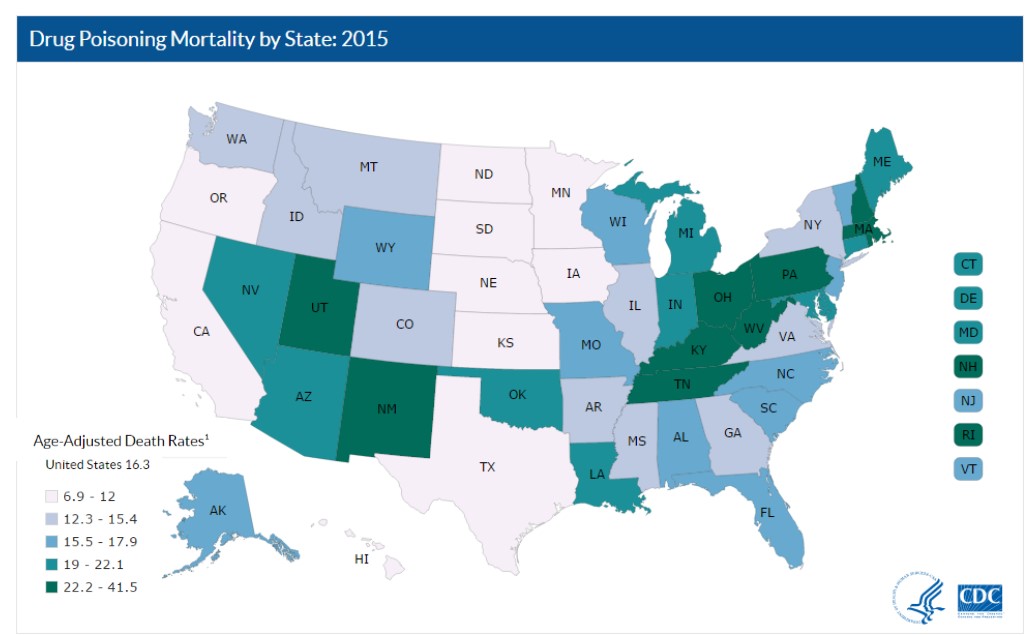
Connecticut’s mortality rate from firearms is less than half the national average, the state’s homicide rate is slightly above half the national average, but the rate of drug poisoning deaths exceeds the national average. Data from the Centers for Disease Control and Prevention (CDC) indicate that Connecticut’s mortality rate from drug poisoning was 17.6 per 100,000 population, with 623 deaths in the state in 2014, the 19th highest rate in the nation.  The U.S. rate that year was 14.7, with 47,055 fatalities.  Last year, Connecticut’s mortality rate from drug poisoning climbed to 22.1, which was the 11th highest rate in the nation, with 800 deaths. 

The states with the highest drug poisoning mortality rates in the nation in 2015 were West Virginia, New Hampshire, Kentucky, Ohio, Rhode Island, Pennsylvania, Massachusetts, New Mexico, Utah, Tennessee and Connecticut.  The lowest rates were in Nebraska, South Dakota, North Dakota, Texas and Iowa.

The CDC reported this month that opioids—prescription and illicit—are the main driver of drug overdose deaths. Opioids were involved in 33,091 deaths in 2015, and opioid overdoses have quadrupled since 1999.

In 2015, according to the CDC, significant increases in drug overdose death rates from 2014 to 2015 were primarily seen in the Northeast and South Census Regions. States with statistically significant increases in drug overdose death rates from 2014 to 2015 included Connecticut, Florida, Illinois, Kentucky, Louisiana, Maine, Maryland, Massachusetts, Michigan, New Hampshire, New Jersey, New York, North Carolina, Ohio, Pennsylvania, Rhode Island, Tennessee, Washington, and West Virginia.

The five states with the highest rates of death due to drug overdose were West Virginia (41.5 per 100,000), New Hampshire (34.3 per 100,000), Kentucky (29.9 per 100,000), Ohio (29.9 per 100,000), and Rhode Island (28.2 per 100,000).

The increase in drug overdose deaths in Connecticut from 2014 to 2015 was 25.2 percent, the fourth highest in the nation among states that had a statistically significant increase.  Only Massachusetts, New Hampshire and Maine had larger increases.

Among the 28 states meeting inclusion criteria for state-level analyses, 16 (57.1%) experienced increases in death rates involving synthetic opioids other than methadone, and 11 (39.3%) experienced increases in heroin death rates from 2014 to 2015, the CDC reported.

The largest absolute rate change in deaths from synthetic opioids other than methadone occurred in Massachusetts, New Hampshire, Ohio, Rhode Island and West Virginia. The largest percentage increases in rates occurred in New York (135.7%), Connecticut (125.9%) and Illinois (120%).

Connecticut, Massachusetts, Ohio, and West Virginia experienced the largest absolute rate changes in heroin deaths, while the largest percentage increases in rates occurred in South Carolina (57.1%), North Carolina (46.4%), and Tennessee (43.5).

Connecticut announced a detailed opiate response initiative this fall.  The Connecticut Opioid REsponse Initiative (CORE) is a strategic plan from Yale experts in response to the state’s opioid and overdose epidemics. It recommends: 1) expanding access to effective, medication-based treatment for substance use disorders; 2) improving transitions within the treatment domain; 3) increasing the availability of naloxone — the antidote to reverse an opioid overdose — and; 4) decreasing the over-prescribing of opioid at high doses or in combination with sedatives.

The CDC said “there is an urgent need for a multifaceted, collaborative public health and law enforcement approach to the opioid epidemic;” the Drug Enforcement Administration referred to prescription drugs, heroin, and fentanyl as the most significant drug-related threats to the United States, the CDC reported.


Connecticut Opioid REsponse Initiative (CORE) news conference, 10/6/16

https://youtu.be/fqw-AXvsL_8

Northeast Sees Relatively Strong International Migration Amidst Overall Weak Population Growth

New data from the U.S. Census indicates that population growth and domestic migration patterns have continued to move away from the East and the Midwest to the South and West, at accelerated rates, the website newgeography is reporting. Equally important, according to the site, pre-Great Recession interstate mobility rates have been restored.  The Census population estimates for the nation, states and the District of Columbia indicate a population increase for the South of 7.7 million between 2010 and 2016. The West gained 4.7 million. By contrast, the Midwest grew 1.1 million, while the East, including Connecticut, was even lower, at 900,000.

Combined, the South and West accounted for 87 percent of the national growth, the website’s analysis of the Census data indicated. In 2011, the South and West captured 82 percent of the national growth. By 2016, the South and West had risen to 94 percent of the national population increase. The South, alone had 57 percent of the growth, up from 52 percent in 2011. The West also had a strong gain, from 31 percent in 2011 to 36 percent in 2016.  The growth leaders:

  • Texas has led the nation in total population growth. Total population growth includes the natural change (births minus deaths), international migration and net domestic migration. Texas added 2.7 million residents, a 10.8 percent increase compared to its 2010 population. This is more than double the national rate of 4.7 percent.
  • California was well behind, with a gain of 2.0 million, despite having started the decade with a 50 percent higher population. California’s growth rate was 5.3 percent.
  • Florida added the third largest number of new residents, at 1.8 million, for a 9.6 percent growth rate from 2010.

Three states suffered population losses over the period. Illinois lost 30,000 residents and West Virginia lost 20,000. Vermont lost 1,000 and was joined by New England neighbors Maine, New Hampshire, Connecticut and Rhode Island in the bottom 10, with slim increases in overall population.

International migration was a bright spot for the Northeast, which along with the South were the two leading regions, followed by the West and Midwest.

The East and Midwest had a near monopoly on the bottom 10 in net domestic migration. New York lost 867,000 net domestic migrants, while Illinois lost 540,000. California’s loss was 383,000. New Jersey lost 336,000 and Michigan 216,000. Connecticut, Pennsylvania, and Ohio lost between 100,000 and 200,000, while Maryland and Massachusetts lost between 70,000 and 100,000.

In 2016, there were 825,000 interstate moves, according to the data outlined by newgeography, which is more than double the post-2000 low of 411,000 in 2011. The 2016 moves exceeded the 2001 to 2009 average by more than 10 percent

PERSPECTIVE: Obscuring What Made America Prosper

by Jacob S. Hacker Distrust in public institutions is a broad cultural trend. It is whipped up in popular entertainment and reinforced by a news media that sometimes seems to relish treating every person and organization as equally venal. Distrust in government, we have seen, is also, however, spread systematically, deliberately, and relentlessly—by GOP leaders who gain politically by “destroying the village to save it” and by powerful interests that have profited from the confusion and disaffection that widespread distrust feeds.

Consider the biggest threat facing our planet: global warming. Sowing doubt about climate change has proved a huge and hugely successful enterprise. Indeed, the fossil fuel industry deserves some special prize for chutzpah: In its propaganda, the bad guys aren’t carbon-emitting corporations trying to preserve trillions in dirty assets but instead climate scientists supposedly ginning up a false crisis to get research grants.

The modern GOP has joined the industry in its endorsement of whatever egregious defense seems most effective at the moment. Although the first lines of resistance (“global warming isn’t happening”; “it is, but for natural reasons”) have more or less crumbled, and “I’m not a scientist” doesn’t seem likely to work for long, either, there are plenty of additional trenches to retreat to: “Reform won’t work.” “It will be too expensive.” “It is pointless absent efforts by other countries.” “We want reform, just not this one —or the next one.” In the meantime, the fossil fuel industry continues to book huge profits and atmospheric carbon dioxide levels continue to rise.

The marketplace of ideas is of great value. But just as in the actual marketplace, we all need help deciding which products are reliable and which are not. Consumer Reports is available for car buyers—whose decisions are a lot simpler than the typical policy choice. Yet, in our hyperpolarized political world, institutions recognized as credible sources of independent knowledge continue to lose ground.

Take the news media. As much as the decline of broadcast and print news has hurt independent journalism, the media remains the main mechanism through which people learn about the broader world. Too often, however, reporters structure stories to create controversy or convey catastrophe…The basic story of this book—that governments and markets, working in tandem, have steadily increased human welfare (if, of late, far too gradually)—offers no hook that will excite reporters.

What’s more, even when journalists cover important policy debates, they tend to fall into the trap of “he said, she said” reporting on political conflict. Simply recounting the claims of both “sides” in a debate—each debate having exactly two—imparts a potentially misleading message of unresolved controversy and false equivalence. When the weight of the evidence is in fact on one side, the “he said, she said” approach provides journalists with a safe posture of neutrality that, in practice, advances particular agendas and makes it harder for readers to understand events…

Our discourse about government has become dangerously lopsided. The hostility of the right is unceasing and mostly unanswered. Eloquent leaders defend individual programs, but too rarely defend the vital need for effective governance. Politicians facing electoral pressures participate in a spiral of silence. Chastened by government’s low standing, they reinforce rather than challenge it…

Rhetoric is only one part of problem. Cowed policymakers also design programs that send much the same message.

The political scientist Suzanne Mettler has documented the increasing tendency to “submerge” policies so the role of government is hidden from those who receive benefits. These subterranean policies include tax breaks for private savings for education and retirement, as well as reliance on private companies and contractors even where these proxies are less efficient than public provision. These submerged benefits are usually bad policies, but they are even worse politics. Voters who don’t recognize government are not likely to appreciate what government does. Nor are they likely to form an accurate picture of government’s role, seeing only its visible redistribution but not the vast numbers of ways in which it enables prosperity…

Consider the most maligned policy of recent years: the Affordable Care Act. Even as the law has expanded health coverage while moderating costs, critics continue to spew out disinformation and insist their direst predictions have come true (and get a respectable hearing from the news media). They claim millions are losing good insurance despite a historic expansion of coverage. They claim costs are skyrocketing despite a historic slowdown of medical inflation...

Given all this, it’s no surprise that Americans know strikingly little about the most important social policy breakthrough of the past half-century. Asked how the actual cost of the law compares with estimates prior to enactment, roughly 40 percent admitted they had no idea. Another 40 percent thought costs were higher than predicted. Only 8 percent knew that costs were substantially lower than anticipated.

Here, as in so many areas, voters have a limited understanding of government performance, receive scant guidance from the media, and are encouraged by a barrage of negativity to assume the worst. In the 2014 election campaign, anti-ACA ads outnumbered favorable ones by a ratio of 13 to 1…

A government that effectively promotes human flourishing is a government worth fighting for. More than ever, the problems we face demand a sustained and principled defense of a vital proposition: The government that governs best needs to govern quite a bit. Americans must remember what has made America prosper.

__________________________

Excerpt from AMERICAN AMNESIA by Jacob S. Hacker and Paul Pierson.  Copyright © 2016 by Jacob S. Hacker and Paul Pierson. Reprinted by permission of Simon & Schuster, Inc, NY. 

Hacker was the keynote speaker at the Connecticut Data Collaborative conference, “Counting What Matters: Better Data for Better Policy in Connecticut,” on Dec. 9.  He is the Stanley B. Resor Professor of Political Science and Director of the Institution for Social and Policy Studies at Yale University, and a member of the Steering Committee of the Scholars Strategy Network, research to improve policy and strengthen democracy.